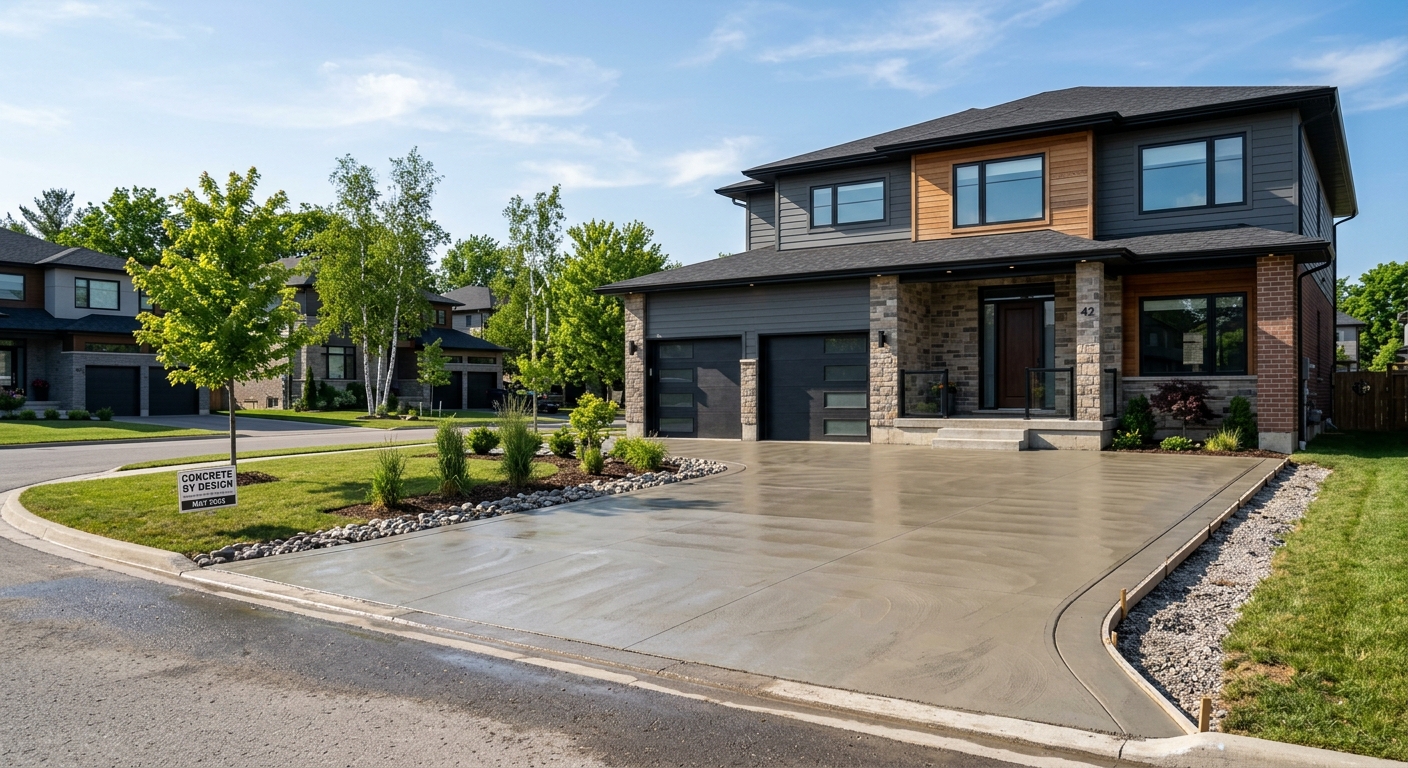
Concrete work options and costs in Cold Lake
Concrete work in Cold Lake is a big part of home maintenance because many properties here are built for real winter weather, and a large share of housing is the single-detached style where driveways, garage pads, and patios get used year-round. In Cold Lake’s economic region, there are 3,910 homeowner households (Statistics Canada, 2021 Census), and the local building stock is heavily geared toward single-detached dwellings—65.7% of homes are this type (Statistics Canada, 2021 Census). That matters because exterior flatwork is constant demand, especially in neighbourhoods like Rochdale where older lots and frequent upgrades are common.
In the Wood Buffalo–Cold Lake area, costs are shaped by deep frost and intense freeze–thaw cycles. That means excavation and forming don’t get “simplified” the way they might in milder climates: footings must sit well below frost depth, and exterior slabs require air-entrained concrete plus tighter control joints to manage thermal and moisture movement. Also, because the warm pour window is shorter, crews often have fewer days to work, and cold-weather measures (blankets, heaters, accelerators, tighter scheduling) can add cost to meet strength and durability targets.
At the same time, contractor availability and site access in areas like Rochdale can swing pricing. A driveway pour with limited truck access or poor drainage may need extra granular base work, which pushes the project toward the upper end of typical price bands. Use the comparison below as a practical starting point for budgeting, then we can narrow it by size, thickness, and finish.
| Application |
Typical Size |
Key Spec |
Finish Option |
Price Range |
| Concrete driveway (standard broom finish) |
400 sq ft (approx. 20 ft x 20 ft) |
4 in slab, air-entrained, control joints, compacted granular base |
Broom finish |
$7,200–$11,200 |
| Exposed aggregate driveway |
400 sq ft (approx. 20 ft x 20 ft) |
4 in slab, air-entrained, proper curing, added aggregate |
Exposed aggregate |
$9,200–$13,400 |
| Stamped concrete driveway or patio |
300 sq ft (approx. 15 ft x 20 ft) |
4 in slab, air-entrained, stamped surface system, sealer-ready cure |
Stamped (light to medium release) |
$9,000–$12,900 |
| Plain concrete patio or walkway |
250 sq ft (approx. 10 ft x 25 ft) |
4 in slab, air-entrained (exterior), compacted base |
Broom/light finish or trowel-broom blend |
$3,750–$6,250 |
| Garage floor (interior slab) |
500 sq ft (approx. 20 ft x 25 ft) |
4 in slab, interior curing protection, vapour considerations as applicable |
Light trowel finish or broom |
$8,000–$14,000 |
| Foundation footings (structural, below frost) |
Varies (example: 800 sq ft of footing footprint) |
Engineered layout, rebar, excavation below design frost depth |
Structural concrete only (no decorative finish) |
$160,000–$280,000 |
Prices are estimates only and vary by project scope, site access and material selection.
What affects the price of concrete work in Cold Lake
In Cold Lake and across the Wood Buffalo–Cold Lake region, quotes for the same “type” of concrete job can vary by 30–50% because the real cost drivers are below the surface: frost-safe excavation depth, granular base quality, reinforcement, and how much time crews can actually spend pouring and curing within the short season. Two contractors can price the same 400 sq ft driveway very differently depending on how they build for freeze–thaw durability, and how they plan truck access and cure protection.
Here’s the core: frost line depth and freeze–thaw cycles dictate every spec. Footings must extend below the design frost depth to prevent frost heave and movement, which raises excavation and forming. For exterior slabs—driveways, patios, and walkways—contractors typically specify air-entrained concrete so the freeze–thaw cycle doesn’t damage the surface over time. Cold Lake’s shorter pour season also means more cold-weather curing precautions (insulating blankets, heaters, sometimes accelerators) so concrete reaches design strength. Finally, with de-icing salt common in winter, sealing becomes practical insurance against surface deterioration and spalling.
Concrete examples in Cold Lake that push cost up or down: (1) A driveway over wet or weak soil often needs deeper, better-compacted granular base and potentially subgrade undercut, which can move a standard broom job closer to the upper end of the $18–$28 per sq ft band. (2) An exposed aggregate driveway usually costs more because of the extra material and finishing method—often the difference between the $22–$35 “decorative” type range and a plain slab. (3) If you’re updating an older home built before 1981 (30.8% of homes built before 1981, Statistics Canada, 2021 Census), you may find drainage or grade issues that require extra prep—an easy place for costs to rise from “budget” to “right-built.”
| Price Factor |
Why It Matters |
Cost Impact |
| Frost line depth |
Determines how deep footings and some thickened areas must go |
Higher excavation and forming; often one of the biggest variables on foundations |
| Site preparation |
Grading, undercut, drainage, and compacted granular base control long-term movement |
More labour and materials if subgrade is soft or drainage is poor |
| Reinforcement |
Rebar or wire mesh manages cracking and load transfer in slabs and footings |
Costs rise with additional steel, chairs/dusters, and tighter placement requirements |
| Mix design |
Air-entrainment and compressive strength targets improve freeze–thaw durability |
Specialized mix costs more and may require batching adjustments |
| Finish type |
Broom vs stamped vs exposed aggregate uses different systems and timing |
Decorative finishes typically add steps and labour; decorative often lands in higher bands |
| Pour size and concrete truck access to site |
Short pour windows mean you need efficient access and the right pump/plan |
Pumping, traffic control, and smaller-batch logistics can increase costs |
| Cold-weather curing precautions |
Protecting curing temperature is critical for strength and durability |
Blankets, heaters, and accelerators can add a meaningful premium |
| Control joint pattern and sealing cost |
Joints control where cracking happens; sealing protects the surface from salt |
More layout time plus sealer material and application steps |
Permits & regulations in Alberta
In Alberta, permits and approvals depend on what concrete you’re doing. Structural concrete work—typically including footings, foundation walls, and grade beams—usually requires a building permit, and engineered drawings are often reviewed by the municipality before construction. For concrete flatwork (driveways, patios, walkways), permits often aren’t required unless the work affects lot grading, drainage, impervious surface coverage limits, or the work ties into municipal right-of-way conditions (like an approach/culvert connection). Always confirm with the local authority before breaking ground, even when the job seems “just concrete,” because drainage and slope changes can trigger requirements.
Before you hire, verify insurance and worker coverage. Ask for the contractor’s liability insurance certificate and confirm they carry WSIB/WCB coverage. In practice, homeowners in Cold Lake can do this step-by-step: (1) check the contractor’s business details and licence information through the Alberta government’s contractor/registry resources (where applicable for the trade), (2) request an up-to-date certificate of insurance—make sure it lists your project address or at least the named insured and expiry date, and (3) ask for proof of WSIB/WCB clearance or active coverage letter. Also request references on similar-scope jobs (driveway sizes, slab thickness, and any cold-weather measures). A contractor who can’t produce these documents usually signals trouble in scheduling, site preparation, or quality control.
Getting concrete right in Cold Lake's freeze-thaw climate
Concrete failures in Cold Lake are usually predictable: inadequate base prep, the wrong mix, missing or poorly planned joints, and poor curing during cold snaps. In freeze–thaw conditions, water expands as it freezes, so the concrete has to be porous-resistant and the slab has to be supported correctly. If the sub-base isn’t compacted to the proper depth and drainage isn’t managed, the slab can “pump” slightly under load and movement shows up later as cracking or surface scaling. If the mix isn’t air-entrained, freeze–thaw stress concentrates at the surface and you can get spalling—even when the slab looks fine initially.
To spec your project correctly in Cold Lake’s market, focus on five items. First, base preparation: use compacted granular sub-base to the right thickness for the local soil and frost movement risk. Second, mix design: for exterior flatwork, target air-entrainment of about 5–7% and specify a minimum 32 MPa compressive strength for durability. Third, control joints: plan spacing to reduce random cracking and keep cracks straight where you can manage them. Fourth, curing: protect freshly poured concrete so it achieves design strength; minimum 7 days of proper curing conditions is standard, and cold-weather measures may be needed. Fifth, sealing: apply a penetrating sealer after curing (often around 28 days post-pour) to repel de-icing salt.
A practical cost example: upgrading a 400 sq ft driveway from broom-finish to exposed aggregate may add roughly $2,000–$4,200 in many Cold Lake quotes (depending on thickness, base repairs, and how much decorative prep is needed). That extra cost is justified when the contractor also nails the base, uses air-entrained mix, and commits to control joints and cure protection—because the finish alone won’t stop freeze–thaw damage.
| Spec |
Why It Matters in Cold Lake |
What to Ask For |
Impact if Skipped |
| Compacted granular base (depth?) |
Reduces settlement and frost-related movement under exterior slabs |
Confirm sub-base thickness, compaction method, and drainage plan |
More cracking, uneven slab, and premature heaving/pumping |
| Air-entrained concrete mix (target air %?) |
Protects against freeze–thaw scaling and surface deterioration |
Ask for air content target (commonly 5–7% for exterior flatwork) |
Spalling risk increases, especially with winter salt exposure |
| Compressive strength (MPa rating) |
Ensures the slab reaches durability strength in a cold season |
Specify minimum 32 MPa and confirm curing protections |
Lower strength and higher risk of surface damage |
| Control joints (spacing per ACI guidelines) |
Controls where cracking happens under thermal movement |
Joint spacing and layout plan before the pour |
Random cracking patterns and harder-to-manage repairs |
| Minimum 7-day curing period |
Cold weather can slow strength gain and increase vulnerability |
Ask how curing will be maintained in sub-zero conditions |
Reduced durability and cracking soon after seasonal shifts |
| Penetrating sealer (when applied after cure) |
Helps resist de-icing salt effects on the surface |
Confirm product type and that sealing happens after cure (commonly ~28 days) |
Faster scaling/spalling and more frequent re-surfacing |
How to choose a concrete work contractor in Cold Lake
Start by confirming coverage and credentials the right way. In Alberta, concrete contractors should be able to provide (1) proof of liability insurance with active dates, (2) proof of WSIB/WCB coverage (or clearance letter showing they’re in good standing), and (3) any trade-level registration requirements that apply to their scope. For homeowners in Cold Lake, the most reliable method is documentation: request a current certificate of insurance, verify the expiry date, and ensure the policy covers general liability for your type of work. Then ask for the WSIB/WCB clearance or proof-of-coverage before any materials are delivered.
Next, get 2–3 itemised written quotes. “Itemised” matters: you want a labour and materials breakdown (excavation/grading, granular base, rebar/wire mesh, formwork, concrete supply, finish labour, curing blankets/heaters if applicable, and sealing if included). Compare like-for-like scope—what’s excluded? Is permit pulling included (if required), is disposal/haul-off included, and who handles any utility locate or minor site adjustments? For warranty, ask for the workmanship warranty length (not just a casual statement), and whether the product/manufacturer warranty applies to the exact mix/sealer system used and whether it’s transferable to you as the homeowner.
For payment, don’t sign up for big up-front amounts. A common safe approach is to keep deposits around 10–15% and hold back a portion until the job is complete and cleaned up. Finally, ask for a written start date and completion estimate that matches Cold Lake’s shorter warm season, so you aren’t stuck waiting during freeze-up.
- Provide current liability insurance certificate with your project location/address or clearly matching named insured details.
- Show WSIB/WCB coverage proof (or clearance letter) before scheduling any pour-day work.
- Use itemised quotes: labour, materials, disposal, granular base, reinforcement, concrete supply, and finishing are separated.
- Confirm whether cold-weather curing measures are included (blankets/heaters/accelerators) for late-season pours.
- Ask for the planned concrete thickness and slab design (don’t accept “standard” without numbers).
- Require a base preparation plan: compaction method, undercut/haul-off if needed, and drainage consideration.
- Ask about air-entrained mix and the target air content for exterior work (commonly 5–7%).
- Confirm control joint layout and spacing, and whether joints will be sealed if your scope includes it.
- Ask when sealing will be applied (often after cure; commonly around 28 days post-pour).
- Get a timeline in writing: start date, pour date window, and completion date estimate.
- Clarify exclusions: what happens if truck access requires a pump, or if additional excavation is discovered?
- Use a payment schedule that keeps upfront to 10–15% and holds back until final walkthrough and cleanup.
Concrete red flags in Cold Lake: a contractor who won’t discuss air-entrainment or control joints; quotes that ignore base preparation/compaction depth; no proof of liability insurance or WSIB/WCB coverage; “lump sum only” estimates without measuring or specifying thickness; and crews that want to pour and rush curing without blankets/heating plans during late-season temperatures.
Frequently asked questions — concrete work in Cold Lake
What is the difference between concrete and cement?
In Cold Lake, people often use “concrete” and “cement” like they mean the same thing, but they don’t. Cement is one ingredient—powdered binder—used inside the concrete mix. Concrete is the full material: cement plus water, sand (fine aggregate), and gravel/crushed stone (coarse aggregate), often with admixtures like air-entrainment for freeze–thaw durability. For exterior work in Alberta’s cold climate, contractors specify an air-entrained mix so the slab can survive intense freeze–thaw cycles without scaling. When you see a quote, ask what mix design is being used (strength and air content), because that mix choice is a major reason driveway and patio prices can land anywhere from the lower end of basic flatwork bands to the higher end when durability specs are included.
How much does concrete work cost in Cold Lake?
Concrete costs in Cold Lake typically depend on thickness, finish level, base prep, and access during the short pour season. As a practical guide, a concrete driveway or slab commonly falls around $18–$28 per sq ft, while a plain patio or walkway is often $15–$25 per sq ft. If you choose stamped or decorative concrete, budgeting for $22–$35 per sq ft is common because the finish process takes more steps and tighter timing. For example, a 400 sq ft broom-finish driveway often prices in the range of $7,200–$11,200, while an exposed aggregate version can land closer to $9,200–$13,400, especially if extra base work is needed. Your final number can swing 30–50% when frost-safe excavation and cold-weather curing precautions come into play.
How deep must footings be for Cold Lake's frost line?
Cold Lake requires footings to extend below the design frost depth to prevent frost heave, which is why contractors plan excavation depth carefully. In Alberta, the needed depth is often in the general range up to about 2.4 m depending on the design and your soil conditions, and it’s determined by the engineered foundation design rather than a one-size estimate. The key point for homeowners: don’t accept a “typical” depth without confirmation that it matches the approved design for your house and site conditions. Older homes and older lots can also have soil variability, so base conditions can require more excavation and rework even when the design already assumes a frost depth. Ask your contractor whether the footing depth is per engineer drawings and whether they’re allowing for extra excavation/handling if unsuitable soil is encountered.
Why does concrete crack in Cold Lake and how is it prevented?
Cracking in Cold Lake is often caused by predictable movement: temperature changes, moisture variations, and freeze–thaw stress. Concrete shrinks as it cures, expands and contracts seasonally, and the ground can move slightly when frost forms and melts—especially if the granular base isn’t compacted correctly. The prevention strategy is to plan where cracks can happen instead of hoping they never do: proper base preparation, air-entrained concrete for freeze–thaw durability, and a control joint layout that limits random cracking. Good contractors also seal/maintain joints as specified and protect curing time so strength develops properly in cold weather. If a contractor skips air-entrainment, you may see spalling (surface flaking), while if they skip joint planning, you’re more likely to see random cracks that are harder to manage cosmetically.
Stamped vs broom-finish concrete — cost difference?
Stamped concrete costs more than broom-finish because it includes extra steps: form-ready timing, stamp patterns, release agents, curing and finishing coordination, and a finish system designed for consistent texture. In Cold Lake, contractors also keep durability specs tight (air-entrained mix and proper curing) so the decorative surface survives freeze–thaw and salt exposure. As a budgeting example, broom-finish driveway work might land around $7,200–$11,200 for a typical 400 sq ft driveway scenario, while stamped concrete driveway/patio work commonly runs closer to $9,000–$12,900 for a 300 sq ft example, depending on thickness, base repairs, and site access. If the contractor “cheats” on base prep or curing, stamped finishes can look good at first but still suffer from spalling—so always compare specs, not just appearance.
When is the best time to pour concrete in Cold Lake?
The best time to pour in Cold Lake is during the warmer portion of the season when temperatures allow proper curing without heavy intervention. Because the warm pour window is shorter, late-season pours may require cold-weather measures—insulating blankets, heaters, and sometimes accelerators—to reach design strength. Even if concrete trucks can deliver, curing conditions are what protect durability in Alberta’s freeze–thaw cycles. Plan your work so the pour and curing period are protected; rushing can lead to under-strength concrete and later cracking or scaling. Practically, many homeowners schedule exterior flatwork earlier in the season to avoid the highest cold-weather premium, while foundations and footings are engineered and scheduled around construction realities. Ask your contractor for a clear pour date window and written curing/protection plan.