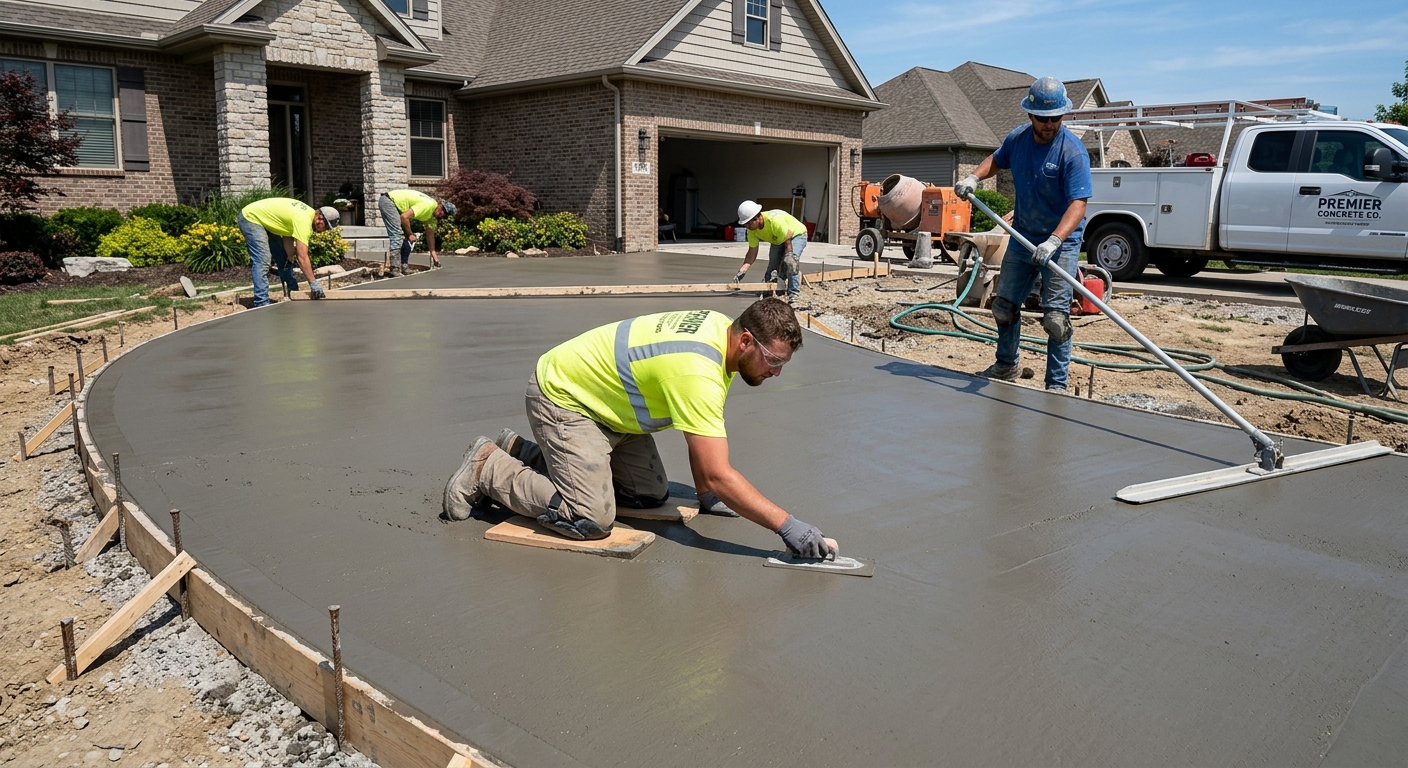
Concrete work options and costs in Highwood
Highwood, Alberta is a small community just outside Calgary, and that mix of rural lots with city-adjacent demand is exactly what drives concrete pricing. In the 2021 Census, Highwood’s population was 2,205 (Statistics Canada, 2021 Census), and most homeowners are adding or refreshing driveway and patio surfaces on similar-sized single-family properties. Concrete flatwork is especially common where people want a durable, low-maintenance surface for daily traffic—particularly in areas with older yards and more frequent rework around landscaping.
In the Calgary region, cold continental weather shapes the job from the ground up. With a design frost depth of about 1.2 m (roughly 4 ft), footings and foundation-related work must extend below undisturbed soil at that depth to reduce frost heave and seasonal movement. That means more excavation and larger footing volumes than you’d see in milder climates. Add frequent freeze–thaw cycles and you’ll also see higher emphasis on air-entrained mixes, proper granular base prep, and well-planned control joints—especially for driveways, patios and walkways. Finally, the practical exterior pour season is shorter, and if concrete is placed late fall or early spring, contractors often need winter-grade placement practices (insulated blankets and/or temporary heat) to protect curing. Those extra steps show up in quotes, and they’re why you can see meaningful contractor availability differences around Calgary when temps swing.
In Highwood, demand is often strongest near the busier residential pockets closer to highway access where properties turn over and renovations are common. If you’re comparing options, the table below gives realistic ranges you’ll typically see in this market, based on the region’s frost and freeze–thaw requirements.
| Application |
Typical Size |
Key Spec |
Finish Option |
Price Range |
| Concrete driveway (standard broom finish) |
20 ft x 10 ft (200 sq. ft.) |
Air-entrained concrete, control joints, compacted granular base |
Broom finish |
$12,000–$18,000 |
| Exposed aggregate driveway |
20 ft x 10 ft (200 sq. ft.) |
Proper cure + wash-off timing, air-entrained mix |
Exposed aggregate (brush-wash) |
$14,500–$22,000 |
| Stamped concrete driveway or patio |
20 ft x 12 ft (240 sq. ft.) |
Air-entrained concrete, integral color or stain, release powder, joints |
Stamped pattern with sealer |
$15,000–$26,000 |
| Plain concrete patio or walkway |
12 ft x 10 ft (120 sq. ft.) |
Compacted granular base, joints sized for movement |
Light broom or smooth trowel (as specified) |
$5,000–$9,000 |
| Garage floor (interior slab) |
20 ft x 20 ft (400 sq. ft.) |
Vapour barrier (as required), proper sub-base, fibre or mesh per design |
Broom finish |
$10,500–$16,500 |
| Foundation footings (structural, below frost) |
Typical 1,000–1,600 sq. ft. footprint |
Engineered reinforcement, excavation to frost depth, below-grade concrete |
Structural (not decorative) |
$28,000–$45,000 |
Prices are estimates only and vary by project scope, site access and material selection.
What affects the price of concrete work in Highwood
In Highwood and the wider Calgary region, you can easily see the same “type” of concrete job come back 30–50% apart from different contractors. The spread usually isn’t about the concrete itself—it’s about what’s included in the base build, whether the mix and reinforcement meet the spec for freeze–thaw, and how a crew protects curing when the weather turns. Even small choices, like the depth of granular base prep or the spacing of control joints, can change labour hours and material quantities.
Frost line depth and freeze–thaw cycles dictate nearly every technical line item. In this region, footings must be engineered to extend below the design frost depth (about 1.2 m / roughly 4 ft) to reduce frost heave and seasonal movement. Exterior slabs also need air-entrained concrete mixes to survive the repeated freeze–thaw cycle. When the pour season is shorter and temperatures drop, contractors may add winter-grade placement measures—insulated blankets, curing protection, and sometimes temporary heat—to keep concrete from freezing before it reaches adequate strength. Those protections are part of why driveway and patio pricing can land near the top of local bands (for example, concrete patios/walkways commonly fall within the $5,000–$9,000 range, while driveway work often sits within $12,000–$18,000 depending on excavation and reinforcement).
Two common Highwood cost swings are: (1) soft or frost-susceptible soils, which force deeper excavation and more imported granular base, and (2) de-icing salt exposure, which increases the importance of sealing and a durable mix design to help reduce surface scaling and spalling over time. On older properties, yard regrading and removing old slabs also add disposal and labour—so you might see dollars move quickly before a contractor even pours.
| Price Factor |
Why It Matters |
Cost Impact |
| Frost line depth — determines footing depth and form height |
Footings must sit below design frost depth to prevent heave |
Higher excavation and concrete volume; can shift structural pricing materially |
| Site preparation — excavation, grading, compacted granular base |
Concrete lasts when the base is stable and well-drained |
Extra truckloads, compaction time, and disposal can add large labour/material costs |
| Reinforcement — rebar or wire mesh requirement |
Controls cracking and improves load performance |
Material and installation labour; also impacts slab thickness |
| Mix design — air-entrainment and compressive strength spec |
Air helps survive freeze–thaw; strength meets performance requirements |
Higher-spec concrete and testing/QA handling can raise material costs |
| Finish type — broom vs. stamped vs. exposed aggregate |
Finish complexity affects labour time and curing steps |
Stamped and exposed options usually sit above standard broom finishes |
| Pour size and concrete truck access to site |
Access affects placement speed, crew efficiency, and whether pumping is needed |
Long carries or pumping add time and equipment fees |
| Cold-weather curing precautions — heating and blankets |
Protects concrete until it reaches adequate strength |
Extra equipment, labour hours, and sometimes scheduling changes |
| Control joint pattern and sealing cost |
Joints guide cracking; sealing helps repel salt and reduce spalling |
Not always included—often the difference between “cheap” and “lasting” |
Permits & regulations in Alberta
In Alberta, permit requirements depend on what you’re building. Structural concrete work—such as foundation footings, foundation walls, and grade beams—generally requires a building permit and is often tied to engineered drawings that the municipality reviews. For concrete flatwork (patios, walkways, driveways), a permit is frequently not required unless the work affects lot grading, impervious surface coverage limits, or municipal right-of-way issues. Even when a permit isn’t required, you still want to confirm requirements with the local authority before breaking ground in Highwood.
Start by asking for the contractor’s proof they’re set up to do the work safely and legally. For any concrete contractor doing structural or municipal-adjacent work, you want liability insurance and WSIB/WCB coverage (Workers’ compensation coverage). A good contractor will also provide references on similar-scale projects in the Calgary region.
How to verify the contractor (step-by-step): first, ask for their insurance certificate—review the policyholder name, coverage amounts, and effective dates. Next, ask for proof of WCB/WSIB coverage and confirm it matches the contractor’s legal name. Then, confirm they’re authorized to perform the work where applicable (look for business registration and any contractor licensing/registration details available through provincial channels). Finally, ask for a copy of their written scope and schedule, so you can see whether disposal, excavation, and protection of adjacent surfaces are included. If anything sounds vague—especially around frost depth excavation depth, drainage, or curing protection—treat that as a red flag before you sign.
Getting concrete right in Highwood's freeze-thaw climate
Concrete can fail in Highwood when the slab is built on an unstable base, when the mix isn’t engineered for freeze–thaw, or when curing is rushed. The most common issue homeowners see over time is spalling: surface scaling and deterioration that starts after repeated freezing, thawing, and salt exposure. To prevent that, you need the right specs, not just “good-looking” concrete on pour day.
First, base preparation: ensure the excavation reaches properly prepared depth for local soil conditions, with a compacted granular sub-base designed for frost performance and drainage. Second, mix design: exterior flatwork should be air-entrained, typically targeting 5–7% air content, and meet a minimum compressive strength commonly spec’d at 32 MPa for durability. Third, control joints: plan a joint layout that limits random cracking and keeps cracks where you can manage them. Fourth, curing: allow proper curing conditions and don’t treat 48 hours as “done”—in practice, you’re looking for minimum 7 days of curing under suitable conditions, and in cold snaps the contractor should protect the slab with insulation blankets and/or temporary heat. Fifth, sealing: apply a penetrating sealer after the slab has cured (commonly around 28 days post-pour) so de-icing salt has less access to vulnerable pores.
What should you ask for? “Air-entrained exterior mix with target air %, minimum 32 MPa, engineered joint pattern, and curing protection plan for the forecast.” If you compare a standard broom driveway to stamped concrete, the price difference can be justified—stamped work can run within $15,000–$26,000, while standard driveway work often lands in the $12,000–$18,000 band. You pay for extra labour, integral colour/release systems (or staining), and more careful finishing timing—those steps help the surface last and look consistent in freeze–thaw.
| Spec |
Why It Matters in Highwood |
What to Ask For |
Impact if Skipped |
| Compacted granular base (depth?) |
Stable support reduces settlement and prevents cracking from frost movement |
“Granular sub-base depth and compaction method for my site conditions” |
Uneven settling, widened cracks, and faster deterioration |
| Air-entrained concrete mix (target air %?) |
Freeze–thaw resistance depends on correct air void system |
“Exterior air content target (typically 5–7%) and confirming air-entrainment” |
Higher risk of spalling and scaling over winters |
| Compressive strength (MPa rating) |
Strength helps concrete resist wear from traffic and salt exposure |
“Minimum 32 MPa mix design” |
Surface wear, early cracking, and reduced long-term durability |
| Control joints (spacing per ACI guidelines) |
Controls where cracks form during shrinkage and temperature cycling |
“Joint spacing plan and how joints align with slab layout” |
Random cracking that can lead to water intrusion and freeze damage |
| Minimum 7-day curing period |
Cold weather can slow hydration and weaken the early surface |
“Curing timeline and protection plan (blankets/heating if needed)” |
Surface scaling, weak topping, and poor long-term performance |
| Penetrating sealer (when applied after cure) |
Salt and moisture are harsher in Calgary-area winters |
“Apply penetrating sealer after cure (commonly ~28 days) and confirm product type” |
Faster spalling and staining, especially in driveways |
How to choose a concrete work contractor in Highwood
Choosing the right concrete contractor in Highwood starts with verifying they can legally and safely perform the work—and that they price to the specs needed for frost depth, freeze–thaw durability, and curing. First, ask for proof of liability insurance and WSIB/WCB coverage. To check each, request current certificates (not screenshots) and confirm the insured party name matches the contractor’s legal business name. For WSIB/WCB, make sure it covers the workers who will be on your site. If you can’t get documentation quickly, that’s a sign they may be cutting corners.
Next, get 2–3 itemised written quotes. Prefer quotes that break out labour, excavation/grading, granular base materials, reinforcement, concrete supply, finishing, and curing/sealing (if included). A lump-sum quote without line items is hard to compare and often hides exclusions like disposal, topsoil removal, saw cutting, or cold-weather protection.
Read the scope carefully: what’s included for permit pulling (where required for structural work), waste disposal, protection of landscaping, and any work to connect to existing sidewalks or drainage? Confirm warranty terms in writing. You should ask for a workmanship warranty period, any product/manufacturer warranty for coatings or sealers, and whether that warranty transfers if you sell the home.
For payment scheduling, never pay more than 10–15% upfront. Hold back a portion until completion and final cleanup. Get your start date and completion estimate in writing, and ask what happens if weather changes affect curing.
- Ask for an air-entrained exterior mix spec (with target air %) for driveways/patios.
- Confirm granular base depth and compaction requirements in writing.
- Request joint spacing and saw-cut timing details.
- Verify cold-weather curing plan (blankets/heating) if temperatures are near freezing.
- Check liability insurance and WSIB/WCB coverage certificates before booking the pour.
- Ensure quotes include excavation and disposal (or list what’s excluded).
- Ask whether reinforcement (rebar/mesh) is included for the intended loads.
- Confirm finishing schedule and whether sealing is included or offered separately.
- Look for an itemised materials-and-labour breakdown, not a single lump sum.
- Review the warranty details: workmanship length and who provides it.
- Demand a written timeline and schedule for deliveries/truck access.
- Confirm you’ll receive a curing/protection note and when you can start using the slab.
Concrete red flags in Highwood: contractors who can’t explain air-entrainment or curing protection, quotes that omit granular base depth and compaction, no plan for control joints, pressure to pay large deposits early, and inconsistent documentation (insurance/WSIB/WCB not provided up front).
Frequently asked questions — concrete work in Highwood
What is rebar and when is it required in Alberta?
Rebar (reinforcing steel) is steel bars embedded in concrete to help control cracking and improve strength where loads or shrinkage stresses are expected. In Alberta, whether rebar is required depends on the project type and how the slab or foundation is engineered—driveways and garage floors may require mesh or rebar based on thickness, soil conditions, and expected loads, while foundation footings and grade beams almost always involve engineered reinforcement. In Highwood, the freeze–thaw climate makes proper structural design and reinforcement especially important for below-grade elements tied to frost performance. If you’re comparing quotes for foundation/footings work (often in the $28,000–$45,000 band), ask for the engineered drawing or at minimum the reinforcement schedule so you can confirm size, placement, and cover requirements.
How long does a concrete project take in Highwood?
Timeline varies by scope, but in Highwood you should plan around base prep, curing protection, and weather. For a driveway or patio, demolition and excavation can take 1–3 days depending on access and how much material needs removal. The pour day itself is usually fast—often 1 day—but the schedule can stretch when curing requires blankets or temporary heat near freezing. Concrete needs minimum 7 days of proper curing under suitable conditions for exterior durability, and many contractors also plan sealing around the 28-day mark after the pour. Interior garage slabs can be quicker once the sub-base is ready, but they still require controlled curing. If your quote is only “pour day + curing,” ask for the full sequence in writing.
What is a concrete overlay and is it suited to Highwood?
A concrete overlay is a new cementitious layer placed on top of an existing slab, typically after surface preparation and sometimes patching. Overlays can be a cost-effective way to refresh appearance and improve usability when the original slab is still structurally sound (no major settlement, widespread heaving, or deep base failure). In Highwood’s freeze–thaw climate, overlays only perform well when the original concrete hasn’t lost its underlying support and when drainage isn’t pushing water under the slab. If the existing driveway is already failing due to movement, an overlay can lock in the problem rather than fix it. Compare overlay pricing to new concrete using local driveway bands—new concrete driveway work commonly falls within the $12,000–$18,000 range, so you’ll want the contractor to demonstrate why the existing slab is a suitable candidate before you choose overlay.
How do I seal concrete to protect it in Highwood?
Sealing helps repel moisture and de-icing salt, which is crucial in Highwood winters where freeze–thaw cycles can drive surface deterioration. The key is timing: most penetrating sealers are applied after the concrete cures sufficiently, commonly around 28 days post-pour. Before sealing, the slab should be clean, fully cured, and dry enough for the sealer to penetrate properly. Ask your contractor what type of sealer they’re using (penetrating vs. film-forming) and whether it’s rated for de-icing salt exposure. Also, note that sealing isn’t a replacement for correct specs—air-entrainment, base prep, and control joints are still the foundation of durability.
What is the difference between concrete and cement?
Concrete is the full material system used in construction—typically cement, water, fine and coarse aggregates (sand and gravel), plus admixtures like air-entrainment agents and strength modifiers. Cement is one ingredient inside concrete; it’s the binder that reacts with water to create strength. In everyday conversation, people say “cement” when they mean concrete, but the durability conversation is really about the full concrete mix design. In Alberta’s cold continental climate and Calgary-area freeze–thaw conditions, the concrete mix needs the right air-entrainment and strength targets to resist spalling. So when you get quotes in Highwood, don’t just ask “what cement”—ask for the exterior air content target and compressive strength rating, since those drive long-term performance.
How much does concrete work cost in Highwood?
Concrete costs in Highwood track closely with the Calgary region because labour availability, truck access, and material specs are shared. For typical homeowner projects, driveway work often lands in the $12,000–$18,000 range depending on excavation, reinforcement, and finish level. Patios and walkways commonly fall within the $5,000–$9,000 band for typical sizes, while stamped or decorative options for a driveway or larger patio can rise to the $15,000–$26,000 range due to extra finishing labour and materials. Foundation footings (structural, below frost) are a different category and commonly sit around the $28,000–$45,000 band depending on excavation volume and engineered reinforcement. To keep pricing accurate, ask for itemised quotes that include base prep, joints, and curing protection plans—those are the line items most responsible for real-world durability.