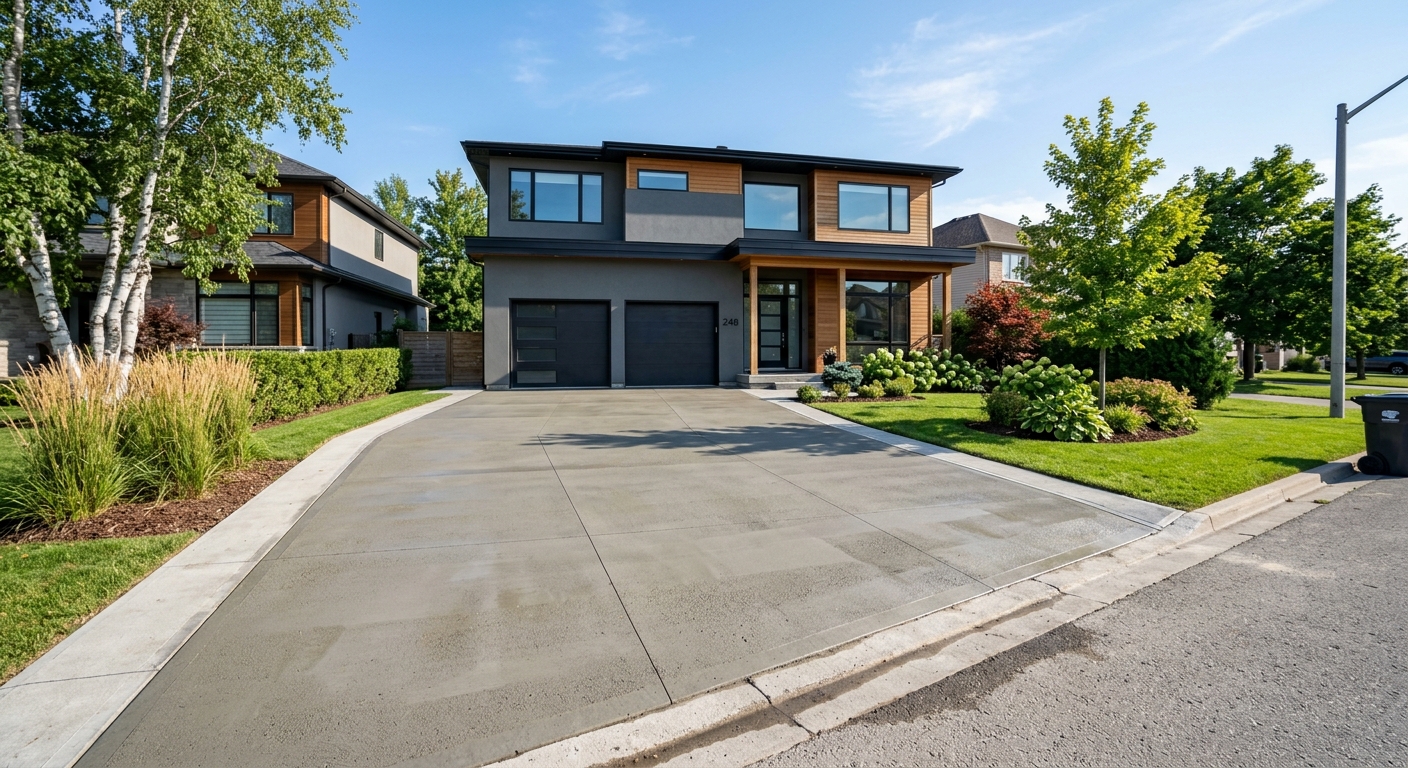
Concrete work options and costs in Callingwood South
Concrete work is a big part of day-to-day home upgrades in Callingwood South, Alberta—especially because most residential flatwork (driveways, patios, walkways and garage slabs) sits in an area that sees long winters and frequent freeze–thaw. Callingwood South’s housing stock includes a large share of family-oriented homes, and that typically translates into repeat demand for practical concrete upgrades like driveway replacement and backyard patio expansions. With a population of 5,581 (Statistics Canada, 2021 Census), the local customer base is steady enough that established crews can usually price with reliable lead times, but specialized footing and foundation work still competes for calendar time during the colder-weather constraints.
In Calgary’s cold continental climate, concrete pricing is shaped less by “just concrete” and more by how it’s engineered and cured. Calgary-area frost depth is engineered around roughly 1.2 m (about 4 ft), meaning exterior footings and many structures must bear on undisturbed soil below that depth. Frequent freeze–thaw cycles also drive the need for air-entrained mixes and tighter control-joint detailing to reduce cracking and spalling, particularly on driveways and patios. On top of that, the exterior pour season is shorter, so winter-grade placement (insulated blankets and sometimes temporary heat) can add cost if your schedule slips into late fall or early spring.
Contractor availability can also tighten during spring thaw when excavation-heavy jobs ramp up. For many homeowners in calling-adjacent areas like Chaparral Valley and nearby established communities, concrete flatwork demand peaks in late spring, which can influence scheduling and mobilization pricing. Below is a practical comparison table of typical options and realistic price bands you’ll see in Callingwood South.
| Application |
Typical Size |
Key Spec |
Finish Option |
Price Range |
| Concrete driveway (standard broom finish) |
400–600 sq. ft. |
Air-entrained mix, control joints, compacted granular base |
Concrete with broom finish and edging |
$12,000–$18,000 |
| Exposed aggregate driveway |
400–600 sq. ft. |
Air-entrained mix, proper curing, aggregate exposure |
Exposed aggregate finish |
$15,000–$22,000 |
| Stamped concrete driveway or patio |
300–600 sq. ft. |
Air-entrained mix, release agent, joint pattern |
Stamped patterns (e.g., slate/flagstone look) |
$15,000–$26,000 |
| Plain concrete patio or walkway |
200–400 sq. ft. |
Air-entrained mix, base prep, control joints |
Broom or smooth trowel finish |
$5,000–$9,000 |
| Garage floor (interior slab) |
400–700 sq. ft. |
Proper sub-base, vapour considerations, saw-cut joints |
Standard broom or trowel finish |
$7,500–$14,000 |
| Foundation footings (structural, below frost) |
House/extension footprint |
Designed reinforcement, frost depth bearing below engineered line |
Structural concrete |
$28,000–$45,000 |
Prices are estimates only and vary by project scope, site access and material selection.
What affects the price of concrete work in Callingwood South
Even when homeowners describe the “same” concrete job in Callingwood South, quotes can differ by 30–50% across the Calgary region because concrete pricing is driven by what’s underneath the surface: excavation depth, granular base specs, reinforcement needs, mix design, finishing labour and curing controls. In cold continental climates like ours, contractors also price for the real risk of placing and curing concrete during temperature swings—especially when work slips toward late fall or early spring. That risk shows up in the cost of air-entrained mixes, insulated blankets and labour time.
Two technical drivers dominate cost here. First is frost line depth and bearing requirements: local engineering practice uses a design frost depth of about 1.2 m, so footings and many foundation-related excavations must reach below the seasonal frost zone to avoid frost heave and seasonal movement. Second are freeze–thaw cycles: exterior slabs and driveways need air-entrained concrete to survive repeated expansion and contraction. When snowplow access, de-icing salt exposure and surface scaling risks are present, sealing and joint detailing become non-negotiable.
Local examples from Callingwood South that commonly move pricing up or down: if your existing driveway has poor drainage and needs regrading and thicker base, that can push a standard broom-finished driveway toward the upper end of $12,000–$18,000. If you upgrade to stamped concrete, the extra labour, stamping steps and finishing time can justify a move into $15,000–$26,000, but only when the base prep and joint plan are done correctly—otherwise you’re paying for appearance without longevity.
Finally, housing age matters. Older neighbourhood lots often have irregular sub-grade or past utility trenches. Fixing those issues can add excavation and granular import, which is why two homes a few streets apart can end up with very different totals.
| Price Factor |
Why It Matters |
Cost Impact |
| Frost line depth — determines footing depth and form height |
Footings must bear below the design frost zone to prevent frost heave and seasonal movement |
Higher excavation and formwork can add significant cost to foundation/footing scopes |
| Site preparation — excavation, grading, compacted granular base |
Compaction and base thickness control settlement and surface cracking |
Unforeseen soil conditions and more imported base can swing pricing materially |
| Reinforcement — rebar or wire mesh requirement |
Controls cracking and supports structural performance under loads |
More steel or thicker slabs add materials and labour |
| Mix design — air-entrainment and compressive strength spec |
Air-entrainment helps concrete resist freeze–thaw damage and spalling |
Upgraded specs cost more but are critical for exterior longevity in Alberta winters |
| Finish type — broom vs. stamped vs. exposed aggregate |
Finishing methods affect labour time and material steps |
Stamped/exposed finishes typically cost more than plain broom work |
| Pour size and concrete truck access to site |
Access affects pump/placement labour and can limit pour speed |
Poor access may require extra handling or a pump, increasing labour |
| Cold-weather curing precautions — heating and blankets |
Maintains adequate curing temperatures during temperature drops |
Blankets/heating add rental and labour if you’re pouring near cold thresholds |
| Control joint pattern and sealing cost |
Joints reduce random cracking; sealing helps repel de-icing salt intrusion |
More sawing/joint detailing and sealing add line-item cost but improve durability |
Permits & regulations in Alberta
In Alberta, many homeowners assume “concrete is concrete,” but the permit requirement hinges on what you’re building and how it affects structure, drainage, and lot servicing. In Callingwood South, structural concrete work—including footings, foundation walls, grade beams and other load-bearing concrete—typically requires a building permit, and engineered drawings are often reviewed as part of the permit process. That’s because these elements are tied to load paths and frost depth bearing conditions.
By contrast, concrete flatwork such as driveways, patios, walkways and garage slabs often does not require a permit on its own, unless it touches lot grading and stormwater/drywell planning, impacts impervious surface coverage considerations, or involves any work in/near municipal right-of-way or site drainage that a municipality regulates. Don’t guess—confirm before breaking ground.
Step-by-step verification (what I recommend to homeowners in Callingwood South): first, ask the contractor for proof of liability insurance (certificate of insurance) and confirm the coverage limits align with your project size. Next, verify WSIB/WCB coverage documentation—this protects you if a worker is injured on site. Finally, check licensing/registration status using the appropriate online channels for Alberta trades and business standing, and request references from similar foundation or driveway scopes. Also ask whether the permit pull (when required) is included in their scope and who is responsible for inspections.
Getting concrete right in Callingwood South's freeze-thaw climate
Concrete fails in Callingwood South mainly when the design and execution don’t match the local freeze–thaw reality. The most common homeowner-visible problems—surface scaling, spalling and early cracking—often trace back to inadequate base preparation, poor air-entrainment, skipped or rushed curing, and weak joint/finishing planning. To spec the job correctly, start with the foundation of the project: (1) base preparation with compacted granular sub-base sized to the local soil and frost exposure conditions; (2) a freeze–thaw-ready mix design with air-entrainment, typically in the 5–7% range for exterior flatwork, and a minimum compressive strength target such as 32 MPa; (3) a control joint plan that limits random cracking; (4) curing with proper protection so concrete reaches adequate strength—minimum 7 days under suitable conditions; and (5) sealing applied about 28 days after the pour to repel de-icing salts.
Here’s the money logic: if you choose plain broom-finished concrete, you’re generally in the $12,000–$18,000 driveway band, while a stamped option often lands in $15,000–$26,000. The price difference is justified when the contractor protects curing, uses the right air-entrained mix, builds the correct base thickness, and follows an honest joint layout. If those fundamentals are missing, stamped concrete can look great at day one and still fail early due to freeze–thaw damage. In Calgary, de-icing salts accelerate surface breakdown—so sealing and the joint plan protect your finish and extend service life.
When you interview contractors, ask technical questions (not just “what finish do you do?”): Who measures air content? What base depth and compaction do they use? How do they handle late-season curing with blankets/heating? That’s how you avoid spalling caused by inadequate air-entrainment.
| Spec |
Why It Matters in Callingwood South |
What to Ask For |
Impact if Skipped |
| Compacted granular base (depth?) |
Provides frost-resistant support and reduces settlement/cracking under repeated loading |
Ask for base thickness by scope and proof of compaction method (e.g., test/roller passes) |
Uneven settlement, cracking, and premature surface deterioration |
| Air-entrained concrete mix (target air %?) |
Air bubbles provide room for freezing water, reducing freeze–thaw spalling |
Ask for target air content (typically 5–7% for exterior flatwork) and mix confirmation |
Higher risk of scaling and spalling in Alberta winters |
| Compressive strength (MPa rating) |
Strength supports durability under traffic and winter stressors |
Ask for the minimum design compressive strength (commonly 32 MPa target for flatwork) |
Surface failure, deeper cracking and reduced service life |
| Control joints (spacing per ACI guidelines) |
Controls where cracks occur so they don’t turn into random, structural cracks |
Ask for joint spacing and timing of saw cuts to match slab geometry |
Random cracking and faster water intrusion |
| Minimum 7-day curing period |
Ensures concrete develops adequate strength before cold exposure and de-icing activity |
Ask how they protect curing when temperatures drop (blankets/heating) |
Lower strength gain, surface scaling and reduced durability |
| Penetrating sealer (when applied after cure) |
Reduces water and salt penetration that can accelerate spalling |
Ask for sealer type and confirmation it’s applied after the cure window (about 28 days) |
Salt/water intrusion leading to scaling and aesthetic/structural decline |
How to choose a concrete work contractor in Callingwood South
Choosing the right concrete contractor in Callingwood South is mostly about verification and clarity—because concrete performance depends on details that are easy to skip when a contractor is rushed. In Alberta, start by confirming licensing/registration status for the trade/business (use the relevant provincial online resources). Then require a certificate of liability insurance and review the coverage limits. After that, ask for WSIB/WCB coverage documentation—this is essential protection for you and the contractor’s workers if an incident occurs on site.
Next, get 2–3 itemised written quotes (not just a lump-sum number). Itemised pricing should separate labour, excavation/base materials, reinforcement (if applicable), formwork, concrete supply, finish products, and disposal/haul-away. Scope questions matter: is the permit pull included where needed? Is excavation disposal included, or is it an extra? Are you paying for pumping, or is truck access assumed?
Warranty should be stated clearly: workmanship warranty length, whether it covers cracking/spalling under normal use, and whether the manufacturer warranty (for specialty materials like stains/sealers) is transferable or remains with the original purchaser. For payment, follow a sensible schedule—never pay more than 10–15% upfront. Hold back the remainder until the job is complete and clean-up is verified. Finally, insist on a written start date and a completion estimate tied to weather windows.
- Ask for evidence of insurance and WSIB/WCB before work begins.
- Confirm the quote includes site access assumptions (distance to truck, need for pump).
- Require itemised base prep (granular depth and compaction approach).
- Ask what air-entrainment and strength spec they will use for exterior work.
- Confirm control joint spacing and sawing/timing to manage cracking.
- Clarify curing protection plan if temperatures drop (blankets/heating).
- Check whether they include sealing (and when) for exterior flatwork.
- Verify reinforcement plan (mesh vs. rebar) matches the slab purpose.
- Confirm disposal/haul-away for excess soil is included or priced.
- Ask about drainage and grading tie-ins (especially where water could pool).
- Ensure the contract states warranty terms in plain language.
- Get a written timeline and understand weather-related schedule risk.
In Callingwood South, concrete contractor red flags include: skipping a written scope (especially base depth and joint plan), claiming “we’ll seal later” without scheduling it for the correct cure window, not discussing air-entrainment for exterior work, pressuring you for large upfront payments, and offering vague cure/temperature practices that don’t acknowledge Calgary’s freeze–thaw cycle.
Frequently asked questions — concrete work in Callingwood South
How long does concrete take to cure?
For most concrete placements in Callingwood South, you should plan for a minimum of 7 days of curing before treating the slab as fully set for normal foot traffic. Full strength development continues well beyond that window, often over several weeks, and exterior durability depends on curing conditions—especially with Calgary’s temperature swings. If the contractor uses insulated blankets or temporary heat during cold snaps, that protection can materially improve outcomes by keeping the concrete in a proper temperature range for strength gain. If you’re comparing options, remember that a straightforward broom-finished driveway in the $12,000–$18,000 band can still fail early if curing is rushed. Ask your contractor what curing method they’ll use and how long they’ll protect the surface before exposing it to de-icing salts and heavy loads.
Do I need a permit for concrete work in Alberta?
In Alberta, permit needs depend on whether the concrete is structural or related to site grading/drainage. Typically, structural concrete such as footings, foundation walls and grade beams requires a building permit and often engineered drawings reviewed through the municipality. For flatwork like driveways, patios and walkways, a permit often isn’t required by itself, unless your project affects lot grading, stormwater management, impervious surface considerations, or involves municipal right-of-way changes. Before you pour in Callingwood South, confirm with your local authority what applies to your lot and scope—especially if you’re adjusting elevation, reworking drainage, or adding a new driveway apron. A solid contractor should also tell you whether they include permit handling where required and what inspections you should expect.
Concrete vs pavers for a patio in Callingwood South?
Concrete and pavers both work well in Callingwood South, but freeze–thaw and de-icing salt exposure often determine which option fits your priorities. A plain concrete patio typically falls in the $5,000–$9,000 band and can last decades when built with proper compacted granular base, air-entrained mix, control joints and curing. Pavers can look “upgrade-ready” and allow for localized repairs, but they rely on excellent bedding and drainage; in a deep winter, poor base prep can cause uneven movement. Concrete also benefits from having a single monolithic surface that sheds water predictably when graded right. If you’re looking for the lowest maintenance and fastest install, broom-finished or lightly finished concrete usually wins. If aesthetics and flexibility matter most and you can budget for base precision, pavers can be a strong alternative.
How long does a concrete driveway last?
In Alberta conditions around Callingwood South, a properly built driveway commonly lasts 20–30 years, and sometimes longer, depending on base preparation, air-entrained mix, control joints, sealing, and maintenance habits. Calgary’s freeze–thaw cycles and winter de-icing salts are the big challenges; they can lead to surface scaling and spalling if the concrete mix and curing weren’t engineered for the climate. A basic broom-finished driveway in the $12,000–$18,000 range can perform very well if the contractor places concrete with the right air content, does correct base compaction and includes joint sealing where appropriate. Higher-cost decorative work, like stamped concrete in the $15,000–$26,000 band, can also last long—provided the joints and air-entrainment aren’t compromised. Ask the contractor what they’ll do to control cracking and when sealing will be applied.
What is air-entrained concrete and why does it matter here?
Air-entrained concrete is designed with tiny, evenly distributed air bubbles that give freezing water room to expand. That reduces internal pressure inside the concrete and helps prevent freeze–thaw damage like scaling and spalling. In Callingwood South and across the Calgary region, this matters because the climate produces repeated freeze–thaw cycles and because de-icing salts increase surface vulnerability. Without proper air entrainment, a driveway or patio can look fine at first but break down faster at the surface, especially during winter. When you request a quote, ask the contractor to specify the target air content for exterior flatwork (commonly about 5–7%) and confirm the mix design. This is one of the key reasons quotes can differ—contractors who engineer for durability tend to cost more up front, but they protect your long-term service life.
How do I prepare the base for a concrete slab?
Base preparation is where durability starts in Callingwood South. The contractor should excavate to the required depth, remove soft/unsuitable material, and then place and compact a granular sub-base in layers to achieve the right support for your slab. The exact depth depends on site soil conditions, frost exposure, and the type of slab (driveway vs. patio vs. garage floor), but the goal is stable, well-compacted support that limits settlement and reduces cracking. For exterior work, you also want the base built to resist frost movement—this ties back to engineered frost depth concepts used for foundations in the Calgary area. During the quote process, ask for the specified base thickness, the compaction approach (and whether they use a roller/appropriate compaction method), and how they’ll address drainage and grading so water doesn’t pool. Poor base prep is a common reason concrete fails early.