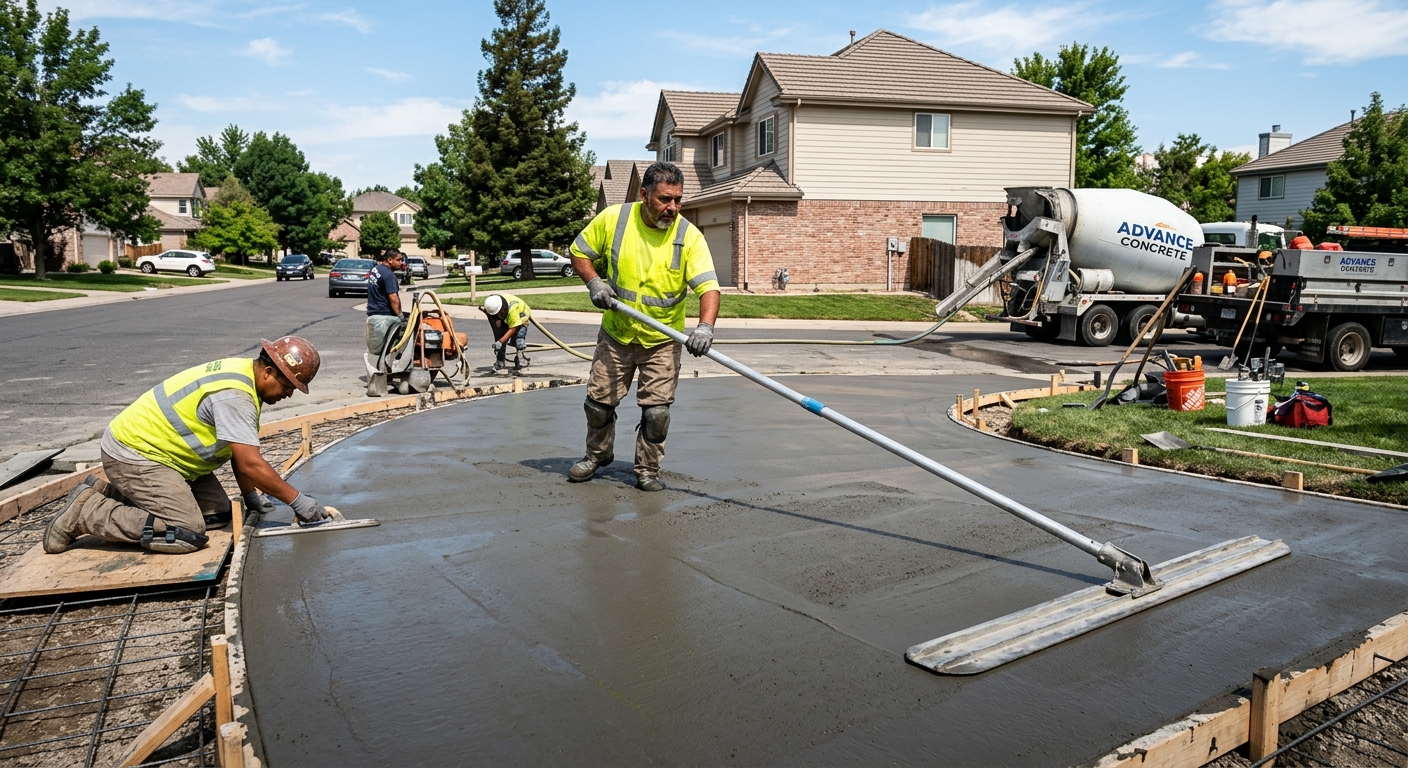
Concrete work options and costs in Smoky Lake
Concrete work in Smoky Lake is a year-round need, but it’s never “one-size-fits-all” because we’re dealing with deep frost, intense freeze–thaw cycles, and a shorter warm-season pour window. That matters in a town where most homes are single-detached (79.8% of dwellings), and where the majority of households are owner-occupied (73.9% of households own). In practice, that usually means steady demand for exterior flatwork like driveways, patios, and walkways—especially as many homes are older; 70.5% of dwellings were built before 1981, so repairs and replacements come up often.
In the Wood Buffalo–Cold Lake area, contractors plan pours around temperature swings and may use blankets, heaters, or accelerators to protect fresh concrete. Foundations and other structural work also need deeper, properly formed excavation below frost depth, plus air-entrained concrete to resist freeze–thaw damage. The result is that projects here typically land toward the upper end of typical prairie pricing—particularly for anything exterior and fully exposed to moisture and de-icing salts.
If you’re in or near downtown Smoky Lake or the newer subdivisions on the edges of town, you’ll often see driveways and garage slabs upgraded first, because accessibility and curb appeal improve immediately while the weather holds. Use the table below to compare common concrete options and realistic price ranges before you request an itemised quote.
| Application |
Typical Size |
Key Spec |
Finish Option |
Price Range |
| Concrete driveway (standard broom finish) |
400–600 sq. ft. |
Air-entrained exterior mix, control joints, compacted granular base |
Broomed finish, edged & sealed |
$7,200–$14,800 |
| Exposed aggregate driveway |
400–600 sq. ft. |
Air-entrained mix, retarder/technique for aggregate exposure, proper curing |
Exposed aggregate (washed/finished look) |
$9,000–$17,800 |
| Stamped concrete driveway or patio |
300–500 sq. ft. |
Air-entrained mix, densifier/seal system, tighter joint control |
Stone/brick stamp pattern |
$8,500–$17,500 |
| Plain concrete patio or walkway |
150–300 sq. ft. |
Air-entrained mix, compacted base, edging & joints |
Float/smooth or light broom |
$2,300–$7,500 |
| Garage floor (interior slab) |
300–500 sq. ft. |
Vapour barrier as needed, proper sub-base, reinforcement per design |
Standard trowel finish, sawcut joints |
$5,500–$12,900 |
| Foundation footings (structural, below frost) |
Per building footprint (estimate) |
Excavation to frost depth, rebar cage, engineered sizing |
Structural concrete only (not decorative) |
$11,000–$25,000 |
Prices are estimates only and vary by project scope, site access and material selection.
What affects the price of concrete work in Smoky Lake
In Smoky Lake and across the Wood Buffalo–Cold Lake region, quotes for the “same” concrete job can vary by 30–50% once you account for frost-depth excavation, weather protection, and the level of base and mix specification. Even small differences—like whether the contractor properly compacts granular base, uses the right air-entrained mix, or plans pour-day temperature protection—can change both material quantity and labour time.
Here’s the big driver: frost line depth and freeze–thaw cycles dictate every spec. Exterior work must be built so it can survive repeated water movement in and out of subgrade. That typically means footings extend well below the design frost depth and slabs are supported by correctly prepared, compacted granular base with drainage. Contractors also use air-entrained concrete designed for exterior freeze–thaw exposure. If you’re pricing driveways and exterior flatwork, that’s why many bids will land around the driveway band of $18,000–$28,000 depending on finish and complexity—while a basic patio or walkway often fits the $15,000–$25,000 style band when scope includes prep, joints, and finishing.
Cold-season scheduling matters too. Because the pour window is shorter, contractors may need blankets, heaters, or accelerators to protect early-age strength. That adds cost, but it’s cheaper than redoing spalled or cracked slabs. De-icing salts also accelerate surface wear; sealing after curing helps slow that down.
Local examples that change your price: replacing an old driveway with heavy millings and hauling away debris increases labour and disposal; widening a driveway for turning radius adds forming and truck-access time; and choosing stamped or exposed aggregate increases finishing labour. With many homes built before 1981 in the area (70.5%—Statistics Canada, 2021 Census), upgrade work commonly includes partial repairs to approach grades and older base that wasn’t designed for today’s performance expectations—often turning a “simple pour” into a deeper prep job. For that reason, the best quotes break work down item-by-item so you can see exactly what’s being done under the surface.
| Price Factor |
Why It Matters |
Cost Impact |
| Frost line depth |
Determines footing depth and form height to prevent frost heave |
Higher excavation and concrete volume; increases labour and forming |
| Site preparation |
Excavation, grading, and compacted granular base control settlement and cracking |
More base and compaction time; reduces failed repairs |
| Reinforcement |
Rebar or mesh helps control cracking and improves structural capacity |
Material + labour for spacing, chairs/ties, and placement |
| Mix design |
Air-entrainment and specified strength are required for freeze–thaw durability |
Specialty mix and batching can raise per-metre costs |
| Finish type |
Broom vs. stamped vs. exposed aggregate changes labour and material technique |
Stamped/exposed typically add finishing time and seal/coating steps |
| Pour size and concrete truck access to site |
Long walks, tight turns, or limited access require more handling |
Extra labour for hose/pumps or additional crew time |
| Cold-weather curing precautions |
Heating/blankets protect early strength in a short pour season |
Added equipment, time, and sometimes accelerators |
| Control joint pattern and sealing cost |
Joint spacing reduces random cracking; sealing improves surface durability |
Cutting labour + sealer product and application labour |
Permits & regulations in Alberta
In Alberta, structural concrete work is typically tied to building permits and engineering review. For homeowners in Smoky Lake, that usually means footings, foundation walls, and grade beams require a building permit and often engineered drawings or sizing information reviewed through the permit process. Because these items are part of the building’s structural system, municipalities want to verify correct dimensions, reinforcement, and bearing conditions.
Concrete flatwork—such as driveways, sidewalks, patios, and walkways—often does not require a permit. However, it can require municipal approval if it affects lot grading, changes drainage, or impacts impervious surface coverage limits or work near the municipal right-of-way. When in doubt, confirm before you dig.
Step-by-step, here’s how a homeowner should verify a contractor in Alberta:
- Check the contractor’s Alberta licensing/registration status on the appropriate provincial registry they reference in bids or contracts.
- Request a Certificate of Insurance for liability. Verify the policy is current and includes the work location (and that the coverage limits are appropriate).
- Confirm WSIB/WCB coverage (workers’ compensation). Ask for a clearance letter or proof of account coverage.
- Ask for references on similar-scale foundation/flatwork projects in cold climates.
- For permit-required structural work, ensure the contractor coordinates with the permit holder/engineer and provides documentation you’ll need for inspections.
Getting concrete right in Smoky Lake's freeze-thaw climate
Concrete failure in Smoky Lake usually comes back to a few predictable issues: poor base support, wrong mix design for freeze–thaw exposure, weak early curing, and joints that aren’t controlled. In a cold and wet cycle like ours in the Wood Buffalo–Cold Lake market, water repeatedly expands and contracts in the subgrade and within the concrete pores. If the slab isn’t protected by air-entrainment and good curing, you’ll often see surface scaling, spalling, and then random cracking as freeze–thaw stresses build up.
To spec the job correctly, start from the bottom up. (1) Base preparation: use a properly graded, compacted granular sub-base at the correct depth for your soil and frost conditions—good drainage is not optional. (2) Mix design: for exterior flatwork, specify air-entrainment (commonly 5–7% air content for freeze–thaw durability) and a minimum 32 MPa compressive strength. (3) Control joints: place joints to limit random cracking—especially important on driveways and patios exposed to thermal movement. (4) Curing: plan for at least 7 days of proper curing conditions; in cold weather, contractors may need blankets or heat to avoid early-age damage. (5) Sealing: apply a penetrating sealer after the cure (often around 28 days) to help repel de-icing salts.
Ask technical questions such as: “What air-entrainment target are you designing for?” and “How will you protect the concrete during the first 48 hours if we’re near freezing?” Spalling from inadequate air-entrainment is one of the costliest “cheap bids” to fix.
A practical dollar example: a broom-finished driveway may land in the lower portion of the driveway range ($18,000–$28,000), while stamped work is usually higher because it requires extra finishing steps and tighter joint control. If the premium is only a few thousand dollars, it’s typically justified for the finish and sealing system—as long as the contractor is still meeting air-entrainment and curing specs, not just changing the top look.
| Spec |
Why It Matters in Smoky Lake |
What to Ask For |
Impact if Skipped |
| Compacted granular base (depth?) |
Supports the slab through freeze–thaw movement and helps manage drainage |
Base depth, material type, compaction method/requirements |
Settlement, uneven slab, and early cracking |
| Air-entrained concrete mix (target air %?) |
Resists freeze–thaw scaling and reduces spalling risk |
Air-entrainment target (commonly 5–7% for exterior flatwork) |
Surface scaling/spalling, faster deterioration |
| Compressive strength (MPa rating) |
Ensures durability and performance through repeated seasonal stress |
Minimum 32 MPa for exterior exposure (as applicable) |
Low strength leads to wear and poor long-term performance |
| Control joints (spacing per ACI guidelines) |
Limits random cracking from thermal and moisture movement |
Planned joint layout and timing of sawcutting |
Random cracking that can widen and trap water |
| Minimum 7-day curing period |
Cold edges and early-age freezing can prevent proper strength gain |
Protection plan if temperatures are near freezing |
Weak early concrete and higher chance of surface failure |
| Penetrating sealer (when applied after cure) |
Helps repel de-icing salts used during Alberta winters |
Sealer type and application timing (often after ~28 days cure) |
Faster salt-driven surface deterioration |
How to choose a concrete work contractor in Smoky Lake
Choosing the right contractor in Smoky Lake is mostly about verifying capability in cold-weather concrete—not just winning the bid. Start with Alberta licensing/registration: ask the contractor to provide their current registration information before work begins. Next, confirm liability insurance. You should receive a current Certificate of Insurance naming the insured party and showing coverage limits appropriate for the project size and scope. Finally, verify WSIB/WCB coverage for workers—request proof (often a clearance letter or account verification).
For quotes, get 2–3 itemised written estimates instead of a lump sum. You want a breakdown that separates labour, excavation, disposal, forms, granular base, reinforcement, concrete supply, finish, and sealing. This makes it easier to compare contractors fairly. Read the scope line-by-line: what’s included for permit pull (if applicable), what’s included for disposal, and whether base depth and compaction are described. If one quote is cheaper because it assumes thinner base or fewer joints, you’ll pay later when the slab moves.
Also check warranty terms. Ask for a workmanship warranty length, any product/manufacturer warranty coverage, and whether the warranty is transferable if you sell your home. Payment terms matter: never pay more than 10–15% upfront, and hold back a portion until substantial completion and clean-up. For timing, request a start date and completion estimate in writing—especially if the work overlaps cold weeks.
- Ask who supplies the concrete and what mix design/air-entrainment target they use for exterior work.
- Confirm the base preparation specs and compaction method (not just “we’ll dig and level”).
- Require an explicit joint plan (layout and timing of sawcut or forming joints).
- Ask how they handle curing during cold weather (blankets/heaters/accelerators if needed).
- Verify liability insurance is active and matches the project location.
- Verify WSIB/WCB clearance/proof before work starts.
- Get a written, itemised quote for comparison—not a single total.
- Confirm disposal/hauling is included or clearly excluded.
- Clarify if traffic control, protection of landscaping, and cleanup are included.
- Confirm reinforcement placement details (rebar size, spacing, chairs/ties, overlap/laps).
- Ask about sealing inclusion for driveways/patios if the bid suggests it.
- Use a contract with start/completion dates and a clear change-order process.
Concrete red flags I commonly see around Smoky Lake include: bids that don’t mention air-entrainment for exterior slabs; no clear plan for base depth/compaction; no control joint layout or vague “we’ll do joints”; refusal to provide insurance/WSIB/WCB proof; and schedules that ignore curing protection when temperatures dip—those shortcuts tend to show up as spalling and cracked edges within a few winters.
Frequently asked questions — concrete work in Smoky Lake
Stamped vs broom-finish concrete — cost difference?
In Smoky Lake and the broader Wood Buffalo–Cold Lake area, stamped concrete costs more mainly because of the extra finishing labour (stamp patterns, texture work, and more careful joint/edge detailing). For a typical driveway or patio, a broom-finished exterior pour generally sits in the lower range of the driveway band (commonly $18,000–$28,000 for many projects once prep and access are included). Stamped work often pushes higher because the contractor also needs a consistent finishing workflow and usually recommends a sealing system to protect the surface from freeze–thaw stress and de-icing salt use. The key is that the “look” should never replace the performance specs—air-entrainment, minimum strength, proper base compaction, and curing protection still matter just as much in Alberta’s winter climate. Get the stamped bid itemised so you can see what’s changed besides the top finish.
When is the best time to pour concrete in Smoky Lake?
The best time is when we can pour with stable temperatures above the contractor’s minimum placement range and keep the concrete warm enough for early strength gain. In Smoky Lake, that usually means late spring through summer, when the ground isn’t frozen and crews can manage curing without heavy heating or complex cold-weather measures. That said, good contractors can pour in colder shoulder seasons if they plan ahead—using blankets, heaters, and sometimes accelerators—to protect curing during the first critical period. Because the warm season is shorter in the Wood Buffalo–Cold Lake region, scheduling can compress, and that can affect price. If you’re flexible, moving the pour to a warmer window may reduce cold-weather costs. If you can’t, ask for their cold-weather curing plan in writing and confirm they’ll still meet exterior air-entrainment and strength requirements.
How long does concrete take to cure?
Concrete strength development is time-dependent and temperature-dependent. In practical terms for homeowners in Alberta: you’ll often see “walk-on” readiness in a few days depending on mix and conditions, but design durability relies on curing for longer. For typical exterior projects in Smoky Lake, contractors plan for at least 7 days of proper curing, with careful protection in cold weather to prevent early-age freezing. Full performance and best results for sealing usually line up closer to the 28-day mark, when penetrating sealer is most effective for repelling de-icing salts. If the weather is marginal, curing protection (blankets/heating where necessary) becomes part of the quality spec, not an optional extra. When comparing quotes, ask how long they require for curing and what they’ll do if temperatures drop at night.
Do I need a permit for concrete work in Alberta?
It depends on what concrete work you’re doing. In Alberta, structural concrete work such as footings, foundation walls, and grade beams is generally tied to building permits and often engineered drawings reviewed through the permit process. For concrete flatwork like driveways, sidewalks, and patios, permits often aren’t required unless the project affects lot grading, impervious surface coverage rules, drainage, or work near the municipal right-of-way. For Smoky Lake homeowners, the safest approach is to ask the contractor and confirm with the local authority before breaking ground—especially if you’re changing drainage patterns or altering elevation near the property line. Also verify the contractor can document insurance and workers’ compensation coverage (WSIB/WCB) for safety and compliance. If your scope touches structural elements, treat it as permit-required until proven otherwise.
Concrete vs pavers for a patio in Smoky Lake?
For patios in Smoky Lake, concrete and pavers both can work well, but they behave differently under Alberta freeze–thaw conditions. Concrete patios tend to be more straightforward for durability when built correctly: compacted base, air-entrained mix for exterior exposure, control joints, and proper curing. Pavers can also perform well if the base is engineered and the jointing/sand bedding is maintained, but they require more attention to settling and weed control over time. Cost-wise, a plain concrete patio or walkway often lands in the patio/walkway band (commonly $15,000–$25,000 depending on size and scope), while pavers can vary widely by thickness, edging, and labour rates. If your goal is longevity with less ongoing maintenance, ask both contractors to explain how they build the base and manage drainage, because that’s where most seasonal movement is decided.
How long does a concrete driveway last?
A well-built concrete driveway in Alberta can last decades. In Smoky Lake’s freeze–thaw climate, longevity comes from the basics done right: air-entrained exterior concrete, properly compacted granular base with good drainage, correct control joint spacing, and curing protection during cold snaps. Sealing after cure helps reduce salt-driven surface wear; it doesn’t stop freeze–thaw forever, but it slows deterioration. If your old driveway is failing early, it’s often due to inadequate air-entrainment, insufficient base preparation, poor drainage, or joints that were never cut/control-managed. Prices reflect that—driveway projects built to perform typically cost closer to the mid-to-upper portion of the local driveway band (commonly $18,000–$28,000 in this region). As a reference point for timing and planning, many homes here are older (Statistics Canada, 2021 Census) and replacement cycles are common, especially when drainage and de-icing habits haven’t been updated.