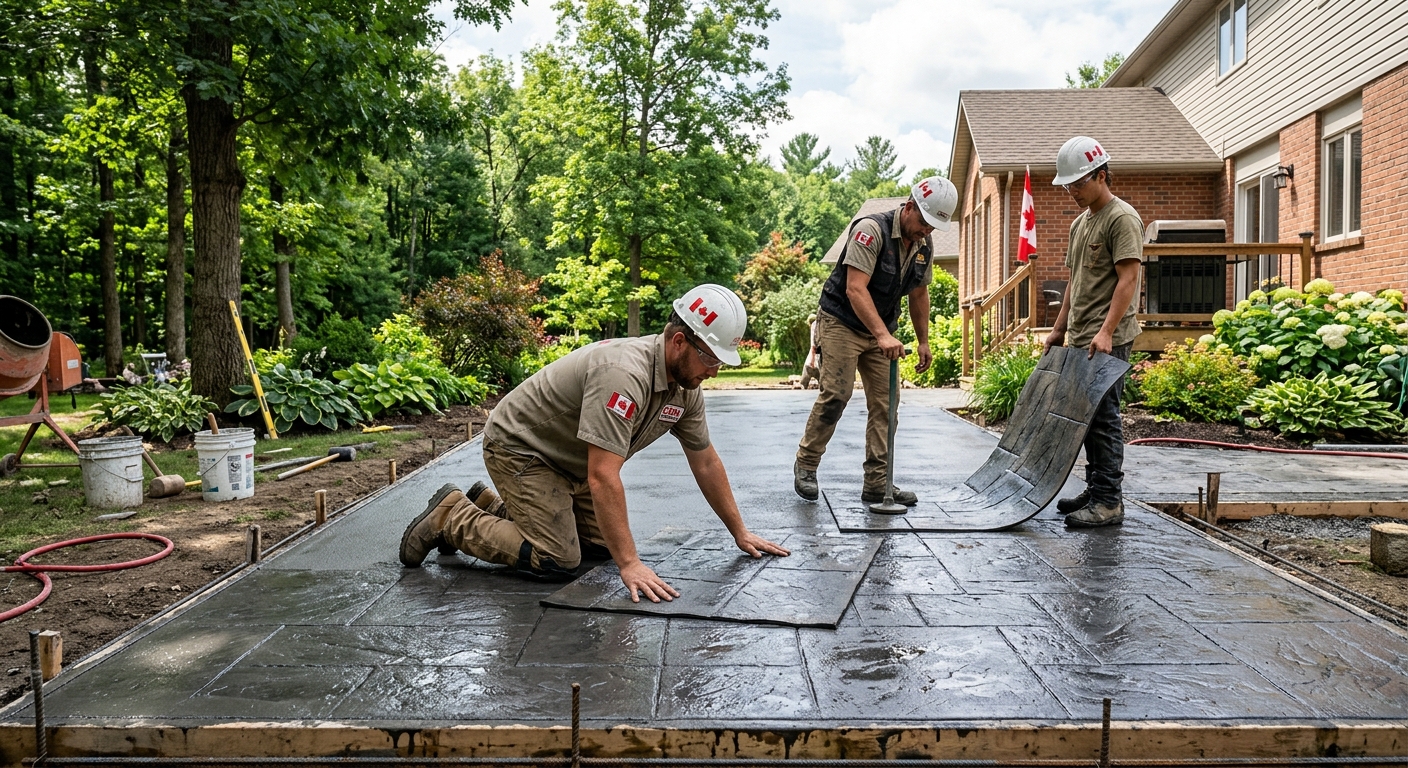
Concrete work options and costs in Beacon Heights
In Beacon Heights, concrete is one of the most dependable materials for driveways, patios, walkways and foundations—especially in a market where many homeowners want long-lived, low-maintenance surfaces. As of the 2021 Census, Beacon Heights has a population of 2,911, which keeps the local construction base fairly steady and means trades tend to schedule projects carefully around the cold season (Statistics Canada, 2021 Census). Most homes in this area are single-detached or attached-style households, and that directly drives demand for exterior flatwork—think driveways and backyard patios that see regular freeze–thaw exposure.
Calgary’s cold continental climate is the biggest cost driver. A design frost depth of about 1.2 m (roughly 4 ft) means footings for houses, garages and retaining walls must be planned to bear on undisturbed soil below that zone to reduce frost heave and seasonal movement. For exterior slabs—especially driveways, walkways and patios—contractors also engineer for freeze–thaw cycles with air-entrained concrete mixes, robust base prep, and control joints. If you’re pouring late fall or early spring, the pour window tightens and cold-weather curing measures (insulated blankets and controlled heat) can add labour and materials costs.
In Beacon Heights, concrete work is especially in demand around the established residential pockets where homeowners are replacing older drive approaches and upgrading backyard slabs before the winter season hits. With these factors in mind, it’s easier to compare options side-by-side—starting with the most common scope items below.
| Application |
Typical Size |
Key Spec |
Finish Option |
Price Range |
| Concrete driveway (standard broom finish) |
24 ft x 10 ft (approx. 240 sq. ft.) |
Air-entrained exterior mix, compacted base, control joints |
Broom finish |
$12,000–$18,000 |
| Exposed aggregate driveway |
24 ft x 10 ft (approx. 240 sq. ft.) |
Air-entrained exterior mix, proper base drainage and joints |
Exposed aggregate |
$15,000–$21,000 |
| Stamped concrete driveway or patio |
24 ft x 10 ft driveway or 16 ft x 12 ft patio |
Air-entrained exterior mix, integral colour, release/bond system |
Stamped pattern (stamped & coloured) |
$15,000–$26,000 |
| Plain concrete patio or walkway |
12 ft x 16 ft patio (approx. 192 sq. ft.) or 4 ft x 20 ft walk (80 sq. ft.) |
Air-entrained exterior mix, compacted base, expansion/edge details |
Plain broom or smooth trowel with slip-resistant finish |
$5,000–$9,000 |
| Garage floor (interior slab) |
22 ft x 20 ft (approx. 440 sq. ft.) |
Vapour barrier, proper thickness, reinforcement as spec’d |
Plain finish or light broom |
$10,000–$16,000 |
| Foundation footings (structural, below frost) |
Typical house footprint (varies by design) |
Engineered foundation design, excavation below frost depth, rebar |
Structural concrete, not decorative |
$28,000–$45,000 |
Prices are estimates only and vary by project scope, site access and material selection.
What affects the price of concrete work in Beacon Heights
In Calgary and the surrounding region, you can see concrete quotes swing by about 30–50% for the same “type” of job. The reason usually isn’t the concrete itself—it’s the engineered specs that keep concrete performing through freeze–thaw, plus the amount of excavation and preparation required at your specific site. In Beacon Heights, small changes in driveway slope, soil condition, and how easily a truck can reach the pour area can translate into extra days of labour and more granular base, which drives up the total.
Frost protection is central. Footings must be planned to extend below the design frost depth of about 1.2 m (roughly 4 ft). In practical terms, that means deeper excavation, taller formwork, and larger concrete volumes for foundation and retaining applications. Exterior slabs—driveways, walkways and patios—also need air-entrained mixes to withstand freeze–thaw cycles and reduce surface scaling and spalling. Cold-season limitations matter, too: Calgary’s exterior pour season is shorter, so when a project slips into late fall or early spring, crews often add cold-weather curing precautions like blankets and controlled heat to maintain proper curing. Finally, because de-icing salt is common in Alberta winters, sealing is frequently treated as a “best practice” to slow deterioration.
Two common Beacon Heights examples: (1) a driveway replacement that requires additional excavation and re-grading for drainage may push you from the lower end of the $12,000–$18,000 band toward the upper end; (2) a patio poured with correct reinforcement and engineered jointing might look similar to a basic pour, but the added materials and labour reduce future patching—often worth it compared to spending again a couple of winters later. Conversely, if your site has straightforward truck access and firm subgrade, costs can land closer to the low end of the patio/walkway $5,000–$9,000 band.
| Price Factor |
Why It Matters |
Cost Impact |
| Frost line depth — determines footing depth and form height |
Footings must bear below frost heave risk |
Higher excavation and concrete volume; can add substantial structural cost |
| Site preparation — excavation, grading, compacted granular base |
Weak or inconsistent subgrade causes settlement and cracking |
Extra truckloads of base and labour; often one of the biggest swings |
| Reinforcement — rebar or wire mesh requirement |
Improves slab durability and limits crack width |
Materials + placement labour; sometimes reduces long-term repairs |
| Mix design — air-entrainment and compressive strength spec |
Freeze–thaw durability and structural performance |
Specialty mix cost + scheduling; critical for exterior work |
| Finish type — broom vs. stamped vs. exposed aggregate |
Labour intensity and curing/finishing steps |
Stamped/exposed work typically costs more than plain broom |
| Pour size and concrete truck access to site |
Delivery logistics affect labour, waste, and schedule |
Limited access may require pumping or smaller batches |
| Cold-weather curing precautions — heating and blankets |
Ensures concrete gains strength correctly during freezing risk |
Temporary equipment and extra labour can add meaningful cost |
| Control joint pattern and sealing cost |
Limits random cracking and protects against salt scaling |
More layout effort + optional sealer increases upfront budget but helps longevity |
Permits & regulations in Alberta
In Alberta, the rules depend on whether the concrete is structural or simply part of exterior grading. For Beacon Heights homeowners, a safe starting point is: structural concrete typically requires a building permit, while most plain flatwork does not. Concrete flatwork like patios, walkways and driveways usually doesn’t require a permit unless it changes lot grading, impacts impervious surface coverage limits, or affects municipal right-of-way elements such as sidewalks or boulevards. By contrast, structural items like house footings, foundation walls, grade beams, and other below-grade supporting concrete typically require a permit and, in many cases, engineered drawings reviewed through the municipal process.
Here’s a practical step-by-step way to verify your contractor’s compliance before you sign:
- Ask for their certificate of insurance (liability) showing current coverage and the correct legal business name.
- Confirm they’re registered for workers’ compensation coverage (WSIB/WCB). In Alberta this is handled through the workers’ compensation system; you can verify via the appropriate clearance process the contractor provides.
- Use the relevant online registry/search tools for Alberta business licensing/registration status and ensure it matches the company name on their quote.
- Request references for similar-scale jobs (driveways and, if applicable, foundation/footing scopes).
- For structural concrete, ask what drawings/engineer sign-offs they’ll follow and whether permit pulling is handled in-house or by your builder/GC.
Always confirm with your local authority before breaking ground, especially if the project ties into drainage, slope corrections, or any work near municipal boundaries.
Getting concrete right in Beacon Heights's freeze-thaw climate
In Beacon Heights and across Calgary’s region, concrete failures are usually about water management and curing—not about “bad luck.” The most common issues in winter are spalling and surface scaling from freeze–thaw plus de-icing salt. That’s why the job has to be engineered around frost depth (about 1.2 m) and frequent freeze–thaw cycles. If the base isn’t compacted to the right depth or drainage is poorly handled, the slab can settle or trap moisture at the surface. If the mix isn’t properly air-entrained, the concrete has less ability to tolerate freeze expansion, and you’ll see premature deterioration.
To spec a correct Beacon Heights install, focus on five things. First, base preparation: compacted granular sub-base to the required depth for your soil and frost conditions. Second, mix design: air-entrainment in the range of about 5–7% for exterior flatwork and a minimum 32 MPa compressive strength. Third, control joints: planned spacing to limit random cracking. Fourth, curing: at least 7 days under proper conditions, and if weather is cold, use cold-weather curing precautions (blankets/heat) so the slab gains strength rather than freezing too early. Fifth, sealing: apply a penetrating sealer after the concrete cure period—commonly around 28 days—so de-icing salts don’t accelerate surface breakdown.
It’s also where money should be spent wisely. For example, a stamped driveway costs more than plain broom—often pushing toward the $15,000–$26,000 band instead of the $12,000–$18,000 band for standard broom. That price difference is justified when the contractor still meets the same freeze–thaw durability specs (air entrainment, correct base, and jointing). If someone cuts those, the decorative finish won’t save it.
| Spec |
Why It Matters in Beacon Heights |
What to Ask For |
Impact if Skipped |
| Compacted granular base (depth?) |
Limits settlement and reduces trapped moisture under the slab |
Base thickness plan by site conditions and frost considerations; compaction test approach |
Cracking, rocking, and early failure around edges and joints |
| Air-entrained concrete mix (target air %?) |
Improves freeze–thaw durability and reduces surface scaling/spalling |
Verify air content target (commonly 5–7% for exterior flatwork) |
Increased spalling risk after winter cycles |
| Compressive strength (MPa rating) |
Ensures structural performance and proper strength gain |
Confirm minimum 32 MPa (or project-specific engineered spec) |
Weaker slab, abrasion failure, and reduced long-term durability |
| Control joints (spacing per ACI guidelines) |
Controls where cracks form instead of letting them wander |
Ask for joint layout and spacing plan for your slab dimensions |
Random cracking and unsightly repairs |
| Minimum 7-day curing period |
Prevents early freezing/poor strength development in Alberta cold snaps |
State curing method and protection plan for temperature swings |
Surface scaling, weakness, and durability loss |
| Penetrating sealer (when applied after cure) |
Repels water and helps protect against de-icing salt effects |
Ask for sealer type and application timing (commonly after ~28 days cure) |
Accelerated deterioration and easier moisture ingress |
How to choose a concrete work contractor in Beacon Heights
Choosing the right contractor matters more in Beacon Heights than in many warmer areas because the climate punishes shortcuts. Start by verifying Alberta compliance and jobsite readiness. Ask for their certificate of liability insurance (current dates and coverage amount), then request proof of workers’ compensation coverage (WCB/WSIB clearance documentation as applicable). Next, confirm the contractor’s business registration/licence status using Alberta’s online registry resources and make sure the legal business name matches the quote and invoice.
For pricing, don’t accept only a “lump sum.” Get 2–3 written, itemised quotes showing labour and materials separately where practical—especially for concrete mix type, reinforcement, excavation, base prep, and finish labour (broom vs. stamped vs. exposed aggregate). Also, read exclusions: is the permit included (when required), is debris/disposal covered, what about cutting and patching existing slabs, and who handles any necessary drainage/grading adjustments? Warranty terms should be clear: workmanship warranty length, whether product/manufacturer warranties apply to materials, and whether any warranty is transferable if you sell.
Payment scheduling should be conservative. Never pay more than 10–15% upfront for mobilization, and hold back a meaningful portion until punch-list items are complete and the slab is properly cured/finished. Finally, demand a start date and completion estimate in writing—concrete schedules in Calgary can shift quickly due to temperature and curing requirements.
- Ask for project photos of similar Beacon Heights concrete scopes in the past year.
- Confirm the mix is air-entrained and that they can state the target air % for exterior work.
- Verify reinforcement details: where rebar or mesh is used and why.
- Check that joints are planned (layout drawings or a written joint schedule).
- Confirm base prep depth and compaction approach—not just “we’ll prep the area.”
- Ask about concrete truck access and whether pumping/short-load logistics are included.
- For cold-weather work, require a written plan for curing blankets/heating.
- Clarify disposal: broken concrete hauling and site cleanup responsibilities.
- Make sure sealing (if included) specifies product type and application timing.
- Get the warranty in writing with scope (what it covers and for how long).
- Avoid “cash discount” offers that bypass itemisation and written scope.
- Confirm schedule commitment: start date, pour day conditions, and curing milestones.
Concrete red flags I watch for in Beacon Heights: (1) quotes that don’t mention air-entrainment for exterior slabs; (2) vague base prep descriptions with no depth/compaction detail; (3) missing joint layout and no discussion of sealing; (4) pushing for large upfront payments or no holdback; and (5) no cold-weather curing plan when a late-season pour is proposed.
Frequently asked questions — concrete work in Beacon Heights
How do I maintain concrete in Beacon Heights's freeze-thaw climate?
In Beacon Heights, the goal is to manage moisture and protect the surface from de-icing salt. For exterior flatwork like driveways and walkways, start with regular sweeping to remove grit and sand that can abrade the surface during thaw cycles. Use de-icer carefully: avoid over-salting and use calcium chloride-type de-icers in moderation where permitted. After your pour cures (often around 28 days), a penetrating sealer helps repel water and slows salt-driven scaling. Keep weeds and drainage issues under control so water doesn’t pool along edges or at joints. If you see early hairline cracking, don’t ignore it—proper sealant in control joints can prevent water from migrating underneath and accelerating freeze–thaw damage. If you’re budgeting, plain broom driveways often fall in the $12,000–$18,000 range, and maintaining them with sealing is one of the smartest “small-spend, big-benefit” steps.
What causes concrete to spall in Beacon Heights winters?
Spalling in Alberta winters typically comes from water freezing inside the concrete and along the surface pores. The most common root causes are insufficient air-entrainment, poor curing, and weak surface/edge protection. If the mix isn’t engineered with the right air content (commonly 5–7% for exterior flatwork), freeze–thaw expansion generates internal pressure and breaks down the surface layer. Inadequate curing—especially if concrete is exposed to cold temperatures before it reaches adequate strength—also increases the likelihood of scaling and spalling. Base and drainage issues can worsen it by keeping water near the surface or by allowing slab movement. Finally, de-icing salt accelerates the chemistry that breaks down the outer paste. That’s why, in Beacon Heights, I strongly recommend asking whether your contractor will use air-entrained concrete, follow a minimum 7-day curing approach, and apply a penetrating sealer after the cure period (often around 28 days).
What is rebar and when is it required in Alberta?
Rebar is reinforcing steel placed inside concrete to increase tensile capacity and control crack width. In Alberta, it’s required when the engineered design calls for it—most commonly in structural concrete like foundation walls, grade beams, and footings. For exterior flatwork (driveways, garage slabs, patios), reinforcement needs vary by slab thickness, soil conditions, and how the slab will be loaded. Many driveways and interior garage floors benefit from reinforcement or wire mesh where designed to limit cracking and improve durability. The key is that reinforcement placement and sizing should match the project spec, not guesswork. In a cold continental climate like Calgary, reinforcement alone won’t prevent freeze–thaw damage—air-entrainment, correct base prep, and jointing are equally important. When rebar is required, it also affects labour and material cost, so it’s wise to ask for the reinforcement plan in your itemised quote.
How long does a concrete project take in Beacon Heights?
Typical timelines in Beacon Heights depend on the scope and weather, because curing conditions are critical with Calgary’s freeze–thaw cycles. For a basic exterior patio or walkway, many projects can be completed in about 1–3 days of active work (excavation/grading/base prep, formwork, pour, finishing), but the slab still needs proper curing—minimum 7 days—before heavy use. For a driveway replacement, the active work is often longer (commonly 2–5 days), especially if demolition, disposal, and grading adjustments are part of the scope. Decorative work like stamping or exposed aggregate can add finishing time because it requires extra steps after placement. If you’re scheduling a late-fall or early-spring pour, cold-weather curing precautions (blankets/heating) can lengthen the process because crews must maintain concrete temperature and curing conditions. Cost-wise, options may range from $12,000–$18,000 for standard driveways to higher bands for stamped finishes, but the schedule impact is mostly driven by curing and access—not just the finish.
What is a concrete overlay and is it suited to Beacon Heights?
A concrete overlay is a new concrete layer placed over an existing slab after surface preparation. It can be suitable when the original slab is still structurally sound—meaning it isn’t severely cracked, heaving, or failing in multiple areas. In Beacon Heights, overlay suitability depends heavily on what’s causing the existing deterioration. If the base beneath the original slab has shifted or the slab is moving due to drainage or soil issues, an overlay won’t “fix” the underlying problem and can fail prematurely under freeze–thaw and de-icing salt exposure. If the existing slab is stable and the surface can be properly prepared (often including grinding/scarification and suitable bonding method), an overlay can be a cost-effective way to refresh appearance and add a new wearing surface. However, if the driveway is severely deteriorated, replacement may be the better long-term investment. For homeowners shopping within the market, it’s worth comparing overlay pricing against the more predictable bands for new concrete, including driveway work commonly in the $12,000–$18,000 range depending on scope and finish.
How do I seal concrete to protect it in Beacon Heights?
Sealing in Beacon Heights is mainly about reducing water and salt intrusion that contributes to scaling and spalling in winter. The most common approach is applying a penetrating sealer after the concrete has cured—often around 28 days for exterior flatwork—so the product can enter the concrete pores and help repel moisture. Before sealing, the slab should be clean and dry; if there’s ongoing moisture, dust, or curing residue, sealing performance can be reduced. Use the right product for exterior and freeze–thaw exposure, and don’t apply sealer too early during cold snaps. If you’re dealing with control joints, the sealant/maintenance strategy for joints is separate from surface sealer, and both matter. In Calgary’s climate, a sealed driveway or patio typically holds up better to de-icing salts than untreated concrete, but it won’t replace proper specs—air-entrainment, base prep, joints, and curing still determine long-term durability. If you’re comparing quotes, ask whether sealing is included and what exact timing and product type are proposed.