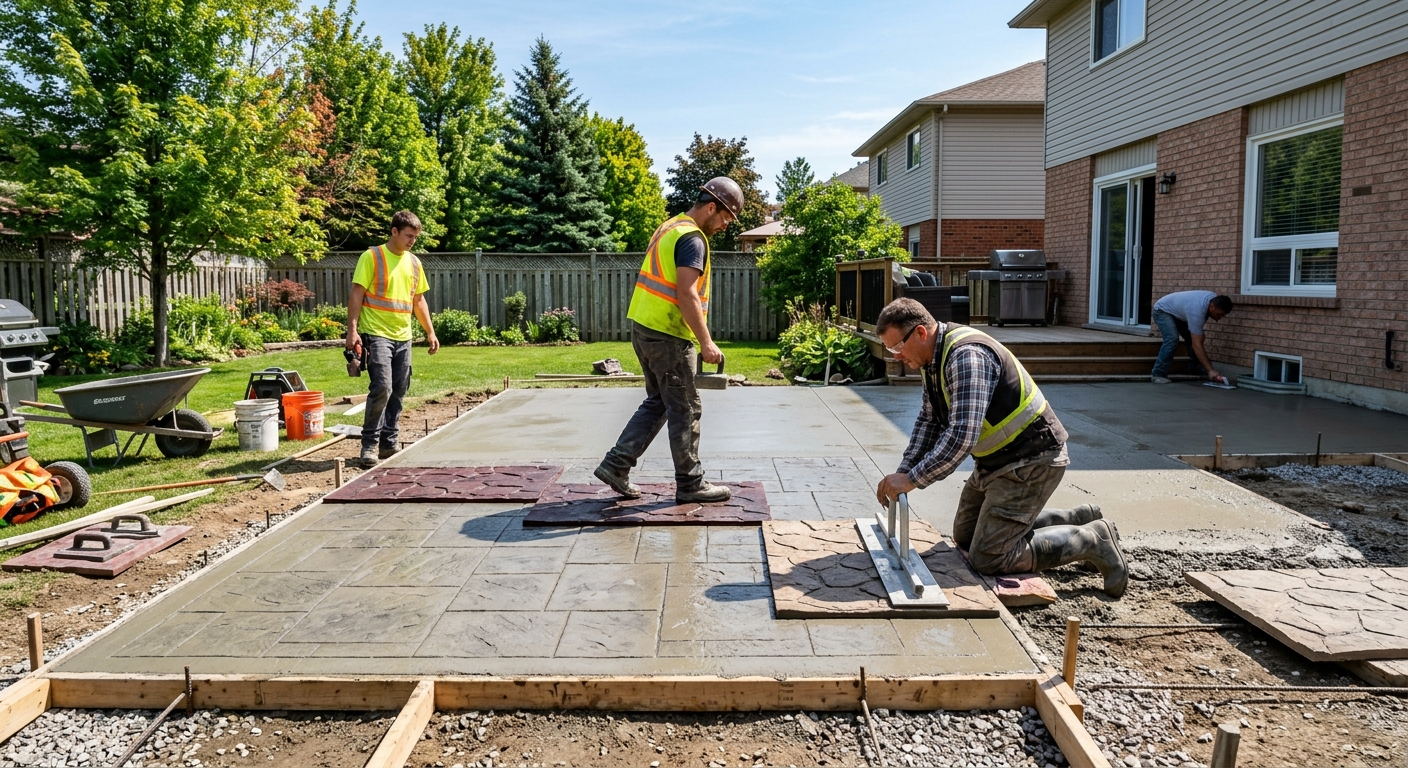
Concrete work options and costs in Hidden Valley
Hidden Valley, Alberta is a community where homeowners expect concrete flatwork to look sharp and perform through harsh winters. With a population of 11,540 (Statistics Canada, 2021 Census), the area’s housing demand keeps concrete crews busy—especially for driveways, patios, walkways, and basement-related foundation work. In Calgary’s broader market, concrete is most often tied to single-detached and suburban growth patterns, so exterior flatwork remains one of the most frequent concrete scopes contractors quote.
Calgary’s cold continental climate directly affects cost. You’re not just paying for concrete—you’re paying for engineered frost protection, air-entrained mixes, proper granular base prep, and the time it takes to cure safely during freeze–thaw cycles. Locally, design frost depth is about 1.2 m (roughly 4 ft), so footing and foundation volumes are higher than in warmer regions, which is why foundation / footings pricing tends to sit higher than people expect. Exterior slabs also face a shorter practical pour season, meaning cold-weather placement may require insulated blankets and/or temporary heat to achieve the right curing conditions.
In Hidden Valley, concrete demand is especially noticeable around newer infill and growth pockets in the neighbourhood area that’s commonly served by local contractors from the Calgary region, where homeowners are coordinating foundations and flatwork upgrades close together. If you want to budget accurately, it helps to compare the main options side-by-side—see the table below.
| Application |
Typical Size |
Key Spec |
Finish Option |
Price Range |
| Concrete driveway (standard broom finish) |
400 sq ft |
Air-entrained mix, compacted granular base |
Broom finish + saw cuts |
$12,000–$16,000 |
| Exposed aggregate driveway |
400 sq ft |
Air-entrained mix, proper curing before wash |
Exposed aggregate look |
$15,000–$18,000 |
| Stamped concrete driveway or patio |
300 sq ft |
Air-entrained mix, release agents, integral colour |
Stamp pattern + borders |
$17,000–$26,000 |
| Plain concrete patio or walkway |
250 sq ft |
Air-entrained mix, compacted base, reinforcement where needed |
Broom finish or smooth trowel (non-slip finish recommended) |
$5,000–$8,500 |
| Garage floor (interior slab) |
500 sq ft |
Vapour barrier, reinforcement, proper slope/drain details |
Broom or lightly trowelled finish |
$9,000–$14,000 |
| Foundation footings (structural, below frost) |
Typical house: 900–1,300 linear ft equivalent |
Engineered rebar, excavation to design frost depth, concrete quality spec |
Structural concrete with required formwork |
$28,000–$45,000 |
Prices are estimates only and vary by project scope, site access and material selection.
What affects the price of concrete work in Hidden Valley
In Hidden Valley and the Calgary region, you can see 30–50% quote swings for the “same” concrete job. That’s usually because the visible part (slab finish) is only one portion of the work. The biggest cost drivers are the hidden ones: excavation depth and haul, compacted base design, reinforcement, mix specification, finishing time, and—crucially—cold-weather curing precautions.
Concrete pricing is engineered around freeze–thaw. Footings and structural elements must bear below the design frost depth (about 1.2 m in Alberta), so excavation is deeper and footing volumes are higher than in milder climates. For exterior slabs like driveways, patios and walkways, air-entrained concrete is essential to survive repeated cycles. Calgary’s shorter exterior pour season also changes the schedule: if temperatures drop, contractors may need winter-grade mixes, insulated blankets, and sometimes controlled heating to maintain curing performance. On top of that, de-icing salt accelerates surface wear and spalling, so sealing is often part of doing it right.
Here are a few practical examples from Hidden Valley that commonly move costs up or down: (1) A driveway requiring extra removal of topsoil to reach competent subgrade often adds granular base and disposal costs, pushing a standard broom project toward the upper end of the $12,000–$18,000 driveway band. (2) If your patio area has poor access for a concrete truck or needs long hose runs, labour rises—sometimes narrowing the gap versus a decorative option. (3) If you want stamped concrete (often in the $15,000–$26,000 range for many typical scopes), you’re paying for additional materials, colour and release systems, and careful finishing time to avoid cold joints in our regional climate.
As a rough rule, the older the house site (and the more mature landscaping you have), the more likely you’ll hit surprises with underground services, uneven grading, or weaker fill—each can add labour and base material. That’s why quotes can differ even before you choose a finish.
| Price Factor |
Why It Matters |
Cost Impact |
| Frost line depth — determines footing depth and form height |
Footings must extend below design frost to prevent frost heave |
Higher excavation and concrete volume; can swing foundation pricing substantially |
| Site preparation — excavation, grading, compacted granular base |
Weak or poorly graded sub-base leads to settlement and cracking |
Extra excavation/disposal + added granular base increases labour and materials |
| Reinforcement — rebar or wire mesh requirement |
Controls cracking for flatwork and is critical in many structural scopes |
Material and placement labour; sometimes tied to engineered drawings |
| Mix design — air-entrainment and compressive strength spec |
Exterior freeze–thaw performance relies on air-entrained concrete |
Winter-grade and higher-spec mixes can cost more, especially in cold seasons |
| Finish type — broom vs. stamped vs. exposed aggregate |
Finish processes affect labour time and material usage |
Stamped/exposed adds colour, release systems, tools and labour; broom is typically cheapest |
| Pour size and concrete truck access to site |
Truck distance/constraints drive labour and scheduling |
Long hose runs or crane/alternate access can add labour and rental costs |
| Cold-weather curing precautions — heating and blankets |
Proper curing prevents surface scaling and reduces long-term issues |
Insulation blankets/heaters add daily setup and material costs |
| Control joint pattern and sealing cost |
Joints manage cracking; sealing protects against de-icing salt |
Cutting/saw time and sealer product add cost, but reduce early deterioration |
Permits & regulations in Alberta
In Alberta, structural concrete work—think foundation footings, foundation walls, grade beams, and other below-grade structural elements—typically requires a building permit, and engineered drawings are often reviewed by the municipality. For concrete flatwork like patios, walkways and driveways, permits are usually not required unless the work changes lot grading, touches impervious surface coverage limits, affects drainage, or involves municipal right-of-way considerations. Because site plans and drainage can trigger review, always confirm with the local authority before breaking ground in Hidden Valley.
Before you sign a contract, verify three things every time: (1) the contractor carries liability insurance, (2) they have the appropriate WSIB/WCB coverage for their workers, and (3) you have documentation of similar, correctly scoped projects. In addition, ask whether they handle permit paperwork when required and whether that process is included in the quote.
Here’s a step-by-step homeowner workflow: start with the contractor’s business name and confirm they’re in good standing by checking the appropriate online business/contractor listings. Next, request an up-to-date certificate of insurance (COI) showing liability coverage—make sure your name is added as applicable “additional insured” if their process includes it. Then ask for WSIB/WCB clearance information or a current coverage letter. Finally, ask for references on comparable Alberta projects (especially those with similar frost depth excavation and exterior slab specs) and request photos that show base prep, reinforcement placement, and jointing.
Getting concrete right in Hidden Valley's freeze-thaw climate
Concrete failure in Hidden Valley usually comes from the freeze–thaw cycle finding weak points: insufficient base prep, inadequate air-entrainment, improper curing, or missing/late sealing. If you spec the job correctly, you reduce the most common outcome we see—spalling and surface scaling from de-icing salt combined with water penetration. In this Calgary-region climate, your best results come from a full system: compacted granular base built to the right depth and slope, an air-entrained mix, controlled jointing at appropriate spacing, and curing that protects early-age concrete from cold stress.
For the mix, exterior flatwork should target 5–7% air content and a minimum 32 MPa compressive strength. For control joints, spacing needs to limit random cracking; and because our pour season is shorter, curing is not optional. Aim for a minimum 7-day curing period under proper conditions. If temperatures are borderline, the contractor should plan winter-grade procedures—insulated blankets and possibly heat—so the slab develops strength before exposure.
Sealing is the “maintenance layer” that helps repel de-icing salt. Penetrating sealer applied after the cure period gives you better protection without hiding surface issues. If you’re choosing between finishes, remember that price alone won’t guarantee performance. For example, a broom-finished driveway can land in the $12,000–$18,000 band, while a stamped driveway often sits in the $15,000–$26,000 range. The extra cost is justified when the contractor is also doing premium prep, correct mix air content, and proper jointing—not just stamping over a weak base. The hidden work is what makes the finish last.
| Spec |
Why It Matters in Hidden Valley |
What to Ask For |
Impact if Skipped |
| Compacted granular base (depth?) |
Reduces settlement and gives the slab support through freeze–thaw |
Documented base depth and compaction testing/verification method |
Cracking, uneven settling, and early edge spalling |
| Air-entrained concrete mix (target air %?) |
Allows expansion during freezing so water doesn’t damage the paste |
Target air content of 5–7% for exterior flatwork |
Higher risk of surface scaling/spalling within a few winters |
| Compressive strength (MPa rating) |
Strength development affects durability and load performance |
Minimum 32 MPa compressive strength spec for the slab |
Greater wear, cracking, and reduced lifespan |
| Control joints (spacing per ACI guidelines) |
Directs cracking to planned lines rather than random fractures |
Joint spacing plan and cutting schedule (saw-cut timing) |
Random cracks, water intrusion, and faster deterioration |
| Minimum 7-day curing period |
Early strength is critical in cold, cycling temperatures |
Curing plan for your pour date, including cold-weather protection if needed |
Weak surface, scaling, and longer-term durability problems |
| Penetrating sealer (when applied after cure) |
Helps repel moisture and de-icing salts |
Application timing after cure (commonly at/after 28 days) and sealer type |
Faster salt damage and more frequent refinishing |
How to choose a concrete work contractor in Hidden Valley
Choosing the right contractor matters in Hidden Valley because the difference between a good and a great pour is mostly in the prep and curing discipline—not the colour or broom pattern you see on day one. Start by verifying Alberta compliance: confirm the contractor is properly registered for their business activities, request a current certificate of liability insurance, and get proof of WSIB/WCB coverage for their workers. To check, ask for the documents directly, verify the policy dates, and make sure the COI shows appropriate coverage limits and aligns with the scope (driveways, patios, footings, etc.). If they won’t provide documentation promptly, treat that as a red flag.
Next, get 2–3 itemised written quotes. You want a breakdown that shows labour, equipment, excavation/base prep, concrete supply, reinforcement, finishing, saw-cutting/joints, and whether sealing is included. Avoid “lump sum only” quotes that don’t specify thickness, mix requirements, air content, or curing/cold-weather provisions. Read the scope for exclusions: is permit pull included where required? Is excavation disposal included? Who protects landscaping and handles haul-away?
Warranty should be explicit: workmanship warranty length (not just “materials guaranteed”), product/manufacturer warranty terms, and whether it’s transferable to a future owner. For payment, never pay more than 10–15% upfront; use a holdback until the job is complete and you have a walk-through. Finally, demand a written timeline with a start date and an estimated completion date.
- Ask for documented base prep details (depth and compaction approach).
- Confirm the mix is air-entrained for exterior slabs.
- Request a joint layout plan (spacing and cutting schedule).
- Check whether they plan cold-weather curing precautions if temperatures drop.
- Confirm reinforcement specs (mesh/rebar) where required by design.
- Make sure truck access constraints are addressed in the quote.
- Verify disposal/haul-away is included if excavation is needed.
- Ask whether sealing is included or recommended after cure.
- Look for itemised labour and materials (not just a total).
- Ensure a written workmanship warranty is provided.
- Confirm insurance and WSIB/WCB documents before signing.
- Require a written start date and completion estimate.
Red flags in Hidden Valley: contractors who won’t discuss air content or curing, quotes that omit excavation/base depth and reinforcement, crews who start without a clear joint plan, “we’ll pour whenever” scheduling without cold-weather protection, and contractors who require large upfront payments without a defined milestone schedule.
Frequently asked questions — concrete work in Hidden Valley
Stamped vs broom-finish concrete — cost difference?
Stamped concrete costs more because it involves additional steps beyond standard broom finishing: integral colour or hardeners, release agents, stamp mats, and typically more careful timing to avoid patchy impressions. In Hidden Valley, a typical broom-finished driveway often lands in the $12,000–$18,000 range (scope dependent), while stamped driveway or patio projects more commonly fall into the $15,000–$26,000 band due to the added labour and materials. The key is that stamped concrete still needs the same cold-climate engineering—air-entrained mix, correct granular base, and proper control joints—or you’ll pay for aesthetics without durability. Ask your contractor for the thickness, mix specs, air content approach, and joint layout before choosing a finish.
When is the best time to pour concrete in Hidden Valley?
For Hidden Valley and the Calgary region, the best time to pour is when daytime temperatures are reliably above freezing and overnight conditions are manageable for curing. Concrete can be placed in colder periods with winter-grade procedures—insulated blankets and, in some cases, temporary heat—but the process must be engineered. If you’re aiming for exterior flatwork (driveways, patios, walkways), many contractors prefer spring through early fall for a simpler cure. Pour timing matters because rushing curing in late fall or early spring raises the risk of scaling and long-term surface issues. If temperatures are borderline on your pour date, ask for the contractor’s cold-weather cure plan and how long protection will be maintained.
How long does concrete take to cure?
Concrete cure time has two parts: early strength gain and full strength development. For homeowners in Alberta, a practical target is at least a 7-day curing period under proper conditions to reach the stability needed for normal handling, and many contractors plan construction protection during this window. Full durability and readiness for sealing typically align closer to 28 days, especially for penetrating sealers intended to repel de-icing salts. In Hidden Valley’s freeze–thaw climate, curing is critical—cold snaps can harm early-age concrete if insulation/heating isn’t used when required. Always ask what curing protection they’ll provide (blankets/heat), how they’ll monitor conditions, and when you can use the driveway or patio safely.
Do I need a permit for concrete work in Alberta?
In Alberta, it depends on what you’re building. Structural concrete work such as footings, foundation walls, and grade beams typically requires a building permit and often engineered drawings reviewed by the municipality. Concrete flatwork like patios, sidewalks, and driveways usually does not require a permit unless it affects lot grading, drainage plans, impervious surface coverage limits, or the municipal right-of-way. Because hidden drainage details and grading can trigger review, confirm with the local authority before starting work in Hidden Valley. Also, ask the contractor whether any permit steps are included in their process for your specific scope, and ensure they’re ready to provide documentation and coordination if the project requires it.
Concrete vs pavers for a patio in Hidden Valley?
Concrete and pavers both can work well in Hidden Valley, but they fail differently. Concrete is typically more cost-stable for the long run when it’s engineered correctly with air-entrainment, proper base prep, control joints, and curing. A plain concrete patio commonly falls around the $5,000–$9,000 band for typical project sizes, while decorative concrete or stamped styles usually cost more. Pavers can be attractive for flexible appearance and easier local repairs, but weed barrier, base compaction, and proper edge restraint are still critical in freeze–thaw cycles. If you want a consistent surface that drains well and you’re prioritizing longevity over “individual unit” replacement, concrete is often a strong fit. If you want easy localized cosmetic repairs, pavers can be appealing—just make sure the base system is built to Alberta winter demands.
How long does a concrete driveway last?
A properly installed concrete driveway in Hidden Valley commonly lasts decades, often 25–35 years or more, but the exact lifespan depends on specs and maintenance. In Calgary-area freeze–thaw conditions, the most common early problems come from inadequate air-entrainment, poor base prep, weak curing, or missing sealing—especially when de-icing salt is used regularly. If your driveway is built within the local cost reality (for example, broom-finish projects often in the $12,000–$18,000 band), it usually includes the engineering elements that drive durability: compacted granular base to support the slab, correct mix design, and control joints that manage cracking. Ask your contractor about air-entrainment, joint spacing, and whether a penetrating sealer is recommended after cure for salt protection.