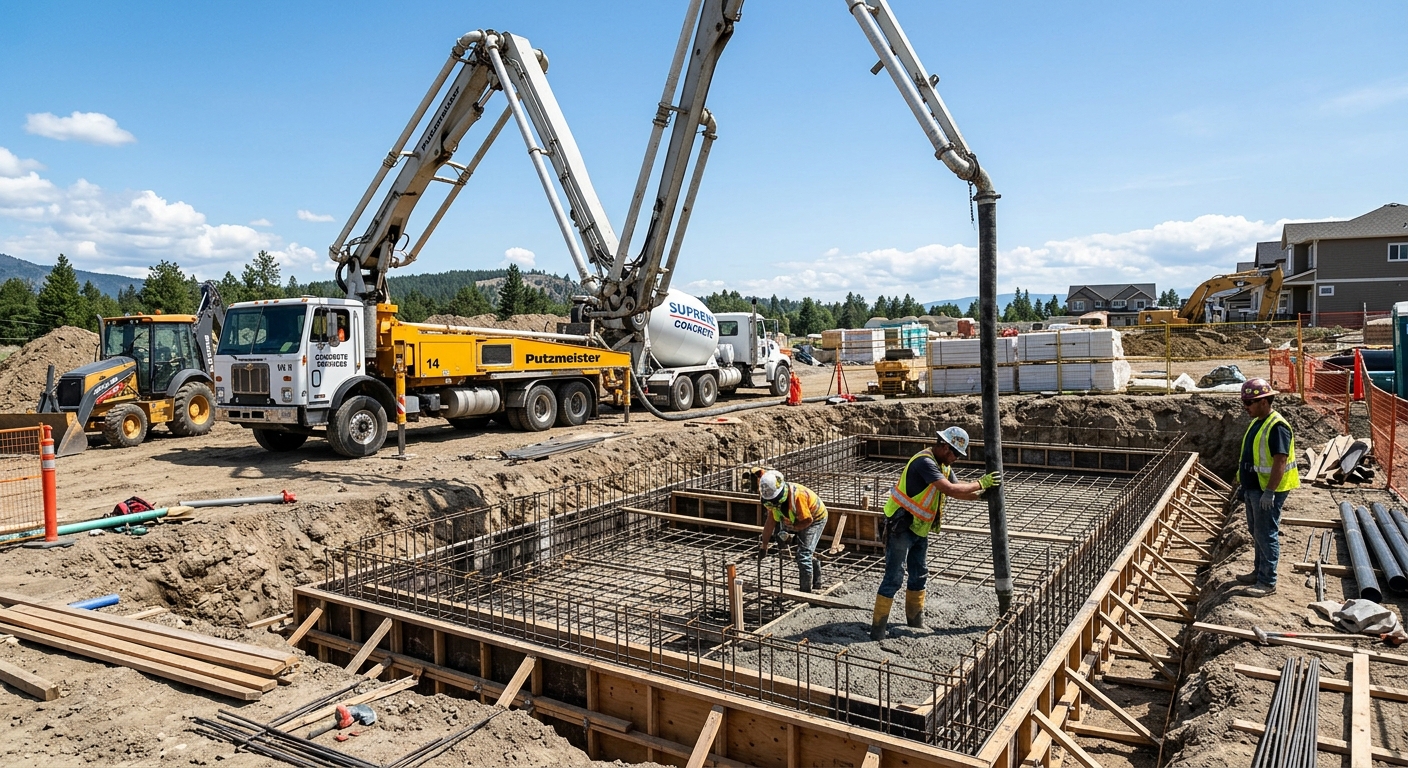
Concrete work options and costs in Grand Centre
Grand Centre, Alberta is a town where homeowners still want dependable, easy-maintenance outdoor surfaces—especially for driveways, patios, and walkways. With a 2021 population of 7,256 (Statistics Canada, 2021 Census), the local market is small enough that word-of-mouth matters, yet busy enough around the main streets and established residential pockets that scheduling can tighten when weather windows open. In this area of the Calgary economic region, a lot of demand comes from single-detached homeowners who expand or upgrade flatwork year after year, and the cold continental climate makes the spec matter as much as the price. You’ll typically see more calls for exterior slab work along well-established residential corridors and near the retail/service strip where access is easier for concrete trucks.
Concrete pricing in Grand Centre is shaped by frost depth engineering, freeze–thaw durability requirements, and the logistics of getting concrete placed and cured correctly in shoulder seasons. Calgary-area projects are built around a design frost depth of about 1.2 m (roughly 4 ft), so foundations, footings, and grade beams have deeper excavation and larger concrete volumes than in milder regions. Freeze–thaw cycles also require air-entrained concrete and a proper control-joint and sealing approach—otherwise you’ll see premature surface scaling and spalling. That combination is why you can sometimes see a 20–30% swing between a budget approach and a long-lasting build, even when the drawings look similar.
Below is a practical range of what homeowners commonly budget in Grand Centre, Alberta, before you compare options and finishes in your quote.
| Application |
Typical Size |
Key Spec |
Finish Option |
Price Range |
| Concrete driveway (standard broom finish) |
24 ft x 10 ft (240 sq. ft.) |
Air-entrained mix, compacted granular base |
Broom finish |
$12,000–$18,000 |
| Exposed aggregate driveway |
24 ft x 10 ft (240 sq. ft.) |
Air-entrained mix, wash/exposure process |
Exposed aggregate |
$15,000–$22,000 |
| Stamped concrete driveway or patio |
24 ft x 10 ft driveway (240 sq. ft.) or 16 ft x 12 ft patio (192 sq. ft.) |
Reinforcement and thicker sections as needed |
Stamped pattern + integral colour |
$15,000–$26,000 |
| Plain concrete patio or walkway |
16 ft x 12 ft patio (192 sq. ft.) or 4 ft x 30 ft walk (120 sq. ft.) |
Air-entrained mix, compacted base |
Broom or light trowel float |
$5,000–$9,000 |
| Garage floor (interior slab) |
22 ft x 20 ft (440 sq. ft.) |
Vapour barrier and reinforcement where required |
Float finish |
$13,000–$21,000 |
| Foundation footings (structural, below frost) |
Single-detached typical perimeter and isolated piers |
Excavation to undisturbed soil below design frost |
Engineered/formed footings |
$28,000–$45,000 |
Prices are estimates only and vary by project scope, site access and material selection.
What affects the price of concrete work in Grand Centre
In Grand Centre and across the Calgary market, even “the same” concrete job can land with a 30–50% price difference depending on engineering depth, mix design, and how the contractor handles the short pour season. On paper, driveways and patios look straightforward; in practice, the cold continental climate forces changes that directly affect labour hours, excavation volume, and materials. For example, a proper design in this region targets a frost depth of about 1.2 m (roughly 4 ft), so footing work requires deeper excavation and more concrete volume than in areas with shallower frost penetration. That’s a major reason foundation/footings budgets typically sit in the $28,000–$45,000 band.
Freeze–thaw cycles also drive requirements for air-entrained concrete and a smart joint and sealing plan. Exterior slabs need an air-entrained mix to manage expansion and contraction, otherwise you can see surface scaling and spalling over time—especially where de-icing salts are used. In late fall or early spring, contractors may need cold-weather curing precautions like insulated blankets and, on some sites, temporary heating to reliably reach cure strength. Those precautions protect durability but add cost.
Two practical examples from Grand Centre: (1) If your driveway borders landscaped beds and the contractor must haul in additional granular base because the subgrade is soft, you’ll often see cost climb even with a similar square footage. (2) If you want stamped or exposed aggregate, the added formwork, colour system, and surface finishing can push the project into the $15,000–$26,000 range. Conversely, a plain broom-finished patio on stable grade with easy truck access may stay closer to the $5,000–$9,000 band.
Housing age also plays a role. Older neighbourhood builds sometimes have older drainage patterns or uneven subgrades that require extra excavation and regrading; that can move a job from “standard” to “engineered rebuild,” and the dollar impact shows up fast when labour and truckloads increase.
| Price Factor |
Why It Matters |
Cost Impact |
| Frost line depth |
Footings must extend below design frost to prevent frost heave and movement |
Higher excavation and formwork; more concrete volume |
| Site preparation |
Grading and compacted granular base reduce voids and settlement |
More machine time, haul-off, and base material |
| Reinforcement |
Rebar or mesh helps control cracking and improves load capacity |
Material cost + additional labour for placement |
| Mix design |
Air-entrainment and strength spec affect freeze–thaw resistance |
Premium mix and stricter batching/placement requirements |
| Finish type |
Broom is simpler; stamped/exposed require extra steps |
Finishing time and consumables increase total cost |
| Pour size and concrete truck access to site |
Limited access can require pumps, smaller lifts, or more handling |
Higher logistics and labour; possible pump or wait time charges |
| Cold-weather curing precautions |
Heating/insulation protect curing when temperatures drop |
Blankets, heaters, monitoring and additional safeguards |
| Control joint pattern and sealing cost |
Proper joints reduce random cracking; sealing helps with salt exposure |
Additional saw-cut labour and sealer materials after cure |
Permits & regulations in Alberta
In Alberta, structural concrete work typically needs a building permit and often engineered drawings reviewed by the municipality. This includes foundation components like footings, foundation walls, and grade beams, because they affect the structural system and must be designed for loads and geotechnical conditions. Concrete flatwork—such as patios, walkways, and driveways—usually does not require a permit unless it changes lot grading, conflicts with stormwater management requirements, or affects impervious surface coverage limits and/or municipal right-of-way considerations. Even when a permit isn’t required, you still want to verify whether any driveway work ties into curb, sidewalk, or drainage infrastructure.
For your Grand Centre project, confirm the scope before breaking ground. Step by step: (1) Ask the contractor for their Alberta business details and proof of insurance—then verify the certificate of insurance matches the work (general liability) and that it’s current. (2) Ask for WSIB/WCB clearance documentation for the workers involved (or proof they’re covered as required). (3) Request references for similar-scale concrete jobs in the Calgary area, ideally with photos showing the finish type and, if possible, how it looks after a winter. (4) For structural work, ensure the permit and engineering documents are part of the contractor’s process.
If you’re unsure whether your specific flatwork needs approval, contact the local authority with your proposed layout and dimensions and ask whether a permit, driveway permit, or grading approval is required.
Getting concrete right in Grand Centre's freeze-thaw climate
Concrete failure in Grand Centre is usually about water and temperature working together: freeze–thaw cycles expand trapped moisture, and if the base isn’t compacted correctly or the mix isn’t air-entrained, the slab can start scaling and spalling. The key to a successful build is not just “pour and finish,” but spec’ing the job to manage moisture, control cracking, and protect curing.
First, base preparation: use a compacted granular sub-base to the right depth for your soil and frost conditions, so the slab doesn’t settle. Second, mix design: exterior flatwork in Calgary-area conditions should use air-entrained concrete with a target air content of about 5–7% and a minimum compressive strength of 32 MPa, depending on the application and engineering requirements. Third, control joints: plan the spacing to encourage predictable cracking lines rather than random cracks. Fourth, curing: aim for at least 7 days of curing under proper conditions—this is where cold weather placement often needs insulated blankets or controlled measures. Fifth, sealing: apply a penetrating sealer after cure (commonly at 28 days post-pour) so de-icing salt exposure doesn’t chew up the surface.
If you’re comparing options, here’s a typical decision point: spending more on proper air-entrainment and reinforcement for a driveway can add a modest amount up front, but it’s usually cheaper than resurfacing later. A stamped driveway will cost more than broom finish, but if the base prep and joints are handled correctly, the visual upgrade can be worth it. If a contractor cuts corners on air content or curing, you may save money initially and pay for it within a few freeze–thaw seasons.
Use the questions below to make sure your quote addresses the details that prevent spalling and surface breakdown.
| Spec |
Why It Matters in Grand Centre |
What to Ask For |
Impact if Skipped |
| Compacted granular base (depth?) |
Proper base depth reduces settlement and helps manage frost movement at the slab edges |
State the base depth (and whether it matches local soil conditions) |
Uneven slab, early cracking, and edge spalling |
| Air-entrained concrete mix (target air %?) |
Air bubbles provide freeze–thaw protection for exterior exposure in Calgary-area winters |
Target 5–7% air for exterior flatwork and confirm it in the mix design |
Scaling/spalling risk increases significantly with salt exposure |
| Compressive strength (MPa rating) |
Strength ensures the slab reaches durability and load capacity under local conditions |
Minimum 32 MPa (or higher if specified by engineer for your design) |
Soft/weak surface that wears and cracks sooner |
| Control joints (spacing per ACI guidelines) |
Limits random cracking by creating intentional weak points |
Joint spacing plan tied to slab size and thickness |
Random cracks that admit water and worsen freeze–thaw damage |
| Minimum 7-day curing period |
Cold nights and rapid temperature swings can interrupt strength gain |
How curing will be protected in cold weather (blankets/heating if needed) |
Surface weakness, scaling, and long-term durability loss |
| Penetrating sealer (when applied after cure) |
Repels moisture and reduces salt-driven surface deterioration |
Apply penetrating sealer after cure (commonly at 28 days post-pour) |
Faster surface breakdown in driveways and walkways |
How to choose a concrete work contractor in Grand Centre
Choosing the right concrete contractor in Grand Centre, Alberta comes down to proof and process. Start by verifying Alberta coverage and readiness. Ask for their liability insurance and confirm the certificate of insurance lists the correct insured details and is current. Next, request WSIB/WCB documentation or clearance proof showing workers are covered for the work being performed. Don’t accept “we have coverage” without paperwork.
Then get 2–3 itemised written quotes, not a single lump sum. The best quotes separate labour and materials (concrete supply, rebar/mesh, excavation, granular base, saw cutting, and finishing). Compare line items—if one contractor’s quote is far lower than the rest, look for missing items like frost-depth excavation, reinforcement, disposal/haul-away, or cold-weather curing provisions.
Read the scope carefully for exclusions: is permit pulling included where needed, is debris disposal included, and who supplies forms, reinforcement, and any temporary protection for curing? For warranty, ask about workmanship duration, how defects are handled, and whether product/manufacturer warranties apply to admixtures or sealers. Also clarify whether warranties are transferable if you sell the home.
Finally, use a sensible payment schedule. Never pay more than about 10–15% upfront, and hold back payment until the job is complete and cleaned up, with final curing and any sealing steps done per the schedule. Get a written start date and completion estimate based on weather windows and curing needs.
- Provide proof of liability insurance with current dates and correct jobsite details.
- Provide WSIB/WCB coverage or clearance for the workers doing the concrete work.
- Show recent photos of similar finish work (broom, stamped, exposed aggregate).
- Use itemised quotes: concrete, base prep, reinforcement, finishing, and sealing.
- Confirm excavation depth to undisturbed soil below design frost for structural work.
- Confirm air-entrainment and compressive strength targets for exterior slabs.
- Ask how they handle cold-weather curing (blankets/heating and monitoring).
- Ask for control joint layout and saw-cut timing plan.
- Confirm whether de-icing-resistant sealing is included and when it’s applied.
- Clarify haul-away/disposal: where debris goes and whether it’s included.
- Request a written schedule: start, pour day, cure protections, and completion.
- Set payment terms in writing; keep holdback until all finishes and cleanup are done.
Concrete red flags in Grand Centre include: quotes that don’t specify mix design (air content and strength), contractors who won’t discuss frost-depth excavation details for footings, no written curing plan for cold nights, “cheap” stamped work with no mention of reinforcement/base thickness, and refusing to provide insurance/WSIB/WCB proof or itemised scope.
Frequently asked questions — concrete work in Grand Centre
How much does concrete work cost in Grand Centre?
In Grand Centre, Alberta, most homeowners budget within the local Calgary-area price bands depending on whether you’re pouring plain flatwork or doing premium finishing. For example, a concrete driveway is commonly estimated in the $12,000–$18,000 range for standard broom finish, while patios and walkways often fall around $5,000–$9,000 for typical residential sizes. If you choose stamped concrete, expect a higher band—commonly $15,000–$26,000—because colouring, moulding, and finishing time add up, and reinforcement/base specs may need to be thicker. Costs can also swing based on excavation for the frost-resistant base, granular prep, truck access, and cold-weather curing precautions. Because Calgary’s freeze–thaw cycles are tough on exterior surfaces, quotes that include air-entrainment, correct jointing, and curing tend to last longer and usually avoid expensive repairs later. (Statistics Canada, 2021 Census)
How deep must footings be for Grand Centre's frost line?
For Grand Centre homes, footings and structural concrete elements must bear below the design frost depth to reduce frost heave and seasonal movement. In this region, the design frost depth is about 1.2 m (roughly 4 ft), so excavation commonly needs to reach undisturbed soil at or below that depth, with forms and concrete placed accordingly. The exact depth can vary by engineering, soil conditions, and how the foundation system is designed, but the practical takeaway is that you should expect deeper excavation and higher footing volumes than in warmer provinces with shallower frost penetration. If a quote sounds “too easy” or doesn’t clearly address frost-depth excavation and engineered requirements for structural work, that’s a concern. Structural foundation/footing budgets in this area often align with the $28,000–$45,000 band due to the volume of concrete, steel, and labour involved.
Why does concrete crack in Grand Centre and how is it prevented?
Concrete cracking in Grand Centre is usually driven by shrinkage, temperature changes, and—most importantly—water movement combined with freeze–thaw cycles. When joints aren’t planned or saw-cut timing is off, cracking becomes random, creating paths for moisture. That moisture then freezes and expands, increasing the risk of surface scaling and spalling. Prevention is about controlling where cracks happen and limiting water entry: use properly compacted granular base, air-entrained exterior concrete, and a deliberate control-joint pattern with appropriate spacing. Also, curing matters—when pour conditions are cold, curing must be protected so the slab gains strength correctly. Lastly, sealing after cure helps repel moisture and de-icing salt impacts. A driveway that looks smooth at first can still fail early if air-entrainment or joint/sealing details are missing, so always ask your contractor what specs they’ll use for exterior exposure in Alberta.
Stamped vs broom-finish concrete — cost difference?
Stamped concrete generally costs more than broom-finish because it requires extra materials and labour: integral colour or colouring steps, release agents, and pattern stamping and texturing, plus more careful finishing to keep the surface uniform. In Grand Centre, you’ll commonly see broom-finished driveway budgets around the $12,000–$18,000 band, while stamped driveway or patio projects often land in the $15,000–$26,000 range. The difference isn’t only the stamping itself; decorative finishes also tend to be paired with reinforcement and stricter base/joint planning to maintain durability and appearance through winter freeze–thaw cycles. If a quote for stamped work is close to broom pricing, ask what’s different—base depth, air-entrainment targets, reinforcement type, and whether sealing is included after curing. That’s where the real cost drivers are hidden. (Statistics Canada, 2021 Census)
When is the best time to pour concrete in Grand Centre?
In Grand Centre and the Calgary region, the best time to pour exterior concrete is when temperatures support placement and proper curing without excessive cold-weather measures. Late spring through summer usually offers the most reliable results because concrete can cure steadily and reach strength before prolonged cold nights arrive. In shoulder seasons, contractors may still pour, but the job often requires winter-grade mixes, insulated blankets, and sometimes temporary heating to keep the curing window on track. That matters because rushing curing in cold weather raises the risk of surface scaling and long-term durability issues. A well-managed schedule is also important for logistics—getting truck access and completing finishing before temperature drops can affect both quality and cost. If your project timing is flexible, plan around weather stability rather than just calendar dates.
How long does concrete take to cure?
Concrete curing happens in stages. For most residential exterior slabs in Alberta, you’ll plan for at least a 7-day curing period where the slab remains protected and isn’t subjected to damaging conditions. Full durability development continues beyond that, and that’s why sealer schedules are typically tied to cure completion. For example, penetrating sealers are commonly applied at about 28 days post-pour to maximize performance against moisture and de-icing salt exposure—especially important in Grand Centre’s freeze–thaw climate. In cold weather, curing can slow down, so contractors often use blankets or heating to keep temperatures in a workable range. Your contractor should provide a curing and protection plan in writing, including how they’ll handle nights, wind, and temperature swings during the initial days after the pour. If curing protection isn’t discussed, ask directly—this is where many quality problems start.