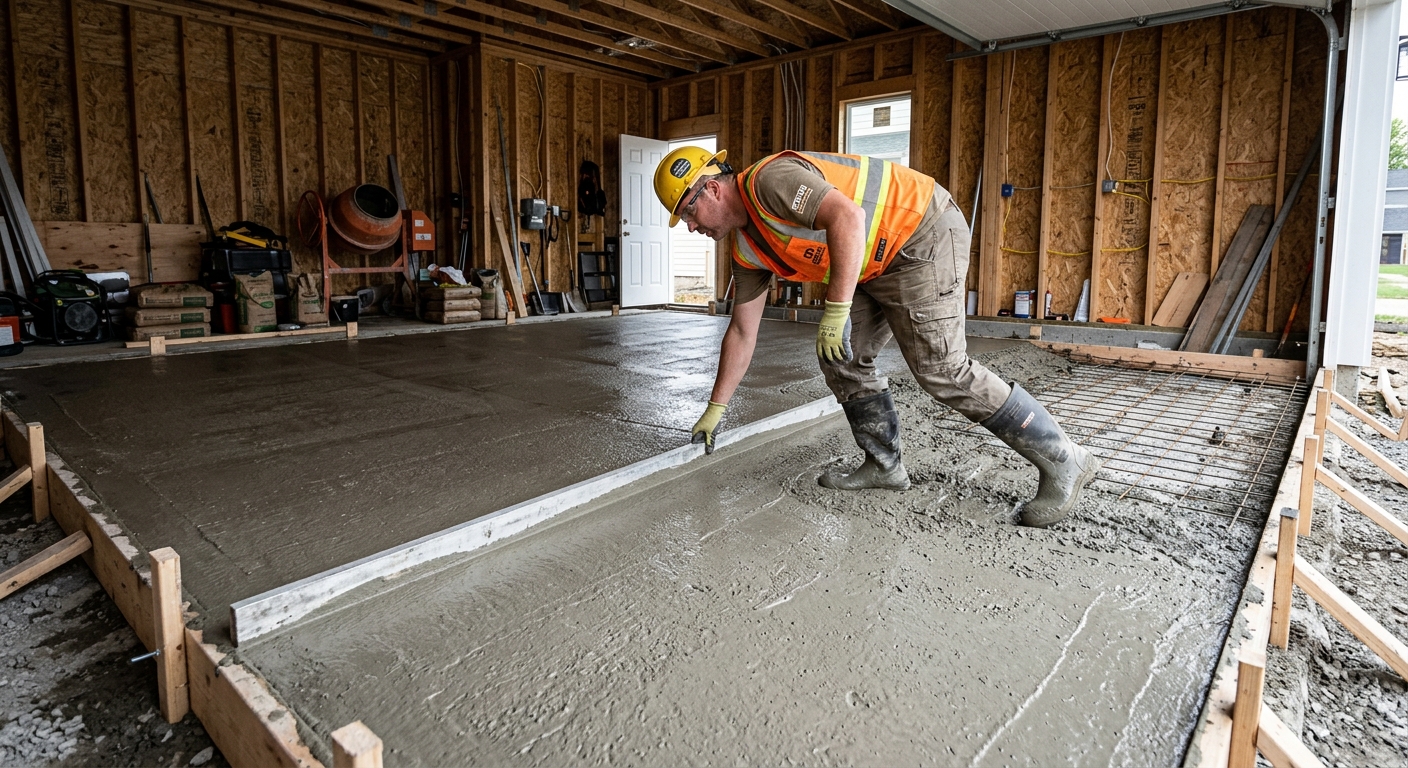
Concrete work options and costs in Belle Rive
Belle Rive, Alberta has a steady demand for durable concrete because homeowners expect driveways, patios, walkways and foundations to hold up through Calgary-area winters. With a 2021 population of 3,958 (Statistics Canada, 2021 Census), the market is smaller than Calgary, so concrete trades often schedule work around neighbourhood clusters—meaning start dates can affect total cost. In this part of the Calgary economic region, most single-detached housing and backyards need practical flatwork like driveway replacement, backyard pads, and entry walkways that can tolerate freeze–thaw cycles.
Concrete pricing in Belle Rive is shaped more by engineering and logistics than by “concrete itself.” In cold continental conditions, the design frost depth is typically about 1.2 m (roughly 4 ft), so exterior footings and many structural elements must be excavated and formed to bear on undisturbed soil below that level. Add frequent freeze–thaw events, and you also get higher costs for granular base prep, air-entrained mixes, and better control joint layouts to reduce random cracking. The pour season is shorter, so winter-grade placement (insulation blankets and/or temporary heat) may be required to protect the curing window.
In Belle Rive, trades are especially busy on the residential edges where lot grading is more variable—when access and excavation are harder, foundation and slab quotes trend higher. If you’re comparing options, the best place to start is understanding where your scope lands within the typical price bands for this tier, then refining specs for your soil, access, and finish.
| Application |
Typical Size |
Key Spec |
Finish Option |
Price Range |
| Concrete driveway (standard broom finish) |
480 sq. ft. (24' x 20') |
Air-entrained exterior mix, rebar where required |
Broom-finish, expansion/control joints |
$12,000–$18,000 |
| Exposed aggregate driveway |
480 sq. ft. (24' x 20') |
Air-entrained mix, surface control for wash/exposure |
Exposed aggregate with sealer |
$14,500–$22,000 |
| Stamped concrete driveway or patio |
320 sq. ft. (20' x 16') |
Air-entrained mix, colour hardeners |
Stamped pattern, release agent, sealing |
$15,000–$26,000 |
| Plain concrete patio or walkway |
240 sq. ft. (12' x 20') |
Air-entrained exterior mix, proper slope |
Float/trowel then broom or lightly textured |
$5,000–$9,000 |
| Garage floor (interior slab) |
480 sq. ft. (24' x 20') |
Vapour barrier, reinforcement, minimum fibre where spec’d |
Medium broom texture |
$10,000–$16,000 |
| Foundation footings (structural, below frost) |
Single-detached typical |
Excavation, forms, rebar, pour below design frost depth |
Structural concrete only (covered by foundation system) |
$28,000–$45,000 |
Prices are estimates only and vary by project scope, site access and material selection.
What affects the price of concrete work in Belle Rive
In Belle Rive and across the Calgary region, it’s common to see quotes for the “same” concrete job swing by 30–50%. That happens because the visible concrete surface is only part of the total scope—most of the real cost is excavation, granular base depth, reinforcement decisions, and how the contractor plans for curing in winter conditions. Two bids can quote the same driveway width, but one may include proper air-entrained mix specs and a thicker engineered base for local soil, while the other may assume a simpler prep plan.
In a design environment with a frost depth around 1.2 m (roughly 4 ft), footings and many support elements must be founded below frost to reduce heave and seasonal movement. Calgary-area freeze–thaw cycles also push contractors toward air-entrained concrete and a careful joint layout. When exterior pours land near shoulder seasons, cold-weather curing precautions (insulated blankets and sometimes heat) can be required to protect the curing window; that’s a direct cost driver compared with a summer pour. On top of that, de-icing salt in Alberta can accelerate spalling if the surface isn’t sealed and the mix isn’t properly air-entrained.
Here are a few local examples where cost can rise or fall in Belle Rive: (1) a driveway replacement on a constrained lot often costs more due to tighter truck access and more labour for forms and finishing; (2) if your existing base is failing or contaminated, base rebuild can push the project toward the higher end of the concrete driveway band of $12,000–$18,000; (3) choosing stamped work typically lifts finish costs into $15,000–$26,000 territory because of colour hardeners, stamping mats, and labour time. Home age also matters—older yards sometimes settle unevenly, which increases grading and can add excavation depth and re-compact labour.
| Price Factor |
Why It Matters |
Cost Impact |
| Frost line depth |
Determines footing depth and form height |
Higher excavation and concrete volume; can shift foundation pricing significantly |
| Site preparation |
Excavation, grading, compacted granular base |
Unstable or frozen ground increases labour and material (granular) costs |
| Reinforcement |
Rebar or wire mesh requirement |
Material + placement labour; critical for garage floors and exterior slabs |
| Mix design |
Air-entrainment and compressive strength spec |
Air-entrained exterior mixes and winter-grade concrete raise per-m³ costs |
| Finish type |
Broom vs. stamped vs. exposed aggregate |
Stamped/exposed adds labour, colour materials, and sealing steps |
| Pour size and concrete truck access to site |
How fast and efficiently concrete can be placed |
Hard access may require smaller loads, more workers, and longer placement time |
| Cold-weather curing precautions |
Heating and blankets to protect early strength gain |
Can add equipment and labour; often needed during late fall/early spring |
| Control joint pattern and sealing cost |
Limits cracking; protects against de-icing salt damage |
More joints/sealer means additional labour and material, but fewer failures |
Permits & regulations in Alberta
In Alberta, many structural concrete elements require a building permit. That typically includes foundation work such as footings, foundation walls, and grade beams, because these components affect structural integrity and must be reviewed against drawings and local requirements. In many cases, engineered drawings are required or reviewed as part of the permit process. For concrete flatwork like patios, walkways, driveways and garage slabs, a permit usually is not required unless the work affects lot grading/drainage, impervious surface coverage limits, or intersects with municipal right-of-way requirements.
For Belle Rive homeowners, the safest approach is to treat anything tied to the foundation system as permit-worthy and to verify any work that changes how water drains away from the house. Before breaking ground, also confirm the contractor carries liability insurance and workers’ compensation coverage (WSIB/WCB) so you’re protected if an accident occurs on-site.
Step-by-step verification (what I ask homeowners to check): (1) Request the contractor’s proof of Alberta business licensing/registration where applicable and confirm they are in good standing using the online registry records they provide; (2) Ask for a current certificate of insurance—verify it includes general liability and that the coverage date is current; (3) Request proof of WSIB/WCB clearance (or equivalent coverage documentation) and keep it on file; (4) Ask for references on similar-scale projects in the Calgary area, especially cold-season placements. If a contractor can’t provide documentation promptly, that’s a red flag.
Getting concrete right in Belle Rive's freeze-thaw climate
Concrete failures in Belle Rive usually come from a predictable set of issues: water intrusion, weak early curing, inadequate air-entrainment, and poor base support. In cold continental conditions with freeze–thaw cycles, water expands when it freezes, which can lead to scaling and spalling. That’s why “it looks fine today” isn’t the standard—exterior concrete has to be engineered so it survives repeated temperature swings.
To spec the job correctly, focus on five areas. First, base preparation: use a compacted granular sub-base to the depth required by your design and local frost considerations, so the slab doesn’t settle. Second, mix design: specify air-entrainment for exterior flatwork—commonly 5–7% air content—and a minimum 32 MPa compressive strength to achieve proper durability. Third, control joints: place joints early enough in the curing/finishing sequence and space them to reduce random cracking paths. Fourth, curing: protect the concrete for at least 7 days under proper conditions; in late fall or early spring, this may mean insulated blankets or temporary heat to avoid surface damage and premature freeze. Fifth, sealing: apply a penetrating sealer about 28 days after pour to help repel de-icing salts and reduce surface breakdown.
If you’re choosing between options, the price difference can make sense. For example, moving from a broom-finish driveway to stamped concrete often costs extra because of colour materials and labour time—those projects typically fall around $15,000–$26,000. But if the base prep and mix specs are right, broom-finish can be the better value. Cutting corners on air-entrainment is where “cheap” turns into expensive repairs months later.
| Spec |
Why It Matters in Belle Rive |
What to Ask For |
Impact if Skipped |
| Compacted granular base (depth?) |
Prevents settlement and reduces freeze-related movement under the slab |
Granular type and minimum compacted thickness; confirm target bearing below frost-sensitive zones |
Cracking, uneven surface, faster deterioration in Belle Rive winters |
| Air-entrained concrete mix (target air %?) |
Helps resist freeze–thaw damage and reduces spalling |
Specify air content, commonly 5–7% for exterior flatwork |
Surface scaling and spalling after first harsh cold cycles |
| Compressive strength (MPa rating) |
Ensures adequate durability and structural performance |
Minimum 32 MPa; confirm mix design sheet if requested |
Reduced strength gain, increased cracking and long-term wear |
| Control joints (spacing per ACI guidelines) |
Controls where shrinkage cracks occur |
Joint spacing and timing plan; confirm sealed or unsealed plan |
Random cracking patterns and higher water infiltration |
| Minimum 7-day curing period |
Strength development is critical before cold exposure |
How curing is protected during cold weather (blankets/heating) |
Weak surface, scaling risk and premature failure |
| Penetrating sealer (when applied after cure) |
Repels de-icing salts used across Alberta |
Confirm sealer type and application around 28 days post-pour |
Accelerated surface deterioration and patchy spalling |
How to choose a concrete work contractor in Belle Rive
Choosing the right concrete contractor in Belle Rive starts with proof. In Alberta, verify licensing/registration documentation where applicable, but more importantly verify insurance and workers’ compensation. Ask for: (1) a current certificate of insurance (general liability at minimum), (2) proof of WSIB/WCB coverage or clearance documentation for the crew, and (3) evidence they’ve completed similar cold-climate pours in the Calgary area. Don’t accept “it’s covered” without paperwork—make them provide documents before the estimate is finalized.
Next, get 2–3 itemised written quotes. I recommend you ask for a labour/material breakdown rather than a single lump sum. Clarify whether excavation, granular base, reinforcement, vapour barrier (for garage slabs), disposal, and any required winter curing supplies are included. Also ask if a permit pull is included for any structural components; for flatwork, confirm what’s excluded and whether grading/drainage is addressed.
On warranty, request the workmanship warranty length in writing and ask whether product warranties from the concrete supplier or sealer manufacturer are included. For payment, plan for a maximum 10–15% upfront deposit, then hold back until the job is complete (including final cleanup and sealing where specified). Finally, insist on a written timeline—start date, pour window, and completion estimate—because cold-weather work depends on protecting the curing process.
- Provide an itemised quote (excavation, granular base, reinforcement, concrete supply, finishing, sealing).
- Confirm concrete mix details: air-entrainment and minimum compressive strength.
- Ask for a joint plan: spacing and whether joints will be cut/saw-timed.
- Require a cold-weather curing plan if the pour is scheduled near freezing.
- Verify truck access and staging plan for your address/lot constraints.
- Confirm disposal/hauling of excavated material is included.
- Ask about base rebuild if existing base is removed—what’s the trigger and how is it priced?
- Check warranty: workmanship term and what actions are covered (and for how long).
- Confirm sealer type and when it will be applied (typically around 28 days post-pour).
- Review payment schedule: limit upfront to 10–15% and use a holdback.
- Request project references in the Calgary region, not just decorative brochure photos.
- Get everything in writing: scope, exclusions, schedule, and specs—no handshakes only.
Concrete red flags I commonly see in Belle Rive include: skipping documentation for WSIB/WCB or insurance, refusing to state mix specs (especially air-entrainment), quoting only a surface price without granular base or reinforcement details, not explaining cold-weather curing safeguards, and promising “cure and done” timelines that ignore the required curing window.
Frequently asked questions — concrete work in Belle Rive
How much does concrete work cost in Belle Rive?
In Belle Rive, concrete pricing usually tracks the Calgary-area cost bands because the scope is heavily driven by excavation depth, frost considerations, and winter curing needs. For typical homeowners, a standard concrete driveway commonly lands around $12,000–$18,000, assuming a typical size and appropriate base prep and exterior mix specs. A plain patio or walkway often comes in around $5,000–$9,000 depending on thickness, access, and how much grading is needed. If you choose decorative finishes, stamped concrete usually increases labour and materials and typically falls in the $15,000–$26,000 range.
How deep must footings be for Belle Rive's frost line?
For the Calgary region that includes Belle Rive, local engineering practice is based on a design frost depth of about 1.2 m (roughly 4 ft). That means structural footings and foundation elements generally need to be founded below that depth into undisturbed soil to reduce frost heave and seasonal movement. Your final footing depth can vary with your soil conditions, drainage, and the specifics of your engineered foundation design, but “shallow” footings are where problems start in Alberta. If you’re comparing quotes, don’t just look at price—ask what the contractor is assuming for excavation depth and bearing conditions, and whether they’ll confirm frost-safe bearing before the pour.
Why does concrete crack in Belle Rive and how is it prevented?
Concrete cracks in Belle Rive mainly due to shrinkage, temperature movement, and restrained settlement—then freeze–thaw cycles can turn fine cracks into pathways for water, which accelerates surface damage. Prevention is mostly about planning: proper compacted granular base support, correct air-entrained exterior mix, and a control joint pattern that intentionally channels cracking to the joints rather than randomly through the slab. Timing matters too—joint cutting needs to happen when the concrete can support it without ravelling. Finally, sealing after cure helps repel de-icing salts, which reduces spalling risk. A well-specified driveway or patio can still crack slightly, but the goal is to control crack location and keep water out.
Stamped vs broom-finish concrete — cost difference?
Stamped concrete costs more than broom-finish because it’s a labour-heavy system: colour hardeners, release agents, stamping, and more careful finishing to achieve clean edges in Alberta’s variable weather. For Belle Rive homeowners, broom-finish driveways typically sit in the $12,000–$18,000 band, while stamped concrete driveways or patios typically trend toward the $15,000–$26,000 range. The “why” is straightforward: more steps, more materials, and tighter timing so the stamped surface sets correctly. If your priority is durability and value, broom-finish with proper air-entrainment, base prep, and sealing often performs exceptionally well in freeze–thaw cycles.
When is the best time to pour concrete in Belle Rive?
The best time is when temperatures support curing—typically late spring through summer when you can achieve steady strength gain without added heating or blanket systems. In Belle Rive and the Calgary region, exterior pours are vulnerable if they’re placed in late fall or early spring because freezes can damage the near-surface and compromise curing. If a pour must happen during colder periods, reputable contractors will discuss cold-weather curing precautions such as insulated blankets and/or temporary heating to protect the slab during early strength development. When you ask for quotes, confirm the expected pour date, the protection plan, and what happens if temperatures drop unexpectedly.
How long does concrete take to cure?
Concrete curing isn’t one single number. For most exterior slabs in Belle Rive, contractors plan a minimum 7-day curing period for proper early strength development, and they protect the surface accordingly during cold or windy conditions. However, for sealing and durability, many homeowners should think in terms of “ready for sealer” around 28 days after the pour, assuming normal curing conditions. This matters because de-icing salts used in Alberta can damage surfaces more quickly if the concrete hasn’t matured. If a contractor promises sealing “right away,” ask what cure conditions they used and whether the concrete has reached the appropriate maturity for that product.