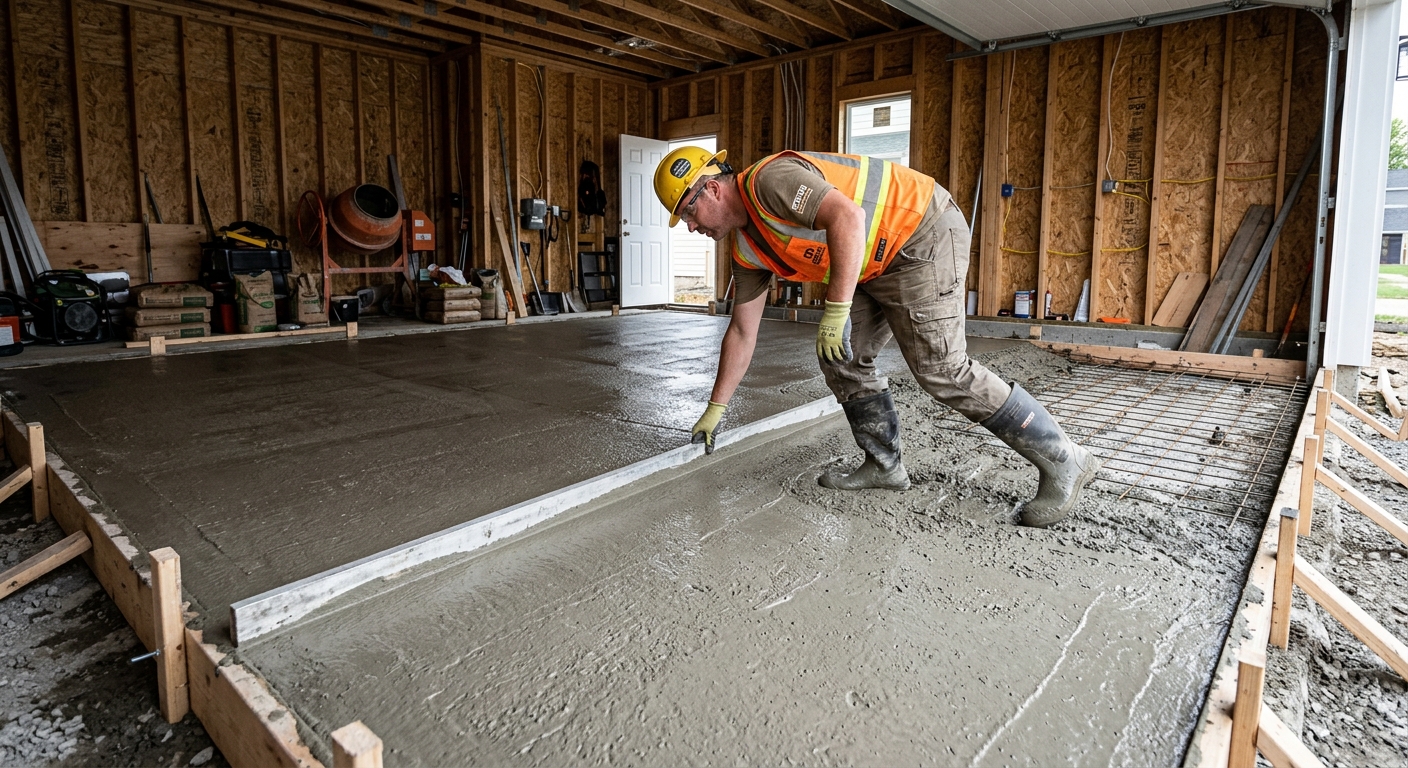
Concrete work options and costs in Provost
In Provost, Alberta, most homeowners who budget for concrete are planning for driveways, patios and walkways—flatwork that fits the town’s housing mix, where single-detached homes make up about 79.6% of dwellings. With roughly 605 homeowner households (79.6% of households own) in the 2021 Census, there’s steady year-round demand, especially around practical outdoor updates like front entries and garage approaches. Another local reality is the age of the housing stock: about 59.9% of homes were built before 1981, so many projects start as “repairs” (edge spalls, uneven slabs, foundation moisture concerns) that quickly turn into larger prep work.
Concrete pricing in the Camrose–Drumheller region is shaped by a cold continental climate with frequent freeze–thaw cycles and a frost depth that contractors must respect. Even when the slab itself looks simple, exterior footings and foundations generally need to be placed below the design frost depth, which drives deeper excavation, more forming and more concrete than in milder areas. Exterior flatwork also uses air-entrained mixes to resist scaling and spalling, and crews plan control joints and curing protection for the short pour season (late spring to early fall). That same weather pressure is why you may see availability tight and unit costs a bit higher during warm windows, and why winter work typically costs more due to heating and insulated blankets.
In Provost, these trades are especially in demand in areas like the residential blocks near main streets where drive access and grading are often constrained. Below is a practical comparison of common concrete options so you can align expectations before you request quotes.
| Application |
Typical Size |
Key Spec |
Finish Option |
Price Range |
| Concrete driveway (standard broom finish) |
24 ft x 10 ft (240 sq. ft.) |
Air-entrained exterior mix; proper base + compacted granular |
Broom finish with control joints |
$14,000–$22,000 |
| Exposed aggregate driveway |
24 ft x 10 ft (240 sq. ft.) |
Air-entrained mix; careful surface retarder/removal and curing |
Exposed aggregate look |
$18,000–$28,000 |
| Stamped concrete driveway or patio |
16 ft x 12 ft (192 sq. ft.) |
Air-entrained mix; integral colour and release/curing plan |
Stamped pattern + sealer |
$18,000–$35,000 |
| Plain concrete patio or walkway |
12 ft x 10 ft (120 sq. ft.) |
Exterior slab prep; drainage and proper thickness |
Broom finish or smooth trowel (safety texture on walkways) |
$12,000–$20,000 |
| Garage floor (interior slab) |
20 ft x 22 ft (440 sq. ft.) |
Vapour control as needed; reinforcement based on use |
Float-finished and jointed |
$8,000–$14,000 |
| Foundation footings (structural, below frost) |
Typical: new build or major underpinning |
Below design frost; reinforced concrete and forming |
Structural concrete placement |
$180,000–$260,000 |
Prices are estimates only and vary by project scope, site access and material selection.
What affects the price of concrete work in Provost
In Provost and across the Camrose–Drumheller economic region, quotes for the same “driveway replacement” can vary by about 30–50% once you account for what’s happening under the surface. The finished concrete is only one line item—contractors are also pricing excavation, base preparation, drainage, reinforcement, concrete mix design and safe curing in our cold continental winters. Because the town’s housing base includes many older homes (about 59.9% built before 1981), additional demolition and soil corrections are common, and that can change the scope quickly.
The big driver is frost and freeze–thaw. Footings and structural foundation elements must be placed below the design frost depth to prevent frost heave, which means more excavation and taller forming in Alberta compared with milder markets. Exterior flatwork also needs air-entrained concrete mixes to survive repeated freeze–thaw cycles; without the right air content, you can get scaling and spalling, and then you’re paying again for repairs. The short pour season (roughly late spring to early fall) also tightens scheduling and can add cost—winter work typically requires heating, insulated blankets and slower, more controlled finishing to reach safe strength gain. Finally, de-icing salt is a reality here, so sealing and surface protection matter for longevity.
Concrete prices in this region often align with the flatwork price bands—driveways commonly land around the $14,000–$22,000 range for standard broom-finished work, while stamped or decorative can move into the $20,000–$35,000 band due to integral colour, stamping labour and additional finishing steps. In Provost, older subgrades can also raise costs: poor drainage or weak topsoil means contractors may have to remove more material and rebuild a thicker, compacted granular base. On the other hand, a straightforward re-pour with good existing drainage can keep pricing closer to the lower end.
| Price Factor |
Why It Matters |
Cost Impact |
| Frost line depth — determines footing depth and form height |
Controls how deep structural concrete must go to avoid frost heave |
Can add substantial excavation + forming time; higher depth increases concrete volume |
| Site preparation — excavation, grading, compacted granular base |
Proper base prevents settlement and keeps water from trapping under slabs |
Often the largest variable; poor soil or drainage increases removal and granular import |
| Reinforcement — rebar or wire mesh requirement |
Improves crack control and load capacity, especially for driveways |
Adds material + placement labour; mesh/rebar details vary by thickness and use |
| Mix design — air-entrainment and compressive strength spec |
Air content helps resist freeze–thaw damage; strength supports durability |
More stringent specs can raise per-m3 costs and affect finishing workflow |
| Finish type — broom vs. stamped vs. exposed aggregate |
Finish method changes labour time, tooling, and sealing requirements |
Decorative work adds cost; plain broom-finish is usually fastest |
| Pour size and concrete truck access to site |
Access affects how far crews must wheel/move concrete and how many loads are needed |
Tight access, long carries or multiple pours increase labour and equipment time |
| Cold-weather curing precautions — heating and blankets |
Low temperatures slow strength gain and increase surface damage risk |
Heating fuel/equipment and longer protection periods raise costs |
| Control joint pattern and sealing cost |
Joints manage cracking; sealing helps protect against de-icing salt scaling |
Added layout work and sealer material/labour, but reduces early deterioration |
Permits & regulations in Alberta
In Alberta, structural concrete work—think footings, foundation walls, and grade beams—typically requires a building permit, and many projects also involve engineered drawings that the municipality reviews as part of the permit process. For concrete flatwork such as patios, walkways and driveways, permits are often not required if the work stays within normal grading and doesn’t create drainage or site-coverage issues. However, you should confirm locally because permits can become relevant if the project changes lot grading, affects stormwater flow, or touches municipal right-of-way requirements.
For the homeowner in Provost, a good verification process starts before the first shovel hits the ground. Step one: ask the contractor for their proof of liability insurance and WSIB/WCB coverage for their workers. Step two: verify their Alberta licensing/registration status using the appropriate provincial online resources for contractors (your contractor should be able to provide their business details that match the registry entry). Step three: request a certificate of insurance and confirm it covers the type of work being done (excavation, concrete placement, and any associated sitework). Step four: ask for references from similar-scale projects in the region—especially exterior slabs where freeze–thaw durability matters.
If you’re planning anything that borders on structural changes (underpinning, foundation repairs that go below grade, or grade-beam work), ask the contractor to confirm the permit plan and who is pulling it. Getting that clarified early is one of the fastest ways to avoid delays and surprise costs.
Getting concrete right in Provost's freeze-thaw climate
Concrete failures in Provost are usually not “mystery cracking”—they’re the predictable results of water, weak base preparation, and insufficient freeze–thaw protection. The freeze–thaw cycle expands and contracts moisture in soil and at the slab interface, so you need base preparation done to the right depth and compaction, along with a drainage plan that prevents trapped water. If the base is too thin or poorly compacted, the slab can settle and create voids where water collects—then scaling and spalling follow.
To spec the job correctly for Alberta’s climate and the Camrose–Drumheller market approach, focus on five things. (1) Base: a compacted granular sub-base to the designed thickness for your soil and expected frost conditions. (2) Mix: air-entrained concrete for exterior work, typically targeting about 5–7% air content, plus a minimum 32 MPa compressive strength specification for durability. (3) Control joints: install them on a layout that limits random cracking and keeps shrinkage cracking in predictable lines. (4) Curing: plan for at least 7 days of curing under proper conditions; in colder periods, protection with insulated blankets or controlled warming is often required to achieve strength gain. (5) Sealing: apply a penetrating sealer after the cure period (commonly around 28 days post-pour) to repel de-icing salts and reduce surface deterioration.
Ask direct questions that target the most common failure: spalling from inadequate air-entrainment. For cost perspective, a standard broom-finish driveway can often land around the $14,000–$22,000 band, while decorative stamped options can move up toward $20,000–$35,000. The right move is to ensure the “hidden” spec items (base, air-entrainment, curing) are correct first—then decide how much you want to spend on appearance.
| Spec |
Why It Matters in Provost |
What to Ask For |
Impact if Skipped |
| Compacted granular base (depth?) |
Prevents settlement and limits water trapping during freeze–thaw |
Granular depth and compaction method specified for your soil conditions |
Uneven slab, voids under concrete, accelerated cracking and edge failure |
| Air-entrained concrete mix (target air %?) |
Reduces scaling and spalling as freezing and thawing repeatedly stress the surface |
Target air content (typically 5–7%) and exterior exposure mix confirmed |
Surface spalling, flaking, and early repairs—often within a few winters |
| Compressive strength (MPa rating) |
Supports long-term durability and safer strength gain in cold conditions |
Minimum 32 MPa specified for exterior slab work |
Lower durability and higher risk of surface damage if curing is affected |
| Control joints (spacing per ACI guidelines) |
Controls where cracks form during temperature swings and shrinkage |
Joint layout, spacing, and whether saw-cut timing is included |
Random cracking across decorative or load-bearing surfaces |
| Minimum 7-day curing period |
Cold temps slow strength gain; proper curing improves resistance to scaling |
How curing will be protected in cool weather (blankets/heating if needed) |
Weaker surface, increased cracking and reduced freeze–thaw performance |
| Penetrating sealer (when applied after cure) |
Repels de-icing salt and reduces moisture ingress into the concrete face |
Sealer type and timing (commonly after cure, around 28 days post-pour) |
Faster surface deterioration, staining, and higher maintenance costs |
How to choose a concrete work contractor in Provost
Choosing the right contractor in Provost is mostly about verification and clarity. First, confirm Alberta licensing/registration status for the business and request proof of liability insurance—then ask for WSIB/WCB coverage documents for their workers. How to check: (1) match the company name and address on the quote to the registry entry, (2) review the certificate of insurance for coverage limits and work type, and (3) look for a clearance letter or current account status documentation for WSIB/WCB. If they can’t provide it quickly, that’s a major concern.
Next, request 2–3 itemised written quotes rather than one lump-sum number. A solid quote should break out labour and materials (excavation, granular base, reinforcement, concrete mix, finishing, joints, sealing, and disposal). Watch the exclusions: is removal of old concrete included, is hauling/dump fees included, and does the quote include any required permit work if your scope affects lot grading or drainage? For warranties, ask for the workmanship warranty length in writing, plus whether product/manufacturer warranties apply to sealers or specialty mixes—and whether the warranty is transferable.
Finally, confirm payment terms. In our market, you shouldn’t pay more than about 10–15% upfront; the remainder should be tied to milestones, with a holdback until clean-up, final grades, and finishing details are completed. Get a written start date and an estimated completion window, especially because the pour season can be tight when weather flips quickly.
- Proof of liability insurance and WSIB/WCB coverage provided before scheduling
- Itemised quote (labour + materials) including excavation and granular base
- Clear thickness and base spec for exterior flatwork
- Exterior mix confirmed: air-entrained and suitable for freeze–thaw exposure
- Control joint layout and whether saw-cutting is included
- Curing plan in writing (how they handle cool nights and strength gain)
- Sealer included or clearly excluded, with timing requirements
- Disposal/hauling fees stated (old concrete removal can change the budget)
- Traffic control and site protection plan for driveways during curing
- Schedule locked to weather tolerances (no “finish today, fix later” promises)
- Warranty terms for workmanship and any specialty products/finishes
- Payment schedule tied to completion milestones with a holdback
Concrete red flags in Provost include: vague quotes with no base thickness or mix details, contractors who skip air-entrainment for “standard concrete,” unclear joint and curing plans, offers to pour near-freezing without heating/blankets, and payment requests that exceed 10–15% upfront or don’t include a completion holdback.
Frequently asked questions — concrete work in Provost
How deep must footings be for Provost's frost line?
For Provost and the Camrose–Drumheller area, footings must be placed below the local design frost depth to reduce the risk of frost heave. In practical terms, crews typically plan for a frost depth around the 1.2 m / 4 ft class of range discussed for central Alberta-style frost conditions, but the exact depth depends on the engineered requirements for your specific soil and foundation design. If your project involves a new foundation, underpinning, or structural repairs, the contractor should follow the engineered footing elevations and include that in the scope. Given many Provost homes are older (59.9% built before 1981), soil conditions and drainage may have changed over time, so ask whether they’re confirming subgrade conditions before setting footing grades.
Why does concrete crack in Provost and how is it prevented?
Concrete cracking in Provost is usually driven by temperature swings, drying shrinkage, and moisture movement during freeze–thaw cycles—not by “bad luck.” The prevention strategy is to control where the concrete cracks (control joints) and ensure the slab isn’t moving on weak or wet subgrade. A properly prepared, compacted granular base helps reduce settlement and keeps water from collecting under the slab. For exterior work, air-entrained concrete is also essential for freeze–thaw durability; it doesn’t prevent cracking entirely, but it helps prevent surface damage like spalling that can make cracks worse. In quoting for your driveway or walkway, ask for the joint spacing plan and the curing approach—those details are commonly where contractors differ most.
Stamped vs broom-finish concrete — cost difference?
Stamped concrete costs more than broom-finished concrete because decorative work adds labour and materials: integral colour or hardeners, moulding/stamping steps, extra finishing time, and typically a sealer schedule to protect the surface. In Provost’s market, a standard broom-finish driveway commonly falls in the $14,000–$22,000 range, while stamped driveway or patio projects often land closer to the $20,000–$35,000 band depending on area size and access. The key is that the decorative appearance should not come at the expense of the structural basics—air-entrainment, correct base prep, and curing protection are still required for exterior freeze–thaw performance.
When is the best time to pour concrete in Provost?
The best time to pour in Provost is during the safer late spring to early fall window when daytime temperatures and curing conditions support strength gain without excessive heating. Alberta’s cold nights and freeze–thaw cycles mean crews must protect the pour if temperatures are dropping—often using insulated blankets and heating measures when needed. If you’re planning ahead, aim for days when the forecast supports finishing and curing, and discuss the contractor’s cold-weather curing plan before you sign. Also remember that many local projects involve older homes and sometimes more prep or drainage work, which can shift the schedule. For homeowners, the goal is to avoid “rush finishing” near freezing, because curing delays can affect long-term durability.
How long does concrete take to cure?
Concrete needs time to develop strength, and in Alberta’s climate that curing period matters. A common baseline is at least 7 days of proper curing conditions for many exterior slabs, but the real durability comes from sustained protection while temperatures stay within the contractor’s control plan. Even if it’s walkable sooner, the surface still benefits from staying protected to reduce scaling risk. For protective treatments, if you’re using a penetrating sealer, many programs apply it after the cure period—often around 28 days post-pour—so the concrete has sufficiently dried and matured to accept the treatment. When you request a quote in Provost, ask how long they’ll maintain curing protection and what they do if weather turns cool during the first week.
Do I need a permit for concrete work in Alberta?
In Alberta, structural concrete work such as footings, foundation walls, and grade beams generally requires a building permit, often supported by engineered drawings reviewed through the municipal process. Concrete flatwork—patios, walkways and many driveways—usually does not require a permit by default, but permits can become relevant if the work changes lot grading, affects stormwater drainage, or impacts municipal right-of-way conditions. Because each site is different, confirm with the local authority before work begins, especially if your concrete project involves raising elevations, reworking downspout drainage, or modifying how water leaves your property. Also verify your contractor’s liability insurance and WSIB/WCB coverage; those requirements protect you during excavation and placement.