Concrete work options and costs in Pincher Creek
Pincher Creek homeowners typically choose concrete because it holds up well against southern Alberta freeze–thaw cycles—when it’s built to the right specs. With single-detached houses making up 81.9% of dwellings in the area (Statistics Canada, 2021 Census), demand is strongest for exterior flatwork like driveways, patios and walkways, especially around long-established neighbourhoods where properties have mature landscaping and established traffic patterns. In Pincher Creek specifically, homeowners often need to replace older slabs as homes built before 1981 age out, which is a common driver for resurfacing, widening, and full replacements.
In the Lethbridge–Medicine Hat economic region, pricing is shaped by a deep frost line and frequent freeze–thaw. For structural work, footings must be set below frost—often in the 5–6 ft range—so excavation and forming tend to be a bigger part of the budget than in milder climates. Exterior slabs also need air-entrained mixes to manage expansion pressure as moisture freezes. The region’s shorter exterior pour season means projects are clustered into warmer windows, and cold-weather protection (blankets, heaters, sometimes accelerators) can add to labour and material costs.
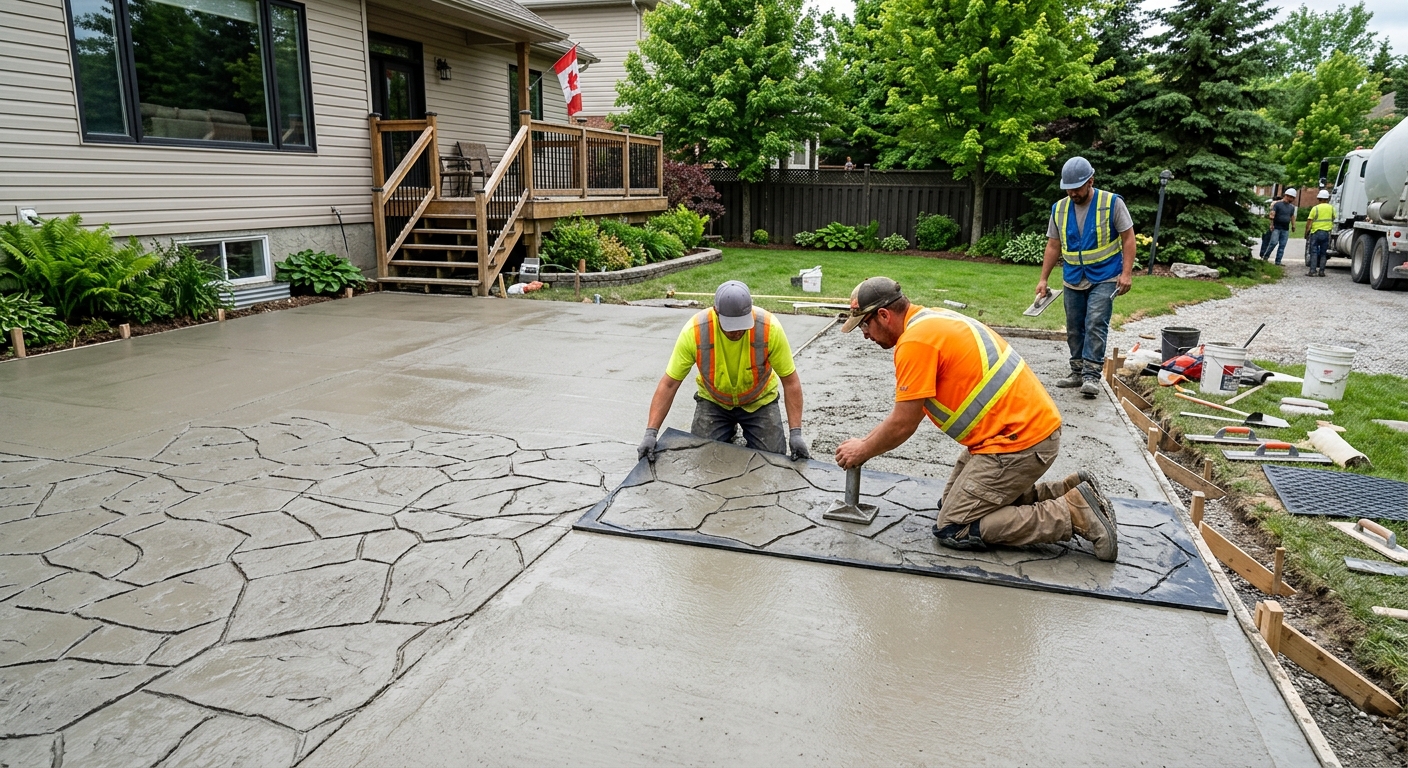
Because of this, you’ll see real cost differences between finishes: standard broom concrete is usually the most budget-friendly, while stamped concrete or exposed aggregate involves extra labour, tooling, and sometimes specialized finishing crews. The same holds true for garage floors versus exterior slabs—garage work can be simpler because drainage and de-icing exposure are usually less intense.
Below is a practical comparison to help you budget before you request an itemized quote.
| Application |
Typical Size |
Key Spec |
Finish Option |
Price Range |
| Concrete driveway (standard broom finish) |
24' x 12' (288 sq. ft.) |
Air-entrained mix for exterior; compacted granular base |
Broom finish + control joints |
$3,800 – $6,300 |
| Exposed aggregate driveway |
24' x 12' (288 sq. ft.) |
Air-entrained mix; proper curing for consistent exposure |
Exposed aggregate finish |
$5,300 – $8,400 |
| Stamped concrete driveway or patio |
16' x 16' (256 sq. ft.) |
Air-entrained mix; reinforced where required |
Stamp mats + color hardener/release |
$6,000 – $9,700 |
| Plain concrete patio or walkway |
12' x 16' (192 sq. ft.) |
Air-entrained mix for exterior; broom or light trowel |
Plain finish + control joints |
$2,300 – $3,900 |
| Garage floor (interior slab) |
22' x 24' (528 sq. ft.) |
Vapour barrier (as specified) + proper base compaction |
Float + broom (or light trowel) |
$4,200 – $7,400 |
| Foundation footings (structural, below frost) |
Typical home footing system |
Engineered design; excavation to frost; reinforced concrete |
Structural concrete only |
$9,500 – $21,000 |
Prices are estimates only and vary by project scope, site access and material selection.
What affects the price of concrete work in Pincher Creek
In the Lethbridge–Medicine Hat region, the same “concrete driveway” can be priced 30–50% differently between contractors and project sites. The main reason isn’t just concrete—it’s what you need to do below and around the slab to make it last. In Pincher Creek’s climate, quotes hinge on frost-line depth, freeze–thaw cycles, drainage requirements, and how much cold-weather protection is needed to reach proper curing.
First, footings must extend below the design frost depth to prevent frost heave. Southern Alberta typically means deeper excavation than many milder provinces, which drives up formwork height, labour time, and disposal of excess soil for structural pours. Second, exterior slabs need air-entrained concrete mixes to handle freeze–thaw pressure. Third, the shorter pour season can concentrate work into warmer weeks; if you’re scheduling near shoulder season, contractors may include heaters, insulating blankets, or admixtures to protect curing time. Even though the region can be relatively dry, curing still matters—low temperatures slow strength gain, which affects when you can safely backfill or load the slab.
De-icing salt is another cost multiplier. It can accelerate surface spalling if the mix and finishing aren’t specified for exterior exposure, so sealing is often recommended to reduce salt intrusion. That’s why a plain broom-finish driveway may land near the $14–$22 per sq. ft. local band, while decorative work like stamped concrete often climbs toward the higher end (for many projects, aligning with $20–$32 per sq. ft. for decorative finishes) because labour, materials, and timing are greater.
Cost also shifts with project details: older neighbourhoods and established lots can mean more excavation around mature trees, sidewalks, or utility locations; limited truck access can add equipment time. Homes built before 1981 may also need regrading or base repair rather than “pour over,” and that can move a driveway from a straightforward replacement into a full rebuild budget.
| Price Factor |
Why It Matters |
Cost Impact |
| Frost line depth |
Determines excavation depth and form height for structural stability |
High—deep digs and extra reinforcement increase labour and equipment |
| Site preparation |
Grading and compacted granular base prevents settlement and frost movement |
Medium to high—more haul, more compaction lifts, and more base material |
| Reinforcement |
Rebar or wire mesh helps control cracking where design requires it |
Medium—materials plus tie-in labour and spacing accuracy |
| Mix design |
Air-entrainment and strength spec are critical for freeze–thaw durability |
Medium—higher-performance mix and stricter placement requirements |
| Finish type |
Broom vs. exposed aggregate vs. stamped affects tools, crew time, and curing |
Medium to high—decorative finishing is more labour intensive |
| Pour size and concrete truck access to site |
Smaller sites or tight access can mean more trips and more labour handling |
Medium—can add equipment time and rework effort |
| Cold-weather curing precautions |
Blankets/heaters help concrete reach strength before exposure to freezes |
Medium—often seasonal add-on cost in Alberta |
| Control joint pattern and sealing cost |
Joints manage cracking; sealing helps reduce salt/chemical surface damage |
Low to medium—small line items that prevent expensive failures |
Permits & regulations in Alberta
In Alberta, concrete work is typically split into two buckets: structural concrete (which usually needs a permit) and flatwork (which often does not). For Pincher Creek homeowners, the practical takeaway is to ask your contractor what will be permitted before any forms go in.
Work that typically DOES require a permit includes structural concrete such as foundation footings, foundation walls, and grade beams—especially where it relates to engineered drawings, load paths, or changes to a building’s structural system. In many cases, engineered drawings are reviewed by the municipality as part of the permitting process.
Work that typically DOES NOT require a permit includes concrete patios, walkways, and driveways on existing lots, provided the work doesn’t significantly change lot grading or trigger impervious surface/ drainage constraints set by the municipality. Even then, some situations (like altering slopes that affect drainage toward neighbouring property or the municipal right-of-way) may still require review.
Step-by-step, here’s how to verify your contractor in Alberta:
- Ask for their certificate of liability insurance (and confirm it’s valid for the dates of your project).
- Request proof of WSIB/WCB coverage (or their exemption/registration details, if applicable).
- For licensing: check the relevant Alberta contractor registry/verification channels that apply to the trade and scope (your contractor should be able to provide their business details and proof of compliance).
- Check references for similar-size concrete jobs in southern Alberta (driveway + exterior curing conditions are a good match).
- Confirm in writing who pulls the permit (if one is required) and whether any permit fees are included.
Getting concrete right in Pincher Creek's freeze-thaw climate
In Pincher Creek, concrete failures are usually tied to water—how it gets into the slab, how it freezes, and whether the slab has the right pathways to relieve stress. The biggest enemy in our freeze–thaw climate is spalling from inadequate air-entrainment, followed by uncontrolled cracking from weak base prep and poor jointing. If you want concrete to last through Alberta winters, you have to spec the job for durability, not just appearance.
1) Base preparation: start with compacted granular sub-base to the correct depth for local soil and frost conditions. Weak or uneven base leads to settlement, which then turns hairline cracks into bigger ones when freeze–thaw expands and contracts the slab.
2) Mix design: exterior flatwork should use air-entrained concrete (commonly 5–7% air by target) and a minimum compressive strength around 32 MPa, placed and finished properly. This is what helps concrete resist internal pressure when trapped water freezes.
3) Control joints: plan joint locations and spacing so shrinkage and movement crack predictably at joints, not randomly through the slab.
4) Curing: budget for at least 7 days of curing under proper conditions. In cold or shoulder-season weather, curing may need blankets/heating to slow down strength loss.
5) Sealing: apply a penetrating sealer after the cure period—commonly around 28 days post-pour—to reduce salt intrusion and help resist surface deterioration.
If you’re comparing prices, this is where the cost difference is justified. For example, a plain broom-finish driveway near the $14–$22 per sq. ft. local band may look similar to a stamped option at first glance, but stamped work demands additional finishing steps; if the base and air-entrainment aren’t nailed down first, you’ll still get premature spalling and cracking. The cheapest quote isn’t a bargain if the spec is underbuilt for freeze–thaw.
| Spec |
Why It Matters in Pincher Creek |
What to Ask For |
Impact if Skipped |
| Compacted granular base (depth?) |
Prevents settlement and frost movement |
Confirm granular type, target lift thickness, and base depth for your soil |
Premature cracking and uneven slab/ponding |
| Air-entrained concrete mix (target air %?) |
Resists freeze–thaw pressure and reduces spalling risk |
Target air content (typically 5–7% for exterior flatwork) and approved admixtures |
Surface scaling/spalling and faster deterioration |
| Compressive strength (MPa rating) |
Determines strength gain before exposure/loading |
Minimum 32 MPa (or project-engineered spec) and temperature protection plan |
Low strength leads to surface damage and joint failure |
| Control joints (spacing per ACI guidelines) |
Controls where shrinkage cracks occur |
Planned joint layout and sawing timing |
Random cracking across the slab |
| Minimum 7-day curing period |
Strength development in cold/shoulder seasons |
How you’ll protect during curing (blankets/heaters if needed) |
Reduced durability and increased early-life cracking |
| Penetrating sealer (when applied after cure) |
Helps block salt and water pathways |
Application schedule (commonly around 28 days post-pour) and product type |
Faster surface wear from de-icing exposure |
How to choose a concrete work contractor in Pincher Creek
When you hire concrete crews in Pincher Creek, you’re really buying proven process: base prep, mix selection, placement timing, finishing, and curing protection. Start by verifying Alberta compliance. Ask for their liability insurance certificate (valid coverage for your project dates), and confirm they carry WSIB/WCB coverage—your contractor should provide clear documentation. For licensing and trade authorization, use Alberta’s online business/trade verification resources and ask the contractor to share their business details matching the project scope. A reputable concrete company won’t hesitate to provide paperwork and references.
Next, get 2–3 itemised written quotes rather than one lump sum. You want labour and materials broken out: excavation/grading, granular base, rebar or mesh (if required), concrete mix spec, finishing, joints, sealing, and disposal/haul. Also confirm what’s excluded: snow removal during curing, permit pull responsibility, disconnect/reconnect of eavestrough splash zones, and whether forms and concrete truck pumping or wheelbarrowing are included.
Look at warranty terms. Ask for the workmanship warranty length and whether it’s tied to finishing/joint sealing practices. Also ask if the product/manufacturer warranty applies to the exact sealer or admixtures used and whether it can be transferred if you sell the home.
For payment, a safe schedule is: keep deposits modest and typically never pay more than 10–15% upfront. Hold back a portion until the final clean-up, curing/protection steps, and any sealing schedule are complete. Finally, demand a start date and completion estimate in writing—weather and frost planning in southern Alberta are real factors, not “best effort.”
- Ask for their mix spec: air-entrainment and strength target for exterior flatwork.
- Confirm joint spacing and whether joints are saw-cut or tooled as appropriate.
- Ask how they handle shoulder-season pours (blankets/heaters/accelerators).
- Require a granular base plan: depth, compaction lifts, and type of base material.
- Request photos of similar driveways/patios in southern Alberta.
- Verify insurance certificate and WSIB/WCB coverage before scheduling.
- Ensure disposal/haul is included if excavation exceeds on-site re-use.
- Clarify truck access and whether pumping or wheelbarrowing is included.
- Confirm if sealing is included, and the timeline for application.
- Check whether reinforcement is included only where required by design/grade.
- Get the rebar mesh size and cover requirements if it’s a structural slab.
- Make sure the scope includes edge details, drainage slope, and transitions.
Concrete red flags I see in Pincher Creek include: quotes that don’t specify air-entrained mix for exterior slabs; no plan for control joints and sealing; refusal to show insurance/WSIB/WCB proof; “we’ll pour and you’ll be fine” cold-weather curing statements; and pricing that assumes easy truck access without assessing your driveway width or gate clearance.
Frequently asked questions — concrete work in Pincher Creek
What is rebar and when is it required in Alberta?
Rebar (reinforcing bar) is steel placed inside concrete to help carry tension and reduce the size and spread of cracks. In Alberta, whether you need rebar depends on the structure and the engineered design, not just the fact that you’re pouring concrete. For structural work like foundation footings and walls, rebar is commonly required because the foundation must handle loads and movement—especially with Pincher Creek’s freeze–thaw cycles and frost depth considerations. For exterior flatwork, some projects need wire mesh or rebar, but many driveway/patio slabs can be designed with different reinforcement approaches based on slab thickness, base prep, and expected loads. If your contractor can’t explain the engineered requirement (or the slab design), ask for the spec in writing before you sign.
How long does a concrete project take in Pincher Creek?
In Pincher Creek, timelines depend on weather, frost depth constraints, and whether you’re doing structural concrete or exterior flatwork. Excavation and base prep can take a full day or more, especially if access is limited or if old concrete must be removed and hauled. A typical driveway or patio involves placement and finishing on the day of the pour, but the “done” date depends on curing and protection. Even if the slab looks solid quickly, it still needs proper curing before you load it or backfill around structural components. In colder shoulder conditions, cold-weather curing precautions (blankets/heaters) can extend the schedule. As a budgeting reference, decorative concrete (like stamped finishes) usually needs more finishing time than a broom finish, so scheduling matters—especially when the pour season is shorter and crews are clustered into warmer weeks.
What is a concrete overlay and is it suited to Pincher Creek?
A concrete overlay is typically a thin new concrete layer placed over an existing slab, often after surface preparation such as grinding and patching. Overlays can be suited to Pincher Creek if the existing concrete is in decent shape—meaning it isn’t badly heaved, extensively delaminated, or structurally failing. Freeze–thaw cycles can magnify bond problems if the old slab is moving or if moisture pathways are present, so the success of an overlay is heavily dependent on prep and drainage. If your existing driveway has spalling, significant cracking, or pumping areas, full replacement is often the better long-term solution. Cost-wise, overlays can be cheaper than full replacement on paper, but if preparation is thorough and materials are adequate, the savings shrink. When comparing options, ask your contractor to explain whether an overlay will withstand de-icing exposure, and whether sealing is part of the plan after cure.
How do I seal concrete to protect it in Pincher Creek?
Sealing helps protect against water and de-icing salts, which is important in Pincher Creek due to winter freeze–thaw. For most exterior flatwork, a penetrating sealer is applied after the concrete has cured—commonly around 28 days post-pour—so the product can soak into the concrete rather than be trapped by surface moisture. Before sealing, the slab should be clean and fully cured; pressure washing is often used, but avoid using chemicals that leave residues. Ask what sealer is being used and whether it’s designed for freeze–thaw exposure and salt resistance. A sealed driveway won’t make the job indestructible if the mix lacks air-entrainment or if control joints are wrong, but sealing is a practical layer of protection, especially where winter maintenance is frequent. If your contractor includes sealing in the quote, confirm the application date and product type.
What is the difference between concrete and cement?
Cement is one ingredient—usually Portland cement—that acts as the binder that reacts with water. Concrete is the full engineered material: cement plus water plus aggregates (sand and gravel) plus air-entraining agents and sometimes admixtures. That’s why your contractor’s mix design matters for Alberta freeze–thaw performance; even though people say “cement,” the durability comes from the complete concrete mix. For Pincher Creek exterior slabs, air-entrainment is particularly important because it helps relieve internal pressure when water in the concrete freezes. So, when you’re comparing quotes, don’t just ask “cement type”—ask for the mix spec, including air content target and compressive strength rating. This is also how decorative finishes stay durable: the finish look comes from labour and tooling, but the long-term performance comes from the concrete system.
How much does concrete work cost in Pincher Creek?
Concrete pricing in Pincher Creek generally follows the southern Alberta cost bands, adjusted for excavation, base prep, reinforcement, finishing, and access. For example, plain concrete driveway and slab work often falls in the $14–$22 per sq. ft. local band, while decorative finishes like stamped concrete commonly align with the higher end of the $20–$32 per sq. ft. range. A typical standard broom driveway can be estimated around a few thousand dollars depending on size and thickness, and exposed aggregate or stamped work usually costs more due to additional finishing steps and material handling. Foundation/footings are priced much higher because you’re excavating below frost and placing reinforced structural concrete—often a project-level range rather than a simple per-sq. ft. rate. Always request an itemised quote so you can see what’s driving the difference: base depth, air-entrainment mix spec, reinforcement, and whether cold-weather curing precautions are included.