Concrete work options and costs in Cochrane
Cochrane homeowners typically choose concrete for driveways, patios and walkways because the area’s housing mix is heavily residential: in 2021, Cochrane’s population was 32,199 (Statistics Canada, 2021 Census), and most households are owner-occupied (83.7% of households own). In fact, single-detached houses make up 59.8% of dwellings—exactly the kind of homes where a new driveway, slab walkway, or front patio is a common upgrade. You’ll see the trade especially busy in neighbourhoods where lots are being refreshed and expanded, such as the newer phases around East End / West End corridors.
Pricing in Cochrane is shaped by the same realities as Calgary: cold continental weather, frequent freeze–thaw cycles, and a design frost depth that’s deep enough to demand properly engineered footings for decks, garages and foundations. That engineering shows up in foundation and slab costs—excavation is more intensive, granular base prep is more substantial, and exterior concrete needs air-entrainment for durability. The pour season also matters: exterior slabs placed in late fall or early spring often require winter-grade mixes, insulating blankets, and sometimes temporary heat so curing happens correctly. When contractors rush curing, you can get surface scaling and later spalling.
Below are typical Cochrane price bands you’ll see from established crews for common projects—use them as a baseline when comparing quotes, then check the inclusions (base depth, reinforcement, jointing, and sealing). For the same overall square footage, differences usually come from how deep they excavate, what mix they specify, and what finishing and curing protections they plan to use.
| Application |
Typical Size |
Key Spec |
Finish Option |
Price Range |
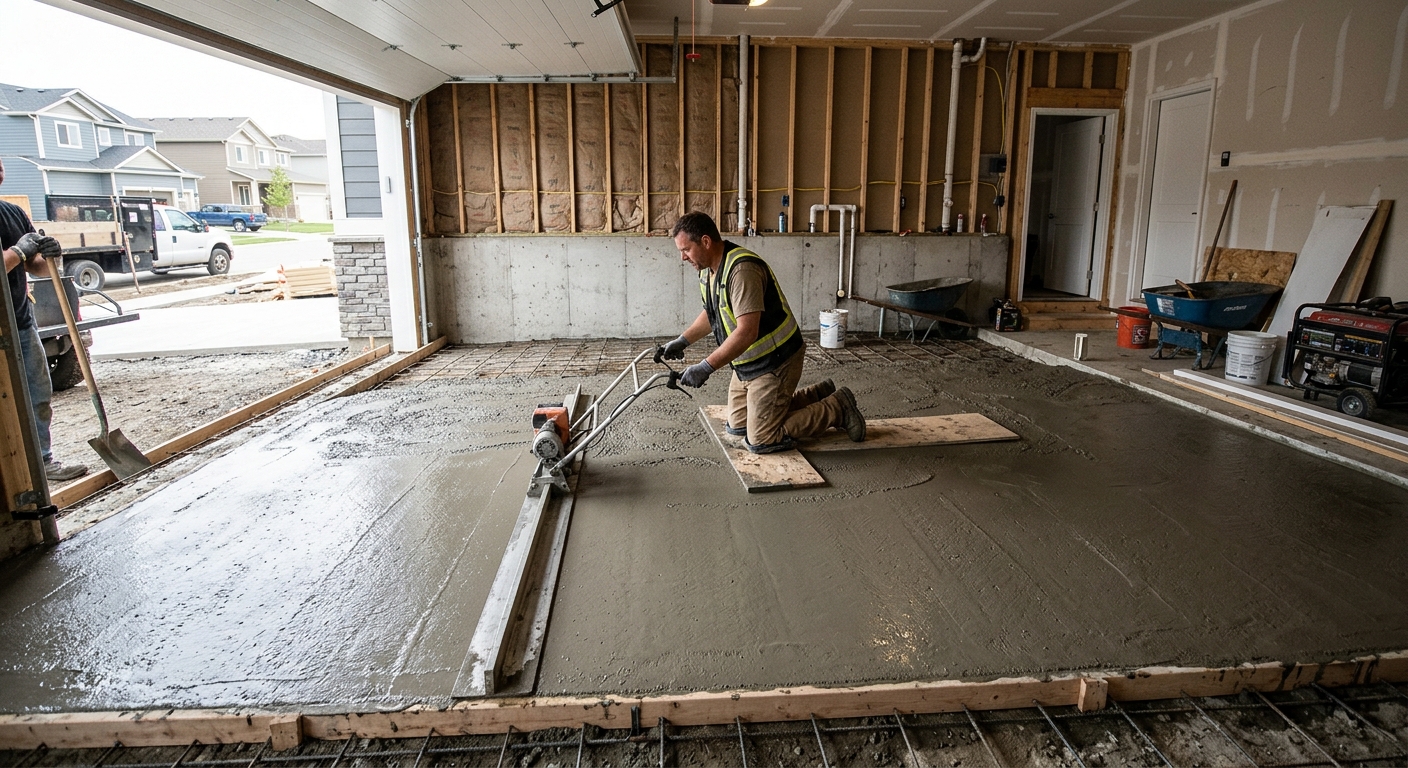
| Concrete driveway (standard broom finish) |
400–600 sq ft |
Air-entrained mix, compacted base, control joints |
Broom finish |
$12,000–$18,000 |
| Exposed aggregate driveway |
400–600 sq ft |
Specified mix with retarder/brushing process, joints |
Exposed aggregate |
$14,000–$20,000 |
| Stamped concrete driveway or patio |
300–550 sq ft |
Air-entrained mix, colour hardener, release agent |
Stamped pattern |
$15,000–$26,000 |
| Plain concrete patio or walkway |
200–400 sq ft |
Compact sub-base, air-entrained exterior mix, joints |
Float + light broom or scored finish |
$5,000–$9,000 |
| Garage floor (interior slab) |
400–650 sq ft |
Vapour barrier (when needed), reinforcement, proper curing |
Standard trowel / broom edge |
$7,500–$14,000 |
| Foundation footings (structural, below frost) |
House/garage scale |
Excavation to undisturbed soil, structural concrete, rebar |
Engineered structural pour |
$28,000–$45,000 |
Prices are estimates only and vary by project scope, site access and material selection.
What affects the price of concrete work in Cochrane
Two quotes for the same driveway or patio in Calgary-area communities can easily be 30–50% apart because concrete pricing isn’t just “concrete per yard.” It’s excavation, granular base design, reinforcement details, truck access, curing protection, and the finish system. In colder pockets of Alberta—including Cochrane—every spec is engineered around frost and freeze–thaw, and that affects labour hours and material choice.
First, the frost line depth dictates footing depth and form height. In Alberta, that design depth is deep enough that footings and below-grade work often require more excavation and larger concrete volumes than in milder provinces. Second, repeated freeze–thaw cycles drive the need for air-entrained concrete mixes on exterior slabs; without the correct air content, durability drops and spalling risk increases. Third, Cochrane’s shorter exterior pour season means late pours often require winter-grade mixes, insulated blankets, and sometimes temporary heat to protect curing. Fourth, de-icing salts accelerate surface deterioration, which is why sealing and a proper surface finish matter on driveways, patios and walkways.
You’ll also see cost swing based on real site conditions. For example: a driveway on a sloped lot may require extra grading and retaining preparation, while a flat, accessible site reduces equipment time. A small patio enclosed by tight fencing can increase labour due to hauling and pumping logistics. For homeowners comparing options, it’s common to see a standard broom driveway start in the $12,000–$18,000 band, while stamped work can jump into $15,000–$26,000 because colour hardeners, release agents, and more intricate finishing add cost—if the sub-base and joints aren’t done properly, though, stamped concrete will still crack.
| Price Factor |
Why It Matters |
Cost Impact |
| Frost line depth — determines footing depth and form height |
Footings must bear on undisturbed soil below design frost depth to prevent frost heave |
Can be a major cost driver on foundations/footings (higher excavation + concrete) |
| Site preparation — excavation, grading, compacted granular base |
Proper base thickness and compaction prevent settlement and reduce cracking |
Typically increases labour and granular material where access is tight or soil is poor |
| Reinforcement — rebar or wire mesh requirement |
Reinforcement improves performance for loads and reduces surface cracking |
Adds material and placement labour; varies with slab type and engineering |
| Mix design — air-entrainment and compressive strength spec |
Exterior air-entrainment helps concrete survive freeze–thaw cycles |
Costs more per load but reduces long-term failure risk and repairs |
| Finish type — broom vs. stamped vs. exposed aggregate |
Different finishing systems require more steps and labour time |
Stamped/exposed usually higher; broom is fastest and most budget-friendly |
| Pour size and concrete truck access to site |
Smaller pours or difficult access can require pump systems or extra handling |
Access issues can raise total labour and equipment fees |
| Cold-weather curing precautions — heating and blankets |
Proper curing in Alberta prevents scaling and surface/structural issues |
Can add significant cost in late fall/early spring pours |
| Control joint pattern and sealing cost |
Joints manage cracking location; sealing protects against de-icing salt damage |
Not always included in low bids; omission leads to faster deterioration |
Permits & regulations in Alberta
In Alberta, structural concrete work typically requires a building permit, and many projects also need engineered drawings reviewed by the municipality. The work that usually does require a permit includes foundation footings, foundation walls, grade beams, and any structural slab elements tied to the house structure (for example, a new basement foundation system or structural underpinning). If your scope includes changes to load paths, below-grade structural concrete, or anything that affects the building’s engineered design, treat it as “permit-level” work until confirmed otherwise.
Concrete flatwork—driveways, patios, walkways, and garage approach slabs—usually does not require a permit unless it affects lot grading, impervious surface coverage limits, or the municipal right-of-way (for example, work that changes drainage patterns near the street or alters how stormwater is managed). Before breaking ground in Cochrane, confirm requirements with the local authority for your specific drainage and grading conditions.
To verify a contractor in Alberta, follow a simple checklist. First, ask for proof of liability insurance and request the certificate of insurance (COI) showing coverage in force and project location. Second, confirm they have WSIB/WCB coverage where applicable for their workforce—ask for a clearance letter or coverage confirmation. Third, verify the contractor’s relevant trade registration/licensing and business information through the applicable online registry channels, then cross-check the company name and licence details against the quote and invoice. Lastly, get references for similar-size concrete jobs completed in the last 12–24 months.
Getting concrete right in Cochrane's freeze-thaw climate
Concrete failure in Cochrane usually comes down to four things: weak or poorly prepared base, inadequate air-entrainment, wrong jointing, and rushed curing. In a freeze–thaw environment, water expands as it freezes; if the mix doesn’t include the right air-void system and if water can’t drain away properly, you can see surface scaling and later spalling even when the slab “looks fine” at first. That’s why the winning spec is engineered around the region’s frost and temperature swings, not just around appearance.
To spec your job correctly, start with base preparation: compacted granular sub-base to the proper depth for the soil and loads, with grading that supports drainage away from the house. Next, require an air-entrained exterior mix—typically 5–7% air content for many exterior flatwork applications—along with a minimum 32 MPa compressive strength target. Then lock in a control joint plan: joints should be spaced to encourage cracking where it won’t be unsightly or structurally problematic. Curing is equally important: plan for at least 7 days of proper curing conditions; in cold weather, curing may require insulation blankets and, sometimes, temporary heat so the concrete reaches strength and durability. Finally, sealing matters. A penetrating sealer applied about 28 days after the pour helps repel de-icing salts and reduces salt-related surface breakdown.
Ask technical questions like: “What air content are you targeting for this driveway?” and “How are joints laid out around garage door openings and expansion gaps?” If you choose a premium finish, justify the cost with the right foundation. For example, moving from a broom-finish driveway toward exposed aggregate might add roughly a few thousand dollars within the $12,000–$18,000 to $14,000–$20,000 neighbourhood—worth it if the base, mix, joints and curing are properly engineered. But if a low bid skips reinforcement, uses the wrong mix, or omits sealing, you’ll pay later in repairs, not aesthetics.
| Spec |
Why It Matters in Cochrane |
What to Ask For |
Impact if Skipped |
| Compacted granular base (depth?) |
Prevents settlement and controls moisture movement under freeze–thaw cycles |
Base thickness, compaction method, and whether proof-rolling is done |
Cracks, uneven slabs, and accelerated deterioration |
| Air-entrained concrete mix (target air %?) |
Improves freeze–thaw durability and reduces spalling risk |
Target air content (commonly 5–7% for exterior flatwork) and mix type |
Surface scaling/spalling, especially on salted driveway edges |
| Compressive strength (MPa rating) |
Ensures the slab gains adequate strength for durability and loads |
Minimum 32 MPa target and documented mix schedule |
Lower performance and increased cracking over time |
| Control joints (spacing per ACI guidelines) |
Controls where shrinkage cracking occurs |
Planned joint spacing and cut timing (so cracking is managed) |
Random cracks that can widen and trap moisture |
| Minimum 7-day curing period |
Curing is critical for strength development in cold-weather conditions |
Curing plan, blanket/heating use, and when finishing happens |
Scaling and reduced durability, particularly for early spring pours |
| Penetrating sealer (when applied after cure) |
Helps repel de-icing salts and reduces surface breakdown |
Sealer type and timing (around 28 days post-pour) |
Faster surface deterioration and spalling around edges |
How to choose a concrete work contractor in Cochrane
Choosing a contractor in Cochrane is mostly about verifying three things: credentials, detailed scope, and the ability to execute to climate-correct specs. First, ask for proof of liability insurance (COI) and ensure the policy is active for your project dates and includes concrete work. Second, confirm WSIB/WCB coverage—ask for a clearance letter or coverage confirmation for their workforce so you’re not stuck with unexpected liabilities. Third, verify the contractor’s relevant Alberta trade registration/licensing information and confirm the business name matches the quote and invoice.
Next, get 2–3 itemised written quotes that break down labour and materials—not just a single lump sum. You want to see inclusions like excavation and granular base depth, reinforcement details, concrete mix type (air-entrainment), joint cutting plan, and whether winter curing measures are included. Ask whether a permit is part of the job if your scope includes structural concrete work. Clarify disposal and haul-away: do they include debris removal, spoil handling, and any required reinstatement?
Warranty matters too. A workmanship warranty should be stated clearly (duration, what’s covered, and the process to request service). Also ask about the product/manufacturer warranty on specific admixtures/sealers if applicable, and whether it transfers if you sell the home. On payment terms, never pay more than about 10–15% upfront; hold back the remainder until key milestones are complete and the surface is protected. Finally, require a written start date and completion estimate, plus a weather plan—freeze–thaw control and curing protection should be part of the schedule, not an afterthought.
- Request COI for liability insurance and confirm jobsite coverage in Cochrane.
- Ask for WSIB/WCB clearance or proof of coverage for all workers.
- Confirm trade registration/licence details match the company on the quote.
- Get 2–3 itemised quotes with labour + material breakdown.
- Require base thickness and compaction method in writing (not just “proper base”).
- Confirm the concrete mix is air-entrained for exterior freeze–thaw exposure.
- Ask for minimum strength target (commonly 32 MPa for many specs) and curing plan.
- Require a control joint layout and cut timing schedule.
- Clarify reinforcement type and placement (rebar/wire mesh) where needed.
- Ask whether sealing is included and the expected application timing (about 28 days).
- Review exclusions: what’s not included (demo, disposal, drainage repairs, forms removal)?
- Set a payment schedule with no more than 10–15% upfront and clear holdback conditions.
Red flags to watch for: vague quotes that omit base depth and mix specifications, promises of “fast pour” without winter curing measures, no written joint/sealing plan (common on cheap driveways), refusal to provide COI/WSIB/WCB documentation, and missing timeline/weather contingencies—especially risky in Cochrane where freeze–thaw cycles punish poor curing and jointing.
Frequently asked questions — concrete work in Cochrane
Why does concrete crack in Cochrane and how is it prevented?
Concrete cracks in Cochrane mainly because of shrinkage and temperature movement—then freeze–thaw turns small cracks into bigger problems if water gets into the slab. Prevention starts before the pour: a properly compacted granular base reduces settlement, and a correct exterior air-entrained mix improves freeze–thaw durability. Control joints are also critical; they provide predetermined crack locations so the slab doesn’t fracture randomly. A common failure pattern here is driveways that were poured without a joint plan or with joints cut too late, then sealed too early or never, so de-icing salt and meltwater accelerate deterioration. When you compare bids around the $12,000–$18,000 driveway band, ask specifically for base depth, air-entrainment, reinforcement (if required), and joint spacing—those details prevent the “usual” cracking complaints.
Stamped vs broom-finish concrete — cost difference?
Stamped concrete typically costs more than broom-finish because it involves extra materials (colour hardeners/release agents) and more labour time for pattern stamping, finishing and detailing at edges. In the Calgary–Cochrane market, a broom-finish driveway commonly sits around the $12,000–$18,000 band for typical sizes and scope, while stamped concrete driveway or patio work often lands in the $15,000–$26,000 range depending on square footage, pattern complexity and excavation/access. The key point: stamped work doesn’t fix weak base prep or poor curing—those still must be correct in Alberta’s freeze–thaw climate. If your stamped option is priced close to broom-finish, double-check that the base depth, air-entrained mix, and jointing are still engineered for durability, not just aesthetics.
When is the best time to pour concrete in Cochrane?
The best time for exterior flatwork in Cochrane is when temperatures allow normal curing without heavy intervention—generally late spring through summer, before freeze–thaw swings become extreme. Alberta’s cold continental climate means the pour season is shorter, and winter-grade mix, insulating blankets, and/or temporary heat may be required once nights cool down or when forecasts show rapid temperature drops. Pouring in late fall or early spring can still be done, but the quote should explicitly include cold-weather curing precautions and a clear curing plan for at least 7 days. If a contractor says they can “just pour whenever,” without discussing blankets/heating and curing protection, that’s a risk for scaling and longer-term durability. For homeowners, it’s often smarter to schedule around the curing window than to accept a cheaper labour-only bid that cuts corners on temperature control.
How long does concrete take to cure?
Concrete curing is about time and conditions. In Cochrane, you should plan for a minimum of 7 days of proper curing for strength development, and you should protect the slab through that period—especially during cold snaps. Even if the surface feels hard earlier, full durability and performance depend on adequate curing under the right temperature conditions. If cold weather hits, contractors typically use insulating blankets and sometimes temporary heat to keep the concrete within a workable curing range. Sealing is usually done later: a penetrating sealer is typically applied around 28 days after the pour so it can perform properly against de-icing salt exposure. The practical takeaway: don’t treat “pour day” as the finish line—ask your contractor for a written curing plan and protection steps, then plan not to pressure-wash or de-ice early.
Do I need a permit for concrete work in Alberta?
In Alberta, permit requirements depend on the type of concrete work. Structural items like foundation footings, foundation walls, and grade beams typically require a building permit and often engineered drawings. Concrete flatwork—driveways, patios, and walkways—usually doesn’t require a permit unless it affects lot grading, impervious surface limits, or drainage/right-of-way conditions near the street. Because the details matter, you should confirm with the local authority before starting, especially if your new slab changes water flow away from the house. When hiring a contractor in Cochrane, ask whether permits are needed for your specific scope and whether their quote includes the permit pull (if applicable). Also verify they carry liability insurance and WSIB/WCB coverage so you’re protected if anything goes wrong during the work.
Concrete vs pavers for a patio in Cochrane?
Concrete and pavers can both work well in Cochrane, but freeze–thaw affects them differently. Concrete patios rely on correct base prep, air-entrained mix, control joints, and curing—done properly, they’re strong and relatively low maintenance. Pavers can look great and can be easier to repair if individual units shift, but they depend heavily on a well-graded base, correct edge restraints, and proper polymeric sand/drainage to prevent movement during freeze–thaw cycles. Price-wise, a plain concrete patio or walkway is often in the $5,000–$9,000 band for typical sizes and scope, while pavers can run higher once excavation, base, edging, and labour are included. For most homeowners, the best decision comes down to your priorities: budget and long-term durability (favouring concrete) versus surface flexibility and modular repair (often favouring pavers).