Concrete work options and costs in Windsor Park
Windsor Park, Alberta is a small community within the Calgary region (population 4,410 per the Statistics Canada, 2021 Census), so pricing is driven by how efficiently crews can mobilize, how busy the Calgary-area season is, and how demanding our freeze–thaw cycle is on exterior concrete. Most homeowners here are dealing with the same concrete flatwork categories—driveways, patios and walkways—often on newer lots where design decisions are made early. In this area, concrete demand is especially noticeable around established residential pockets where additional parking pads and backyard slabs are common.
In Calgary and nearby towns, the colder continental climate matters as much as the design. With a design frost depth around 1.2 m (about 4 ft) in local engineering practice, footings must bear on undisturbed soil below that depth. That increases excavation and concrete volumes, which is why foundation/footing work typically runs higher than in milder regions. Freeze–thaw cycles also push contractors toward air-entrained mixes, granular base prep, and well-planned control joints to reduce cracking and spalling. Finally, the exterior pour season is shorter, so winter-grade placement, insulated curing blankets (when needed), and tighter scheduling can add cost—especially for driveways and patios scheduled late in the year.
Below are realistic Windsor Park price ranges you can use to compare quotes before you get into the details of size, access, reinforcement, and finish. Use the table as your “sanity check,” then ask your contractor to explain any numbers that fall far outside the band.
| Application |
Typical Size |
Key Spec |
Finish Option |
Price Range |
| Concrete driveway (standard broom finish) |
20 ft x 10 ft (200 sq. ft.) |
Air-entrained exterior mix, wire mesh or rebar, control joints |
Broom finish |
$12,000–$18,000 |
| Exposed aggregate driveway |
20 ft x 10 ft (200 sq. ft.) |
Air-entrained exterior mix, designed for freeze–thaw durability |
Exposed aggregate (bottle wash) |
$15,000–$22,000 |
| Stamped concrete driveway or patio |
20 ft x 12 ft (240 sq. ft.) |
Air-entrained exterior mix, reinforcement and joints |
Stamped + sealed |
$15,000–$26,000 |
| Plain concrete patio or walkway |
200–300 sq. ft. |
Air-entrained mix, compacted base, control joints as needed |
Float + broom edge |
$5,000–$9,000 |
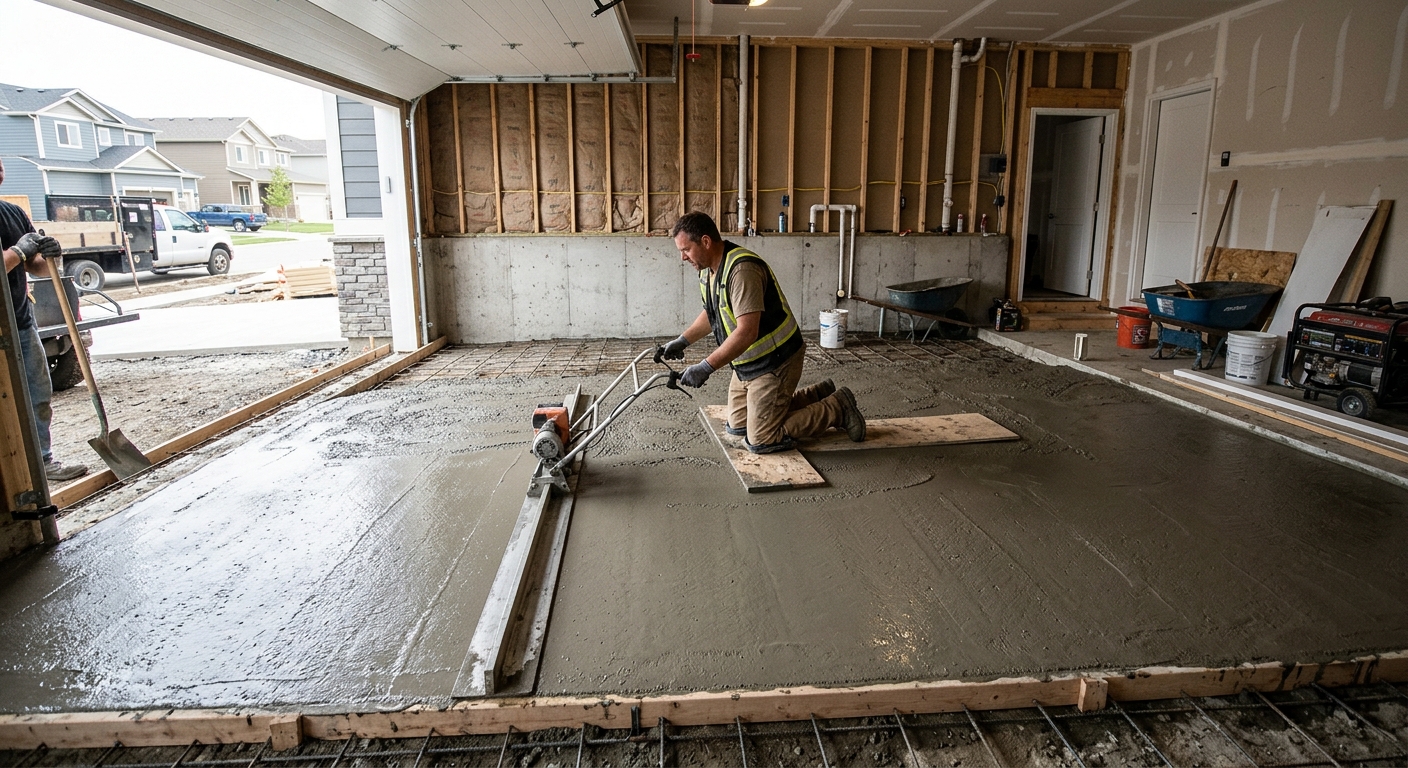
| Garage floor (interior slab) |
22 ft x 22 ft (484 sq. ft.) |
Vapour barrier, reinforcement, proper base prep |
Smooth trowel or light broom |
$10,500–$17,500 |
| Foundation footings (structural, below frost) |
Typical house/garage footprint |
Designed below frost depth, rebar, engineered specs |
Structural grade |
$28,000–$45,000 |
Prices are estimates only and vary by project scope, site access and material selection.
What affects the price of concrete work in Windsor Park
In Windsor Park and across the Calgary market, it’s common to see quote spreads of 30–50% for the same “concrete job,” even when homeowners think the scope is identical. The biggest drivers are hidden in engineering and site conditions: how deep we have to excavate to manage frost, how much base and reinforcement is required, and how the contractor plans for freeze–thaw and curing. For exterior work, air-entrained concrete and proper jointing aren’t optional in practice—skimping here is what leads to surface scaling and spalling later.
Because our frost depth is engineered around roughly 1.2 m (about 4 ft), footings for houses, garages, decks and retaining structures must extend below that depth to resist frost heave. That means more excavation, more formwork height, and more concrete volume—so foundation/footing work often lands in the $28,000–$45,000 band, not the “budget” ranges some people expect. Exterior slabs also need air-entrained mixes to survive frequent freeze–thaw cycles, and that increases mix cost slightly but reduces long-term failure risk. Late-season pours add cost through cold-weather curing precautions: insulated blankets, sometimes supplemental heat, and stricter temperature monitoring.
Here are a few real examples of how local conditions move the price up or down in Windsor Park. First, a driveway over clay or poor subgrade can force deeper granular base and more compaction work, nudging a standard broom-finish driveway from the lower end of $12,000–$18,000 toward the upper end. Second, limited truck access or rebar detailing for a wide garage slab increases labour and scheduling. Third, choosing stamped concrete can raise the finish cost into the $15,000–$26,000 range, but it’s often justified when homeowners want curb appeal and a sealed, colour-stable surface that matches stone or siding.
| Price Factor |
Why It Matters |
Cost Impact |
| Frost line depth — determines footing depth and form height |
Footings must bear below the design frost depth to prevent frost heave. |
Can add major excavation and concrete volume cost; often pushes foundation work toward the higher end of the band. |
| Site preparation — excavation, grading, compacted granular base |
Proper base prevents settlement and reduces future cracking. |
Extra hauling/compaction can raise slab costs 10–25% on difficult sites. |
| Reinforcement — rebar or wire mesh requirement |
Controls cracking and improves structural performance for driveways and slabs. |
Added materials + labour for tie-in and spacing; commonly 5–15% variance. |
| Mix design — air-entrainment and compressive strength spec |
Air-entrainment helps concrete survive freeze–thaw cycles. |
Material price increase, but typically reduces warranty risk and failures. |
| Finish type — broom vs. stamped vs. exposed aggregate |
Finish affects labour time, tooling, and curing/sealing requirements. |
Stamped/exposed options typically move projects into the higher price band. |
| Pour size and concrete truck access to site |
Access limits truck placement and increases labour for wheelbarrow/pumping. |
Reduced efficiency can add 10–20% depending on distance and constraints. |
| Cold-weather curing precautions — heating and blankets |
Cold slows strength gain; winter-grade placement protects the surface and structure. |
Can add meaningful labour/material cost if a pour is scheduled near freezing. |
| Control joint pattern and sealing cost |
Joints guide cracking; sealing helps resist moisture and de-icing salt damage. |
Small line item, but skipping it usually leads to early spalling and repairs. |
Permits & regulations in Alberta
In Alberta, structural concrete work such as footings, foundation walls, grade beams and other load-bearing foundation elements generally requires a building permit, and municipalities often expect engineered drawings for the foundation design. For concrete flatwork—patios, walkways and most driveways—permits are commonly not required by default, unless the work affects lot grading, impervious surface coverage limits, drainage patterns, or the municipal right-of-way. Because rules can vary by situation, confirm with the local authority before breaking ground, especially if you’re changing elevations, adding a new driveway approach, or tying into existing drainage.
Before you sign, verify your contractor is properly insured and capable of doing regulated work safely. Here’s a homeowner-friendly step-by-step checklist in Windsor Park: (1) ask for a valid certificate of insurance showing general liability with project details and effective dates; (2) confirm workers are covered by WSIB/WCB—request proof and match it to the company name you’re hiring; (3) verify licensing/registration for the contractor (and any required trade qualifications) through provincial online listings or the contractor’s own documentation package; (4) request references from similar-scale jobs in the Calgary area—especially exterior slabs and foundation pours.
If the contractor can’t provide certificates clearly or hesitates when you ask what’s included (permit pulls, engineering, disposal, and scheduling), that’s a warning sign. Get everything in writing and make sure the scope aligns with what the permit (if required) will cover.
Getting concrete right in Windsor Park's freeze-thaw climate
Concrete fails in Windsor Park primarily because water gets into the slab, then freeze–thaw cycles expand and stress the surface. The two most preventable problems are (1) poor base preparation (leading to settlement and random cracking), and (2) inadequate air-entrainment and curing (leading to spalling/scaling). In a cold continental climate like Calgary’s, you spec the job as a system: compacted base at the right depth, a properly designed air-entrained mix, a control joint plan, and curing/finishing steps that protect strength gain. Then you finish with sealing so de-icing salts and moisture don’t accelerate surface damage.
Here’s how to spec correctly. Start with a compacted granular sub-base to the correct frost-aware depth for your soil and lot conditions. Next, require an air-entrained exterior mix with target air content around 5–7% and a minimum 32 MPa compressive strength for exterior durability. Build in control joints at sensible spacing to limit random cracking—especially on driveways and patios that experience thermal movement. Curing matters: aim for at least 7 days under proper conditions, and if temperatures dip, insist on cold-weather curing precautions such as insulated blankets and/or heating to avoid early strength loss. Finally, apply a penetrating sealer 28 days after the pour (once cured) to repel moisture and de-icing salt.
One pricing example: homeowners sometimes choose a cheaper “plain slab” spec hoping to save money, but if they cut corners on air-entrainment or joint layout, they may be back in multiple seasons—turning a short-term saving into major repair costs. For driveways, the difference between finishing options often lands in the $12,000–$18,000 band for standard work and higher ranges for stamped or decorative finishes; the best spend is on the performance specs that stop spalling first.
| Spec |
Why It Matters in Windsor Park |
What to Ask For |
Impact if Skipped |
| Compacted granular base (depth?) |
In Windsor Park, frost movement and settlement are controlled by excavation depth and a properly compacted base. |
Base depth based on site conditions and engineering; moisture-conditioned, compacted granular sub-base. |
Settlement, uneven slabs, and early cracking. |
| Air-entrained concrete mix (target air %?) |
Freeze–thaw cycling demands resilient air void structure for exterior slabs. |
5–7% air content for exterior flatwork with records of air testing. |
Higher risk of surface scaling and spalling over winter cycles. |
| Compressive strength (MPa rating) |
Cold weather affects strength gain; adequate strength supports long-term durability. |
Minimum 32 MPa compressive strength and curing method suited to forecast temps. |
Weak surfaces, reduced durability, and faster deterioration. |
| Control joints (spacing per ACI guidelines) |
Concrete shrinks and expands; joints control where cracks form. |
Joint spacing and layout plan for driveway/patio dimensions; saw-cut timing specified. |
Random cracking and unsightly, water-trapping fractures. |
| Minimum 7-day curing period |
Proper strength gain is critical in Calgary-area cold snaps and variable temperatures. |
How curing will be maintained and monitored (blankets/heating if required). |
Surface weakness, scaling, and reduced structural performance. |
| Penetrating sealer (when applied after cure) |
Sealing helps resist moisture and de-icing salt-driven damage in winter. |
Penetrating sealer applied after full cure—typically 28 days post-pour. |
Faster surface breakdown and more frequent repairs. |
How to choose a concrete work contractor in Windsor Park
Choosing a contractor in Windsor Park is mostly about verification and clarity. In Alberta, structural concrete (footings and foundation walls) is the area where permitting and engineering matter most, and your contractor should be comfortable discussing engineered drawings, frost considerations and curing procedures—not just “pour and go.”
First, verify insurance and coverage. Ask for: (1) certificate of insurance showing general liability and jobsite coverage; (2) WSIB/WCB clearance or proof of coverage for their workers; and (3) contractor identification details that match the quote and invoice. You can check licensing/registration through provincial online resources and confirm the company name on the certificate aligns with the legal contractor you’re hiring. If they can’t provide clean documentation, don’t proceed.
Next, request 2–3 itemised written quotes. The best quotes break down labour and materials rather than giving one lump sum. Look for what’s included: excavation and haul-off, disposal, reinforcement type and spacing, control joints, curing method, and whether the price includes permit pull (if applicable). Also clarify if sealer is included for exterior slabs and when it will be applied.
Warranty should be specific: workmanship warranty length, product/manufacturer warranty where relevant, and whether coverage is transferable if you sell the home. On payment, avoid paying more than 10–15% upfront; hold back a portion until substantial completion. Get a start date and completion estimate in writing so you’re not stuck waiting through the shortest part of the pour season.
- Confirm the contractor’s general liability insurance certificate includes your project address.
- Verify WSIB/WCB coverage with documentation (not verbal claims).
- Ask whether the contractor provides air-entrained exterior mixes and how they prove it (air tests).
- Require a base prep plan: excavation depth, granular base thickness, and compaction method.
- Check that reinforcement matches the slab type (mesh vs. rebar) and is installed correctly.
- Demand a control joint layout and saw-cut timing to control cracking.
- Ask about cold-weather procedures: insulated blankets, heating plan, and curing monitoring.
- Clarify whether disposal/haul-off is included or billed separately.
- Review the schedule: crew availability, pour date target, and weather contingencies.
- Make sure the quote lists finish type (broom, stamped, exposed aggregate) and sealing (if exterior).
- Confirm warranty details in writing, including who owns cure/sealer responsibilities.
- Use a staged payment plan: deposit only (10–15%), then progress payments with holdback.
Concrete red flags I commonly see around Windsor Park include: quotes that don’t specify air-entrainment or compressive strength, skipping the granular base compaction details, delaying control joints/saw cuts, “cheap” winter pours without blankets/heating plans, and vague wording like “we’ll see if we need rebar” instead of a specified reinforcement scope.
Frequently asked questions — concrete work in Windsor Park
How long does concrete take to cure?
In Windsor Park (Alberta), cure time is more than just “it hardens overnight.” Concrete typically reaches initial set quickly, but strength keeps building over time. Most exterior slabs should be treated as construction-strength for at least 7 days before heavy loads, with curing conditions maintained to avoid surface weakness. Full durability development generally takes longer, which is why we recommend planning sealing after full cure—often around 28 days for penetrating sealers. If you pour near freezing, curing can’t be rushed; insulated blankets and/or heating may be needed to keep temperature in the right range for proper strength gain. A contractor who gives you only one date without discussing curing method is usually not planning for the climate reality of Calgary’s freeze–thaw cycles. For budgeting comparisons, remember that jobs that include winter curing precautions cost more but reduce the risk of early scaling.
Do I need a permit for concrete work in Alberta?
In Alberta, structural concrete work—such as footings, foundation walls, and grade beams—typically needs a building permit and often engineered drawings reviewed by the municipality. Concrete flatwork like patios, walkways and most driveways usually does not require a permit by default, but there are common exceptions in Windsor Park: if the work changes lot grading, affects drainage, increases impervious coverage beyond limits, or impacts municipal right-of-way/approach requirements, you should check with the local authority before starting. The safest approach is to ask your contractor to confirm whether a permit is required for your exact scope and whether it will be pulled as part of the job. You should also verify the contractor has the right insurance and coverage. If you’re budgeting, remember that foundation/footings in the $28,000–$45,000 band generally involves stricter process controls than simple flatwork like a patio in the $5,000–$9,000 range.
Concrete vs pavers for a patio in Windsor Park?
Concrete and pavers can both look great in Windsor Park, but the freeze–thaw climate and maintenance tradeoffs differ. A properly built concrete patio—using air-entrained concrete, correct granular base prep, control joints, and a penetrating sealer—can handle winter moisture movement with fewer individual “units” to shift. Pavers can be excellent too, but they depend heavily on base consistency and jointing sand; if water channels underneath, freeze–thaw can heave individual pavers, creating trip hazards. Concrete also tends to be smoother and quicker to repair if a single section fails, whereas paver failures can require lifting and relaying. Cost-wise, a plain concrete patio often fits the $5,000–$9,000 range depending on size and site access; stamped concrete can move higher into decorative bands. My practical advice: choose concrete when you want durability with fewer joints; choose pavers when you want easy visual customization and don’t mind more ongoing base/joint upkeep.
How long does a concrete driveway last?
A well-built concrete driveway in Alberta can last many years—often 20+—but “last” depends on the specifications and winter exposure. The main threats are freeze–thaw damage, de-icing salt exposure, and water getting under or through the slab due to weak base prep or missing control joints. In Windsor Park’s climate, air-entrainment and proper curing are key to reducing spalling and scaling. A driveway built with compacted granular base, correct reinforcement for the slab type, a joint plan, and a penetrating sealer (typically after full cure) performs significantly better than one poured with minimal attention to these details. If your contractor is quoting only on finish (broom vs. decorative) and doesn’t discuss air content or joints, you should question the durability. Budgeting also matters: standard driveways are commonly in the $12,000–$18,000 range, while decorative options rise into higher bands due to labour and finishing steps.
What is air-entrained concrete and why does it matter here?
Air-entrained concrete is concrete made with microscopic air bubbles purposely introduced during mixing. Those tiny voids act like “pressure relief” when water in the concrete freezes and expands, which helps the surface survive repeated freeze–thaw cycles. In Windsor Park and the Calgary area, that matters because exterior slabs are constantly exposed to moisture from snowmelt, rain, and de-icing salts. Without air-entrainment, freeze–thaw stresses are more likely to break down the surface and lead to scaling and spalling—often noticeable in just a few winters. That’s why exterior flatwork is engineered differently than interior basement pours: contractors target an air content roughly in the 5–7% range and pair it with proper base preparation and curing. If a quote doesn’t mention air-entrainment for driveway/patio work, it’s a gap in the technical spec, not a “minor omission.”
How do I prepare the base for a concrete slab?
Base preparation is the foundation of performance—especially in Windsor Park where the frost depth and freeze–thaw cycles drive how we build. The contractor should excavate to the required depth for your soil and frost conditions, remove topsoil and unsuitable material, then install a compacted granular sub-base in lifts. The granular base needs to be properly graded and compacted to reduce settlement; settlement turns into cracking because the slab can’t move evenly. For exterior slabs, good drainage detailing matters too so water doesn’t pool near edges. In your quote, ask for the base prep scope: excavation depth, granular thickness, compaction approach, and whether reinforcement is specified and installed correctly. Skipping or rushing this step often shows up as hairline cracking, uneven slabs, and premature surface breakdown—regardless of whether you chose a plain broom finish or a decorative option in the $15,000–$26,000 decorative range.