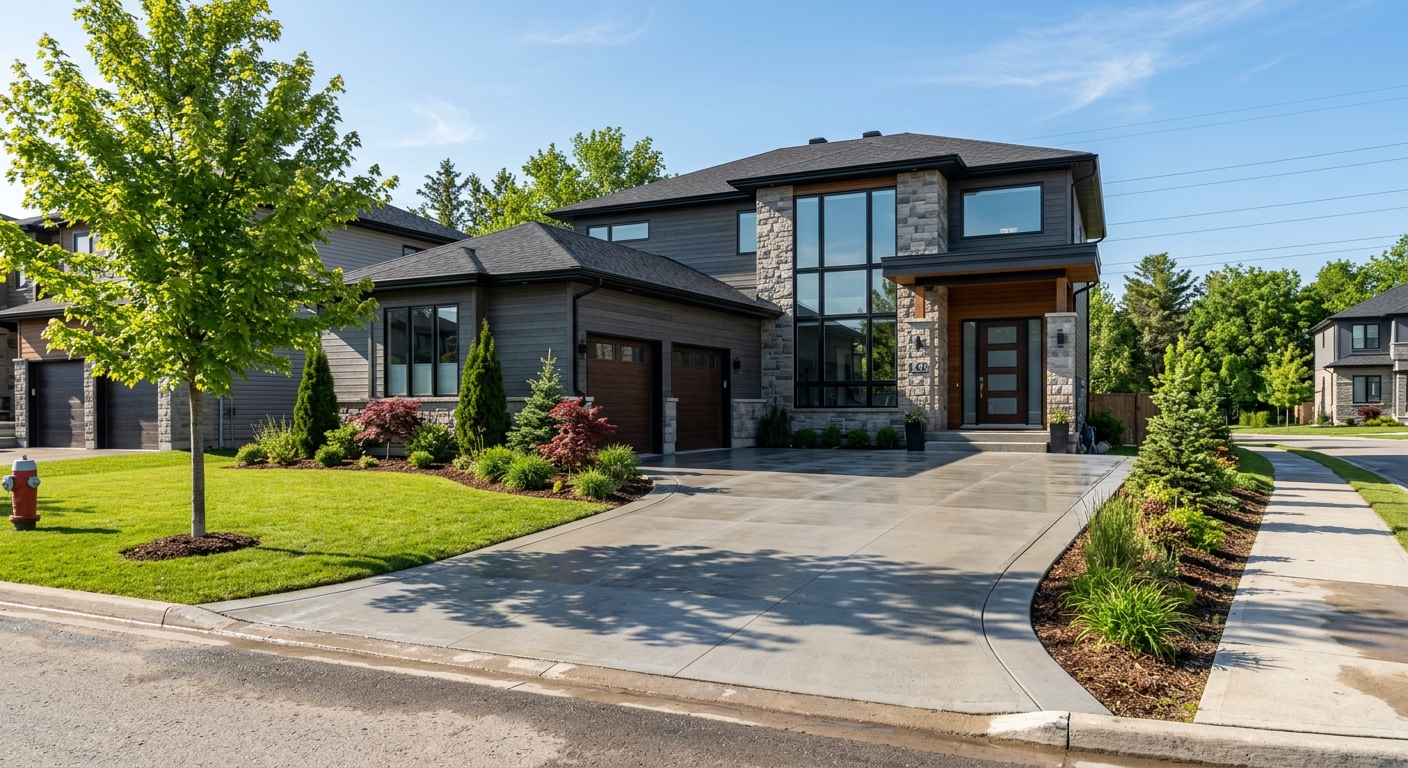
Concrete work options and costs in Lincoln Park
Lincoln Park, Alberta is a small community, but the demand for durable concrete flatwork is steady—especially as homeowners invest in driveways, patios and walkways that can handle Calgary’s freeze–thaw swings. In a town of about 1,590 people (Statistics Canada, 2021 Census), the housing mix is anchored by single-detached homes, which is exactly where concrete contractors get their busiest work cycles for exterior slabs. If your neighbourhood is in the denser pockets near the established residential streets, you’ll notice crews working around school-year traffic patterns and limited street access more often.
Pricing in the Calgary region can also be noticeably different from milder parts of Alberta and Canada because the design frost depth drives deeper excavation for footings and tougher base prep for slabs. The area experiences frequent freeze–thaw cycles, so contractors engineer around frost heave with proper granular sub-base, air-entrained concrete, and well-spaced control joints. On exterior pours, the pour season is shorter, and winter-grade placement (insulating blankets and sometimes temporary heat) can add labour and material costs if you’re pushing scheduling late in the year.
Below is a practical comparison of common options homeowners request in Lincoln Park, including where finish choices matter most. Use this as a starting point, then line up your quote with specs—depth, reinforcement, mix design and curing—so you’re comparing apples to apples in the table.
| Application |
Typical Size |
Key Spec |
Finish Option |
Price Range |
| Concrete driveway (standard broom finish) |
24 ft x 20 ft |
4 in slab, 6-mil poly, compacted granular base, control joints |
Broom finish, basic sealer optional |
$12,000–$18,000 |
| Exposed aggregate driveway |
24 ft x 20 ft |
4 in slab with washed/stamped-ready mix, base and joints as per design |
Exposed aggregate (medium stone exposure) |
$14,000–$20,500 |
| Stamped concrete driveway or patio |
24 ft x 20 ft driveway or 400 sq ft patio |
4 in thickness (exterior), reinforcement as required, integral color |
Stamp pattern + release + color hardener (where specified) |
$15,000–$26,000 |
| Plain concrete patio or walkway |
300–450 sq ft |
4 in slab, proper slope, compacted base, joints |
Float/straightedge with light broom or trowel finish |
$5,000–$9,000 |
| Garage floor (interior slab) |
20 ft x 22 ft |
4 in slab, vapor barrier, thickened edges (if required), wire mesh |
Broom finish or light trowel |
$9,000–$14,500 |
| Foundation footings (structural, below frost) |
Typical house re-structure varies |
Excavation to design frost depth, reinforced concrete, formwork |
Structural concrete (not decorative) |
$28,000–$45,000 |
Prices are estimates only and vary by project scope, site access and material selection.
What affects the price of concrete work in Lincoln Park
In Lincoln Park (and across the Calgary economic region), it’s common to see quotes for the “same” concrete job swing by 30–50%. The difference usually isn’t just the concrete—it’s the engineering behind it: excavation depth, base thickness, reinforcement, concrete mix requirements, and cold-weather curing provisions. Two contractors can offer the same broom-finish driveway size, yet one might include the right granular base and air-entrainment while the other cuts corners to hit a lower number. With Lincoln Park’s small population of about 1,590 people (Statistics Canada, 2021 Census), crew availability also matters—during busy exterior construction windows, labour can get more competitive.
Climate is the biggest driver. In cold continental conditions, frost depth and freeze–thaw cycles dictate every spec. Footings must extend below the design frost depth (Alberta commonly requires deeper bearing capacity than southern regions) to prevent frost heave and seasonal movement. Exterior slabs require air-entrained concrete to survive repeated expansion and contraction. When pours are scheduled near the shoulder season, contractors must plan for a shorter curing window using insulated blankets and sometimes heat—this is why a “fall quote” can be more expensive than a mid-summer pour even at the same square footage.
In practical terms, a driveway that needs extra excavation for wet or disturbed soil can push you upward toward the upper end of the concrete driveway/slab band of $12,000–$18,000. Conversely, a straightforward patio on stable grade with good truck access is more likely to land in the middle of $5,000–$9,000. For older neighbourhood streets where there may have been prior landscaping fill or services, expect the base-prep and disposal line items to be where the money moves.
| Price Factor |
Why It Matters |
Cost Impact |
| Frost line depth — determines footing depth and form height |
Deeper frost protection means more excavation and more concrete volume |
High (foundation scope can swing tens of thousands) |
| Site preparation — excavation, grading, compacted granular base |
Sub-base thickness and compaction prevent settlement and premature cracking |
Medium to high (especially if soil is wet or disturbed) |
| Reinforcement — rebar or wire mesh requirement |
Controls cracking and supports load transfer for slabs and footings |
Medium (depends on slab type and engineering) |
| Mix design — air-entrainment and compressive strength spec |
Air voids are essential for freeze–thaw durability; strength ensures structural performance |
Medium (higher-spec mix costs more, but failure costs more) |
| Finish type — broom vs. stamped vs. exposed aggregate |
Labour steps and specialized materials vary by finish system |
Medium to high (stamped/exposed usually costs more) |
| Pour size and concrete truck access to site |
Long carry distances increase labour and can affect scheduling and placement quality |
Low to high (access is a common hidden variable) |
| Cold-weather curing precautions — heating and blankets |
Protects curing strength gain and prevents surface scaling in freezing conditions |
Medium (often noticeable in late fall/early spring) |
| Control joint pattern and sealing cost |
Joints reduce random cracking; sealing helps repel de-icing salts |
Low to medium (small line item, big performance benefit) |
Permits & regulations in Alberta
In Alberta, the permit rules depend on whether the concrete work is structural or purely flatwork. Structural concrete work—such as footings, foundation walls, grade beams, and other load-bearing foundation elements—requires a building permit. Those projects are commonly supported by engineered drawings that the municipality reviews as part of the building approval process. For concrete flatwork like patios, walkways and driveways, a permit often isn’t required by default, unless the work affects lot grading, connects to services, changes stormwater/flow paths, or impacts impervious surface coverage limits and municipal right-of-way requirements. Because those triggers can vary by site and by how the grade is being reworked, confirm with the local authority before you order materials or break ground in Lincoln Park.
Before the pour, verify contractor accountability like a pro: (1) check that the contractor carries liability insurance (request a current certificate of insurance naming you as an interested party if needed), (2) confirm WSIB/WCB coverage for workers, and (3) get written references for similar-scale cold-climate concrete work. A straightforward process for homeowners is to ask for: the certificate of insurance, a WSIB/WCB clearance or account confirmation letter (from the contractor), and the contractor’s registration/eligibility details through Alberta’s relevant online registries. Then, match those dates to the project start date.
If you’re planning structural changes, insist the permit pull is clearly identified in the contract. If it’s flatwork, still ensure the scope addresses grade, drainage, and disposal—those are where issues usually start.
Getting concrete right in Lincoln Park's freeze-thaw climate
Concrete fails in Lincoln Park mainly when the slab or foundation isn’t protected against frost movement and freeze–thaw cycling. The most common problems I see are surface scaling and spalling from inadequate air-entrainment, settlement from weak base preparation, and random cracking when control joints aren’t planned early. In this Calgary region, you spec the job around the design frost depth and ensure the slab is built on properly compacted granular material to the right depth. That base detail matters because even a good top finish won’t fix a weak sub-base.
For exterior durability, the mix design should be air-entrained with a target air content typically around 5–7% for exterior flatwork, plus a minimum compressive strength of 32 MPa (as specified for the exposure and design). Then plan control joints so cracks happen in the right places, not wherever the slab wants. Curing is equally important: plan for at least 7 days of proper curing conditions. In cold weather, contractors may need insulating blankets or heat to protect early strength gain. Finally, sealing should be a penetrating sealer applied after the concrete has cured—commonly around 28 days—so it can repel de-icing salts.
Here’s a dollars-and-sense example: a stamped patio can land in the $5,000–$9,000 band for simpler plain patios, but stamped work usually shifts higher (up toward the $15,000–$26,000 band when you’re doing larger stamped driveways or complex patterns). The finish can cost more, but it’s only justified if the base prep, air-entrainment and curing are correct—otherwise you’re paying premium dollars for a surface that may start spalling sooner.
| Spec |
Why It Matters in Lincoln Park |
What to Ask For |
Impact if Skipped |
| Compacted granular base (depth?) |
Prevents settlement and frost-related movement under slabs in Calgary’s freeze–thaw conditions |
Base thickness and compacted to a specified density; confirm excavation to the correct sub-base depth |
Cracking, uneven settling, and joint failure |
| Air-entrained concrete mix (target air %?) |
Air voids help the concrete resist freeze–thaw damage and reduce spalling risk |
Target air content typically 5–7% for exterior flatwork; ask what spec is being used |
Surface scaling and spalling, especially with de-icing salt |
| Compressive strength (MPa rating) |
Ensures durability and load performance under cold-climate exposure |
Minimum 32 MPa (or higher if the engineer/design requires); ask for mix design sheet |
Lower strength, premature wear, and long-term deterioration |
| Control joints (spacing per ACI guidelines) |
Controls where shrinkage and thermal cracks occur in freeze–thaw cycles |
Proposed joint spacing and saw-cut timing; ask for joint layout drawings |
Random cracking and faster water ingress |
| Minimum 7-day curing period |
Cold weather can slow strength gain and increase early-age cracking risk |
How curing is protected; confirm whether blankets/heating are planned below certain temperatures |
Reduced performance, surface scaling, and weak durability |
| Penetrating sealer (when applied after cure) |
Helps limit chloride and salt penetration that accelerates freeze–thaw damage |
Type of sealer and application timing—commonly around 28 days post-pour |
Higher spalling risk and faster surface degradation |
How to choose a concrete work contractor in Lincoln Park
Choosing the right contractor in Lincoln Park means verifying capacity and accountability, not just picking the lowest number. In Alberta, ask for proof of liability insurance and WSIB/WCB coverage before any work starts. To check: request their certificate of insurance (ensure coverage is active for your dates and that they can provide any standard endorsements required), then ask for a current WSIB/WCB clearance/confirmation document tied to the company performing the work. For licensing/registration verification, use the contractor’s business registration details and any relevant Alberta online registries available for your contractor type; if they can’t point you to what’s applicable, treat it as a red flag.
Next, get 2–3 itemised written quotes. You want a breakdown that separates labour, excavation/site prep, reinforcement (mesh/rebar), concrete supply, finishing steps, and disposal/haul-away. Avoid lump-sum pricing that doesn’t spell out thickness, base depth, and whether control joints and sealing are included.
Review warranty terms carefully: workmanship warranty length should be in writing, and you should understand whether any manufacturer warranty on materials is provided directly or via the contractor and whether it’s transferable. Payment scheduling matters too—never pay more than about 10–15% upfront. Hold back the balance until the job is complete and any punch-list items are addressed. Finally, demand a start date and a completion estimate in writing, especially with Calgary’s shorter exterior pour season—weather delays happen, but you want them acknowledged in the plan.
- Confirm the quote includes excavation and disposal (or clearly states exclusions).
- Ask for slab thickness and base depth (not just “concrete included”).
- Verify reinforcement is specified (wire mesh vs. rebar vs. none).
- Require the mix spec: air-entrainment and compressive strength (e.g., minimum 32 MPa for exterior work).
- Check curing plan details (blankets/heating in cold weather).
- Confirm control joint layout and saw-cut timing.
- Clarify finishing scope: broom finish vs. stamped/exposed aggregate steps.
- Ensure sealing is listed: type and whether it’s included or add-on after curing.
- Ask for a protection plan for the first 7 days (traffic restrictions and timing).
- Get proof of liability insurance and active WSIB/WCB coverage before work begins.
- Review warranty length and what it covers (materials vs. workmanship).
- Make sure the contract states the timeline and how weather impacts scheduling.
Red flags I’d watch for in Lincoln Park: contractors who won’t provide mix specs or air-entrainment details, quotes that omit base depth and reinforcement, promises to pour without discussing cold-weather curing, vague “lifetime” warranties with no paperwork, and requests for large deposits (well above 10–15%) without a staged contract.
Frequently asked questions — concrete work in Lincoln Park
Do I need a permit for concrete work in Alberta?
In Alberta, structural concrete work typically needs a building permit—think footings, foundation walls, and grade beams. Concrete flatwork like patios, walkways and driveways often does not require a permit by default, but it can if the work affects lot grading, impacts stormwater/flow paths, involves right-of-way considerations, or changes impervious surface coverage limits. For homeowners in Lincoln Park, the best approach is to confirm the trigger with the local authority before you excavate, especially if you’re adding new drainage or changing existing slopes. Also ensure the contractor knows whether the scope is structural versus flatwork, because that determines whether engineered drawings and permit steps are part of the package.
Concrete vs pavers for a patio in Lincoln Park?
Both concrete and pavers can work well in Lincoln Park’s freeze–thaw climate, but the spec differences drive the long-term results. Concrete patios are commonly built with a compacted granular base, air-entrained mix, proper slope, and control joints, which helps manage cracking and freeze–thaw movement. Pavers can perform very well too, but they’re more sensitive to base thickness, compaction, and joint sand maintenance—if those aren’t right, you can get rocking or shifting. Cost-wise, a simple plain concrete patio or walkway typically falls around $5,000–$9,000, while pavers often land higher once you include excavation, base prep, edging and final bedding materials. Choose concrete when you want a monolithic surface and fewer maintenance steps, and choose pavers when you value easy section-by-section repair.
How long does a concrete driveway last?
A well-built concrete driveway in Alberta’s cold climate can last decades, but “how long” depends heavily on what’s underneath and how it was cured. In Lincoln Park, the biggest durability factors are frost-safe base preparation below the design frost depth for footings (for foundation work) and, for slabs, compacted granular base, air-entrained concrete and correct curing. Control joints must be placed and saw-cut timing managed so cracks are controlled rather than random. Sealing after proper curing (often around 28 days) helps repel de-icing salt, which otherwise accelerates surface wear. If your driveway is in the standard range of $12,000–$18,000, a contractor that includes the right specs (not just thickness) is the best predictor of longevity. Poor base prep or skipping air-entrainment is what shortens lifespan fastest.
What is air-entrained concrete and why does it matter here?
Air-entrained concrete is designed with microscopic air bubbles intentionally created in the mix so water inside the concrete has room to expand when it freezes. In Alberta’s freeze–thaw cycles, that reduces the risk of surface scaling and spalling, which are common failure modes on exterior slabs like driveways, patios and walkways. For Lincoln Park homeowners, this is not optional if you want long-term durability—especially where de-icing salts are used. A contractor should specify exterior mix requirements (commonly targeting about 5–7% air content for exterior flatwork) and a minimum compressive strength such as 32 MPa for the exposure conditions. If someone won’t discuss air-entrainment or curing, that’s a strong sign the concrete may not be engineered for our climate.
How do I prepare the base for a concrete slab?
Base preparation is where good concrete performance starts. In Lincoln Park and across the Calgary region, contractors excavate to the planned sub-base depth, then place compacted granular material in lifts to reach the required density. The goal is to create a stable, frost-resistant foundation so the slab doesn’t settle or move with seasonal temperature changes. For exterior flatwork, the recipe usually includes a properly graded sub-base, often a vapor barrier or poly where applicable, and correct drainage slope away from buildings. Ask your contractor for the base depth and the compaction approach—not just “we’ll prep the base.” Also confirm the reinforcement plan and control joint layout, because base issues and joint omissions often show up as cracking patterns and uneven surfaces over the first couple of seasons.
How do I compare concrete quotes?
To compare quotes fairly, you need to line up the specs, not just the totals. Start by requesting itemised quotes that break down excavation and disposal, granular base prep, reinforcement (wire mesh vs. rebar), concrete mix spec (air-entrainment and compressive strength), finishing method, and whether control joints and sealing are included. Verify curing provisions too—if a quote doesn’t mention cold-weather curing precautions like blankets or heating when temperatures drop, you could be taking on hidden risk. For typical Lincoln Park projects, confirm you’re comparing within the same price band: plain patios or walkways often land near $5,000–$9,000, while standard driveways typically fall around $12,000–$18,000. The best quote isn’t always the lowest—it’s the one that matches your required thickness, joint pattern, and durability specs for Alberta’s freeze–thaw climate.