Concrete work options and costs in Montrose
In Montrose, concrete work is a practical, long-lasting choice for driveways, patios, walkways and foundations—especially with Calgary’s cold continental freeze–thaw pattern. If you’re planning flatwork, you’re also likely in a neighbourhood where single-detached homes are common; the broader Calgary region has a large share of detached households, which drives year-round demand for concrete flatwork (Statistics Canada, 2021 Census). With Montrose’s population at 3,241 (Statistics Canada, 2021 Census), contractor scheduling can still get tight around the main exterior pour windows, particularly when multiple homeowners are upgrading driveways and basement systems at the same time.
In this climate, pricing reflects engineering and placement—not just the “truck and pour.” Alberta’s frost depth design and freeze–thaw cycling mean exterior footings typically need to sit below the design frost depth (about 1.2 m locally), and slabs must be built on properly compacted granular base. For driveways and patios, local crews routinely use air-entrained mixes and joint patterns to reduce spalling and random cracking. Late-fall and early-spring pours also need cold-weather controls (insulating blankets, sometimes temporary heat) to protect curing, which can push projects toward the upper end of the price ranges.
In Montrose, trades are especially busy around the residential growth pockets where homes are being regraded, replaced, or added onto—often near the newer servicing areas where driveway access and tie-ins are more involved. With that in mind, here’s a straightforward way to compare common options and budget appropriately.
| Application |
Typical Size |
Key Spec |
Finish Option |
Price Range |
| Concrete driveway (standard broom finish) |
12 ft x 24 ft (288 sq. ft.) |
4 in. slab, air-entrained mix, compacted granular base, control joints |
Broom finish |
$12,000–$18,000 |
| Exposed aggregate driveway |
12 ft x 24 ft (288 sq. ft.) |
4 in. slab, proper curing + wash timing, joint layout |
Exposed aggregate (form liner + wash) |
$14,500–$21,500 |
| Stamped concrete driveway or patio |
300 sq. ft. |
4 in. slab, release agent, stamping mats, air-entrained mix |
Stamped (stone/brick patterns) |
$15,000–$26,000 |
| Plain concrete patio or walkway |
200 sq. ft. |
4 in. slab (or project-based thickness), compacted base, edges + joints |
Plain / light broom |
$5,000–$9,000 |
| Garage floor (interior slab) |
24 ft x 24 ft (576 sq. ft.) |
Vapour barrier as needed, properly tied rebar/wire mesh, sawcut joints |
Standard finish (broom or smooth-trowel options) |
$10,500–$19,500 |
| Foundation footings (structural, below frost) |
Typical house: 800–1,400 sq. ft. of footing footprint |
Engineered reinforcement, excavation to design frost depth, concrete placed for load-bearing |
Structural (no surface finish) |
$28,000–$45,000 |
Prices are estimates only and vary by project scope, site access and material selection.
What affects the price of concrete work in Montrose
Even when two homeowners request what sounds like the same job in Montrose, quotes can swing by 30–50% across the Calgary region and Alberta because the cost drivers are hidden under the surface: excavation depth, granular base volume, steel requirements, and how cold-weather protection is handled. In practice, two driveways with the same square footage can require very different prep if one site has heavier clay, more removal, or tighter truck access. That’s why an “almost identical” quote from another contractor may still land at a different total.
The big technical reasons tie back to frost and freeze–thaw. Alberta’s design frost depth is typically deep enough that footings for houses, garages and retaining structures must extend below the design frost level (locally about 1.2 m). That affects both excavation depth and concrete/formwork height—directly raising foundation costs, often pushing foundation / footing work into the $28,000–$45,000 band. For exterior slabs like driveways and patios, frequent freeze–thaw cycles demand air-entrained mixes and a well-graded granular base; shortcuts there usually show up later as scaling or spalling. Also, the pour season can be shorter, so late-year or early-spring placements may require winter-grade mixes and insulated blankets to keep curing on track—adding labour and rental costs. De-icing salts in winter accelerate surface damage, which is why sealing is frequently recommended.
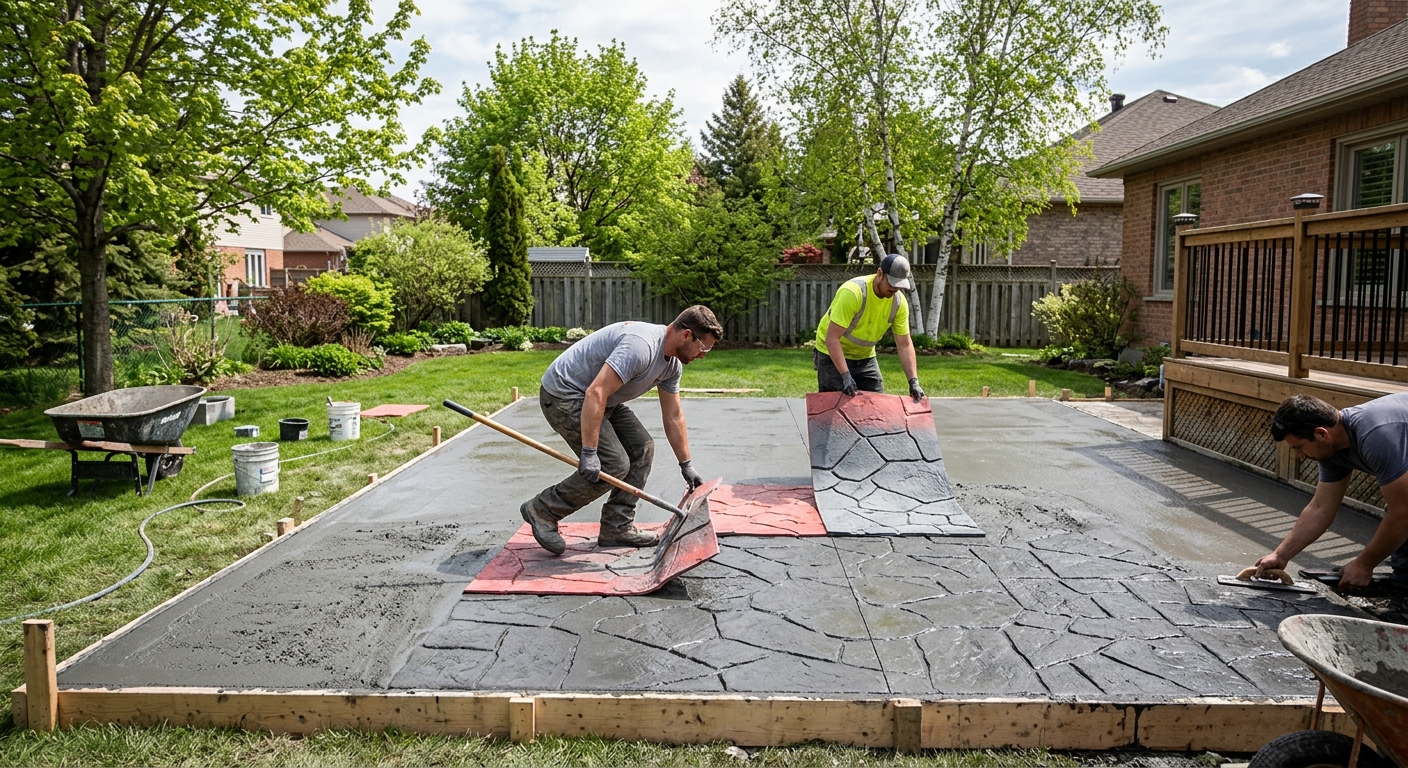
Concrete examples from Montrose: (1) a driveway on compacted native soil with good access will price closer to the low-to-mid range, while one requiring hauling, regrading and deeper base prep often moves toward the top end of the $12,000–$18,000 driveway band; (2) a stamped patio typically costs more than a broom-finished option because labour time increases substantially, which is why stamped jobs often track through $15,000–$26,000. On older neighbourhood properties, foundation or perimeter rework may also uncover unexpected fill or poor drainage, adding hundreds to thousands in excavation and drainage prep.
| Price Factor |
Why It Matters |
Cost Impact |
| Frost line depth |
Determines footing depth and form height |
More excavation and concrete = higher footing budgets (often drives foundation quotes toward the high end) |
| Site preparation |
Excavation, grading, compacted granular base |
Unstable soils or heavy removal can add days of labour and hauling |
| Reinforcement |
Rebar or wire mesh requirement |
Steel plus tying/placement time increases cost, especially on larger slabs |
| Mix design |
Air-entrainment and compressive strength spec |
Exterior air-entrainment and engineered strength specs typically add material cost vs plain mixes |
| Finish type |
Broom vs. stamped vs. exposed aggregate |
Stamped/exposed require extra labour steps and more controlled curing |
| Pour size and concrete truck access to site |
Distance, reach, and staging impacts productivity |
Long wheelbarrow distances or tight access increases labour time and risk |
| Cold-weather curing precautions |
Heating and blankets |
Winter rentals and setup protect curing when temps drop |
| Control joint pattern and sealing cost |
Prevents random cracking and improves durability against salts |
Proper jointing + sealers add line items but reduce long-term repair likelihood |
Permits & regulations in Alberta
In Alberta, if you’re building or modifying structural concrete—think foundation walls, footings, grade beams and any engineered structural elements—a building permit is typically required, and engineered drawings are commonly reviewed by the municipality. For concrete flatwork like patios, walkways and driveways, a permit is often not required by default. However, you may need one if the work affects lot grading, changes drainage patterns, or touches municipal requirements around impervious surface coverage or right-of-way considerations. Because requirements can vary by scope and location within the municipality, confirm with the local authority before breaking ground.
Regardless of permit needs, verify your contractor is properly insured and accountable. Step-by-step for a homeowner in Montrose: (1) ask for a certificate of insurance showing general liability (and specifically concrete/contractor coverage) for the job period; (2) confirm workers’ compensation coverage (WSIB/WCB) by requesting documentation—your contractor should be able to provide a clearance letter or proof of account coverage; (3) for licensing: check that the business is eligible to perform the type of work proposed, then request the contractor’s contact details and proof of standing before scheduling excavation; and (4) ask for references on similar-scope projects in Calgary-area conditions (freeze–thaw + winter curing). If they can’t provide references or won’t show insurance/coverage paperwork, that’s a major warning sign.
Getting concrete right in Montrose's freeze-thaw climate
Concrete failure in Montrose usually isn’t “bad luck”—it’s a spec and construction sequence issue in a climate that punishes mistakes. Freeze–thaw cycling, de-icing salt exposure, and deep frost make air-entrainment, base preparation and curing non-negotiable. If the base is under-compacted, the slab settles and cracks; if air content is low, water moves in and spalling starts; and if curing is rushed when temperatures drop, surface scaling can develop and widen over time.
To spec the job correctly for Calgary-area conditions: (1) base preparation—excavate to the required depth for frost performance and compact a granular sub-base in lifts to achieve the density the engineer/contractor is targeting; (2) mix design—order an air-entrained mix; for exterior flatwork, target about 5–7% air content, and require a minimum 32 MPa compressive strength depending on the application; (3) control joints—plan joint spacing and sawcut timing to control where cracking occurs; (4) curing—plan for at least 7 days of curing under proper conditions; in cold weather, use insulating blankets and protection to maintain curing temps; and (5) sealing—apply a penetrating sealer after the concrete has cured, commonly around 28 days post-pour, to help repel salt and reduce surface deterioration.
A practical budget example: replacing a broom-finished driveway with a stamped finish might add material and labour (often pushing the project into the $15,000–$26,000 band for stamped work versus broom-finish at $12,000–$18,000). That premium is justified when the base prep, air-entrainment, jointing and curing are still handled correctly—stamping alone won’t prevent spalling if the mix and curing are compromised.
| Spec |
Why It Matters in Montrose |
What to Ask For |
Impact if Skipped |
| Compacted granular base (depth?) |
Supports the slab through deep seasonal frost movement |
Compaction method + base depth to match frost/soil conditions |
Settling and random cracking, especially after freeze–thaw cycles |
| Air-entrained concrete mix (target air %?) |
Helps concrete resist freeze–thaw damage |
Confirm target 5–7% air content for exterior flatwork |
Higher risk of spalling and scaling with winter salts |
| Compressive strength (MPa rating) |
Provides structural durability for Alberta conditions |
Minimum 32 MPa compressive strength (per application) |
Reduced long-term performance and increased surface wear |
| Control joints (spacing per ACI guidelines) |
Controls crack locations to protect aesthetics and water movement |
Planned joint spacing and sawcut timing |
Random cracking that can allow water to enter and expand damage |
| Minimum 7-day curing period |
Ensures strength gain and durability |
How curing will be managed if temps drop (blankets/heating) |
Surface scaling, weak top layer, and premature deterioration |
| Penetrating sealer (when applied after cure) |
Improves resistance to de-icing salt exposure |
Sealer type and timing—often about 28 days after pour |
Faster salt-driven spalling and higher maintenance/reseal costs |
How to choose a concrete work contractor in Montrose
Choosing the right contractor for concrete in Montrose is less about the lowest number and more about proof: insurance, experience with frost/freeze–thaw specs, and a scope that protects you from later surprises. In Alberta, verify the contractor carries liability insurance and has workers’ compensation coverage (WSIB/WCB). How to check each: request a current certificate of insurance for the specific project dates (not an old copy) and confirm coverage limits; ask for proof of WSIB/WCB coverage or a clearance letter that matches the contractor and job; and confirm the contractor is set up to perform the work they’re proposing (and ask for the business contact details and references).
Then get 2–3 itemised written quotes instead of one lump sum. You want labour and materials broken out—especially for excavation, granular base, reinforcement, concrete supply (air-entrainment), finishing steps (broom vs stamped), and any disposal/haul-off. Carefully read what’s excluded: permit pull, protection of existing landscaping, and concrete cutting/sawing are commonly misunderstood. Ask about warranty: confirm workmanship warranty length, whether product/manufacturer warranties apply to sealers or admixtures, and whether any warranty is transferable if you sell the home. For payments, keep control—never pay more than 10–15% upfront, and hold back a portion until the job is complete and surfaces cure as agreed. Get the timeline in writing with a start date and completion estimate; in cold weather, a contractor should also describe curing protection plans.
- Ask for their specific air-entrainment and strength specs for your exterior pour.
- Confirm control joint layout and sawcut timing before the pour.
- Verify they will protect curing in cold weather (blankets/heating where needed).
- Insist on itemised excavation, haul-off/disposal and granular base quantities.
- Check they include compaction and base preparation, not just “fill and pour.”
- Review whether reinforcement is included (mesh vs rebar) based on your application.
- Confirm finish materials (sealer type, stamping/exposed aggregate release and wash process).
- Ask for proof of liability insurance matching your project dates.
- Request WSIB/WCB clearance/proof for the contractor and crews.
- Confirm warranty terms in writing (workmanship and any sealer-related coverage).
- Use a clear payment schedule with a holdback until cure completion and cleanup.
- Get start date, weather contingency plan, and completion target in writing.
Concrete red flags in Montrose include: skipping air-entrainment or refusing to state air/strength targets, calling control joints “optional,” quoting without detailing excavation and granular base depth, pressuring you for high upfront payment, and failing to show current insurance/WSIB/WCB documentation.
Frequently asked questions — concrete work in Montrose
How do I seal concrete to protect it in Montrose?
Sealing in Montrose is about managing water and salt exposure. After your concrete cures (commonly about 28 days for exterior slabs), a penetrating sealer soaks into the pores and helps repel de-icing salts and water. In Calgary-area freeze–thaw conditions, this matters because salt-driven scaling can start at the surface and progress as temperatures swing. Before sealing, the concrete should be clean and fully dry—no fresh paint/curing compounds, and any efflorescence needs to be addressed first. For pricing context, a plain broom-finish patio or walkway often sits around $5,000–$9,000, while the sealer line item is usually minor compared to the cost of redoing a failed surface. If you’re pouring in colder weather, make sure your contractor protects curing; sealing won’t fix weak top surfaces caused by poor curing.
What is the difference between concrete and cement?
Cement is one ingredient; concrete is the finished building material. In everyday terms, cement is the binding component that reacts with water, while concrete includes cement plus aggregates (sand/gravel), water and typically admixtures like air-entraining agents for exterior durability. In Alberta’s freeze–thaw climate, the “concrete” part is engineered—especially the air-entrained mix—so the slab can resist spalling when water freezes inside the paste. When contractors talk about a 32 MPa mix or target air content, they’re specifying the concrete formulation, not just the cement. This is why you should ask whether the project uses an air-entrained exterior mix and what strength is specified—especially for driveways and patios exposed to winter salts.
How much does concrete work cost in Montrose?
Concrete costs in Montrose generally track the same Alberta pricing realities seen in the Calgary region: excavation depth, frost considerations, and finish labour. As a quick guide, a concrete driveway (standard broom finish) commonly budgets around $12,000–$18,000 depending on site prep and access. Patios and walkways often fall around $5,000–$9,000 for typical residential sizes. If you want decorative work, stamped concrete driveways or patios often move up into $15,000–$26,000 because the process takes more steps and requires tighter control. For foundation / footings, budgets often sit around $28,000–$45,000, largely because excavation is more intensive and the frost-protected design depth drives concrete and formwork volume. In cold-weather pours near shoulder seasons, curing precautions can shift a quote toward the higher end, so always ask what’s included for curing protection.
How deep must footings be for Montrose's frost line?
For Montrose projects, footings are typically designed to bear below the local design frost depth to reduce frost heave and seasonal movement. Based on local practice in the Calgary area, a design frost depth of about 1.2 m (roughly 4 ft) is commonly referenced for residential foundation considerations, but your exact footing depth should be confirmed by your engineer and approved drawings for your site conditions. The key homeowner takeaway is that footings are not “one depth fits all”—soil type, local geotechnical findings and engineered requirements can change the final design. Because of that, the best way to answer your specific question is to ask your contractor to follow the approved foundation design and provide the footing depth and bearing requirements from the drawings. Skipping this step is one of the most expensive mistakes in Alberta climates.
Why does concrete crack in Montrose and how is it prevented?
Concrete cracks in Montrose primarily because concrete contracts as it cures, then expands and contracts with temperature swings and moisture movement. In freeze–thaw conditions, water movement and subgrade movement can also contribute if the granular base isn’t properly prepared and compacted. The good news: you can prevent uncontrolled cracking with the right plan. Ask your contractor for a control joint layout with correct spacing and sawcut timing so cracks happen in predictable locations. A proper compacted granular base helps prevent settlement-related cracking. For exterior durability, ensure the mix is air-entrained and the curing is protected—because inadequate air content and rushed curing often show up as surface scaling and spalling, even if the slab otherwise looks “fine.” A properly built driveway or patio in Alberta is built for the winter cycle, not just for one summer season.
Stamped vs broom-finish concrete — cost difference?
Stamped concrete costs more than broom-finish because it’s labour-intensive and detail-driven. With stamped concrete, contractors add multiple layers of work: stamping mats, release agents, timing control, finishing consistency, and careful curing so the pattern holds up through the freeze–thaw cycle. Broom-finish is simpler—typically a standard trowel/broom texture with a straightforward joint layout. In Montrose, you can expect stamped driveways and patios to commonly price in the $15,000–$26,000 band, while a standard broom-finished driveway often budgets around $12,000–$18,000. The important caveat: if the air-entrainment, base prep, control joints and curing precautions aren’t handled correctly, stamped concrete won’t be “stronger” just because it looks decorative. Always compare itemised specs, not just the decorative finish.