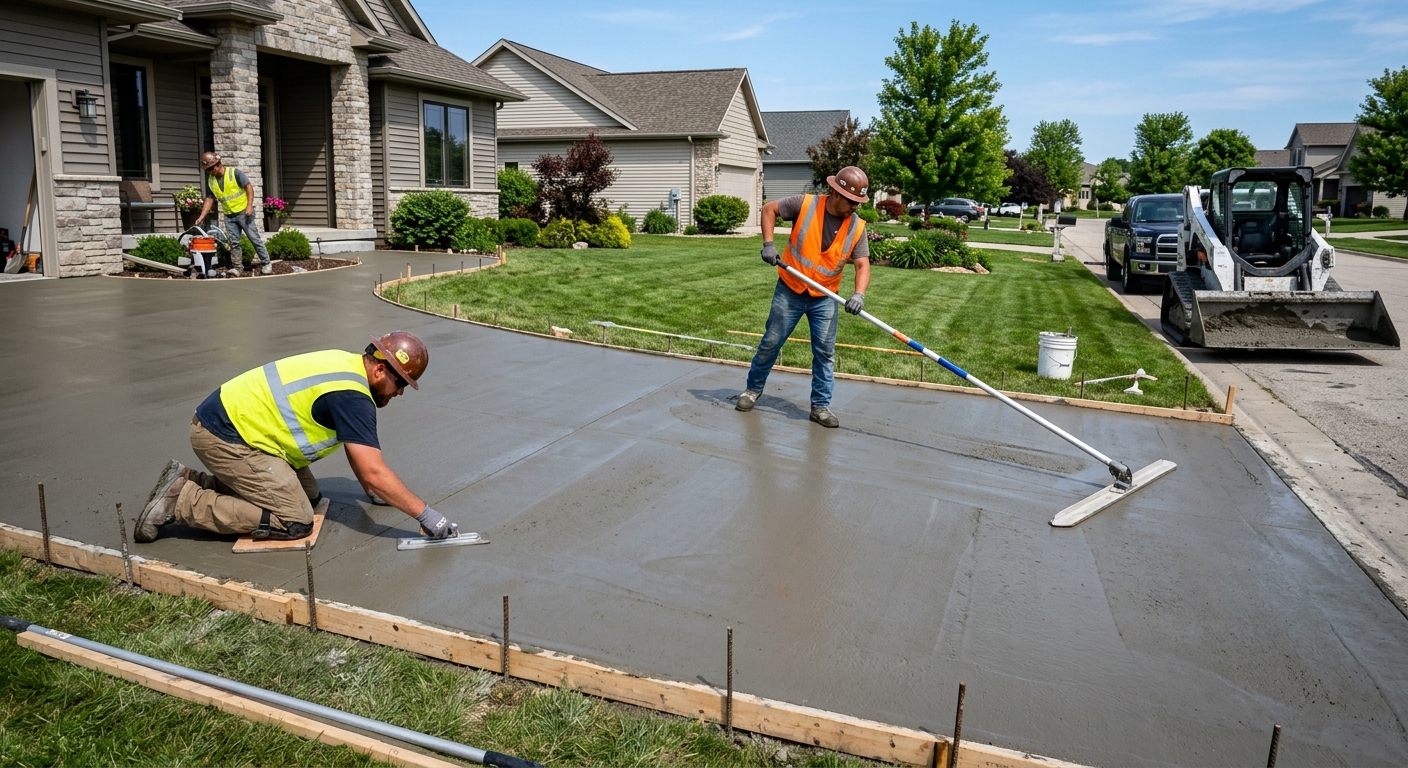
Concrete work options and costs in Eau Claire
Eau Claire, Alberta is a small community on the Calgary side of things, and that shows up in concrete pricing: demand is steady, but crews can be tied up with bigger projects in the metro. With a population of 1,875 (Statistics Canada, 2021 Census), many homeowners are upgrading driveways, patios, and foundation elements on similar lot sizes and soil conditions, so contractors tend to price with the same engineered assumptions for frost protection and drainage. The local housing mix also matters—most projects you’ll see are single-detached homes and accessory builds, which drives repeat demand for driveway and walkway work (Statistics Canada, 2021 Census).
In Calgary’s cold continental climate, costs aren’t just about “concrete thickness.” The design frost depth is engineered to be around 1.2 m (about 4 ft) in this region, so footings for houses, garages, and retaining structures must bear below that depth. Freeze–thaw cycles then push specs toward air-entrained mixes, granular base prep, and control joints to reduce cracking and spalling. The practical pour season for exterior flatwork is shorter, and if you’re placing concrete in late fall or early spring, cold-weather measures (insulating blankets, sometimes temporary heat) can add labour and materials. That’s why two contractors quoting the same driveway can be 30–50% apart when one includes proper base, air-entrainment, and curing protection and the other doesn’t.
In Eau Claire—especially around established residential pockets near local busier streets where access is tighter—driveways and garage approaches are in particularly high demand, and truck access and disposal handling can become a cost driver. Below are common options and realistic ranges to help you compare like-for-like in your quote.
| Application |
Typical Size |
Key Spec |
Finish Option |
Price Range |
| Concrete driveway (standard broom finish) |
20 ft x 10 ft (200 sq ft) |
Air-entrained exterior mix, engineered base |
Broom finish, joints cut/sealed where required |
$12,000 – $16,000 |
| Exposed aggregate driveway |
20 ft x 10 ft (200 sq ft) |
Air-entrained exterior mix, proper curing |
Exposed aggregate with sealed surface |
$16,000 – $18,000 |
| Stamped concrete driveway or patio |
16 ft x 12 ft (192 sq ft) |
Air-entrained exterior mix, colour hardener |
Stamped pattern with release agent and seal |
$18,000 – $26,000 |
| Plain concrete patio or walkway |
10 ft x 12 ft (120 sq ft) |
Exterior air-entrained mix, compacted base |
Light broom or smooth trowel (sloped) |
$5,000 – $9,000 |
| Garage floor (interior slab) |
20 ft x 22 ft (440 sq ft) |
Fibre or mesh reinforcement (site-dependent) |
Broom finish or light trowel |
$12,000 – $17,000 |
| Foundation footings (structural, below frost) |
Typical house footing perimeter |
Reinforced concrete, excavation to frost depth |
Engineered finish (not decorative) |
$28,000 – $45,000 |
Prices are estimates only and vary by project scope, site access and material selection.
What affects the price of concrete work in Eau Claire
In Eau Claire and the wider Calgary economic region, quotes for the same-looking job can differ by 30–50% because “concrete” is only one line item. Contractors may be pricing different assumptions for excavation depth, granular base thickness, reinforcement, mix design, and how much labour it takes to place and cure in a cold-weather schedule. In this region, frost depth engineering and freeze–thaw cycles dictate nearly every spec: exterior work must be built to bear below the design frost depth (about 1.2 m here) and most slabs benefit from air-entrained mixes to survive repeated freezing and thawing. Placement is also time-sensitive—shorter pour seasons mean crews may schedule differently, and cold-weather curing (blankets/heating) can add cost if you’re not pouring in the warmest window.
De-icing salt is another Alberta reality. Salt accelerates surface deterioration, so sealed, properly cured slabs tend to last longer than “poured and left alone” concrete. That’s why a standard driveway might land closer to the $12,000–$18,000 band when base and air entrainment are done correctly, while stamped or exposed finishes can jump toward the $15,000–$26,000 range because of additional materials, labour, and longer finishing time. For patios and walkways, plain work can still be in the $5,000–$9,000 band, but only when excavation, compaction, and slope/drainage are treated as part of the system.
Here are a few Eau Claire examples where local conditions raise or lower costs: (1) tight side-yard access that limits truck placement increases labour and sometimes pump or haul time; (2) “soft” topsoil that needs deeper excavation and replacement can add base volume and disposal; (3) a late-season patio pour that requires insulation blankets and extended protection can add curing time and cost even if the concrete volume is similar. On older homes, you may also find utility adjustments (service lines, low spots, or drainage corrections) that affect the final slab elevation—those changes can influence both material quantity and site prep.
| Price Factor |
Why It Matters |
Cost Impact |
| Frost line depth — determines footing depth and form height |
Footings must bear below design frost to prevent heave |
Higher excavation volume; can push foundation costs toward the upper band |
| Site preparation — excavation, grading, compacted granular base |
Proper base reduces settlement and keeps slab flat long-term |
Soft soils and removal/add-back can significantly increase labour and materials |
| Reinforcement — rebar or wire mesh requirement |
Controls cracking and improves structural performance |
Extra steel and placement labour; often necessary for slabs with heavier loading |
| Mix design — air-entrainment and compressive strength spec |
Air-entrainment helps resist freeze–thaw damage |
Winter-grade options and engineered strength add cost but reduce failure risk |
| Finish type — broom vs. stamped vs. exposed aggregate |
Finish complexity drives additional labour and materials |
Stamped/exposed typically costs more than standard broom finished work |
| Pour size and concrete truck access to site |
Placement logistics affect crew time and consolidation quality |
Limited access can require extra labour, hauling, or scheduling changes |
| Cold-weather curing precautions — heating and blankets |
Concrete must maintain curing temperatures to reach strength |
Blankets, heaters, monitoring time—especially in late fall/early spring |
| Control joint pattern and sealing cost |
Joints manage cracking; sealing protects against salt and scaling |
Additional saw cutting and product; improves long-term durability |
Permits & regulations in Alberta
In Alberta, structural concrete work usually needs a building permit and often engineered drawings that the municipality reviews. That includes concrete that is part of the structure—such as foundation footings, foundation walls, and grade beams. For concrete flatwork like driveways, patios, and walkways, permits are often not required on their own, unless the work affects lot grading, impervious surface coverage limits, or requires changes that touch a municipal right-of-way or curb/sidewalk area. Because requirements can change by lot conditions, it’s smart to confirm with the local authority before breaking ground.
For your Eau Claire project, verify the contractor before they mobilize:
Step 1: Ask for their Alberta contractor details (and confirm they are eligible for the work type, especially for structural items). Step 2: Request a certificate of liability insurance and make sure it lists your project address or includes them as the contractor of record for the job. Step 3: Confirm they have the required WSIB/WCB coverage for their workers (you’re looking for proof, not verbal reassurance). Step 4: Ask for clearance documentation and a couple of references on comparable-scale concrete jobs in similar climate conditions. Step 5: Keep the permit/approval responsibilities clear in writing—who pulls the permit (if needed), what drawings are required, and what inspections apply.
If it’s foundation work, don’t accept “we’ll handle it later.” Require the permit/engineering path upfront so you’re not paying for rework.
Getting concrete right in Eau Claire's freeze-thaw climate
Concrete failures in Eau Claire are rarely “mystery problems.” They’re usually the result of a weak system: insufficient base, poor mix design for freeze–thaw, incorrect jointing, or curing that gets interrupted by cold snaps and poor temperature control. In this Calgary region, the design frost depth is around 1.2 m, so footings and slab supports must be engineered to sit on undisturbed soil below that depth. For exterior flatwork, the mix should be air-entrained—commonly 5%–7% air content for exterior exposure—so water in the paste can freeze without causing the same internal pressure that leads to spalling.
To spec the job correctly, focus on five practical areas: (1) base preparation—a compacted granular sub-base to the right depth for your soil and frost conditions; (2) mix design—air-entrainment plus a minimum 32 MPa compressive strength; (3) control joints—spacing that encourages cracking where it’s expected; (4) curing—minimum 7 days under suitable conditions, with blankets or heat when temperatures are dropping; and (5) sealing—a penetrating sealer applied after cure to repel de-icing salts.
Ask contractors how they’ll prevent spalling specifically. If someone proposes plain (non-air-entrained) concrete or avoids curing protection in shoulder seasons, that’s where you’ll see premature scaling.
For a dollar reality check: a standard broom-finished driveway may come in around the $12,000–$18,000 band. If you upgrade to stamped concrete, the typical shift is driven by extra finish labour and materials—often placing the project closer to the $15,000–$26,000 band. The cost difference is justified when the contractor still includes proper base, air entrainment, and curing protection—otherwise you pay more for a finish without fixing the durability.
| Spec |
Why It Matters in Eau Claire |
What to Ask For |
Impact if Skipped |
| Compacted granular base (depth?) |
Eau Claire freeze–thaw and frost-driven movement need a stable support layer |
Base depth to engineered design, compaction test/verification, correct drainage slope |
Settlement and uneven cracking; premature joint failure and water ponding |
| Air-entrained concrete mix (target air %?) |
Prevents internal damage when water freezes and expands repeatedly |
Exterior air content target of 5%–7% and documented mix design |
Higher chance of surface scaling and spalling during Alberta winters |
| Compressive strength (MPa rating) |
Strength gain is needed for durability under snow loads and de-icing exposure |
Minimum 32 MPa and proper cure temperature/time |
Weak surface, scaling, and reduced long-term abrasion resistance |
| Control joints (spacing per ACI guidelines) |
Controls where cracks occur so they don’t become random fractures |
Joint spacing plan for your slab size and thickness; saw cutting schedule |
Random cracking, water infiltration, and freeze–thaw escalation at cracks |
| Minimum 7-day curing period |
Cold snaps can interrupt hydration and reduce strength development |
Written curing plan; blankets/heating if temps will be low during the cure window |
Surface damage, reduced strength, and early deterioration |
| Penetrating sealer (when applied after cure) |
Repels salt and reduces moisture movement into the paste |
Sealer applied about 28 days post-pour (after cure) unless product dictates otherwise |
Faster salt-related spalling and scaling; more maintenance earlier |
How to choose a concrete work contractor in Eau Claire
Choosing the right concrete contractor in Eau Claire is mostly about verifying the basics and demanding clear scope. First, confirm Alberta coverage and legitimacy: ask for liability insurance (certificate of insurance), then request proof of WSIB/WCB coverage for their workers. If the contractor can’t provide it, don’t proceed. Next, get 2–3 quotes that are truly comparable—ideally itemised with a labour + materials breakdown, not just a lump sum. That should include excavation/base prep, concrete volume and mix design, reinforcement (if required), finishing method, saw-cut timing, and any sealing allowance.
Read exclusions carefully. Common “gotchas” include disposal not being included, extra excavation for poor subgrade treated as a change order, and permit or inspection responsibilities that aren’t spelled out. For structural work like footings and grade beams (when applicable), make sure permits/engineering are addressed up front. For flatwork, ask whether sealing is included and what happens if the job must shift due to cold-weather scheduling and curing requirements.
Warranty matters too. Require a workmanship warranty length, clarify whether there’s a product/manufacturer warranty (for sealers or speciality mixes), and note whether the warranty is transferable if you sell your home. For payment scheduling, keep it conservative—never pay more than 10%–15% upfront, and hold back a portion until finish quality and cleanup are complete. Also get a written start date and completion estimate.
- Ask for the mix design (air-entrainment and target strength) and confirm it’s for exterior freeze–thaw exposure.
- Require base thickness and compaction details (and whether they’ll verify compaction).
- Confirm reinforcement approach (mesh vs. rebar, and when it’s used).
- Get a jointing plan: spacing and who controls the saw-cut timing.
- Ask how they handle cold-weather curing (blankets/heating) if temps drop.
- Confirm sealing scope: product type and timing (around 28 days post-pour).
- Make sure disposal, dump fees, and haul distance are included or clearly excluded.
- Clarify site access: where trucks can pour from, and how they manage limited access.
- Demand an itemised quote that breaks down labour and materials.
- Check warranty details in writing—workmanship, products, and whether it’s transferable.
- Confirm insurance and WSIB/WCB proof before work starts.
- Never accept “verbal scope.” Everything important should be in the contract.
Concrete red flags in Eau Claire: contractors quoting “thin concrete” without engineered base depth; promises of decorative finishes without a curing plan; missing or vague insurance/WSIB/WCB proof; withholding jointing or sealing scope until after the pour; and schedules that ignore cold-weather placement requirements, especially for exterior slabs.
Frequently asked questions — concrete work in Eau Claire
Can concrete be poured in cold weather in Eau Claire?
Yes, but not the same way as in midsummer. In Eau Claire and the broader Calgary region, cold-weather placement has to be engineered around freeze–thaw risk and proper curing. Many contractors can pour when temperatures are low if they use cold-weather practices such as winter-grade mixes, insulating blankets, and monitoring to keep the concrete warm enough for hydration. This is why scheduling matters: late fall or early spring pours often need extra labour and materials for curing protection. If the job is a driveway in the $12,000–$18,000 band, the “real” difference is often whether cold-weather curing is included, not just the concrete volume. Always ask your contractor for a written cold-weather curing plan and confirm minimum cure time (typically 7 days) before they move on.
How do I maintain concrete in Eau Claire's freeze-thaw climate?
Maintenance is about protecting the slab from moisture movement and de-icing salt. In Eau Claire’s winter conditions, the most effective steps are (1) keep the surface clean of grit and sand that can abrade; (2) use de-icing products appropriately and avoid over-salting; (3) seal exterior concrete after cure—typically about 28 days post-pour—so salt has less direct access to the paste; and (4) address small cracks early if they allow water ingress. Proper joints and a good sealer reduce freeze–thaw escalation at crack locations. If your project included a decorative finish (often closer to the $15,000–$26,000 range), sealing becomes even more important because surface texture can trap residues. For any settled spots or drainage issues, fix the grading first—sealing alone won’t fix ponding.
What causes concrete to spall in Eau Claire winters?
Spalling usually comes from water getting into the concrete and freezing, then expanding and breaking the surface. In Alberta winters, two common drivers are inadequate air-entrainment and poor curing conditions during placement. Without proper air-entrainment (commonly targeted around 5%–7% for exterior work), the freeze–thaw cycle can damage the paste and lead to surface scaling and spalling. The other big contributor is missing or poorly planned joints and base prep, which allow water to pool or infiltrate cracks. Salt then accelerates surface deterioration. If you see spalling on a driveway or walkway, it’s often tied to an earlier spec or construction sequence choice—especially if the contractor didn’t include sealing. When comparing bids, the safe assumption is that properly specified exterior flatwork should perform well even if it costs more; skipping air-entrainment and curing protection is what typically makes the cheaper quote fail sooner.
What is rebar and when is it required in Alberta?
Rebar (reinforcing steel bars) is used to strengthen concrete and control cracking, particularly where tensile stresses occur. In Alberta, whether rebar is required depends on the engineered design and the type of concrete element—not just the homeowner’s preference. For structural concrete like foundation footings, grade beams, and foundation walls, reinforcement is typically designed by an engineer and is part of the structural system (and often tied to permitting and inspections). For flatwork such as garage floors, driveways, and patios, rebar or mesh may be required based on thickness, soil conditions, and loading (for example, heavier vehicle use or poor subgrade). In Eau Claire’s freeze–thaw environment, reinforcement works best when paired with proper base compaction, air-entrained concrete, and correct jointing. If a contractor can’t explain why reinforcement is (or isn’t) included for your specific application, ask for the thickness and reinforcement details in writing.
How long does a concrete project take in Eau Claire?
Timeline depends on the scope and—very importantly—curing and weather. For typical exterior flatwork, the actual pour day is often short (a crew may place and finish in hours), but the project duration includes excavation, forming, base prep, finishing, and curing protection. Even after the surface “looks done,” concrete needs time to gain strength: a minimum of about 7 days is a common benchmark before heavy loads, and decorative or more specialized work may need additional protection. If temperatures are dropping, curing blankets or temporary heat can extend the on-site schedule. For example, a standard driveway in the $12,000–$18,000 band might be completed in about a week from first excavation to usable status, but cold-weather curing can stretch the safe-use timeline. Always request a written start date and completion estimate, and ask how weather impacts their curing plan.
What is a concrete overlay and is it suited to Eau Claire?
A concrete overlay is a new thin concrete layer (often bonded with special preparation) placed over an existing slab to restore appearance or extend service life. In Eau Claire’s freeze–thaw climate, overlays can be suitable if the existing concrete is structurally sound and the surface is prepared correctly—meaning proper cleaning, soundness verification, and correct bonding system. Overlays are not a good solution if the base is failing, the slab is heaving, or there are major drainage problems; water movement will continue to attack from below or through cracks. If you’re dealing with minor surface deterioration, an overlay may cost less than full replacement, but the durability depends on proper prep and the overlay mix design for exterior conditions. Because Eau Claire projects often include salt exposure, overlays should be planned with joints and sealing in mind. If you’re unsure, ask for a condition assessment before choosing between overlay versus replacement.