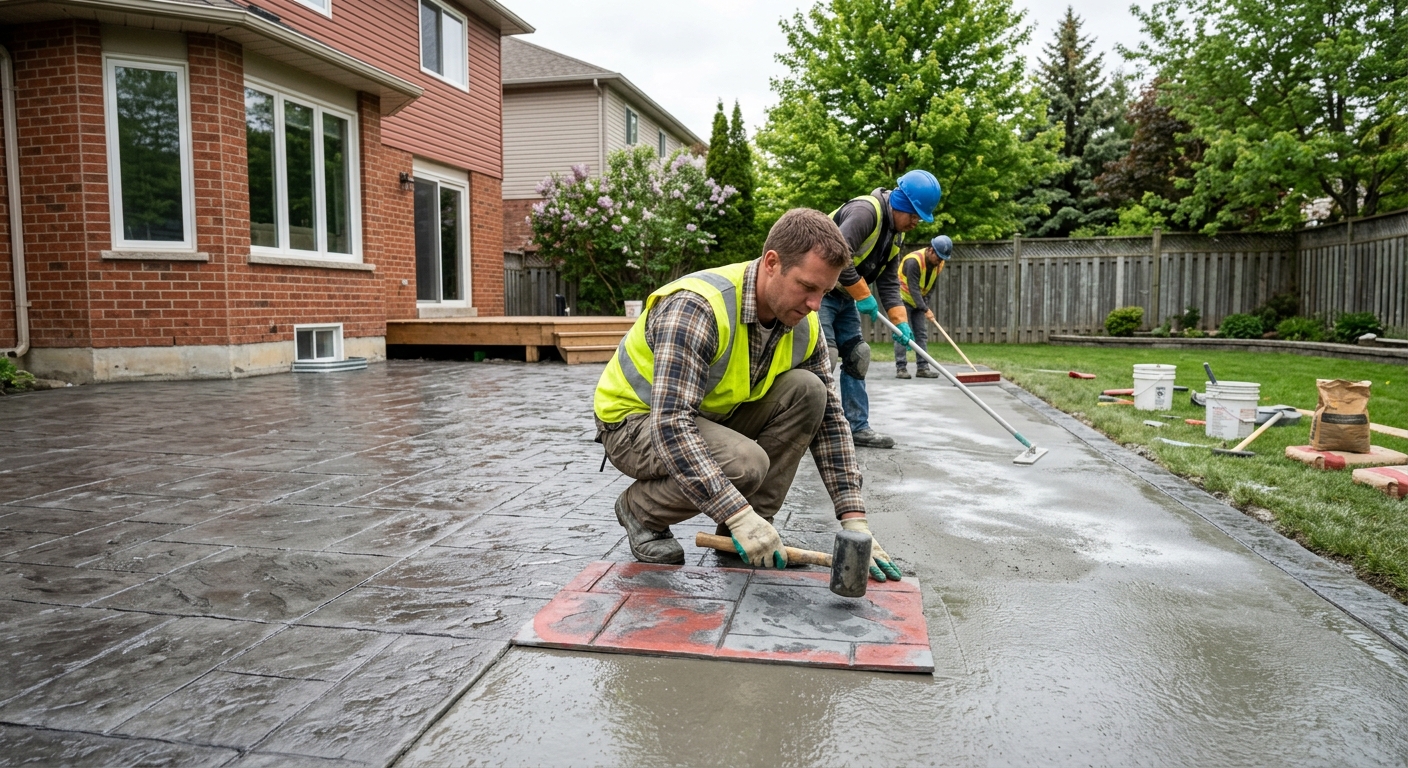
Concrete work options and costs in Mission
In Mission, Alberta, concrete work tends to be planned around a cold continental climate and the realities of freeze–thaw. With a population of 4,505 (Statistics Canada, 2021 Census), demand is steady for driveway and patio repairs, garage slabs, and the structural concrete that supports newer home builds and renovations. The primary market for exterior flatwork typically comes from single-detached home lifestyles in neighbourhoods like Westgate and the surrounding Mission area, where owners want durable, low-maintenance surfaces for daily use and seasonal weather.
In the Calgary economic region, contractors price concrete based on more than just surface square footage. Frost-depth engineering is a major driver: exterior foundations and footings must extend below undisturbed soil depth to reduce frost heave. Freeze–thaw cycling also pushes spec decisions—air-entrained concrete for exterior slabs, proper granular base preparation, and control joints to limit cracking and future spalling. Because the pour season is shorter and cold-weather placement is more common, you may see higher labour and materials costs for insulation blankets, winter-grade admixtures, and careful curing to protect the slab during the first week.
That’s why two homeowners in Mission can receive noticeably different quotes for “the same” driveway: one may need deeper excavation for frost protection and reinforcement, while the other can reuse more of the existing base. Use the ranges below as a practical starting point, then compare finish choices and site constraints in the table to narrow down realistic expectations.
| Application |
Typical Size |
Key Spec |
Finish Option |
Price Range |
| Concrete driveway (standard broom finish) |
24 ft x 10 ft (240 sq. ft.) |
Air-entrained mix, granular base, control joints |
Broom finish |
$12,000–$18,000 |
| Exposed aggregate driveway |
24 ft x 10 ft (240 sq. ft.) |
Air-entrained mix, thorough base prep |
Exposed aggregate with sealer |
$16,000–$22,000 |
| Stamped concrete driveway or patio |
20 ft x 12 ft (240 sq. ft.) |
Air-entrained mix, fibres/additives as required |
Stamped pattern with release agent |
$15,000–$26,000 |
| Plain concrete patio or walkway |
10 ft x 12 ft (120 sq. ft.) |
Air-entrained mix, 1/4 in per ft slope where needed |
Broom finish or light float |
$5,000–$9,000 |
| Garage floor (interior slab) |
22 ft x 20 ft (440 sq. ft.) |
Vapour barrier (as required), engineered base, reinforcement |
Float finish or broom finish |
$10,500–$17,500 |
| Foundation footings (structural, below frost) |
Typical detached home footing system |
Engineered footing design, rebar cages, below frost excavation |
Structural concrete (no decorative finish) |
$28,000–$45,000 |
Prices are estimates only and vary by project scope, site access and material selection.
What affects the price of concrete work in Mission
In the Calgary region around Mission, two quotes for the same-looking concrete project can differ by 30–50% because concrete is “engineered work,” not just a poured surface. Your final price is shaped by excavation volume, base preparation, reinforcement, mix requirements, finish type, and the winter/cold-weather curing plan. When a contractor prices a driveway or patio, they’re often pricing three things at once: the concrete, the ground preparation, and the risk-control measures needed to survive frost and freeze–thaw.
Frost-depth requirements are a primary driver. In Alberta, footings for houses, garages, decks and retaining structures must bear on undisturbed soil below the design frost depth (roughly 1.2 m, about 4 ft). That means deeper excavation, more hauling and more formwork. Freeze–thaw cycling then dictates air-entrained concrete for exterior slabs; without it, you’re more likely to see scaling and spalling over time. Cold-weather placement also shortens the practical pour window and can add costs for winter-grade mixes, insulated blankets, and sometimes temporary heat so the slab reaches proper early strength. Finally, de-icing salt in winter accelerates surface damage—so sealing is often recommended to protect the top layer.
In Mission, a driveway replacement on compacted clay or disturbed soil can push costs toward the higher end of the $12,000–$18,000 driveway band because excavation and granular replacement increase. A stamped patio may cost closer to the $15,000–$26,000 band when extra base prep, release agents, and finishing time are needed for crisp pattern lines. Conversely, a small walkway on stable, easily accessible ground may sit nearer the $5,000–$9,000 band.
| Price Factor |
Why It Matters |
Cost Impact |
| Frost line depth — determines footing depth and form height |
Footings must sit below design frost to reduce frost heave |
Higher excavation and rebar/form labour; can swing structural pricing significantly |
| Site preparation — excavation, grading, compacted granular base |
Correct base depth and compaction prevents settlement and cracking |
Adds hauling, labour and granular material costs; biggest swing factor for flatwork |
| Reinforcement — rebar or wire mesh requirement |
Reduces cracking and improves load distribution |
Material and tying/binding labour; often required for driveways and garage slabs |
| Mix design — air-entrainment and compressive strength spec |
Air-entrainment protects against freeze–thaw; strength supports load |
Winter-grade and designed mixes cost more per yard but reduce long-term failures |
| Finish type — broom vs. stamped vs. exposed aggregate |
Finishes change labour time, materials and cure/handling steps |
Stamped/exposed typically increase price versus plain broom-finish |
| Pour size and concrete truck access to site |
Smaller pours can require more mobilization; limited access increases set-up time |
May require smaller batches, pumps, or additional crew; raises labour costs |
| Cold-weather curing precautions — heating and blankets |
Protects early strength gain and reduces scaling risk |
Can add day-by-day labour and equipment charges during shoulder-season pours |
| Control joint pattern and sealing cost |
Joints manage shrinkage cracking; sealer helps repel de-icing salt damage |
Better protection usually costs a bit more up front but limits failure and future patching |
Permits & regulations in Alberta
In Alberta, structural concrete work typically requires a building permit and often engineered drawings that get reviewed by the municipality. That means items like foundation footings, foundation walls, grade beams, and other structural components connected to the building’s load path should be permitted and inspected. For concrete flatwork—driveways, patios, and walkways—the work usually does not require a permit unless it affects lot grading, impervious surface coverage limits, or municipal right-of-way concerns. Even then, the need for a permit can vary depending on how the slab ties into existing grades or drainage.
Before breaking ground in Mission, verify the contractor is covered and document everything. Step-by-step, ask the contractor for:
- Proof of liability insurance (a Certificate of Insurance showing the insured entity and coverage limits).
- WSIB/WCB clearance or account documentation showing they have appropriate coverage for workers.
- A copy of their business registration and any applicable trade licensing (and confirm who is responsible for the permitted scope).
- References on similar-scale concrete jobs (especially exterior flatwork in freeze–thaw climates).
For your own verification, check the contractor’s insurance documents against the legal name on the quote, and confirm the clearance letter is current. If engineered drawings or permits are required for the structural scope, ask who submits the permit package and whether inspections are included in the schedule. When in doubt, ask your municipality’s building and development staff what applies to your specific scope and lot conditions.
Getting concrete right in Mission's freeze-thaw climate
Concrete doesn’t fail in Mission because it “isn’t strong enough”—it fails most often because the spec doesn’t match the freeze–thaw environment. The most common problems are spalling (surface scaling), cracking from shrinkage and settlement, and premature deterioration where de-icing salts attack the surface. The fix is to spec the whole system: base, mix, joints, curing, and surface protection.
First, base preparation: you need a properly excavated and compacted granular sub-base to the right depth for the local soil and frost conditions. This prevents water movement and minimizes settlement. Second, mix design: for exterior flatwork, require air-entrainment—typically around 5–7% air—plus a minimum 32 MPa compressive strength so the slab can handle winter cycles. Third, control joints: they must be laid out to limit random cracking, with a pattern that fits the slab geometry. Fourth, curing: you should plan for at least 7 days of curing under proper conditions; in cold weather, contractors may need insulated blankets or temporary heat to protect early strength. Fifth, sealing: apply a penetrating sealer after the concrete has cured (commonly around 28 days) to help repel de-icing salt and moisture.
Ask direct questions so you’re not paying for “look” without performance. For example, if a stamped patio quote is higher than a broom-finish patio, the price difference is justified when the contractor also includes correct air-entrainment, joint layout, and cold-weather curing precautions—because those items protect the slab for years. If the quote cuts corners on those, you’re likely buying crack repair later rather than beauty now. In Mission, that’s the trade-off that matters most in a freeze–thaw climate.
| Spec |
Why It Matters in Mission |
What to Ask For |
Impact if Skipped |
| Compacted granular base (depth?) |
Reduces settlement and limits water movement under freeze–thaw cycling |
“What base depth and compaction method are you using, given our soil and frost considerations?” |
Uneven settling, early cracking, and rough surface deterioration |
| Air-entrained concrete mix (target air %?) |
Helps concrete resist freeze–thaw damage and scaling |
“Confirm air content target (typically 5–7% for exterior flatwork).” |
Spalling and surface breakdown in winters with freeze–thaw cycles |
| Compressive strength (MPa rating) |
Supports structural performance and durability in service |
“Provide mix design showing minimum 32 MPa (or higher if engineered).” |
Lower early and long-term strength; increased risk of damage under load |
| Control joints (spacing per ACI guidelines) |
Manages shrinkage cracking and directs it to joints |
“Show planned joint layout and spacing for my slab dimensions.” |
Random cracking and wider, uglier repair zones |
| Minimum 7-day curing period |
Ensures proper early strength gain during cold-season variability |
“How do you protect the slab if temperatures drop? What curing plan is included?” |
Scaling, weak surface, and higher long-term failure risk |
| Penetrating sealer (when applied after cure) |
Repels moisture and helps reduce de-icing salt impact |
“Will you apply penetrating sealer at/after 28 days, and what product do you use?” |
Faster surface erosion and more frequent patching |
How to choose a concrete work contractor in Mission
Choosing a concrete contractor in Mission starts with verification—because in freeze–thaw conditions, workmanship and crew discipline matter as much as the concrete recipe. In Alberta, confirm the contractor is operating legally and carries the right coverage. For licensing, ask which parts of your scope require permits and engineered documentation (structural work typically does). Then check insurance:
- Liability insurance: ask for a Certificate of Insurance showing coverage and the legal business name.
- WSIB/WCB coverage: request a current clearance letter (or equivalent documentation) confirming workers are covered.
- Work history: request references for similar projects—driveways, patios, and exterior flatwork in Calgary’s winter conditions.
Next, get 2–3 itemised written quotes. “Itemised” matters because you want labour and materials separated—especially for excavation, base prep, reinforcement, mix design (including air-entrainment), finishing labour, curing protection, and sealing. Review the exclusions: disposal of excess soil? Permit pull and inspections for structural work? Any work not included if frost depth excavation is deeper than expected? A solid quote spells this out.
Warranty should be clear: ask for workmanship warranty length, any product/manufacturer warranty details, and whether warranty is transferable if you sell the home. For payment, never agree to a large upfront deposit; a common safe approach is 10–15% upfront, then hold back a meaningful amount until completion and cleanup. Finally, get a written timeline with start date and estimated completion—concrete schedules in Mission can shift quickly due to temperature and curing needs.
- Ask for mix details: air-entrainment target and minimum strength (e.g., 32 MPa for typical specs).
- Confirm base depth and compaction expectations (not vague “proper base prep”).
- Require a joint layout plan (where joints go and how spacing is determined).
- Clarify reinforcement (rebar type/spacing or mesh specification).
- Ask what happens if temperatures drop during the pour window.
- Confirm curing protection items are included if cold weather hits.
- Get a written statement on sealing after cure (commonly around 28 days).
- Verify truck access and pumping plan if the site is tight.
- Ensure disposal/hauling is included or priced transparently.
- Check that the quote includes protection of landscaping and cleanup requirements.
- Confirm inspection responsibility for permitted structural scopes.
- Require a clear warranty statement in writing before work begins.
Concrete contractor red flags in Mission include: vague quotes that don’t specify air-entrainment or curing steps, offering “bottom-line cheaper” by skipping control joints or base depth, lack of insurance/clearance documentation, refusing to put the curing and sealing plan in writing, and demanding large upfront payments beyond 10–15% without clear milestones.
Frequently asked questions — concrete work in Mission
What is the difference between concrete and cement?
Concrete is the final engineered material you walk on: cement plus water, plus aggregates (sand and gravel), and sometimes admixtures like air-entrainment. Cement is only one ingredient inside concrete. In Mission and the Calgary region, the “cement + water + aggregate” formula is tuned for freeze–thaw durability—especially for exterior slabs that see winters with frequent freeze–thaw cycles. That’s why contractors talk about mix design and air content: cement alone doesn’t prevent surface scaling if the concrete isn’t air-entrained and properly cured.
When you ask for a quote, look for wording that confirms an air-entrained mix and a minimum strength target like 32 MPa for typical flatwork. You can also expect winter-grade curing precautions to be included for late-season pours, because that early strength gain period drives long-term performance.
How much does concrete work cost in Mission?
In Mission, pricing typically follows Alberta’s frost-engineered realities and Calgary-area labour rates, so costs can move more than homeowners expect. For example, a concrete driveway in the region is commonly estimated in the $12,000 – $18,000 band depending on excavation, base prep, reinforcement, and finish. Plain concrete patios and walkways often land in the $5,000 – $9,000 range based on size, slope, and joint layout. Decorative upgrades like stamped concrete usually sit higher, often in the $15,000 – $26,000 band for comparable surface areas.
Your site conditions matter: if excavation for frost protection and stable granular base is deeper, you’ll pay more. If the project is scheduled in cold weather, curing protection (blankets/heating) can also add cost to prevent scaling or weak surface development.
How deep must footings be for Mission's frost line?
For Mission (Calgary region), local practice uses a design frost depth of about 1.2 m (roughly 4 ft). That typically means house and garage footings must bear on undisturbed soil below that depth to reduce frost heave. The exact requirement depends on soil conditions and your engineered foundation design, but the frost-depth concept is the key reason foundation pricing often isn’t comparable to milder climates.
Homeowners sometimes assume a “shallow footing” is fine, and then excavation volumes explode when stable bearing depth is confirmed. That’s also why permitting and engineering are so important for structural concrete like footings and foundation walls.
Why does concrete crack in Mission and how is it prevented?
Concrete commonly cracks for a few predictable reasons in Mission’s freeze–thaw climate: shrinkage during curing, settlement if the base wasn’t properly prepared, and temperature-driven movement. Freeze–thaw can also reveal weaknesses if the mix lacks sufficient air-entrainment or if curing is rushed—surface scaling and spalling can happen even when hairline cracking looks “small.”
Prevention comes from the right specs: a compacted granular sub-base sized for local soil, an air-entrained mix designed for exterior exposure, control joints placed to manage shrinkage cracking, and a proper curing window. In cold weather, protecting the slab for at least the first week is essential. Sealing after cure is also recommended because de-icing salts can accelerate surface damage.
Stamped vs broom-finish concrete — cost difference?
Stamped concrete costs more mainly because it requires additional labour and material steps: form-ready finishing, stamp timing, release agents, and often additional crew time to keep patterns crisp and uniform under outdoor curing conditions. In Mission, decorative concrete also has to be engineered for winter exposure—so you still need air-entrainment and joint design, which keeps the job “performance-led,” not just cosmetic.
A typical driveway with a broom finish often falls in the $12,000 – $18,000 range, while stamped concrete for a comparable surface area is commonly quoted in the $15,000 – $26,000 band. The higher cost is usually justified when the contractor includes correct base prep, proper joints for crack control, and curing protection. If a stamped quote skips those, the pattern will look good briefly, but durability is the real test in Calgary-area winters.
When is the best time to pour concrete in Mission?
The best time is when temperatures allow proper curing without excessive risk. In the Calgary region, exterior pours in late spring through summer usually provide the most reliable curing conditions. In fall or early spring, you can still pour, but the plan must account for cold nights and temperature swings. That’s where winter-grade mixes, insulated blankets and sometimes temporary heat become necessary to reach proper early strength.
For homeowners, the practical point is scheduling: pour decisions should follow the contractor’s curing plan, not just the forecast. If curing is compromised, you increase the risk of surface scaling—especially where de-icing salts will later be used. Ask your contractor how they protect the slab during the first 7 days and how sealing is timed after cure (commonly around 28 days) for exterior flatwork.