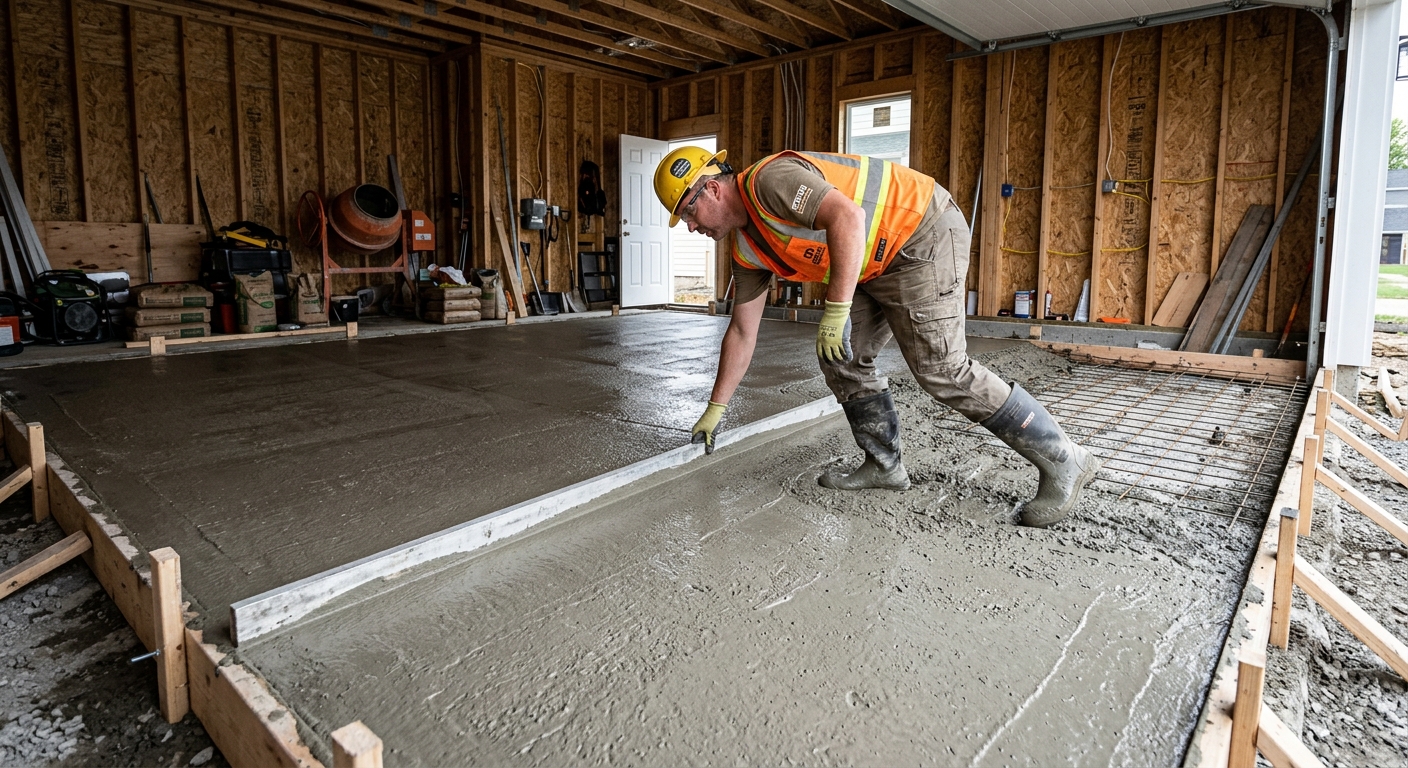
Concrete work options and costs in Ekota
Ekota homeowners typically choose concrete because it holds up well to Calgary-area winters when the mix, base prep, and curing are done correctly. With a 2021 population of 2,563 (Statistics Canada, 2021 Census), demand is spread across smaller residential pockets rather than large downtown projects, so scheduling can be tighter at peak pour times. Most concrete flatwork in this market follows the common single-family housing pattern; concrete driveways, patios and walkways are especially in demand around growing residential streets near SE and SW belt areas of Calgary’s orbit that feed into Ekota, where new builds and upgrades are frequent.
Concrete pricing in the Calgary economic region reflects a cold continental climate: frost depth is engineered to be about 1.2 m (roughly 4 ft), meaning footings must be placed below that depth, and exterior slabs need air-entrained concrete to withstand freeze–thaw cycling. Frequent freeze–thaw also pushes contractors toward granular base prep, well-spaced control joints, and sometimes winter-grade practices. Because the pour season for exterior slabs is shorter, labour availability can spike when temperatures allow placement and finishing.
Below is a practical comparison of the main concrete options homeowners ask for in Ekota, with budget ranges aligned to local contractor pricing and the region’s engineered frost-and-curing requirements. Use this as a starting point before you request itemised quotes for your site access, soil conditions, and finish selections.
| Application |
Typical Size |
Key Spec |
Finish Option |
Price Range |
| Concrete driveway (standard broom finish) |
24 m² (approx. 12 ft × 20 ft) |
Air-entrained mix; compacted granular base; control joints |
Broom finish, edges formed |
$12,000–$18,000 |
| Exposed aggregate driveway |
24 m² (approx. 12 ft × 20 ft) |
Air-entrained mix; proper curing window; surface retarder timing |
Exposed aggregate (stone broadcast) |
$14,000–$22,000 |
| Stamped concrete driveway or patio |
18–30 m² (varies by layout) |
Air-entrained mix; base and joint planning; release-agent system |
Stamp pattern + color hardener/sealer |
$15,000–$26,000 |
| Plain concrete patio or walkway |
12–20 m² (varies) |
Air-entrained mix; compacted base; edge forms |
Smooth trowel + light broom/brush texture |
$5,000–$9,000 |
| Garage floor (interior slab) |
25–35 m² (typical double garage) |
Vapour control measures as needed; joints; curing |
Broom finish; optional hardener |
$8,500–$14,500 |
| Foundation footings (structural, below frost) |
Perimeter for typical house |
Engineered footing design; placed below design frost depth (~1.2 m) |
Structural concrete; rebar as designed |
$28,000–$45,000 |
Prices are estimates only and vary by project scope, site access and material selection.
What affects the price of concrete work in Ekota
In Ekota and across the Calgary region, it’s common to see quotes for the “same” concrete job vary by 30–50% once you account for frost-depth engineering, base prep, reinforcement, and finish complexity. The trade-offs come down to what’s included (excavation and granular supply, rebar/wire mesh, air-entrained mix spec, joints and sealing) versus what’s treated as “allowance” or optional. Even when you’re targeting the same driveway footprint, deeper excavation and higher labour effort can add cost quickly because Calgary-area practice is driven by frost and freeze–thaw.
Here, the design frost depth is about 1.2 m, so footings must be set below that level for houses, garages, decks and retaining structures to reduce frost heave and seasonal movement. Exterior slabs also require air-entrained concrete mixes to handle repeated freeze–thaw cycles, and cold-weather curing precautions—like insulated blankets and sometimes temporary heat—protect strength development during the shorter pour season. De-icing salts used on winters roads and sidewalks can accelerate surface spalling if the mix and finishing details aren’t right, so sealing is often priced as a recommended step.
Two local examples that commonly move the number: (1) stiffer soils and higher groundwater can increase excavation, hauling and granular replacement, pushing a driveway closer to the higher end of the $12,000–$18,000 band; (2) a stamped finish with deeper colour work and more timing sensitivity often shifts a patio toward the $15,000–$26,000 stamped/designer band, because the labour intensity and curing window are tighter. If your home is older and you’re replacing sunken approach slabs or patching around settlement, expect additional saw-cutting and demolition—often costing more than a new, straightforward pour.
| Price Factor |
Why It Matters |
Cost Impact |
| Frost line depth — determines footing depth and form height |
Engineered placement below design frost helps prevent frost heave. |
Higher excavation depth can add substantial labour and concrete volume. |
| Site preparation — excavation, grading, compacted granular base |
Proper base prevents voids and early cracking/spalling. |
Loose subgrade or poor drainage increases material and compaction time. |
| Reinforcement — rebar or wire mesh requirement |
Controls cracking under load and thermal movement when specified. |
Extra steel, chairs, and inspection steps raise cost. |
| Mix design — air-entrainment and compressive strength spec |
Freeze–thaw durability relies on air content and proper strength development. |
Higher-spec mixes and winter-grade adjustments can increase material cost. |
| Finish type — broom vs. stamped vs. exposed aggregate |
Finish affects labour, timing, and sealing requirements. |
Decorative work typically adds labour hours and materials. |
| Pour size and concrete truck access to site |
Limited access increases labour, pumping or multiple deliveries. |
Long wheelbarrow carries and pump requirements can add significant cost. |
| Cold-weather curing precautions — heating and blankets |
Protects strength gain during short pour season and colder nights. |
Temporary heat/insulation adds rental and labour. |
| Control joint pattern and sealing cost |
Joints manage cracking; sealing helps resist salt scaling. |
Good joint layout and sealing add line items but reduce callbacks. |
Permits & regulations in Alberta
In Alberta, structural concrete work typically needs a building permit. That includes footings, foundation walls, and grade beams (anything engineered as part of the structure). For these items, engineered drawings are often required and reviewed through the municipal process before construction proceeds. Concrete flatwork—such as driveways, patios, and walkways—usually does not require a permit on its own unless it intersects with lot grading, impervious surface coverage limits, or work that affects municipal right-of-way conditions.
Because requirements can hinge on how your slab ties into drainage and property limits, it’s smart for Ekota homeowners to confirm directly with the local authority before breaking ground—even for a “simple” patio. Also verify coverage before work starts: ask for proof of liability insurance and WSIB/WCB (as applicable), and request references on projects of similar scope and winter exposure.
Step-by-step contractor checks in Alberta:
- Check the contractor’s business licensing/registration details through the appropriate Alberta channels (start with the contractor’s website and official registry listings).
- Request a certificate of insurance showing current general liability coverage and the policy period.
- Ask for WSIB/WCB clearance or proof of coverage (or the applicable exemption documentation, if they qualify).
- Confirm the name on the insurance certificate matches the legal entity doing the work.
- Get it in writing: permit responsibility, inspection points, and who handles any required engineering sign-offs.
Getting concrete right in Ekota's freeze-thaw climate
Concrete failures in Ekota are usually predictable: water gets in, the surface cycles through freeze–thaw, and weak spots break down. The biggest drivers are insufficient base preparation, non-air-entrained or incorrectly proportioned mix, and rushed curing after placement. When contractors don’t plan around Calgary’s cold continental winter, you can see scaling, spalling, and random cracking sooner than expected—especially on driveways and walkways exposed to tire spray and de-icing salts.
To spec the job correctly in this region, lock in five essentials. First, base prep: require a compacted granular sub-base sized to your soil and frost strategy (placed and compacted properly beneath the slab). Second, mix design: specify air-entrainment at 5–7% air for exterior flatwork and a minimum 32 MPa compressive strength. Third, control joints: set a joint spacing plan that limits shrinkage cracking into neat, repairable lines. Fourth, curing: demand a minimum 7 days of curing under suitable conditions; in cold weather, that may include insulated blankets or temporary heating. Fifth, sealing: schedule a penetrating sealer applied after the concrete has cured—commonly at about 28 days—to repel salt and moisture.
When you’re comparing options, a dollar example helps: a broom-finish driveway may land near the $12,000–$18,000 band, while a stamped/decorative package often reaches the $15,000–$26,000 band. If the decorative quote still includes the same air-entrainment, joints, curing protection and sealing plan, the price difference is justified; if not, the cheaper “decorative” approach can cost you later.
| Spec |
Why It Matters in Ekota |
What to Ask For |
Impact if Skipped |
| Compacted granular base (depth?) |
Provides drainage and support so the slab doesn’t move during freeze–thaw. |
Ask for the granular depth and compaction method tied to your soil. |
Settlement and cracking; joints open wider over time. |
| Air-entrained concrete mix (target air %?) |
Air bubbles give space for freezing water expansion. |
Ask for target air content of 5–7% for exterior flatwork. |
Higher risk of surface scaling and spalling in Alberta winters. |
| Compressive strength (MPa rating) |
Strength development supports durability under loading and temperature swings. |
Ask for minimum 32 MPa design requirement. |
Underperforming concrete can crack and wear faster. |
| Control joints (spacing per ACI guidelines) |
Controls where cracks form when the slab shrinks and expands. |
Ask for the joint spacing and layout plan before the pour. |
Random cracking that’s harder and more expensive to repair. |
| Minimum 7-day curing period |
Cold nights can slow hydration and leave the surface vulnerable. |
Ask how they’ll maintain curing conditions for at least 7 days. |
Reduced strength gain and early surface deterioration. |
| Penetrating sealer (when applied after cure) |
Helps repel water and salt that drive scaling and spalling. |
Ask for penetrating sealer application timing—commonly around 28 days. |
Salt and moisture damage increases; more maintenance required. |
How to choose a concrete work contractor in Ekota
Choosing a contractor in Ekota comes down to confirming three things: proper Alberta coverage, a scope you can read, and a realistic plan for winter durability. Start with licensing and insurance. Request proof of liability insurance and WSIB/WCB coverage before work begins, and make sure the certificate is current and matches the company name on the contract. Then check their Alberta registration/licensing details through official registry listings and the information they publish. Don’t rely on verbal assurances—ask for documents.
Next, get 2–3 itemised written quotes that break out labour and materials. You want line items for excavation/grading, granular base, reinforcement, concrete mix spec (including air entrainment), joint layout, finishing, curing precautions, and sealing—because those are the pieces that create durable concrete in freeze–thaw weather.
Read the scope for exclusions: is permit handling included for structural work, is disposal of concrete included, and are there allowance amounts for unknowns like soil conditions or poor access? Warranty matters too: ask for a workmanship warranty period, how long it lasts, whether it’s transferable if you sell, and what’s covered (cracks can be complicated—make sure the process is spelled out). Finally, payment terms should be conservative: typically no more than 10–15% upfront, with a holdback until the job is fully complete and deficiencies are corrected. Timeline-wise, ask for a start date and completion estimate in writing, noting that cold snaps can shift exterior pours.
- Verify Alberta licence/registration details from official sources.
- Confirm general liability insurance is active and matches the contractor’s legal name.
- Request WSIB/WCB proof or clearance documentation before the first day on site.
- Get quotes that specify the concrete mix (air-entrainment) and minimum strength.
- Ask for written base prep specs: granular depth and compaction requirements.
- Confirm reinforcement plan (rebar/wire mesh) where required by design/load.
- Require a control joint spacing/layout description for driveways and patios.
- Ask how they’ll protect curing in cold weather (blankets/heating if needed).
- Clarify disposal: demolition haul-away included or extra?
- Check access constraints: can they use a truck chute/pump or will they carry?
- Confirm sealing product type and when it will be applied (after cure).
- Use a payment schedule with a holdback until final inspection and cleanup.
Concrete contractor red flags in Ekota: vague mix specs (no air-entrainment target), refusal to provide insurance/coverage documents, skipping or under-explaining control joints, promising work “anytime” without winter curing precautions, and quotes that exclude base prep or disposal without clarifying allowances.
Frequently asked questions — concrete work in Ekota
How do I maintain concrete in Ekota's freeze-thaw climate?
In Ekota and the wider Calgary region, maintenance is mostly about keeping water and salt from getting into the surface. Sweep debris regularly so standing water doesn’t sit in low spots, and avoid using rock salt in heavy bursts; even when air-entrainment and joints are correct, aggressive salt can accelerate surface wear. If your driveway or walkway has a penetrating sealer, inspect it after the first winter and re-apply when water no longer beads—often on a schedule determined by the product. For small spalls, repair early using a compatible patch system rather than letting freeze–thaw expand the damage. A well-built driveway in this climate typically includes proper joints and sealing; that reduces the “maintenance cycle” compared with concrete that was finished without a curing plan.
What causes concrete to spall in Ekota winters?
Spalling is the flaking or scaling you sometimes see on exterior concrete after winter, and in Alberta it’s usually driven by freeze–thaw combined with moisture and inadequate mix/finishing. The most common cause is insufficient or incorrectly specified air-entrainment, which means water expanding as it freezes creates internal pressure and breaks down the surface. It can also happen when finishing and curing are rushed—especially when late fall or early spring temperatures don’t support proper hydration. Poor base prep that allows movement can worsen cracking, and cracks become pathways for water and salt, which then cycles repeatedly. If you’re shopping quotes in Ekota, compare whether they include air-entrained concrete, a minimum curing window (not just “pour and go”), and sealing—those details can be the difference between a driveway near the $12,000–$18,000 band that lasts and one that needs repairs sooner.
What is rebar and when is it required in Alberta?
Rebar is steel reinforcing bar used to help concrete resist tensile stresses and control cracking, particularly under load. In Alberta, whether you need rebar (and how much) depends on the engineered design, slab thickness, soil conditions, and intended use—so it’s not a one-size-fits-all rule. For structural work like foundation footings and grade beams, reinforcement is typically determined by engineer drawings and required for structural integrity, and those permit-related concrete elements are commonly part of the building package. For flatwork like driveways, many designs still include wire mesh or rebar in the slab when loads or thickness call for it. If you’re getting quotes in Ekota, ask for the reinforcement spec and whether it matches the design and expected truck/vehicle loads, not just the finishing style.
How long does a concrete project take in Ekota?
Timelines vary with size, access, and weather, but in Ekota you should plan around the actual pour schedule plus curing and curing protection. A standard driveway or patio often includes demolition/excavation and base work first, then reinforcement (if specified), then the pour and finishing. Even though the concrete placement may happen in a single day, the project isn’t “complete” until curing conditions are met and edges/joints are finished properly. In cold weather, contractors may need insulated blankets or temporary heat, which can extend time. As a rule of thumb, many exterior flatwork projects take roughly a week from first site prep to final sealing readiness, while the concrete itself develops strength over time. Structural footings/foundation work can take longer because inspections and engineering steps may be required.
What is a concrete overlay and is it suited to Ekota?
A concrete overlay is a new layer placed over an existing slab after repairs and surface preparation—often used to improve appearance or extend service life. In Ekota’s freeze–thaw climate, an overlay can be suitable only if the existing concrete has good underlying soundness and the prep is done correctly (including removal of deteriorated material and proper bonding/patching of defects). Overlays fail when water pathways remain—like active delamination, significant base settlement, or wide cracks that keep moving. If the original slab is structurally compromised, it may be better to remove and replace. If you’re considering an overlay, ask your contractor for a detailed condition assessment plan and expected prep steps, and request a durability approach that matches air-entrainment and joint control principles used for exterior work in the Calgary region. The cost can vary widely compared with a new pour, so an overlay should be treated like an engineered repair, not an aesthetic shortcut.
How do I seal concrete to protect it in Ekota?
Sealing is best viewed as a moisture and salt barrier that helps slow scaling and spalling on exterior slabs in Alberta winters. For typical driveways and walkways, use a penetrating sealer designed for concrete and apply it after the slab is fully cured—commonly at about 28 days post-pour, assuming conditions are suitable. Before sealing, the surface should be clean and dry; remove dust, debris, and any residual curing compounds if present. Ask your contractor which sealer type they use and whether it’s rated for freeze–thaw exposure and de-icing salt. If you’re budgeting, sealing is usually a modest line item compared with major concrete work; however, skipping it on a high-salt driveway can increase wear, especially when freeze–thaw is frequent. If your project lands in the standard driveway ranges (for example $12,000–$18,000 for broom-finished slabs), sealing is often one of the most cost-effective durability add-ons.