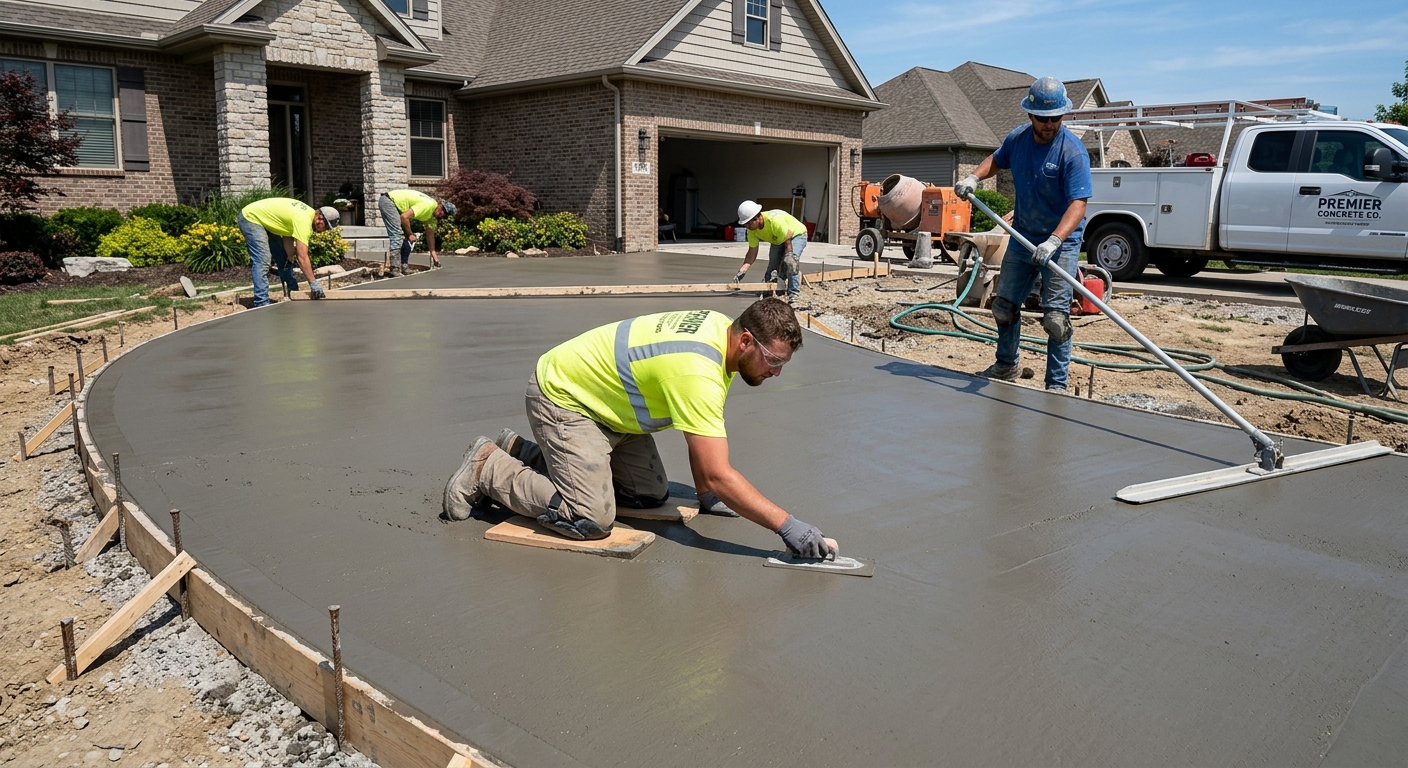
Concrete work options and costs in Highlands
In Highlands, Alberta, most concrete flatwork starts with the same goal: durable, low-maintenance surfaces for busy driveways, patios and walkways. Highlands is part of Calgary’s broader market (population 2,604 in 2021, per Statistics Canada, 2021 Census), and the local housing mix is geared toward family living—so the concrete demand tends to cluster around driveways, side-yard pads, and rear patios for spring and summer use.
Prices in Calgary-area concrete work often reflect more than just materials. In this cold continental climate, the design frost depth is engineered around frost heave and freeze–thaw cycling; footings and foundation elements must bear below the effective frost depth (about 1.2 m, roughly 4 ft). That drives higher excavation volumes for foundations and, for exterior slabs, it also raises the importance of proper granular base prep and air-entrained mixes. On top of that, the region’s shorter exterior pour season means contractors plan pours around curing conditions—cold-weather placement can require insulated blankets and sometimes temporary heat to protect early strength gain.
In Highlands proper, trade demand is especially strong in mature, established pockets where homeowners are upgrading aging flatwork and adding drainage fixes alongside sidewalks and back-yard access. You’ll usually see more scheduling competition around late spring to early fall, with winter work focused on foundation stages. With that in mind, here’s how common concrete options typically price out before you compare specific scopes and finishes.
| Application |
Typical Size |
Key Spec |
Finish Option |
Price Range |
| Concrete driveway (standard broom finish) |
24 ft x 10 ft (240 sq ft) |
Air-entrained mix, compacted granular base, control joints |
Broom finish + saw cuts |
$12,000–$18,000 |
| Exposed aggregate driveway |
24 ft x 10 ft (240 sq ft) |
Air-entrained mix, washed aggregate exposure, sealed after cure |
Exposed aggregate with sealer |
$14,500–$20,500 |
| Stamped concrete driveway or patio |
20 ft x 14 ft (280 sq ft) |
Air-entrained mix, colour hardener (where used), proper jointing |
Stamped pattern (stone/brick look) |
$15,000–$26,000 |
| Plain concrete patio or walkway |
12 ft x 16 ft (192 sq ft) |
Air-entrained mix, compacted base, edge forms |
Float/screed + broom or trowel texture |
$5,000–$9,000 |
| Garage floor (interior slab) |
24 ft x 22 ft (528 sq ft) |
Vapour barrier, vapour/insulation plan as required, mesh or rebar |
Broom finish, optional hardener |
$10,500–$17,000 |
| Foundation footings (structural, below frost) |
Typical semi-detached/garage footprint varies |
Excavation to design frost depth, rebar, engineered reinforcement |
Structural concrete (no decorative finish) |
$28,000–$45,000 |
Prices are estimates only and vary by project scope, site access and material selection.
What affects the price of concrete work in Highlands
If you’ve ever received two quotes for what sounds like the “same” concrete job in Calgary and the surrounding area, it’s common to see variance of 30–50%. The difference usually isn’t the brand of cement—it’s the engineered details: how deep the base is, how much excavation is required, whether the mix is properly air-entrained for exterior freeze–thaw exposure, and how the contractor plans curing in the short practical pour window.
In Alberta’s freeze–thaw conditions, frost depth and seasonal cycling dictate every step. Footings must extend below the design frost depth (about 1.2 m, roughly 4 ft), which increases excavation and footing volume compared with warmer regions. For exterior slabs like driveways and patios, contractors also specify air-entrained concrete to survive Calgary’s frequent freeze–thaw cycles and to reduce the risk of scaling and spalling. When pours happen late in the season, winter-grade curing precautions—insulated blankets and sometimes heat—add cost but protect early strength gain. And if de-icing salt is used (typical in Highlands), sealing becomes more than “cosmetic”; it’s a durability step.
In real Highlands projects, cost drivers often show up fast. Example 1: if your driveway area requires removing unsuitable soil and replacing with compacted granular base, pricing can shift toward the upper end of the driveway band (from roughly $12,000–$18,000). Example 2: a stamped patio that looks identical on paper can widen toward $15,000–$26,000 when additional reinforcement, integral colour/colour hardener, and a tighter joint plan are included. Local housing stock and upgrades matter too: older lots often have thinner original edges and less robust drainage, so contractors must correct grading and prep work before they can pour a slab that won’t heave.
| Price Factor |
Why It Matters |
Cost Impact |
| Frost line depth — determines footing depth and form height |
Supports must bear below frost heave risk in Alberta’s climate |
More excavation and concrete volume; often shifts foundation costs upward |
| Site preparation — excavation, grading, compacted granular base |
Correct base prevents settlement and protects the slab during freeze–thaw |
Unsuitable soil removal and haul-off add labour/equipment time |
| Reinforcement — rebar or wire mesh requirement |
Helps control cracking and supports load distribution |
Material cost plus time to chair/position steel correctly |
| Mix design — air-entrainment and compressive strength spec |
Air content improves durability against freeze–thaw scaling/spalling |
Cold-weather and strength specs can add small material cost but major long-term value |
| Finish type — broom vs. stamped vs. exposed aggregate |
Finish method affects labour time, materials, and curing/sealing schedule |
Stamped/exposed work typically carries a higher cost band |
| Pour size and concrete truck access to site |
Long carries or tight access can require pumps or more labour |
Accessibility can move pricing up or down significantly |
| Cold-weather curing precautions — heating and blankets |
Ensures strength gain and reduces early-age damage in late/early pours |
Direct added cost for insulation/heat and extra checks |
| Control joint pattern and sealing cost |
Jointing manages shrinkage cracking; sealing helps repel de-icing salt |
More saw cuts and sealant steps raise price slightly but reduce callbacks |
Permits & regulations in Alberta
In Alberta, structural concrete work generally needs a building permit, and it’s often supported by engineered drawings reviewed by the municipality. That typically includes foundation elements such as footings, foundation walls, grade beams, and other structural components where loads are transferred to the ground. For homeowners in Highlands, that means if you’re changing foundation geometry, adding a new bearing element, or going beyond cosmetic flatwork, start with the permit path.
Concrete flatwork—like patios, walkways and driveways—often does not require a permit by itself. However, a permit may be required or additional approvals may apply if your work changes lot grading, affects stormwater management, increases impervious surface coverage beyond municipal thresholds, or impacts the municipal right-of-way (for example, modifications near curb/sidewalk or drainage tied to the boulevard). When in doubt, confirm with the local authority before breaking ground.
Step-by-step contractor verification is worth doing. First, ask for the contractor’s liability insurance certificate showing coverage for the period of your project. Second, request proof of clearance for the required provincial workers’ compensation coverage (WSB/WCB coverage). Third, verify the company’s Alberta business information and any applicable trade registration/licensing details through official online registries. Finally, check references from similar Highlands-area jobs—especially ones with exterior slabs in cold-weather conditions—and confirm they can produce a clear scope, warranty details, and an agreed schedule in writing.
Getting concrete right in Highlands's freeze-thaw climate
Concrete failures in Highlands are usually about one thing: the slab can’t tolerate freeze–thaw movement at the surface or within the base. When the base isn’t compacted to the right depth, when the mix isn’t properly air-entrained for exterior exposure, or when curing is rushed, you see scaling, spalling and random cracking sooner than expected. In this Calgary-area climate, the design frost depth (about 1.2 m, roughly 4 ft) is why foundation work is engineered so carefully—and the same durability mindset applies to driveways and patios.
To spec the job correctly, start with (1) base preparation: excavate to the required depth, place compacted granular sub-base, and ensure proper drainage away from your foundation. (2) Mix design: air-entrainment is critical for freeze–thaw durability; for exterior flatwork, target 5–7% air content and specify a minimum 32 MPa compressive strength. (3) Control joints: plan saw-cut timing and spacing so shrinkage cracking happens where you want it, not randomly. (4) Curing: plan for at least 7 days of proper curing conditions; in cold weather, this may require insulated blankets or heat. (5) Sealing: apply a penetrating sealer after the slab has cured (commonly around 28 days) to repel de-icing salt.
When you compare options, price differences can be justified. For example, a stamped patio may land around the higher patio band (often toward $9,000+ for larger areas or heavier scope), but you’re paying for extra labour, finishing steps, and colour/joint detailing—not just “looks.” If a contractor offers stamped pricing with the same base and joint plan as a plain patio, that’s a red flag.
| Spec |
Why It Matters in Highlands |
What to Ask For |
Impact if Skipped |
| Compacted granular base (depth?) |
Stability against settlement and freeze–thaw movement |
Confirm base thickness and compaction method, plus drainage grade |
Uneven support, early cracking, heaving and spalling risk |
| Air-entrained concrete mix (target air %?) |
Durability against freeze–thaw scaling |
Target 5–7% air for exterior flatwork; confirm air test frequency |
Higher chance of surface scaling and scaling-related failure |
| Compressive strength (MPa rating) |
Early and long-term load performance |
Minimum 32 MPa at specified age; confirm cold-weather strength plan |
Reduced strength gain, increased cracking and structural weakness |
| Control joints (spacing per ACI guidelines) |
Controls shrinkage cracking location |
Joint spacing and timing of saw cuts; specify joint sealing approach |
Random cracks that can open to water and accelerate freeze damage |
| Minimum 7-day curing period |
Protects strength development in Alberta’s temperature swings |
Confirm curing plan and any winter-grade heating/blanket requirements |
Surface damage, reduced durability, higher long-term failure rate |
| Penetrating sealer (when applied after cure) |
Helps repel de-icing salts used in Calgary-area winter |
Apply penetrating sealer after full cure (commonly around 28 days) |
Faster salt-driven deterioration and spalling on traffic surfaces |
How to choose a concrete work contractor in Highlands
Choosing a contractor in Highlands is less about who’s cheapest and more about who documents the details. Start with Alberta compliance. Ask for a current liability insurance certificate (showing coverage limits and the jobsite address), and confirm workers are covered under the province’s workers’ compensation system (request proof of WSIB/WCB coverage/clearance). Then verify the contractor’s business details through official online registry sources, and request their trade/registration information where applicable.
Next, get 2–3 itemised written quotes. You want a breakdown that separates labour, excavation/site prep, reinforcement, formwork, concrete supply, finishing, saw-cutting and sealing. Avoid true lump sums that don’t say what’s included. Ask whether a permit is included (if required), whether disposal/haul-off is included, and how they handle drainage adjustments and base repair on older lots.
Warranty matters too. Request the workmanship warranty length and whether it’s tied to joint sealing and maintenance. Also clarify product/manufacturer warranties for any admixtures or sealers, and whether any warranty is transferable if you sell the home.
Payment should be controlled. Never pay more than 10–15% upfront; hold back a portion until the job is fully complete and cleaned, with curing and sealing steps done as scheduled. Finally, request a written timeline with a start date and completion estimate, and make sure cold-weather curing contingencies are stated in the contract.
- Confirm liability insurance certificate is current and specific to the project dates.
- Confirm WSIB/WCB coverage and request a clearance/proof document.
- Use itemised quotes (labour, materials, prep, reinforcement, finish, sealing).
- Ask who supplies/installs rebar or mesh and whether it’s correctly supported on chairs.
- Confirm air-entrained mix and target air content for exterior work.
- Ask for base thickness and compaction standards (and how drainage grade is set).
- Verify control joint spacing plan and saw-cut timing.
- Confirm curing method, especially for pours near shoulder seasons.
- Ask whether insulating blankets/heating are included when temperatures drop.
- Clarify disposal/haul-off for excavated material and any topsoil replacement scope.
- Check warranty terms for workmanship and how callbacks are handled.
- Set a payment schedule with ≤10–15% upfront and a holdback until final acceptance.
Concrete red flags in Highlands: vague “we’ll pour concrete” scopes with no base thickness or joint plan, no mention of air-entrainment for exterior slabs, quotes that treat stamped or exposed work as identical to broom-finished pricing, missing insurance/WCB proof, and contractors who ask for full payment upfront or won’t commit curing/sealing steps in writing.
Frequently asked questions — concrete work in Highlands
When is the best time to pour concrete in Highlands?
For Highlands and the Calgary area, the best results typically come when daytime temperatures stay reliably above the contractor’s minimums and you can maintain proper curing conditions. Late spring through early fall is usually the practical window for exterior slabs like patios, sidewalks and driveways. In this cold continental climate, early/late pours can require insulated blankets and sometimes temporary heat to achieve adequate strength gain and reduce surface scaling. If you’re aiming for exterior flatwork, plan around schedule availability—contractors often move quickly when the region warms up. For timing, ask your contractor how they handle cold snaps and what curing checks they perform. If you’re comparing quotes, make sure any winter-grade curing precautions are clearly included.
How long does concrete take to cure?
Concrete cures in stages. Most contractors in Alberta plan for a minimum 7 days under proper curing conditions before treating the slab as substantially stable for routine use, assuming temperatures are appropriate. However, full durability and readiness for sealers is typically closer to 28 days, because the slab needs time to reach a more mature state. This matters in Highlands because freeze–thaw cycles can target weak early-age surfaces, and de-icing salt can accelerate deterioration if sealing is skipped or applied too early. If your pour happens near cooler weather, curing may be extended and supported with blankets or heating to ensure early strength development. Ask your contractor what curing method they’ll use and when you can legally start driving, moving furniture, or walking on the surface.
Do I need a permit for concrete work in Alberta?
In Alberta, structural concrete work like footings, foundation walls, and grade beams generally requires a building permit, often supported by engineered drawings reviewed by the municipality. Concrete flatwork such as patios, walkways and many driveways often does not require a permit by itself. That said, if your project affects lot grading, drainage, impervious surface coverage limits, or touches municipal right-of-way concerns (for example, certain curb/sidewalk modifications), you may need additional approvals. For Highlands homeowners, the best practice is to confirm before excavation. Also verify the contractor carries liability insurance and has the required workers’ compensation coverage. If something triggers permitting, ask whether the quote includes permit coordination or if it’s separately handled.
Concrete vs pavers for a patio in Highlands?
Concrete and pavers both work well, but the decision usually comes down to your tolerance for maintenance, crack expectations, and how you handle freeze–thaw. A properly built plain concrete patio (often in the $5,000–$9,000 range depending on size and site prep) can be very durable if it has an air-entrained mix, compacted granular base and the right control joints. Pavers can be easier to repair section-by-section, but they’re more labour-intensive for excavation and base layers, and they still require correct base compaction to prevent shifting. In Highlands winters, de-icing salt can affect concrete surfaces too—this is why sealing after cure matters, while paver joints still need attention. Ask for base specs and drainage for both options, then compare warranties and realistic lifespan—not just material price.
How long does a concrete driveway last?
With Highlands’ freeze–thaw cycles, a well-built concrete driveway can last for many years—often decades—when the base is prepared properly, the mix is air-entrained, and joints and edges are executed correctly. Durability is strongly tied to early-age curing and long-term maintenance like sealing. If your driveway is planned as a standard broom-finish slab, it commonly falls in the $12,000–$18,000 range for typical sizes, while higher-detail options like exposed aggregate or extensive repairs can push pricing upward. The key to longevity is avoiding water intrusion at joints and ensuring the slab isn’t sitting on soft or poorly compacted base. If your existing driveway has spalling or heaving, ask your contractor whether excavation and base replacement are included before pouring new concrete—this is where longevity is won or lost.
What is air-entrained concrete and why does it matter here?
Air-entrained concrete includes small, evenly distributed air bubbles in the mix. Those microscopic voids give water a place to expand when temperatures drop and freeze, which helps prevent the concrete paste from breaking down under repeated freeze–thaw cycles. In Highlands and the broader Calgary area, this is crucial because winter cycling is frequent and can rapidly accelerate surface scaling and spalling if the mix isn’t engineered for it. For exterior flatwork, contractors typically target air content around 5–7% and specify adequate compressive strength (commonly a minimum 32 MPa) for performance. When you review a quote, ask specifically whether the mix is air-entrained, whether they will perform/record air tests at delivery, and what curing precautions they’ll use during cold weather to protect early strength gain.