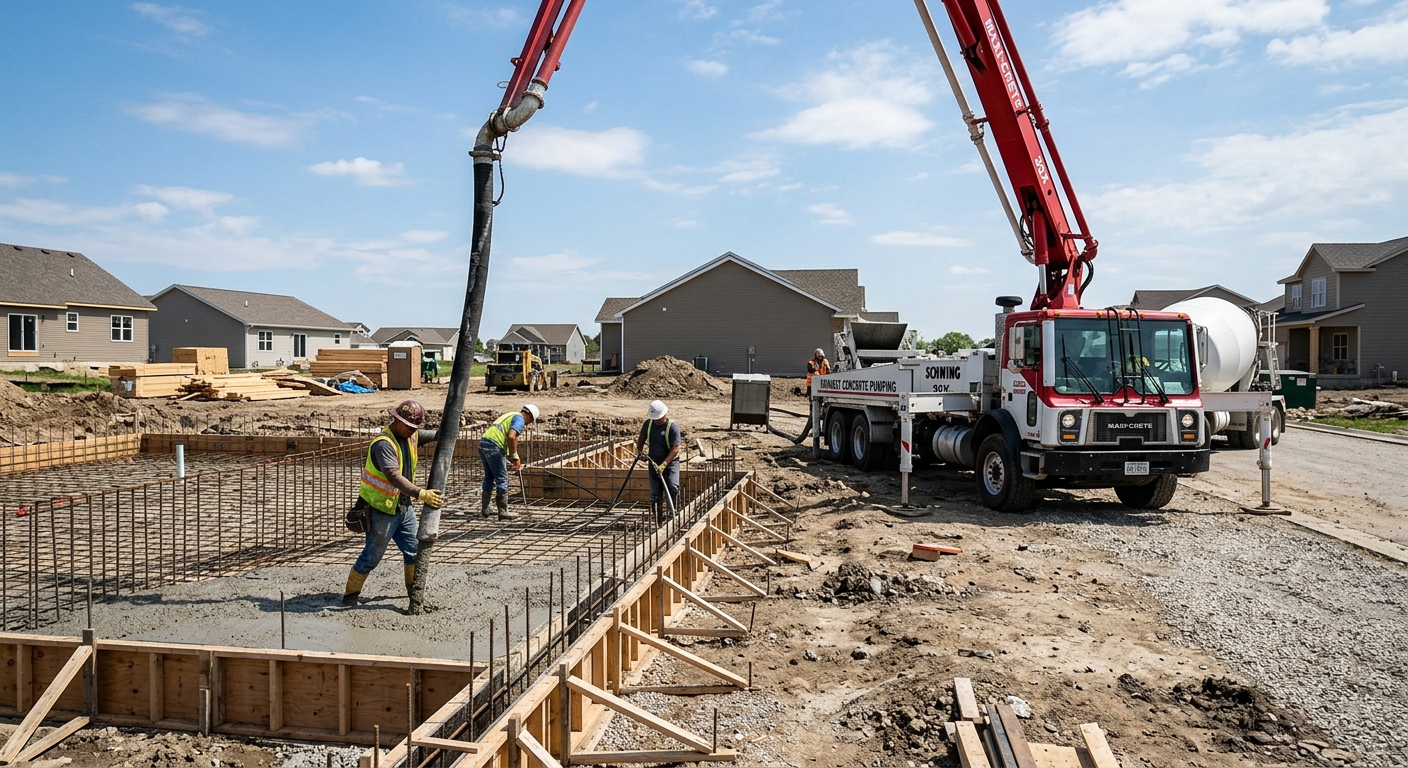
Concrete work options and costs in Canossa
Canossa, Alberta homeowners typically plan their concrete work around winter frost, freeze–thaw cycles and the shorter exterior pour season in the Calgary region. With a population of 3,211 (Statistics Canada, 2021 Census), Canossa is small enough that the best crews often get booked quickly—especially in neighbourhood pockets where families are actively building or upgrading driveways and backyard flatwork. Also, most demand is tied to the region’s housing profile; in many Calgary-area communities, single-detached homes are the dominant use type, which directly drives concrete flatwork needs like driveways, patios and walkways.
In this cold continental climate, contractors engineer every exterior pour to resist frost heave and surface scaling. That usually means deeper excavation, a properly compacted granular base, air-entrained concrete, and a careful control joint plan. Compared to milder areas, footing and slab scopes are more labour- and equipment-intensive because the design frost depth in Alberta commonly runs to about 2.4 m, so foundations and structural elements cost more. For flatwork, Calgary’s frequent freeze–thaw cycles also shorten the practical window for cold-weather placement—so winter-grade placement practices (and sometimes temporary heat/insulation blankets) can add to the bill even when the slab size looks “simple.”
In Canossa, demand is especially high around newer residential edges where lots are still being finalized and drainage/grade adjustments are common. When you get quotes, the variation is often less about concrete “strength” and more about the engineered details—so the table below compares typical options side-by-side.
| Application |
Typical Size |
Key Spec |
Finish Option |
Price Range |
| Concrete driveway (standard broom finish) |
400 sq. ft. (e.g., 20' x 20') |
Air-entrained exterior mix; reinforced slab as required |
Broom finish |
$12,000–$18,000 |
| Exposed aggregate driveway |
400 sq. ft. (e.g., 20' x 20') |
Air-entrained exterior mix; proper surface timing for exposure |
Exposed aggregate with sealer-ready finish |
$15,000–$22,000 |
| Stamped concrete driveway or patio |
300 sq. ft. (e.g., 15' x 20') |
Air-entrained mix; integral colour/texture system |
Stamp + colour (textured mats) |
$15,000–$26,000 |
| Plain concrete patio or walkway |
250 sq. ft. (e.g., 10' x 25') |
Air-entrained exterior mix; control joints |
Smooth trowel or broom edge |
$5,000–$9,000 |
| Garage floor (interior slab) |
500 sq. ft. (e.g., 20' x 25') |
Vapour barrier and reinforcement as required |
Standard broom or light trowel finish |
$9,000–$15,000 |
| Foundation footings (structural, below frost) |
Typical single-detached: 1,000–1,800 sq. ft. total footing area |
Excavate to undisturbed soil below design frost depth; engineered rebar |
Structural concrete with rebar installation |
$28,000–$45,000 |
Prices are estimates only and vary by project scope, site access and material selection.
What affects the price of concrete work in Canossa
In Canossa and the wider Calgary region, it’s common to see quote differences of 30–50% for the “same” concrete job. The usual reason isn’t the concrete itself—it’s the engineered prep and winter-proofing details that protect the slab or foundation from Alberta’s environment. A contractor who prices only the pour can look cheaper on paper, but if they under-excavate, skip proper base compaction or don’t specify air-entrainment, you’ll likely pay later for repairs after spalling or settlement.
Frost depth drives foundation and excavation cost. In Alberta, footings typically need to extend to undisturbed soil below the design frost depth (often about 2.4 m), so excavation volume rises and formwork height increases. That’s why foundation/footings generally sit in the $28,000–$45,000 band. Freeze–thaw cycles also dictate air-entrained concrete for all exterior slabs (driveways, patios and walkways) and a reliable control joint layout to reduce random cracking.
Cold-weather placement matters for exterior concrete too. Calgary-area seasons are shorter for exterior work, and if you pour late fall or early spring, you may need winter-grade mix plus insulated blankets or temporary heating to achieve proper curing. De-icing salt accelerates surface deterioration in a freeze–thaw climate—so sealing becomes a real cost/benefit decision, not an upsell.
Two local examples that routinely move the price up or down in Canossa: (1) soft or frost-susceptible subgrade that requires deeper granular replacement; and (2) difficult access that limits truck placement and increases labour hours for material handling. A driveway may land near the low end of the $12,000–$18,000 band when site access is good and base prep is straightforward, but it can drift upward when excavation and reinforcement requirements increase. For a patio, keeping the scope simple (straight geometry, good drainage, standard broom finish) helps keep you within the $5,000–$9,000 range; stamps and exposed finishes raise material and labour intensity.
| Price Factor |
Why It Matters |
Cost Impact |
| Frost line depth — determines footing depth and form height |
Footings must sit below the design frost depth to prevent frost heave and seasonal movement |
Raises excavation volume and concrete/formwork; can add thousands on foundations |
| Site preparation — excavation, grading, compacted granular base |
Correct base thickness and compaction prevent settlement and premature cracking |
Soft subgrade or poor access increases labour and import materials |
| Reinforcement — rebar or wire mesh requirement |
Controls cracking and improves structural capacity for slabs and footings |
Material and labour for tying, placing and chairs adds cost |
| Mix design — air-entrainment and compressive strength spec |
Air-entrainment helps resist freeze–thaw scaling and spalling |
Winter-grade or higher-spec mixes cost more, but reduce failure risk |
| Finish type — broom vs. stamped vs. exposed aggregate |
Finishes require different labour, timing, and specialty processes |
Stamped/exposed adds labour and materials; may push you toward higher driveway/patio bands |
| Pour size and concrete truck access to site |
Smaller pours or limited access increase handling time |
Shortens productivity; may require more crews or multiple deliveries |
| Cold-weather curing precautions — heating and blankets |
Proper curing is harder in cold conditions; protects early-age strength |
Temporary heat/blankets and extra monitoring can add significant labour/material costs |
| Control joint pattern and sealing cost |
Joints manage cracking; sealing helps repel de-icing salt impacts |
Sealer and a planned joint layout add line items, but protect the surface |
Permits & regulations in Alberta
In Alberta, the rule of thumb is: structural concrete work needs more oversight than typical backyard flatwork. For Canossa homeowners, concrete flatwork such as patios, walkways and most driveways typically does not require a building permit, unless the work affects lot grading, municipal drainage expectations, impervious surface coverage limits, or the municipal right-of-way. By contrast, concrete used for structural components—like foundation footings, foundation walls, grade beams and other structural-grade concrete—generally requires a building permit and often engineered drawings that are reviewed through the municipal process.
Step-by-step verification is the homeowner’s best protection: (1) ask the contractor for the permit/engineering responsibility details in writing—what they pull and what you must approve; (2) confirm the contractor carries liability insurance and provides a current certificate of insurance showing the policy is active and includes your address/job location; (3) verify they have the appropriate worker coverage (commonly WSIB/WCB coverage for workers) and request a clearance or proof of coverage; and (4) check references on similar-scale Alberta projects, ideally including exterior slabs that were poured in cold-weather conditions.
If you’re unsure whether your specific scope affects grading or right-of-way issues, contact the municipality before breaking ground and have the contractor document proposed drainage and elevations. Always confirm with the local authority—permit requirements can change based on how a project ties into grading and services.
Getting concrete right in Canossa's freeze-thaw climate
Concrete failures in Canossa usually come from one of five problems: weak base preparation, incorrect mix design, insufficient reinforcement, poor control joint planning, or rushed curing in cold weather. In Calgary’s freeze–thaw climate, the biggest visible long-term issue is spalling and surface scaling when concrete isn’t properly air-entrained for exterior exposure. Another common issue is random cracking from inadequate sub-base compaction or missing/poorly placed joints—water gets in, freezes, and widens cracks.
To spec the job correctly, focus on: (1) base preparation—excavate to the required depth for undisturbed soil and install a compacted granular sub-base that supports the slab under local frost conditions; (2) mix design—ensure exterior flatwork uses air-entrainment (typically 5–7% air content) and meets a minimum 32 MPa compressive strength; (3) control joints—plan their spacing and layout so cracking happens where it should; (4) curing—allow at least 7 days of curing under proper conditions, and when temps drop, use winter placement practices (insulated blankets and, when required, temporary heating); and (5) sealing—apply a penetrating sealer once curing is complete (commonly after 28 days) so the surface resists de-icing salts.
Here’s a practical money example: a broom-finished driveway might price in the $12,000–$18,000 band. A stamped upgrade can land in the $15,000–$26,000 range, and that difference is justified when the contractor also maintains correct base, air-entrainment, reinforcement placement, and curing/blanket practices. If those fundamentals aren’t right, the “prettiest” finish won’t last.
| Spec |
Why It Matters in Canossa |
What to Ask For |
Impact if Skipped |
| Compacted granular base (depth?) |
In Canossa’s frost environment, a firm base prevents settlement and reduces cracking |
Base thickness and compaction testing method; confirm it’s to undisturbed soil level |
Early cracking, uneven surfaces, and accelerated freeze–thaw damage |
| Air-entrained concrete mix (target air %?) |
Freeze–thaw cycles demand air voids so water can expand without destroying the paste |
Target 5–7% air content for exterior flatwork |
Surface scaling/spalling, especially with de-icing salt in winter |
| Compressive strength (MPa rating) |
Cold-weather curing requires a mix that reaches early and final strength reliably |
Minimum 32 MPa design/compliance target; confirm placement temperature and curing plan |
Reduced durability and strength development |
| Control joints (spacing per ACI guidelines) |
Controls where cracks form as the slab expands and contracts |
Joint layout, spacing and sealing plan consistent with the slab geometry |
Random cracking and water infiltration into the slab base |
| Minimum 7-day curing period |
Proper curing is harder in Calgary-area temperature swings |
Guarantee curing conditions and protect from freezing/thawing hazards |
Surface weakness, increased scaling risk and long-term deterioration |
| Penetrating sealer (when applied after cure) |
Sealer helps repel de-icing salts and water that worsen freeze–thaw cycles |
Penetrating sealer application typically after cure (often around 28 days) |
Faster salt-related spalling and more frequent maintenance |
How to choose a concrete work contractor in Canossa
Choosing the right concrete contractor in Canossa comes down to verification and clarity. Start by confirming Alberta coverage: ask for a current certificate of liability insurance (so you can confirm the policy is active for the project period) and request proof of worker coverage—commonly WSIB/WCB for employees. A legitimate contractor should provide these documents without hesitation and be able to match them to your job address.
Next, get 2–3 itemised written quotes that break down labour and materials—not just one lump sum. You want line items that show excavation/base prep, reinforcement, concrete supply/mix type, finishing and any winter-weather curing provisions. Read the scope carefully for what’s excluded: is removal/disposal included? Is regrading to meet final elevations included? Is sealing included (and when)? If the contractor is vague about those items, your “final price” often shifts later.
Warranty matters too. Ask for the workmanship warranty length and what it covers (cracks, scaling, settlement) and whether product/manufacturer warranties apply to any specialty materials. Confirm if warranties are transferable if you sell the home. For payment, avoid paying more than 10–15% upfront. Hold back the remainder until the work is complete, surfaces are sealed if included, and clean-up is done. Finally, request a start date and completion estimate in writing—cold-weather protection can affect the schedule, so you want commitments tied to curing requirements.
- Provide current certificate of liability insurance showing active coverage for your project.
- Provide proof of WSIB/WCB coverage (or applicable worker coverage) and clearance details.
- Give an itemised quote showing excavation, granular base, reinforcement, concrete mix and finishing.
- Clarify what site access means (truck location, hose lengths, staging) and who supplies access equipment.
- Confirm air-entrainment and exterior mix specification in writing.
- Ask about winter curing: blankets/heating/temperature monitoring plan if temps are borderline.
- Confirm control joint locations, spacing and whether joints will be sealed.
- Ask for curing duration commitments (minimum 7 days) and protection from freezing.
- Confirm whether penetrating sealer is included and when it’s applied after cure (commonly around 28 days).
- Ask who handles disposal of excavated material and whether any hauling fees are included.
- Request a workmanship warranty and what failures it covers (spalling/scaling/cracking).
- Use a payment schedule that holds back until final inspection/cleanup is completed.
Concrete red flags in Canossa include: quotes that omit base depth or compaction details; no mention of air-entrainment for exterior slabs; “we’ll pour whenever” assurances without cold-weather curing plans; vague scope language about excavation and disposal; and contractors asking for large upfront payments (well beyond 10–15%) without a signed schedule and milestones.
Frequently asked questions — concrete work in Canossa
How long does concrete take to cure?
In Canossa and the Calgary region, curing time is a combination of schedule and temperature. For most properly placed concrete, contractors plan for at least 7 days of curing before treating the slab as stable for normal use, but full durability develops over time. In cold snaps, curing can be slower and freezing during early age is a real risk, so reputable crews use cold-weather placement practices—insulated blankets and, when needed, temporary heat—to keep the concrete from freezing before it reaches strength. If you’re pouring exterior concrete near the end of the season, confirm the protection plan in writing. For long-term resistance to Alberta de-icing salts, sealing is typically done after full cure—often around 28 days—so you get better water and salt repellency.
Do I need a permit for concrete work in Alberta?
In Alberta, it depends on what you’re building. For Canossa homeowners, concrete flatwork such as most patios, walkways and typical driveways usually does not require a permit, unless it impacts lot grading, drainage expectations, impervious surface limits, or municipal right-of-way issues. Structural concrete work is different: foundation elements like footings, foundation walls and grade beams generally require a building permit and often engineered drawings reviewed through the municipality. The safest approach is to ask the contractor exactly what permit responsibilities are (and whether they pull one) and then verify with the local authority before demolition or excavation. Also confirm the contractor has current liability insurance and worker coverage.
Concrete vs pavers for a patio in Canossa?
Concrete and pavers can both work well in Alberta, but your choice should follow your climate priorities. In freeze–thaw conditions around Canossa, concrete patios succeed when the mix is air-entrained, the base is compacted properly, and control joints are placed so cracking doesn’t become random. A plain concrete patio typically lands in the $5,000–$9,000 band for a typical residential scope, while stamped concrete usually moves higher. Pavers can be attractive because individual units can be replaced, but paver performance depends heavily on edge restraints, bedding sand thickness, and drainage. If your goal is low maintenance with a monolithic surface, concrete often wins. If you anticipate future re-grading or like modular repairs, pavers may fit better—just make sure the contractor explains how they’ll handle drainage and base compaction.
How long does a concrete driveway last?
A well-built concrete driveway in Canossa is often designed to last decades, but real-life longevity depends on the same details that manage freeze–thaw: air-entrained exterior concrete, deep enough base and proper compaction, and a control joint strategy that limits random cracking. Durability also depends on winter maintenance practices. De-icing salt and moisture cycling can lead to surface scaling if the concrete mix and curing weren’t right. That’s why quotes for exterior driveways commonly fall in the $12,000–$18,000 range when the engineered base prep and finishing are solid. If you choose decorative options, costs rise (stamped/exposed bands can reach higher), but the lifespan only improves if the contractor keeps the fundamentals: base prep, reinforcement as required, correct mix design, curing protection, and a proper sealer plan.
What is air-entrained concrete and why does it matter here?
Air-entrained concrete is mixed with tiny, evenly distributed air bubbles designed to withstand freeze–thaw. In Canossa and the Calgary region, water trapped in non-air-entrained concrete expands when it freezes, which can damage the paste and cause scaling and spalling over time—especially under the repeated cycles that come with winter and thawing periods. For exterior slabs like driveways, patios and walkways, ask that the contractor specify air-entrainment and that they target a typical exterior air range (often 5–7% for flatwork) appropriate to the mix and exposure. This is one of the biggest “why quotes differ” items: crews who cut corners on mix design may quote less, but they’re more likely to run into premature surface deterioration. It’s also tied to curing and finishing timing, not just the ingredient list.
How do I prepare the base for a concrete slab?
Base prep is where good concrete jobs start, and in Canossa’s frost climate it needs to be treated as an engineered component—not a quick site cleanup. The steps usually include: excavating to the required depth for undisturbed soil and/or replacing unsuitable material; installing a properly graded granular base; and compacting in lifts to achieve a firm, stable foundation. The final slab thickness and reinforcement placement depend on the prepared base and expected loads (like parking a truck on a driveway). You should also confirm drainage so surface water doesn’t pool next to the slab. Ask your contractor to state the granular base depth, compaction approach and how they manage frost-sensitive soil. When base prep is done correctly, the concrete performs closer to its design intent; when it’s skipped, you’ll see cracking sooner and spend more later—regardless of whether your driveway cost falls around $12,000–$18,000 or higher.