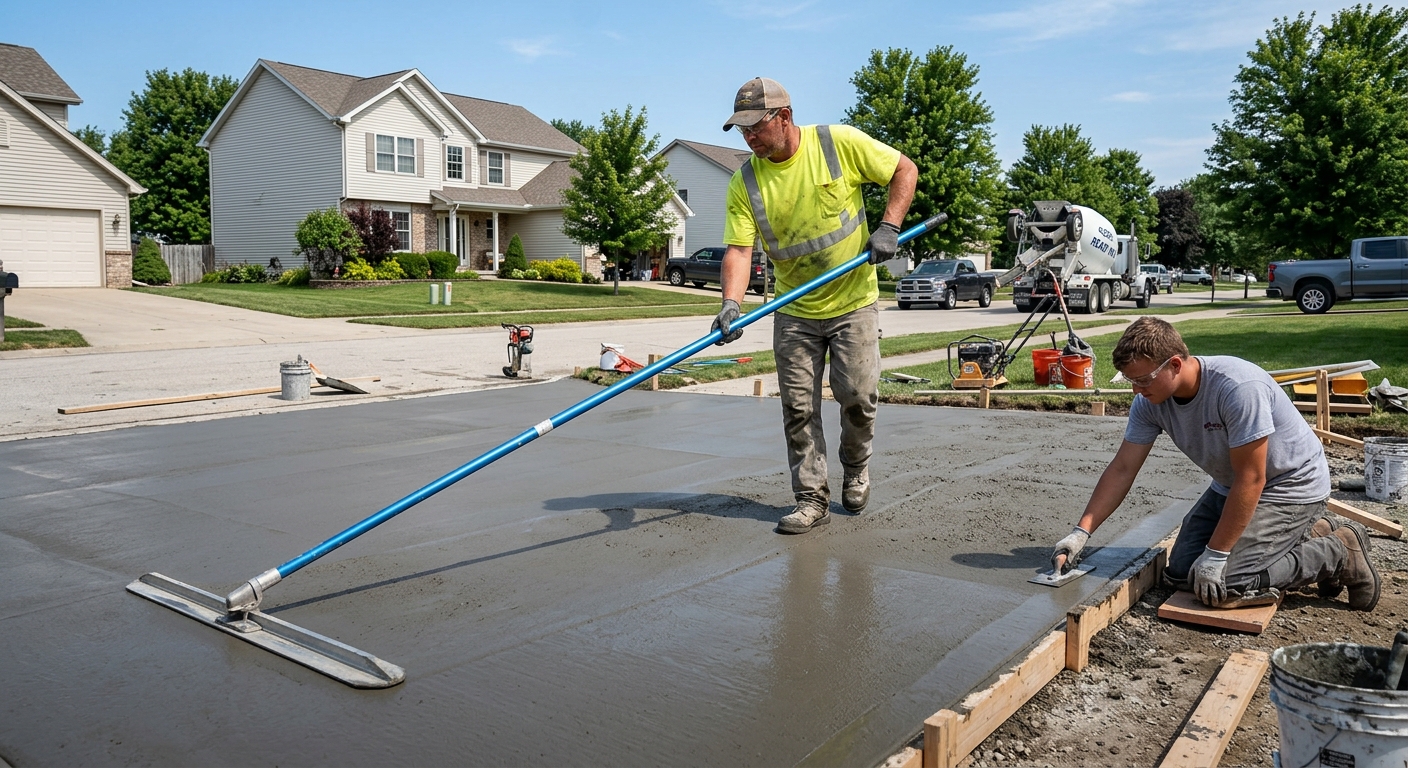
Concrete work options and costs in Chaparral
Chaparral is a growing pocket in the Calgary economic region, and for homeowners here the “right” concrete option usually comes down to one thing: how well the slab will hold up through Alberta’s freeze–thaw cycles. With a population of about 12,500 (Statistics Canada, 2021 Census), Chaparral’s demand is steady for driveways, patios and walkways that look good and resist surface scaling and cracking. Most flatwork in this market is tied to single-detached homes and modern infill builds, so contractors are often scheduling multiple pours across similar sites back-to-back—timing matters because exterior concrete placement has a shorter practical season in cold weather.
Calgary-area pricing also reflects engineered specs. In this climate, footings and any below-grade work generally need to sit below the local design frost depth (commonly around 1.2 m, roughly 4 ft). That pushes excavation and foundation volumes higher than in milder provinces, and it’s one reason foundation work often lands at the top end of the regional bands. For exterior slabs like driveways and patios, we rely on air-entrained mixes, granular base prep, and control joints to manage freeze–thaw movement, plus cold-weather curing precautions if pours happen late in the year. Neighbourhood demand is especially strong around the active residential streets closer to local amenities and commuting routes, where new driveways and backyard patios are a frequent upgrade.
Below is a practical cost comparison for the most common concrete projects we bid in Chaparral, Alberta—then we’ll break down what drives the differences in your quote.
| Application |
Typical Size |
Key Spec |
Finish Option |
Price Range |
| Concrete driveway (standard broom finish) |
24 ft x 10 ft (240 sq ft) |
Air-entrained mix, compacted granular base, 4 in slab |
Broom finish |
$12,000–$18,000 |
| Exposed aggregate driveway |
24 ft x 10 ft (240 sq ft) |
Air-entrained mix, retarder/exposure, proper curing |
Exposed aggregate |
$15,500–$22,500 |
| Stamped concrete driveway or patio |
20 ft x 12 ft (240 sq ft) |
Air-entrained mix, integral colour options, sealer |
Stamped (sold/installed as driveway or patio) |
$15,000–$26,000 |
| Plain concrete patio or walkway |
12 ft x 16 ft (192 sq ft) |
Air-entrained mix, compacted base, joints |
Broom or light trowel finish |
$5,000–$9,000 |
| Garage floor (interior slab) |
22 ft x 22 ft (484 sq ft) |
Proper vapour control, slab thickness per design, reinforcement as needed |
Float/steel trowel, optional hardener |
$9,500–$15,500 |
| Foundation footings (structural, below frost) |
1-storey house typical wall footing system |
Excavate to undisturbed soil below design frost, reinforced concrete footings |
Structural concrete (engineered) |
$28,000–$45,000 |
Prices are estimates only and vary by project scope, site access and material selection.
What affects the price of concrete work in Chaparral
In Chaparral, two quotes for what looks like the same concrete job can easily land 30–50% apart across the Calgary area. The big reason is that “concrete” isn’t just the slab—it’s engineered frost protection, excavation and compaction, reinforcement, mix design, and finishing steps that prevent freeze–thaw damage over the long run. When one contractor designs for durability and the other targets the lowest short-term cost, the long-term cost shows up as scaling, spalling and costly repairs.
Every exterior application here is shaped by the cold continental climate. Frost depth and freeze–thaw cycles dictate that footings extend below the design frost depth (commonly about 1.2 m for local practice) so the slab doesn’t heave with seasonal soil movement. Exterior slabs also need air-entrained concrete mixes to survive repeated freezing and thawing. Finally, the pour season is shorter and cold-weather curing precautions can be unavoidable—insulated blankets, maintaining temperature, and scheduling to achieve proper curing adds cost. If homeowners apply de-icing salts regularly (very common in Calgary-area winters), a quality sealer becomes essential to reduce surface deterioration and salt-driven scaling.
Local examples that move price up or down in Chaparral: a driveway that requires more excavation due to soft/variable fill costs more than one built over firm native soil; a stamped driveway is priced higher because it includes integral colour/texture work (often aligning with the $15,000–$26,000 stamped band), while a standard broom-finish driveway usually sits in the $12,000–$18,000 range. We also see late-fall pours shift budgets—if the mix, curing methods and protection aren’t planned, durability suffers and contractors may price higher to manage the risk.
| Price Factor |
Why It Matters |
Cost Impact |
| Frost line depth |
Footings must extend below design frost to prevent heave |
Higher excavation and form height; can shift foundation pricing substantially |
| Site preparation |
Grading, excavation and compacted granular base control movement |
Soft soil or poor drainage increases disposal and base material |
| Reinforcement |
Rebar/wire mesh helps control cracking and supports loading |
Labour and steel material; differs by slab thickness and design |
| Mix design |
Air-entrainment and strength spec are essential for freeze–thaw |
Cold-weather-rated, air-entrained mixes can cost more but reduce failures |
| Finish type |
Broom vs. stamped vs. exposed aggregate changes steps and materials |
Stamped/exposed require extra crews, labour time and colour/exposure systems |
| Pour size and concrete truck access to site |
Smaller job sizes can cost more per square foot; access affects placement method |
Access constraints can add labour for pump/handling and delays |
| Cold-weather curing precautions |
Cold placement needs blankets/heating to protect early strength gain |
Temporary heat/blankets add direct costs and schedule management |
| Control joint pattern and sealing cost |
Joints manage cracking; sealing reduces salt-driven scaling |
More engineering and extra materials/crew time for quality results |
Permits & regulations in Alberta
In Alberta, structural concrete work typically requires a building permit, and it’s common for engineered drawings to be reviewed as part of the approval process. That includes work such as foundation footings, foundation walls, and grade beams—anything that forms part of the structural system. For concrete flatwork like patios, walkways and driveways, permits are often not required in the usual case; however, you may need to check if the project affects lot grading, ties into stormwater management, changes impervious surface coverage limits, or impacts municipal right-of-way. Because rules can vary by how the work is planned on your lot, always confirm with the local authority before breaking ground.
For homeowners in Chaparral, the practical process is: (1) decide whether your scope is structural or flatwork; (2) ask the contractor which permits (if any) are required for your specific drawings; (3) require proof of insurance and coverage before work starts. A reputable contractor in Alberta will carry liability insurance and WSIB/WCB coverage. Then, check references from similar-scale jobs, not just photos.
To verify credentials step-by-step: first, ask the contractor for a certificate of insurance and confirm it covers the work you’re hiring (and that it lists the correct legal entity). Second, request their WSIB/WCB clearance letter or current coverage documentation. Third, confirm their Alberta licensing status through the relevant public registry details available online for their trade designation. If they can’t provide documents promptly, that’s a red flag—especially in a cold-weather market where delays can damage concrete curing schedules.
Getting concrete right in Chaparral's freeze-thaw climate
Concrete failures in Chaparral are usually preventable. In our freeze–thaw environment, slabs and exposed surfaces are most vulnerable to spalling, scaling and random cracking when the base is wrong, the mix lacks proper air entrainment, curing is rushed, or joints aren’t cut and sealed on schedule. Specifying correctly starts with the under-slab system: compacted granular sub-base sized and compacted to the right depth for local frost conditions and soil behaviour. Next is the mix design. Exterior flatwork commonly needs air-entrained concrete with target air content around 5–7% (to create protective microscopic voids). You should also expect a minimum 32 MPa compressive strength spec for durable exterior performance.
Control joints are another big lever. Without an intentional joint pattern, cracks appear randomly where the slab is weakest, and once water and salts get into those cracks, deterioration accelerates. Curing matters as much as everything else: plan for at least 7 days of curing under proper conditions, and when weather turns cold, cold-weather curing precautions (insulated blankets and/or temporary heating) protect early-age strength development. Finally, sealing is typically applied after the cure period—often around 28 days post-pour—so penetrating sealer can help repel de-icing salts and moisture.
Ask the contractor the technical questions that prevent the most common issue: inadequate air-entrainment. If someone proposes a cheaper mix without confirming air content and strength, you’re buying future repair risk. As an example, if a stamped driveway quote is higher—within the $15,000–$26,000 band—part of the premium is labour and materials for texture/colour plus disciplined curing. In contrast, a standard broom driveway in the $12,000–$18,000 band can be a better value when you prioritise durability over appearance.
| Spec |
Why It Matters in Chaparral |
What to Ask For |
Impact if Skipped |
| Compacted granular base (depth?) |
Proper base reduces pumping and movement during freeze–thaw |
Granular sub-base depth and compaction testing method; confirm it’s designed for local soil |
Settlement and cracking; faster deterioration of the surface |
| Air-entrained concrete mix (target air %?) |
Air voids protect against freeze–thaw scaling and spalling |
Confirm air content target (commonly 5–7% for exterior flatwork) on the ticket/spec |
Surface scaling/spalling and premature patching |
| Compressive strength (MPa rating) |
Strength gain supports durability under traffic and weather exposure |
Minimum 32 MPa rating for exterior flatwork unless engineered otherwise |
Lower performance; increased cracking risk |
| Control joints (spacing per ACI guidelines) |
Joints control where cracking happens so it stays manageable |
Joint spacing and timing for saw-cut or formed joints |
Random cracking; moisture and salt infiltration |
| Minimum 7-day curing period |
Cold weather slows strength gain; curing protects early performance |
Plan for temperature protection; curing method and duration |
Reduced strength and more scaling; long-term durability drops |
| Penetrating sealer (when applied after cure) |
Sealer helps repel de-icing salts and moisture in Alberta winters |
Sealer type and timing (often after ~28 days, once fully cured) |
Faster salt-driven surface damage |
How to choose a concrete work contractor in Chaparral
Choosing the right concrete contractor in Chaparral is less about the cheapest line and more about proof: coverage, scope clarity, and how they protect curing in Alberta’s cold-weather window. Start with licensing and insurance verification. Ask for their Alberta licence/trade registration details (as applicable to their role), plus a certificate of liability insurance that matches the company name you’ll contract with. Then confirm WSIB/WCB coverage. In practice, you want either a current clearance letter or documented proof showing the contractor and their workers are covered for the work you’re hiring. Don’t accept “we have coverage” without documents—request them before signing.
Next, get 2–3 written, itemised quotes instead of a lump sum. You want labour and materials broken out (excavation, granular base, reinforcement, concrete supply, forming, finishing, curing protection, saw-cutting joints, and sealing). Read exclusions carefully: is disposal included, are underground utilities located and protected, who manages weather-related stoppages, and is the permit work included (when required for structural scope)?
Warranty matters too. Ask for the workmanship warranty length, what it covers (cracks, delamination, spalling), and whether it’s tied to proper use and maintenance. Check the product/manufacturer warranty if any admixtures or sealer systems are specified. For payment, never pay more than 10–15% upfront; use a holdback until the work is complete and cleaned up. Finally, insist on a written timeline: start date, concrete pour date window (especially important in cold spells), and estimated completion.
- Request proof of liability insurance and confirm the legal name matches your contract.
- Ask for WSIB/WCB clearance documentation before work begins.
- Get 2–3 itemised quotes (labour vs materials) rather than one lump sum.
- Confirm frost-related excavation depth assumptions in writing for your scope.
- Verify the concrete mix ticket includes air-entrainment and the strength spec (e.g., minimum 32 MPa for exterior flatwork).
- Ask how control joints will be cut/placed and the spacing plan.
- Confirm curing protection method for cold weather (blankets/heating plan if needed).
- Check whether de-icing salt exposure is accounted for with sealing timing (~after curing).
- Clarify who disposes of excess soil and whether topsoil restoration is included.
- Confirm site access assumptions (truck approach, pumping needs, staging areas).
- Review warranty terms in plain language—duration, exclusions, and repair process.
- Use a sensible payment schedule: small deposit, staged progress payments, holdback at completion.
In Chaparral, a few concrete contractor red flags include: quoting “cheaper mix” without stating air content; skipping base prep details (depth/compaction) and talking only about the surface finish; refusing to provide insurance/WSIB/WCB documentation; starting pours without a cold-weather curing plan; and offering a warranty that doesn’t mention workmanship or proper curing/sealing responsibilities.
Frequently asked questions — concrete work in Chaparral
Do I need a permit for concrete work in Alberta?
In Alberta, structural concrete work—such as foundation footings, foundation walls and grade beams—typically requires a building permit and often engineered drawings that the municipality reviews. For concrete flatwork (patios, walkways and most driveways), permits are often not required unless the job affects lot grading, impervious surface coverage limits, stormwater considerations, or the municipal right-of-way. In Chaparral, it’s common for homeowners to assume “it’s only a driveway,” then discover the scope touches grading or drainage. Before you sign anything, ask the contractor whether your project is structural or flatwork and who is responsible for permits. Also confirm they carry the right liability insurance and WSIB/WCB coverage; permit timing and curing schedules are tightly linked to weather in Calgary-area winters.
Concrete vs pavers for a patio in Chaparral?
For patios in Chaparral, concrete and pavers both work well, but freeze–thaw influences the decision. Concrete patio slabs made with air-entrained mix, a properly compacted granular base, and timely control joints tend to handle Calgary winters with fewer joints to maintain. Pavers can look great and allow easier partial replacement, but they can shift if the base isn’t built to spec—especially after repeated thaw cycles and heavy de-icing use. In terms of budgeting, a plain concrete patio or walkway often falls around $5,000–$9,000 depending on size and site conditions. Stamped options are higher (often within the $15,000–$26,000 band for decorative work). If you want the simplest maintenance and long-term performance, well-specified concrete usually wins. If you want max design flexibility and “replace one section” convenience, pavers may be worth it.
How long does a concrete driveway last?
A properly built concrete driveway in Chaparral commonly lasts 20+ years, and longer when it’s designed for frost protection and maintained properly through Alberta winters. The key drivers are sub-base preparation, proper joint spacing, air-entrained concrete, and curing done right for cold-weather conditions. If your driveway is exposed to frequent freeze–thaw and you use de-icing salts, a penetrating sealer applied after the cure period (often around 28 days post-pour) can significantly slow surface scaling. That said, no driveway is maintenance-free: even durable slabs can crack at joints or where moisture gets into poor workmanship details. When comparing quotes in Calgary, make sure the cheaper option isn’t skipping granular base depth, reinforcement assumptions, or cold-weather curing precautions—these are the items that protect the slab and determine whether you’ll be redoing it in a decade or two.
What is air-entrained concrete and why does it matter here?
Air-entrained concrete is designed to include tiny, evenly distributed air bubbles throughout the mix. In Chaparral’s freeze–thaw climate, those air voids give freezing water a place to expand, reducing internal pressure that would otherwise cause surface scaling, spalling and premature deterioration. This is why exterior flatwork specifications in the Calgary region consistently include air-entrainment and a realistic strength requirement (often minimum 32 MPa for exterior applications). If a contractor doesn’t confirm air content on the concrete ticket or doesn’t spec it in writing, you can’t verify durability. Over time, salt and melting cycles intensify damage on poorly air-entrained slabs—meaning repairs can become more likely right when you need the driveway most. So, when you’re comparing quotes, ask directly: what air content target are you using and how will you protect curing during cold weather?
How do I prepare the base for a concrete slab?
Base preparation is what separates a long-lasting slab from a cracked one in Alberta. In Chaparral, proper prep means excavation to the right depth, placing and compacting a granular sub-base, and shaping for drainage before any concrete is delivered. The exact depth depends on site soil conditions, frost considerations, and how the slab is engineered. Ask your contractor how they’ll handle soft spots, how they’ll confirm compaction, and what granular material is used. Good base work reduces pumping and movement during freeze–thaw, which prevents settlement-related cracking. It also influences finish performance: a slab that settles unevenly will develop visible cracks and uneven edges even if the concrete mix is correct. A well-prepped base also improves your ability to hit the expected pricing range—moving from “might be okay” to durable work that fits the typical driveway and patio bands homeowners see in the Calgary market.
How do I compare concrete quotes?
To compare concrete quotes in Chaparral, insist on like-for-like scope, not just total price. Ask for an itemised breakdown covering excavation and disposal, granular base depth, reinforcement (if included), concrete supply, forming, finishing, curing protection, saw-cut joint plan, and sealing (when applicable). Confirm what’s included for cold-weather curing—blankets/heating—because in the Calgary region, that can change both performance and cost. Use the typical price bands as a sanity check: for example, a standard broom-finish driveway often lands around $12,000–$18,000, while stamped work commonly fits within $15,000–$26,000. If one quote is far below the band without explaining differences in base prep, mix spec, reinforcement, or finish complexity, treat it as a risk. Finally, verify the contractor’s liability insurance and WSIB/WCB coverage and request references for similar-size projects with durable cold-climate results.