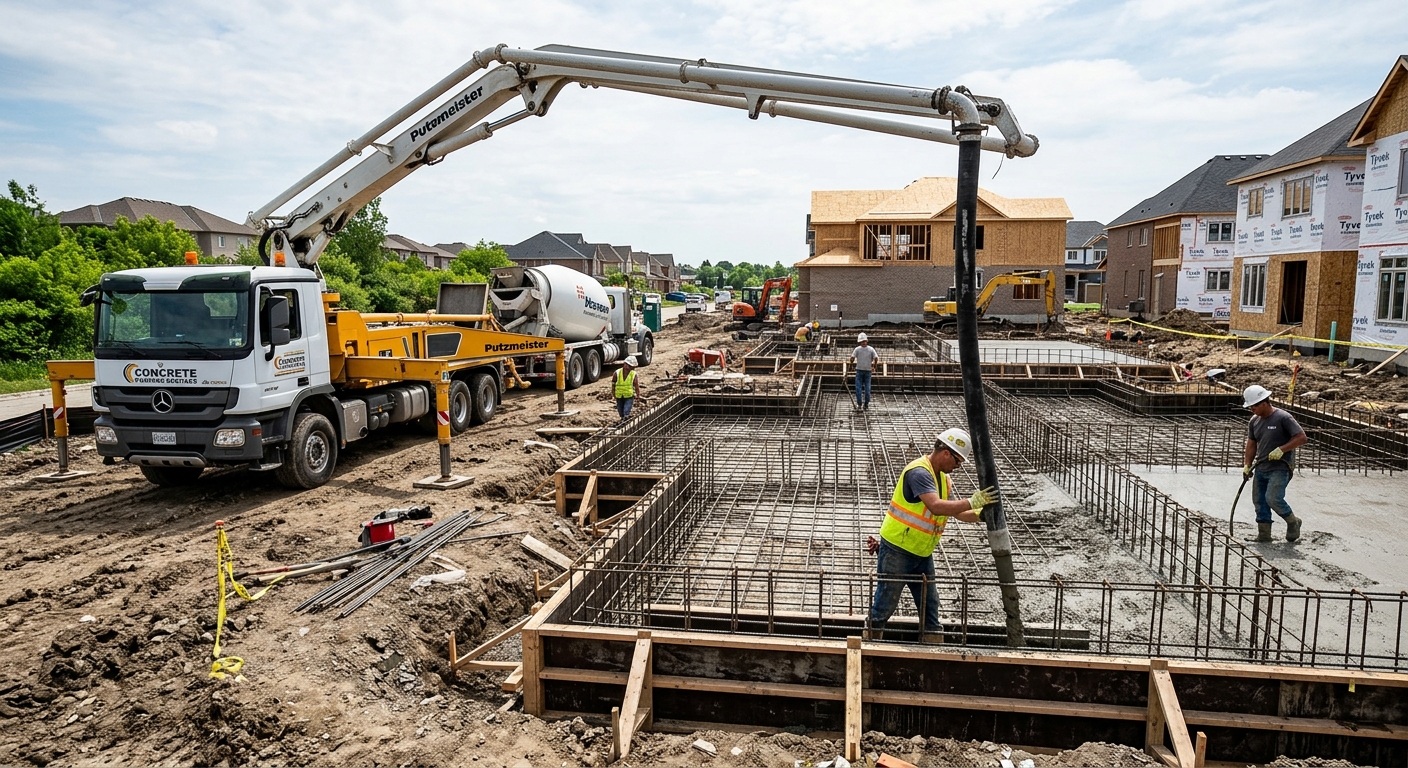
Concrete work options and costs in Delwood
Concrete work is a big part of everyday curb appeal in Delwood, Alberta, especially for homeowners planning driveways, patios and walkways that can handle Calgary-area freeze–thaw cycles. Delwood is a small community—population 3,379 (Statistics Canada, 2021 Census)—and that size means many trades operate with a smaller local crew pool, so scheduling can tighten during exterior construction season. The market is also shaped by the dominant housing stock: in Calgary’s region, single-detached homes are the most common setting for new flatwork, which keeps demand strong for concrete driveway replacements and slab renewals.
In this cold continental climate, cost differences show up even when the “square footage” looks similar. Calgary’s concrete specs are driven by frost depth and seasonal movement: footings and foundation elements must bear below the design frost depth (about 1.2 m locally) to reduce frost heave. For exterior slabs, air-entrained concrete and a properly compacted granular base are non-negotiable to resist freeze–thaw cracking and surface scaling. The practical pour window is shorter, and when contractors place concrete late fall or early spring, they may need winter-grade protection such as insulated blankets or temporary heat—adding labour and equipment costs. On top of that, driveways and patios in established pockets of Delwood can involve heavier excavation and more disposal, which increases total pricing.
Because of those variables, your best way to compare quotes is to line up scope and finish type. Below are realistic cost bands for the most common projects in Delwood—then you can see which option fits your goals and budget before discussing design details with your contractor.
| Application |
Typical Size |
Key Spec |
Finish Option |
Price Range |
| Concrete driveway (standard broom finish) |
20 ft x 24 ft (480 sq ft) |
Air-entrained exterior mix; reinforced per design; compacted granular base |
Broom finish with edging |
$12,000–$18,000 |
| Exposed aggregate driveway |
20 ft x 24 ft (480 sq ft) |
Air-entrained mix; hardened surface; controlled exposure |
Exposed aggregate finish |
$16,500–$22,500 |
| Stamped concrete driveway or patio |
Approx. 400–600 sq ft |
Air-entrained mix; reinforcement; release agent system |
Stamped patterns (field/score lines) |
$15,000–$26,000 |
| Plain concrete patio or walkway |
12 ft x 16 ft (192 sq ft) |
Exterior air-entrained mix; compacted base; control joints |
Float + light broom |
$5,000–$9,000 |
| Garage floor (interior slab) |
24 ft x 24 ft (576 sq ft) |
6 in. slab typical; vapor barrier; reinforcement as required |
Standard smooth/steel-trowel |
$9,000–$15,000 |
| Foundation footings (structural, below frost) |
Typical house footprint varies |
Excavate to design frost depth; engineered rebar; structural concrete |
Formed concrete (no decorative finish) |
$28,000–$45,000 |
Prices are estimates only and vary by project scope, site access and material selection.
What affects the price of concrete work in Delwood
In Delwood and the broader Calgary market, two quotes for the “same” concrete slab can differ by 30–50% because scope details often change: excavation depth, base thickness, reinforcement type, finish system complexity, and whether cold-weather measures are required. In a small community of 3,379 (Statistics Canada, 2021 Census), contractor availability can also affect scheduling—late timing can push work into shoulder conditions, which raises costs.
Frost and freeze–thaw are the biggest drivers. Calgary-area engineering practice uses a design frost depth of about 1.2 m, meaning footing and foundation work must be excavated and formed below undisturbed soil at that depth to prevent frost heave. Every exterior slab then needs air-entrained concrete to survive repeated freeze–thaw cycles without spalling. Because the pour season is shorter, contractors often have to plan around curing: in late fall or early spring they may use insulated blankets, heaters and rapid moisture control so concrete achieves proper strength. That’s why an exterior driveway that lands in a cooler window might move from the lower side of the $12,000–$18,000 band toward the upper side.
Local conditions can also move the needle up or down. For example: (1) a sloped yard or high water table can increase excavation and drainage work; (2) older lots sometimes have compacted fill that needs removal and replacement before a proper granular base; (3) tight access lanes—common near established residential areas—can add equipment time for forming and concrete truck staging. Finish choices do matter too: stamped & decorative concrete typically aligns with the $15,000–$26,000 band because of labour-intensive patterning and release/sealing workflow, while plain patios often stay closer to $5,000–$9,000 when the base and thickness are straightforward.
| Price Factor |
Why It Matters |
Cost Impact |
| Frost line depth — determines footing depth and form height |
Footings must bear below design frost to reduce seasonal movement. |
Higher excavation and concrete volume can add major cost. |
| Site preparation — excavation, grading, compacted granular base |
Proper base prevents settlement and protects the slab over time. |
More trucking, disposal and granular material raises totals. |
| Reinforcement — rebar or wire mesh requirement |
Controls cracking from shrinkage and load stresses. |
Material and placement labour increase for larger slabs. |
| Mix design — air-entrainment and compressive strength spec |
Exterior air content and strength help resist freeze–thaw damage. |
Cold-weather or higher-spec mixes can cost more. |
| Finish type — broom vs. stamped vs. exposed aggregate |
More complex systems require extra steps and curing coordination. |
Stamped/exposed finishes typically move the project upward. |
| Pour size and concrete truck access to site |
Concrete placement efficiency affects labour time and risk of cold joints. |
Tighter access can add equipment and staging time. |
| Cold-weather curing precautions — heating and blankets |
Maintains curing temperature so concrete gains strength properly. |
Adds equipment, labour and time, especially outside season. |
| Control joint pattern and sealing cost |
Joints reduce random cracking; sealing helps with de-icing salt exposure. |
Correct jointing plus later sealer can add a meaningful line item. |
Permits & regulations in Alberta
In Alberta, structural concrete work typically requires more formal approval than simple flatwork. For homeowners in Delwood, concrete jobs such as footings, foundation walls, grade beams and any structural elements usually require a building permit, and engineered drawings are commonly reviewed through the municipal process before work proceeds. That includes most foundation-type concrete beyond just a decorative slab.
Concrete flatwork like driveways, patios and walkways often does not require a permit by itself, unless it changes site grading, affects lot drainage, or impacts municipal rules around impervious surface coverage and how water is managed. Even when a permit isn’t automatically triggered, you should still confirm with the local authority before you excavate—especially if you’re moving fill around the house or changing downspout discharge patterns.
Step-by-step, you can protect yourself by verifying the contractor before they break ground. First, ask for their certificate of liability insurance and WSIB/WCB clearance letter (or proof of coverage, as applicable). Second, confirm they have the right licensing/registration for the trade scope they’re performing in Alberta—many concrete contractors are engaged through the general contracting side, but the responsibility to do the work safely and legally still matters. Finally, request references on similar-scale projects completed recently in Calgary-area conditions. If a contractor can’t provide documentation quickly, treat it as a red flag.
Getting concrete right in Delwood's freeze-thaw climate
Concrete failures you commonly see in Delwood usually trace back to a few predictable gaps: poor base preparation, the wrong concrete mix, missing or poorly spaced control joints, and rushed curing. In a Calgary-region freeze–thaw environment, water gets into hairline cracks and cycles through expansion when it freezes, leading to spalling and surface scaling—especially where de-icing salts sit. To spec the job correctly, you want a system approach, not just a “pour date.”
Start with base prep: use a compacted granular sub-base at the depth engineered for your soil and frost conditions so the slab doesn’t settle. Next, specify a suitable exterior mix—typically 5–7% air content for air-entrained concrete used on exterior flatwork—and require a minimum 32 MPa compressive strength at appropriate curing/age. Then set a joint plan: control joints must be spaced to limit random cracking to manageable lines. Curing is critical: aim for at least 7 days under proper temperature and moisture conditions; in cold periods, blankets or heat may be required to reach strength safely. Finally, sealing matters: apply a penetrating sealer after the concrete has fully cured (commonly around 28 days) to reduce chloride and moisture uptake from winter maintenance.
Here’s a practical price perspective. If you choose a basic broom-finish driveway, you might land in the $12,000–$18,000 band. If you upgrade to stamped concrete in the $15,000–$26,000 band, the cost is usually justified by more labour hours and careful finishing steps—but only if the base, air-entrainment, jointing, and curing are equally correct. Fancy patterning won’t prevent spalling caused by inadequate air content or rushed cure in Alberta’s freeze–thaw climate.
| Spec |
Why It Matters in Delwood |
What to Ask For |
Impact if Skipped |
| Compacted granular base (depth?) |
Prevents settlement and protects the slab through frost cycles. |
Base thickness and compaction test method; excavation to suitable subgrade. |
Cracking from movement, uneven slab, early failure spots. |
| Air-entrained concrete mix (target air %?) |
Durable freeze–thaw resistance in exterior exposure. |
Air content target (commonly 5–7% for exterior flatwork) and mix design documentation. |
Surface scaling/spalling, accelerated deterioration with winter salt exposure. |
| Compressive strength (MPa rating) |
Strength gain supports long-term load and abrasion resistance. |
Minimum 32 MPa (or higher if specified by engineering/scope) and test/acceptance approach. |
Under-strength concrete can crack or wear prematurely. |
| Control joints (spacing per ACI guidelines) |
Controls where cracks form during shrinkage. |
Joint layout drawing: spacing, saw-cut timing, and finishing around edges. |
Random cracking and widened joints that allow water ingress. |
| Minimum 7-day curing period |
Ensures proper hydration and strength in Alberta temperature swings. |
Curing plan, including weather monitoring and winter curing measures if needed. |
Reduced strength and increased risk of scaling. |
| Penetrating sealer (when applied after cure) |
Helps repel moisture and salts in freeze–thaw seasons. |
Sealer type and application timing (typically after full cure, around 28 days). |
Higher chloride absorption, faster surface deterioration over winters. |
How to choose a concrete work contractor in Delwood
Choosing the right concrete contractor in Delwood means verifying both technical capability and legal coverage before you sign. In Alberta, confirm their liability insurance (request a certificate and ensure it covers concrete work and jobsite risk), and ask for proof of WSIB/WCB coverage with a clearance letter where applicable. Then verify that the contractor’s registration/licensing aligns with the scope they’ll perform. You can also confirm credibility by matching their references to the kind of work you’re doing—driveways and exterior slabs in a freeze–thaw climate require different finishing and curing habits than interior flatwork.
Get 2–3 itemised written quotes that break labour and materials separately. Look for what’s included: excavation limits, granular base thickness, reinforcement details, saw-cut timing, and whether disposal is priced or treated as an extra. Ask if a permit pull is included when required (structural foundation elements generally need one), and confirm whether engineered drawings are part of the scope if your project triggers that requirement. A solid warranty should specify workmanship duration and what’s covered; ask about any manufacturer warranty on materials and whether it transfers if you sell the home.
For payment, use a schedule that protects you: never pay more than 10–15% upfront, and hold back a meaningful portion until the job is complete and site cleanup is confirmed. Finally, insist on a written timeline with a start date and completion estimate, so you’re not stuck waiting through Alberta shoulder-season weather.
- Provide a detailed scope sheet (thickness, base prep, reinforcement) rather than a vague description.
- List concrete mix design requirements, including air-entrainment for exterior flatwork.
- Confirm control joint layout and saw-cut plan to minimize random cracking.
- Ask what cold-weather curing measures they use (blankets/heaters) and when they’re required.
- Show how they’ll handle slope, drainage, and tie-ins to existing grades.
- Include hauling/disposal for excavated material—don’t assume it’s included.
- Request proof of liability insurance with coverage limits and dates.
- Request WSIB/WCB clearance letter (or applicable proof of coverage) before work starts.
- Ask for recent references in the Calgary area on similar square footage and finish type.
- Get the permit responsibility in writing if structural concrete elements are involved.
- Use a payment schedule with holdback until final finishing and cleanup.
- Confirm warranty terms in writing, including workmanship and any transferable product coverage.
Concrete red flags in Delwood include: (1) quotes that don’t specify air-entrainment or curing protection despite exterior exposure, (2) missing documentation for liability insurance or WSIB/WCB coverage, (3) vague scope that omits base thickness and reinforcement details, (4) payment demands beyond 15% upfront, and (5) promises of “we’ll pour anytime” without discussing cold-weather risk and curing time.
Frequently asked questions — concrete work in Delwood
How long does concrete take to cure?
In Delwood, Alberta, curing time is where many exterior concrete projects either succeed or fail—especially with Calgary-area freeze–thaw cycles. Concrete reaches a practical strength milestone after about 7 days, but it continues gaining strength for weeks. If the weather turns cold, contractors often need winter-grade protection such as insulated blankets or controlled curing to keep the temperature in a safe range so it can hydrate properly. For waterproofing and chloride resistance, many homeowners plan sealing after full cure—commonly around 28 days—so the penetrating sealer can do its job. If you’re comparing quotes, ask what curing plan they’ll use and whether they factor in temperature monitoring rather than just “calendar days.”
Do I need a permit for concrete work in Alberta?
In Alberta, permit requirements depend on what concrete work you’re doing. Structural concrete like footings, foundation walls and grade beams typically requires a building permit and may rely on engineered drawings reviewed through the municipal process. For concrete flatwork such as driveways, patios and walkways, permits often are not required unless the work affects lot grading, drainage, impervious surface rules, or municipal right-of-way conditions. Before you excavate in Delwood, confirm with the local authority. Also ask your contractor to clarify whether permits are part of their scope—if something triggers a permit, you don’t want it discovered late. Finally, make sure you’re working with a contractor carrying liability insurance and WSIB/WCB coverage.
Concrete vs pavers for a patio in Delwood?
Concrete and pavers can both work well in Delwood, but the freeze–thaw climate makes workmanship and base prep just as important as the final look. Concrete patios typically come in the $5,000–$9,000 band for many standard sizes, and when the mix is air-entrained and joints are planned, the surface holds up well against winter salt and temperature swings. Pavers can be easier to repair if individual units shift, but they still require a properly compacted granular base and correct slope for drainage—otherwise you’ll get heaving and uneven settlement. If you want a smooth, monolithic surface with simple maintenance, plain or broom-finished concrete often wins on cost and longevity. If you want maximum flexibility in layout and colour patterns, pavers may justify the different approach—just insist on engineered base specs and proper edge restraints.
How long does a concrete driveway last?
With good base prep, air-entrained concrete, and correct jointing, a concrete driveway in Delwood often lasts decades. Typical service life commonly ranges into the 20–30+ year category, but the actual outcome depends on freeze–thaw durability and how the slab is maintained. Winter maintenance matters: aggressive de-icing and repeated wetting can accelerate surface scaling if the concrete mix isn’t properly air-entrained or if curing was rushed. A driveway price often falls within the $12,000–$18,000 band for standard broom finishes, and spending at the right scope points (base thickness, reinforcement choices, and a controlled joint plan) has a bigger impact on lifespan than minor finish upgrades. Ask the contractor about sealing timing and joint spacing before you decide.
What is air-entrained concrete and why does it matter here?
Air-entrained concrete includes tiny, evenly distributed air bubbles intentionally built into the mix. In Delwood and the Calgary region, that matters because freeze–thaw cycles move moisture in and out of the slab. When water freezes, it expands; the entrained air bubbles give that expansion space, reducing internal pressure and lowering the risk of spalling and surface scaling. For exterior flatwork, contractors typically target about 5–7% air content depending on the mix design and exposure. If a contractor doesn’t specify air-entrainment, you’re more likely to see deterioration during winter seasons, especially where de-icing salts are used. When you compare quotes in Alberta, ask for the mix design details and how they’ll verify proper curing—those two items usually explain differences in price and long-term performance.
How do I prepare the base for a concrete slab?
Base prep is the foundation of a durable slab in Delwood. Start with excavation to the specified depth, then remove unsuitable soils and replace with engineered granular material. Contractors should grade to the correct slope and compact the sub-base in lifts to achieve consistent density—because a slab that settles unevenly will crack regardless of the finish. For exterior projects, the base must also account for frost-related movement; Calgary-area design practice uses a design frost depth of about 1.2 m for foundational elements, and the slab’s granular system must be engineered accordingly. Ask your contractor what granular depth they’ll use, whether compaction testing is performed, and how they’ll prevent water from pooling. For best results, insist that the concrete be air-entrained for the region and that they include a curing plan appropriate for Alberta temperatures.