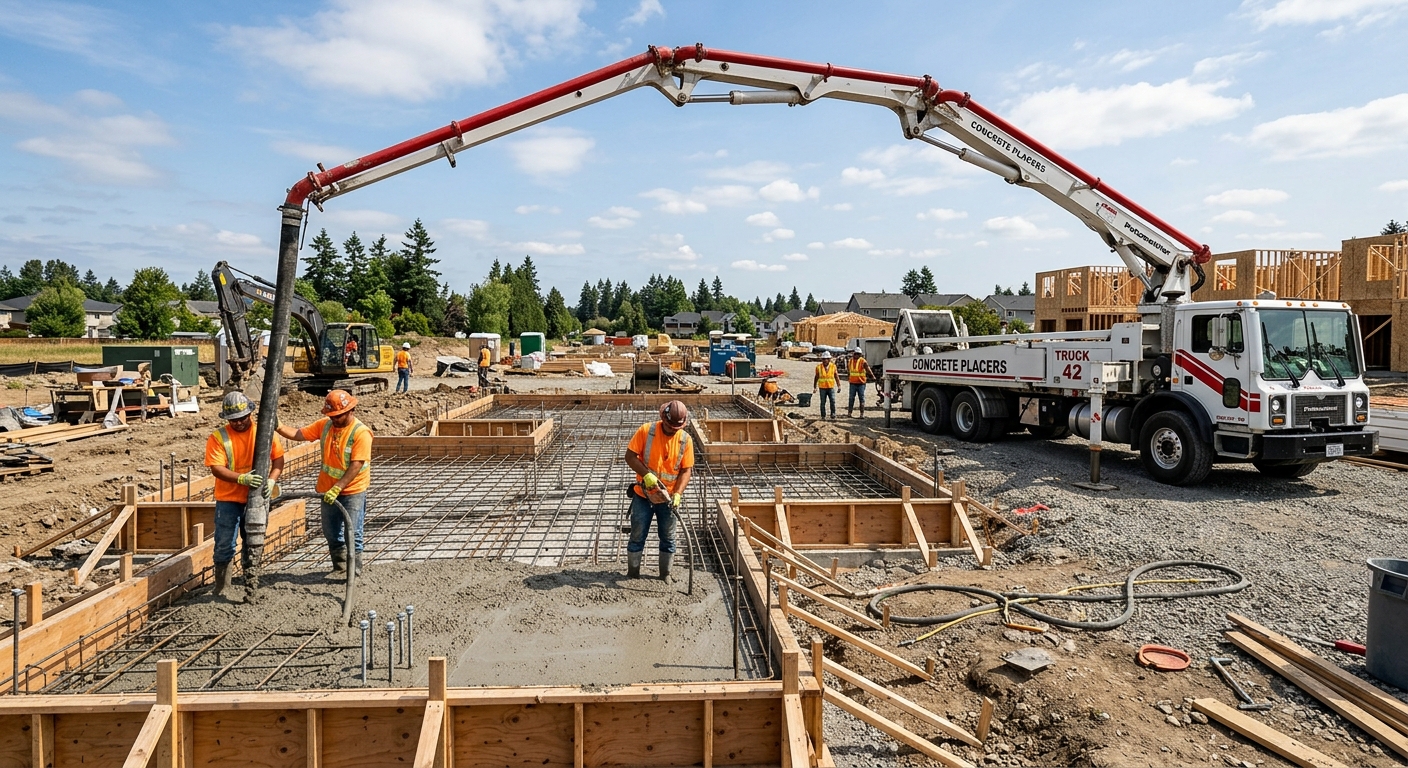
Concrete work options and costs in Millet
Millet is a small community in the Edmonton economic region, and most homeowners here lean toward conventional, family-style properties—single-detached homes make up 71.9% of the housing stock (Statistics Canada, 2021 Census). With about 660 homeowner households (82.5% of households own), the concrete market is steady: driveways, patios, walkways and garage floors are the most common upgrades, and they’re the jobs that most often get replaced or refreshed when families remodel or move.
In this cold continental climate, frost protection drives cost. Edmonton-area frost depths are commonly designed around 1.5 m or more, so exterior work typically needs deeper excavation, properly formed footings (where required), and well-compacted granular base. Freeze–thaw cycles during late fall, winter and spring also mean exterior slabs need air-entrained concrete, good drainage, and well-planned control joints to reduce cracking and surface spalling. Another local pricing reality: the flatwork pour season is shorter, so scheduling and cold-weather protection (insulated blankets or heated enclosure systems) can add labour and materials premiums when projects slip late into the year.
Concrete contractors are especially busy around main residential clusters like the Millet core and newer subdivisions near the community edges, where driveways and patios are frequently expanded for growing households. If you’re comparing options, it helps to match finish and site conditions to realistic budget ranges—see the comparison table below.
| Application |
Typical Size |
Key Spec |
Finish Option |
Price Range |
| Concrete driveway (standard broom finish) |
16 ft x 40 ft (640 sq ft) |
Air-entrained exterior slab, compacted base |
Broom finish, edges formed |
$9,000 – $18,000 |
| Exposed aggregate driveway |
16 ft x 40 ft (640 sq ft) |
Air-entrained mix, aggregate exposure process |
Exposed aggregate (salt-resistant look) |
$12,000 – $21,500 |
| Stamped concrete driveway or patio |
12 ft x 24 ft driveway return or patio (288 sq ft) |
Air-entrained mix, color hardener |
Stamped pattern, sealer |
$12,000 – $26,000 |
| Plain concrete patio or walkway |
10 ft x 16 ft (160 sq ft) |
Compacted granular base, joints |
Float + light broom |
$3,500 – $9,000 |
| Garage floor (interior slab) |
24 ft x 24 ft (576 sq ft) |
32 MPa mix, vapor considerations |
Light broom or smooth-trowel |
$6,500 – $14,000 |
| Foundation footings (structural, below frost) |
Per typical medium build (varies widely) |
Engineered geometry, below frost design |
Structural concrete only |
$25,000 – $60,000 |
Prices are estimates only and vary by project scope, site access and material selection.
What affects the price of concrete work in Millet
In Millet and across the Edmonton economic region, it’s common to see quotes for what looks like the “same” concrete job come in 30–50% apart. The difference usually isn’t the finish name—it’s the spec behind it (base depth, reinforcement, air content, mix design, joint layout), the amount of excavation, and how efficiently the contractor can stage trucks and crews in a winter-ready environment.
First, frost design is the big driver. Exterior work needs footings below the design frost depth to prevent frost heave, and Alberta’s frost considerations are typically deeper than milder regions. Second, freeze–thaw cycles mean exterior slabs need an air-entrained mix and proper drainage details. Third, because the pour season is realistically shorter, scheduling pressure can push labour and materials premiums toward late spring–early fall, and cold-weather curing precautions (insulated blankets, curing protection, sometimes heated enclosures) add cost when pours happen near the shoulder season. Finally, de-icing salt can accelerate surface spalling if the mix and air-entrainment aren’t right, which is why sealing is a meaningful line item—not an optional “nice-to-have.”
Two practical examples from Edmonton-area sites: (1) A driveway where excavation hits frost-susceptible soils can force deeper base and more granular replacement, pushing costs toward the higher end of the $9,000–$18,000 driveway band; (2) a stamped patio may start in the $12,000–$26,000 range, but when the contractor includes correct jointing, color curing, and a proper sealer schedule, the higher price is justified because it lowers the chance you’ll replace the job early.
With nearly half of homes built before 1981 in this area profile, many lots have older grading patterns and existing concrete to break out, which typically means higher disposal, haul-off, and base rework costs than a clean, newly excavated site (Statistics Canada, 2021 Census).
| Price Factor |
Why It Matters |
Cost Impact |
| Frost line depth — determines footing depth and form height |
Footings must extend below design frost depth to resist heave |
More excavation + more concrete; can increase budget substantially |
| Site preparation — excavation, grading, compacted granular base |
Correct base thickness and compaction prevent settlement and cracking |
Hidden labour and material volume can swing the price 15–30% |
| Reinforcement — rebar or wire mesh requirement |
Rebar/wire helps control cracking where movement is expected |
Material + placement time; often moderate but important |
| Mix design — air-entrainment and compressive strength spec |
Air-entrainment is critical for freeze–thaw durability; strength supports loading |
Air-entrained exterior mix can raise material cost but reduces failures |
| Finish type — broom vs. stamped vs. exposed aggregate |
Complex finishes require additional labour, materials and curing/sealing steps |
Stamped/exposed work typically pushes toward higher bands |
| Pour size and concrete truck access to site |
Short access routes reduce pump time, labour staging and wait fees |
Poor access can add truck/pumping charges and crew time |
| Cold-weather curing precautions — heating and blankets |
Ensures concrete reaches adequate strength during cold periods |
Extra materials + labour; can be a meaningful surcharge |
| Control joint pattern and sealing cost |
Joints manage shrinkage cracking; sealer helps repel salt/surface wear |
Small cost per sq ft, but prevents costly early replacement |
Permits & regulations in Alberta
In Alberta, structural concrete work—think foundation footings, foundation walls, grade beams and other structural components—typically needs a building permit, and many projects require engineered drawings that the local municipality reviews. Concrete flatwork (driveways, patios, walkways) usually does not require a permit, but it can if your plan affects lot grading, drainage/impervious surface considerations, or work touches municipal right-of-way conditions. Because rules can vary depending on the impact to site grading, always confirm with the local authority before you break ground in Millet.
Before work starts, verify your contractor is protected and accountable. Step-by-step: (1) check their Alberta business details/registration and any trade qualifications they claim (often available through provincial or municipal-facing resources and the company’s own documentation); (2) request a current certificate of liability insurance naming you as the certificate holder when appropriate; (3) ask for WSIB/WCB clearance—get documentation, not just a promise; and (4) call references from similar-size Edmonton-area jobs (driveways, exterior slabs) where freeze–thaw durability was a concern.
If you’re paying for a foundation pour, ask whether the permit and engineered drawings are included in their scope or handled by your builder/engineer. For flatwork, ask what drainage modifications are included, because that’s the part that often triggers permitting questions.
Getting concrete right in Millet's freeze-thaw climate
Concrete fails in Millet mostly because of how it was built for freeze–thaw and soil movement. If the base isn’t compacted to the correct depth, water can sit under the slab and freeze, lifting concrete (heave). If the mix isn’t properly air-entrained, water inside the paste expands during freezing and causes spalling—flaking, scaling and rough surfaces that you’ll notice within a few winters. And if control joints and curing aren’t handled correctly, shrinkage cracking shows up randomly rather than where it’s designed.
To spec the job correctly, insist on five core items. (1) Base preparation: excavate to the required depth and build a compacted granular sub-base with proper grading and drainage. (2) Mix design: for exterior flatwork, target air-entrainment in the 5–7% range and specify minimum 32 MPa compressive strength. (3) Control joints: place joints to control where cracks form—don’t “wing it.” (4) Curing: allow a minimum 7 days to cure properly under suitable conditions; if temperatures are borderline, use curing protection such as insulated blankets or heated enclosures so the concrete develops strength. (5) Sealing: apply a penetrating sealer after the concrete has cured (commonly around 28 days post-pour) to help repel de-icing salts and reduce surface deterioration.
When comparing options, remember the “cheap” approach is usually the one that skips base depth, uses the wrong mix, or rushes curing. For example, going from a plain patio finish to stamped concrete may move you into the $12,000–$26,000 stamped band, but the additional cost is only justified when the contractor also includes correct joints, color curing and a sealer plan. Otherwise, stamped results can still crack or spall like any other exterior slab.
| Spec |
Why It Matters in Millet |
What to Ask For |
Impact if Skipped |
| Compacted granular base (depth?) |
Prevents water trapping and heave during freeze–thaw |
Base thickness based on site soils + compaction method |
Settlement, cracking, and premature failure |
| Air-entrained concrete mix (target air %?) |
Reduces freeze–thaw damage and spalling |
Exterior air-entrainment target of 5–7% (confirm with mix ticket) |
Scaling and spalling within a few winters |
| Compressive strength (MPa rating) |
Ensures durability and supports traffic loads |
Minimum 32 MPa for typical exterior flatwork |
Surface wear, cracking, reduced lifespan |
| Control joints (spacing per ACI guidelines) |
Controls shrinkage cracking locations |
Joint spacing and timing plan (saw-cut or tooled) |
Random cracking and visible repairs |
| Minimum 7-day curing period |
Strength gain depends on temperature and curing conditions |
What happens if it’s cold (blankets/heating) |
Weak slab, increased cracking risk |
| Penetrating sealer (when applied after cure) |
Helps resist de-icing salt and surface scaling |
Apply around 28 days post-pour (or per product label) |
Faster surface deterioration and staining |
How to choose a concrete work contractor in Millet
Choosing the right concrete contractor in Millet is about paperwork, details, and the ability to build for freeze–thaw—not just pouring fast. First, verify Alberta trade/licensing where applicable for the type of work, then confirm liability insurance is active (request a certificate of insurance before work starts). Next, ask for WSIB/WCB coverage documentation and a clearance letter or equivalent proof—your contract should be clear on who is responsible if a worker is injured on site.
Then get 2–3 itemised written quotes. Ask for labour and materials breakdown, including base prep, reinforcement, concrete mix specification (air-entrainment and strength), finishing method, joints, curing protection, and sealing. Avoid lump-sum numbers with vague scope; instead, require a scope checklist that clearly states what’s included. Also ask whether permits (when required for structural work) are pulled and who coordinates inspections. Confirm disposal/hauling of old concrete is included if you’re doing a replacement, and ask about equipment access limitations if your driveway is tight.
For warranty, get the workmanship warranty length in writing, whether it’s tied to proper maintenance (like sealing), and whether any manufacturer product warranty is separate. Payment schedule matters: don’t pay more than 10–15% upfront, and hold back a portion until the finish, joints, and cleanup are complete. Finally, request a start date and a completion estimate in writing so you can plan around Millet’s shorter pour season.
- Ask for mix tickets showing air-entrainment and strength specs for exterior work.
- Confirm the contractor’s base preparation spec (depth and granular material) before quoting.
- Require joint spacing and whether joints are tooled or saw-cut.
- Check that they include drainage and grading details, not just concrete volume.
- Verify liability insurance limits are appropriate and certificate is current.
- Verify WSIB/WCB coverage with documentation, not verbal confirmation.
- Request at least three references from Edmonton-area freeze–thaw projects.
- Get an itemised quote: excavation, base, steel/mesh, concrete, finishing, curing protection, and sealing.
- Clarify what happens if weather changes mid-pour (blankets/heating plan).
- Confirm disposal/haul-off is included if there’s demo involved.
- Ask about protected curing practices and who is responsible for follow-up.
- Use a payment schedule with a holdback until job completion and final inspection.
Concrete red flags in Millet include: quoting without base thickness details, not discussing air-entrainment for exterior slabs, skipping a joint layout plan, asking for most payment upfront, and providing certificates/insurance that aren’t current or can’t be matched to the job’s contractor name.
Frequently asked questions — concrete work in Millet
Stamped vs broom-finish concrete — cost difference?
In Millet, stamped concrete is usually more expensive than broom-finish because it adds labour-intensive steps: forms/mats for the stamp, color hardener or integral color, release agent, and extra sealing attention. A broom-finish driveway typically lands in the broader $9,000 – $18,000 driveway band depending on size and base prep. Stamped concrete tends to fall into the $12,000 – $26,000 band when the project includes the full system—proper joints, color work, curing, and a sealer designed for freeze–thaw conditions. If a quote for stamped work is close to a broom quote, ask what’s being reduced (often it’s mix specification, joint planning, or sealing, which can lead to early surface wear and cracking in Alberta’s winters).
When is the best time to pour concrete in Millet?
The best time in Millet is typically late spring through early fall, when temperatures support strong curing and you can limit cold-weather protection costs. That matters because Alberta’s freeze–thaw cycle is unforgiving: if you pour too late and the slab doesn’t develop strength, you can increase cracking and spalling risk. For exterior flatwork, plan for at least a 7-day curing window under suitable conditions, and confirm the contractor’s plan if nights turn cold (insulated blankets or heated enclosure systems). If you’re aiming for a driveway in the $9,000 – $18,000 range, scheduling early can also reduce premiums caused by compressed pour seasons. For foundation footings, timing is also linked to engineered requirements and inspection sequencing, so build your schedule with your builder.
How long does concrete take to cure?
Concrete curing is often misunderstood. You can walk or lightly work around the slab earlier, but for real durability in Millet’s climate you should treat curing as a strength-building process. A common baseline is a minimum 7-day curing period under proper conditions so the slab reaches meaningful strength. In cold weather, curing needs protection to maintain temperature so the concrete doesn’t cure too slowly. Even after the concrete is cured enough for use, sealers for exterior slabs are typically applied around 28 days after the pour, once the concrete has fully cured to help repel de-icing salt. If your project is a driveway within the $9,000 – $18,000 range, ask whether curing protection and the sealing schedule are included—skipping these steps is one of the fastest ways to see surface scaling during the next few Edmonton-area winters.
Do I need a permit for concrete work in Alberta?
In Alberta, it depends on what concrete work you’re doing. Structural concrete work—such as foundation footings, foundation walls and grade beams—usually requires a building permit and often engineered drawings reviewed through the municipal process. Concrete flatwork like patios, walkways and driveways typically does not require a permit unless it affects lot grading, drainage, impervious surface rules, or work touches municipal right-of-way conditions. For a homeowner in Millet, the best practical approach is to confirm with the local authority before starting, especially if you’re changing elevations, reworking drainage, or replacing a large driveway. Also verify the contractor includes any permit-related tasks if structural work is involved, and make sure they carry current liability insurance and WSIB/WCB coverage before crews arrive.
Concrete vs pavers for a patio in Millet?
Concrete is usually the better value for patios where you want a clean, uniform finish and predictable maintenance. A plain concrete patio often fits within the $3,500 – $9,000 band depending on size, base preparation and finish. Pavers can look great and allow localized repairs, but they require precise base leveling and jointing details; in freeze–thaw climates, poor base or drainage can still lead to shifting, heaving, and weed growth. Concrete also offers straightforward sealing options that help resist de-icing salts where edges are exposed. If you’re considering stamped looks, stamped concrete can be budgeted in the $12,000 – $26,000 range, but it’s only a win when joints, base depth and mix design are correct—otherwise you pay for aesthetics without the durability.
How long does a concrete driveway last?
A well-built concrete driveway in the Edmonton-area climate commonly lasts 20+ years, sometimes longer, but longevity depends on the build quality. The biggest factors are base preparation and drainage, air-entrainment for freeze–thaw durability, and a correct joint layout to control cracking. Sealing (often around 28 days post-pour) helps reduce surface wear from de-icing salts, which is a common cause of spalling in Alberta winters. The contractor’s cure practices matter too: minimum 7-day curing under suitable conditions is a baseline, and cold-weather protection is critical if temperatures drop. Cost influences durability—driveways in the $9,000 – $18,000 range can perform well, but if someone cuts base depth or skips mix specs, you may see scaling and repairs much sooner.