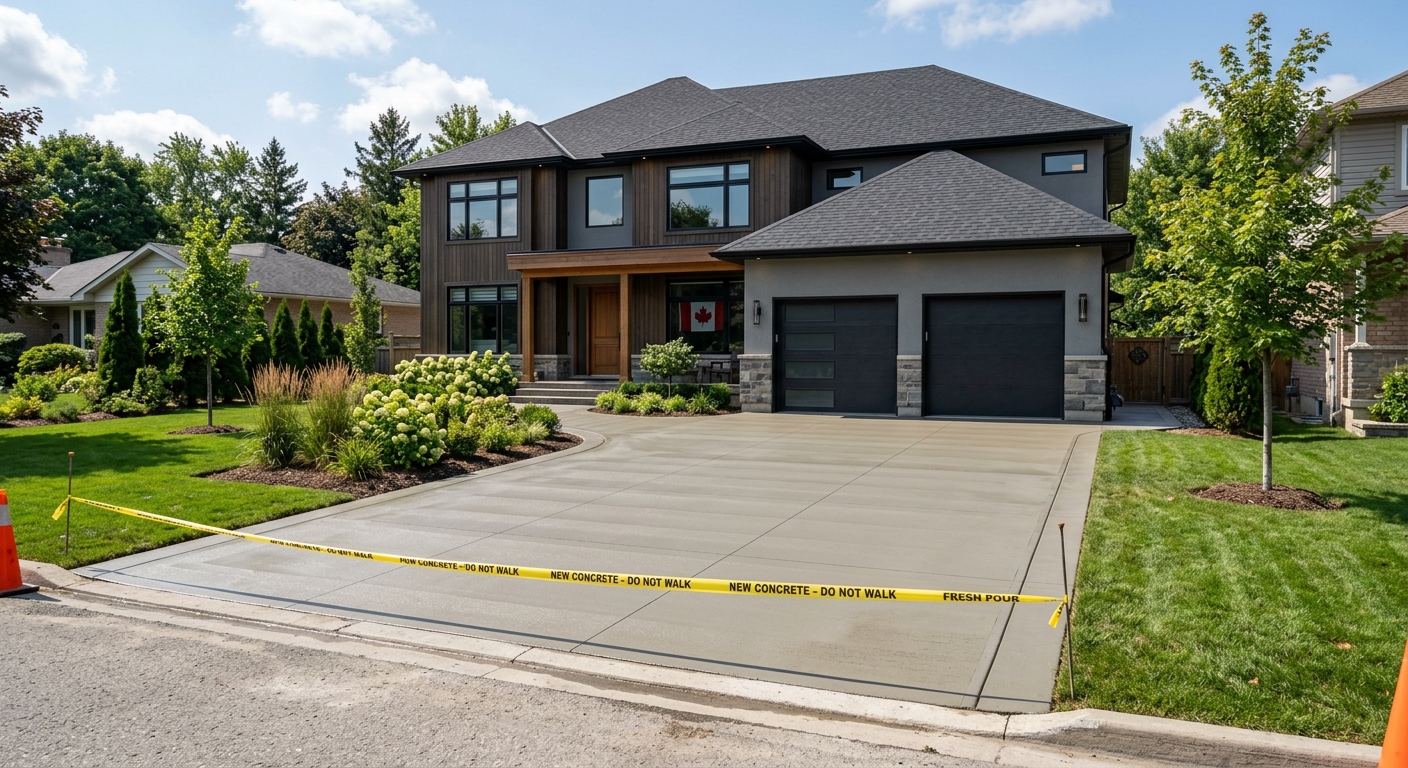
Concrete work options and costs in Blue Quill Estates
Concrete work in Blue Quill Estates, Alberta is largely shaped by a tight, cold-weather construction window and a deep frost design. In a community of about 1,296 residents (Statistics Canada, 2021 Census), you’ll typically see single-family neighbourhood demand driven by families building and upgrading driveways, patios, walkways and garage slabs. Across the wider Calgary economic region, the market tends to favour practical flatwork—because concrete is durable, predictable and relatively low-maintenance once it’s built for freeze–thaw.
In Calgary’s cold continental climate, the frost depth used by engineering practice is about 1.2 m (roughly 4 ft). That means exterior foundations, footings, and anything tied into structural grade must bear on undisturbed soil below that depth. For driveways and patios, your costs still reflect that reality: contractors spend more on excavation, granular base prep, and proper drainage to keep the slab stable through repeated thawing and freezing.
You’ll also see pricing differences from contractor availability and scheduling. Exterior slabs often require winter-grade mixes, insulated curing blankets, and sometimes temporary heat to protect early-age concrete—especially in late fall or early spring. Where de-icing is common (and salt use is hard to avoid), sealing and air-entrainment become non-negotiable to reduce scaling and long-term spalling.
Trade demand is especially strong in the residential pockets around newer build areas off local collector roads—where homeowners commonly upgrade access and landscaping flatwork after the first winter. Use the table below to compare typical scope and budget ranges before you request itemised quotes.
| Application |
Typical Size |
Key Spec |
Finish Option |
Price Range |
| Concrete driveway (standard broom finish) |
400–600 sq. ft. |
Air-entrained exterior mix; compacted granular base; control joints |
Broom finish |
$12,000–$18,000 |
| Exposed aggregate driveway |
400–600 sq. ft. |
Air-entrained mix; wash/expose process; proper curing |
Exposed aggregate |
$14,000–$20,500 |
| Stamped concrete driveway or patio |
300–500 sq. ft. |
Air-entrained mix; release agent; edging and saw-cut joints |
Stamped patterns |
$15,000–$26,000 |
| Plain concrete patio or walkway |
200–400 sq. ft. |
Exterior slab thickness with base prep; joints; proper slopes |
Brush/broom or smooth trowel edge |
$5,000–$9,000 |
| Garage floor (interior slab) |
400–600 sq. ft. |
Vapour barrier where required; properly supported base |
Broom finish |
$7,500–$12,500 |
| Foundation footings (structural, below frost) |
Varies by engineered plan |
Engineered rebar placement; pour below design frost depth |
Structural concrete |
$28,000–$45,000 |
Prices are estimates only and vary by project scope, site access and material selection.
What affects the price of concrete work in Blue Quill Estates
In Blue Quill Estates and the broader Calgary area, two homeowners can receive quotes that differ by 30–50% for what sounds like the “same” concrete job. The usual reason isn’t the concrete itself—it’s the hidden engineering and construction steps required to survive Calgary’s freeze–thaw cycle. Contractors also price risk differently when access is difficult, when excavation is deeper than expected, or when winter scheduling requires added labour planning.
First, frost depth drives the structural and excavation scope. Local engineering practice uses a design frost depth of about 1.2 m. That influences footing depth and formwork height on foundations, and it also affects how far contractors must excavate and rebuild a stable granular base under exterior slabs. Second, the region’s frequent freeze–thaw cycles dictate air-entrained concrete mixes for exterior flatwork and a control-joint layout that reduces random cracking. Third, cold-weather placement can require insulated blankets, curing control, and sometimes temporary heat; the curing window is critical and missing it can increase future repair and warranty disputes.
De-icing salts also accelerate deterioration when the mix and entrained air aren’t right, so sealing and surface protection are often part of a “best value” plan rather than an add-on later. In practice, a basic broom-finish driveway may land in the $12,000–$18,000 band, but a stamped option in the $15,000–$26,000 range is usually worth it only when you’re also budgeting for proper base prep and joints—otherwise you pay extra for a finish that still cracks or scales.
Two concrete examples from this area: (1) a backyard patio that sits over marginal fill may force extra base and regrading—pushing cost toward the upper end of the $5,000–$9,000 patio/work walk range; (2) a foundation redesign due to bearing conditions can increase footing volume and rebar labour, moving foundation/footings toward $28,000–$45,000. In older neighbourhood builds, mature trees and compacted soils can also increase excavation time and disposal fees, which shows up quickly in itemised quotes.
| Price Factor |
Why It Matters |
Cost Impact |
| Frost line depth — determines footing depth and form height |
Structural concrete must bear below design frost to prevent heave and seasonal movement. |
Can shift foundation/footings by tens of thousands depending on excavation depth and soil conditions. |
| Site preparation — excavation, grading, compacted granular base |
Stable base reduces settlement and cracking in exterior slabs through thaw cycles. |
Major driver; difficult access or deeper excavation can add thousands. |
| Reinforcement — rebar or wire mesh requirement |
Controls cracking and improves load capacity where the slab experiences stress. |
Adds labour and materials; under-reinforcement may reduce initial cost but increases long-term risk. |
| Mix design — air-entrainment and compressive strength spec |
Air-entrainment helps resist scaling/spalling during repeated freezing and thawing. |
Usually modest per cubic yard, but it strongly affects durability and warranty confidence. |
| Finish type — broom vs. stamped vs. exposed aggregate |
Finish controls traction, aesthetics, and required crew time/equipment. |
Stamped and exposed aggregate can add significant labour and material costs. |
| Pour size and concrete truck access to site |
More truck trips and extra pumping/equipment increase cost. |
Access constraints can add labour, pumping, and coordination fees. |
| Cold-weather curing precautions — heating and blankets |
Protects early-age concrete from freezing before it gains strength. |
Can add measurable day-rate and consumables in late fall/early spring. |
| Control joint pattern and sealing cost |
Joints manage crack locations; sealing helps resist de-icing salt damage. |
Often overlooked; adding the right joint plan and sealer typically increases short-term cost but reduces failures. |
Permits & regulations in Alberta
In Alberta, structural concrete work typically requires a building permit—especially when it forms part of a house or supporting structural system. That includes footings, foundation walls, grade beams and other structural elements based on engineered plans. Many municipalities in the Calgary area also expect engineered drawings to be reviewed as part of permit approval. For concrete flatwork like patios, walkways and driveways, permits are usually not required unless the work affects lot grading, impervious surface coverage rules, or the municipal right-of-way (for example, work that ties into boulevard areas or changes drainage patterns). Always confirm with the local authority before you excavate.
For contractor accountability in Blue Quill Estates, you should verify insurance and coverage before signing. Step-by-step, start with the contractor’s proof of liability insurance and WSIB/WCB clearance. In Alberta, most reputable contractors can provide a current certificate of insurance showing the correct insured parties and policy limits, plus a clearance letter or equivalent confirmation of workers’ coverage. Next, confirm the contractor is in good standing and that any required business registration is current. Then ask for references on similar-scale projects—driveways, patios, or foundation work—so you’re not relying on photos alone.
If a quote includes “structural concrete” items (footings/grade beams), insist the permit path and engineered requirements are clearly stated. For flatwork, ask how they handle drainage, grading tie-ins, and disposal—these are the items that most often cause disputes.
Getting concrete right in Blue Quill Estates's freeze-thaw climate
Concrete failure in Blue Quill Estates usually comes down to three things: inadequate base support, a mix that can’t handle freeze–thaw, and poor early curing. Calgary’s cold continental weather cycles water in and out of the slab and soil. When moisture moves and the concrete surface can’t tolerate expansion, you get scaling and eventually spalling—especially where de-icing salt is used and where the finish is too dense or the air-entrainment is missing or under-specified.
To spec the job correctly, start with base preparation: use compacted granular sub-base to the right depth for local soil and frost stability. Even a good finish won’t perform if the slab settles or punches under load. Next, specify air-entrained concrete—commonly 5–7% air content for exterior flatwork—and a minimum 32 MPa compressive strength. Then set a control-joint plan: spacing should manage where cracks occur so they don’t wander randomly across driveways and patios. For curing, plan for a minimum 7-day cure under proper conditions; if freezing temperatures are possible, the contractor should explain cold-weather curing methods such as insulated blankets and, if needed, temporary heating to protect early hydration. Finally, add a penetrating sealer after the cure period (typically at 28 days) to help repel de-icing salts and reduce surface deterioration.
Example: if one quote offers a broom-finish driveway in the $12,000–$18,000 range but doesn’t mention air-entrainment targets, joint layout, or curing blankets, it may look cheaper up front. In Calgary winters, that “savings” can lead to scaling in a couple seasons. A slightly higher quote that explicitly includes the right mix and curing practices is often the real bargain over time. Ask the contractor to show their mix spec, joint plan, and curing method—not just their finish style.
| Spec |
Why It Matters in Blue Quill Estates |
What to Ask For |
Impact if Skipped |
| Compacted granular base (depth?) |
Prevents settlement and frost-driven movement under slabs. |
Granular base depth for your soil and frost-stable subgrade; proof of compaction. |
Cracking, uneven surface, and premature failure around edges and joints. |
| Air-entrained concrete mix (target air %?) |
Protects against freeze–thaw scaling and spalling in exterior exposure. |
5–7% target air content (or equivalent spec) for exterior flatwork. |
Surface deterioration and spalling, especially with winter de-icing salts. |
| Compressive strength (MPa rating) |
Ensures the slab reaches required strength for loads and durability. |
Minimum 32 MPa compressive strength at specified test age. |
Reduced performance and higher risk of cracking and surface breakdown. |
| Control joints (spacing per ACI guidelines) |
Directs cracking and limits random fracture patterns. |
Joint spacing and layout plan tailored to the slab dimensions. |
Random cracking, wider cracks, and water infiltration through the slab. |
| Minimum 7-day curing period |
Protects hydration so concrete develops strength without freezing damage. |
Confirmation of curing conditions; cold-weather protection plan if temperatures drop. |
Scaling, weakened surface, and long-term durability problems. |
| Penetrating sealer (when applied after cure) |
Repels de-icing salts and helps reduce surface damage from wetting cycles. |
Penetrating sealer applied after full cure (commonly at 28 days). |
Faster deterioration and more frequent repairs. |
How to choose a concrete work contractor in Blue Quill Estates
Choosing the right contractor in Blue Quill Estates is mostly about verification and clarity. Start with Alberta licensing/registration where applicable for the type of work, then check liability insurance and WSIB/WCB coverage. How to check each: (1) request a current certificate of insurance—confirm it’s not expired and that the policy clearly covers the scope (concrete work, excavation and placement activities); (2) request proof of workers’ coverage (WSIB/WCB clearance or equivalent document); (3) look for a contractor who provides a written scope, technical specs (mix, base, joints, curing) and a realistic schedule. If a contractor can’t provide documentation quickly, that’s a red flag.
Next, get 2–3 itemised written quotes. You want a breakdown that separates labour and materials (concrete, rebar/mesh, granular base, formwork, finishing, saw cutting, disposal) instead of a single lump sum. Read the scope for what’s excluded: permit pull included or not, disposal included, saw-cutting of tie-ins, removal of existing concrete, drainage adjustments, and sealing plans. Warranty also matters—ask for the workmanship warranty length, any manufacturer warranty on products used (if applicable), and whether you can transfer it if you sell your home.
Payment schedule should protect you: never pay more than 10–15% upfront. Hold back the remainder until the job is complete and you’ve confirmed curing/finishing steps are done. Finally, get the start date and estimated completion in writing, including what happens if weather affects curing.
- Ask for air-entrainment and compressive strength targets in writing.
- Confirm base thickness and compaction requirements for your soil conditions.
- Require a control-joint layout plan (not just “we’ll saw cut”).
- Get curing/blanket or heating procedures for cold nights.
- Check whether sealing is included and when it’s applied (e.g., after full cure).
- Verify liability insurance certificate is current and includes project details.
- Verify WSIB/WCB clearance or equivalent workers’ coverage proof.
- Confirm disposal, haul-away, and any load limits for your driveway/access route.
- Require a removal plan for existing concrete (breaking, grading, backfill compaction).
- Ensure quotes specify reinforcement (rebar/wire mesh) where required.
- Ask how they manage drainage slopes away from the house or garage.
- Use a contract that states warranty terms and warranty claim process.
In Blue Quill Estates, common contractor red flags include: vague mix language (“regular concrete” with no air-entrainment target), no mention of curing blankets or winter curing precautions when weather turns, quotes that skip base preparation details, schedules that rush the first week in freezing conditions, and payment requests that exceed 10–15% upfront without milestones.
Frequently asked questions — concrete work in Blue Quill Estates
What is air-entrained concrete and why does it matter here?
Air-entrained concrete is mixed with tiny, evenly distributed air bubbles that give expanding ice somewhere to go during freeze–thaw cycles. In Blue Quill Estates, that’s critical because the region’s cold continental climate repeatedly freezes and thaws moisture in and around the slab. Without proper air content (often 5–7% for exterior flatwork), the surface can scale and eventually spall—especially where de-icing salts are used on driveways and walkways. When comparing bids, don’t just compare total price; ask for the mix spec and whether the contractor can confirm air-entrainment and curing procedures. As a reference point, exterior driveway work often falls in the $12,000–$18,000 band; if one quote is lower but avoids air-entrainment details, it’s often cutting the part that protects you during winter.
How do I prepare the base for a concrete slab?
Base preparation is the foundation of good concrete performance. For Blue Quill Estates, contractors should excavate to a frost-stable, properly compacted sub-base depth based on your site conditions and local frost considerations (engineering practice uses about 1.2 m design frost depth). Then they should grade to the correct slopes, install granular base materials, and compact in lifts to reduce settlement. You also want attention to drainage: water should move away from the house and not pond near slab edges. In itemised quotes, ask what base depth they’re building to, what granular material they’re using, how they confirm compaction, and whether they’re addressing soft spots or existing fill. Skimping on base prep is a common reason you see uneven driveways or cracking around borders later—even when the finish looks fine at first.
How do I compare concrete quotes?
Start by comparing quotes apples-to-apples. Ask each contractor to break down labour and materials and spell out what’s included: concrete thickness, base prep depth, compaction approach, reinforcement (rebar or wire mesh where required), saw-cut timing, joint pattern, and disposal/haul-away. Then compare the “engineering and durability” line items: air-entrainment targets for exterior flatwork, minimum compressive strength (often 32 MPa for typical exterior specs), and cold-weather curing steps like insulated blankets when temperatures drop. Prices in Calgary-area bids can differ by 30–50% because excavation depth, truck access, pumping, and winter curing add costs. For example, a stamped driveway can land in the $15,000–$26,000 range; if it’s priced much lower than another option, verify the base prep and mix spec aren’t being reduced. A good quote reads like a checklist, not a mystery.
Can concrete be poured in cold weather in Blue Quill Estates?
Concrete can be poured in cold weather in Blue Quill Estates, but it must be engineered for it. The issue is not just temperature on pour day; it’s the risk that fresh concrete freezes before it gains strength. Contractors typically use cold-weather placement practices such as winter-grade mixes, insulated blankets, and in some cases temporary heat to maintain curing conditions. The curing window is critical because rushing it—especially late fall or early spring—raises the risk of scaling and long-term structural issues. When you get a quote, ask what the plan is for overnight temperatures: what blankets or heaters will be used, how long the protection stays on, and how they’ll ensure the slab reaches strength before freeze conditions. If a contractor promises a pour without any curing protection plan, that’s a major concern in Alberta’s freeze–thaw cycle.
How do I maintain concrete in Blue Quill Estates's freeze-thaw climate?
Maintenance in Alberta is mainly about protecting the surface from water and de-icing salt damage. Start with sealing: for exterior slabs, a penetrating sealer is typically applied after the cure period (commonly at 28 days) to help repel salts and moisture. During the season, use salt carefully and avoid heavy scraping that chips the surface finish—especially on broom-finished or exposed aggregate. Keep an eye on joints: if you see spalling at edges or cracking that’s letting water in, address it early rather than waiting for full surface failure. Also, maintain drainage so runoff doesn’t pond against the slab. If your patio or walkway is showing early scaling, it can be a sign the mix or air-entrainment wasn’t adequate—repairs may be limited. Planning a proper spec upfront can be the difference between a driveway that stays in the $12,000–$18,000 “value band” for years versus one needing costly resurfacing sooner.
What causes concrete to spall in Blue Quill Estates winters?
Concrete spalls in Blue Quill Estates winters when the slab can’t handle the expansion forces from freezing moisture. The most common cause is inadequate air-entrainment (missing or too low air content), which allows water to freeze within the paste and create disruptive pressure. Another common contributor is poor curing during the first days after placement—if concrete freezes early, the surface can develop weaknesses that later show up as scaling and spalling. De-icing salts accelerate the problem by increasing moisture movement at the surface, and rough handling can chip the top layer so the damage spreads. Base issues also contribute indirectly: if the slab settles or water collects at edges, it increases freeze–thaw exposure and cracks the surface where salts can penetrate. When comparing prices in Calgary, don’t assume the cheapest driveway is safest—verify air-entrainment and curing steps, especially if the job is in the $12,000–$18,000 range versus higher decorative options.