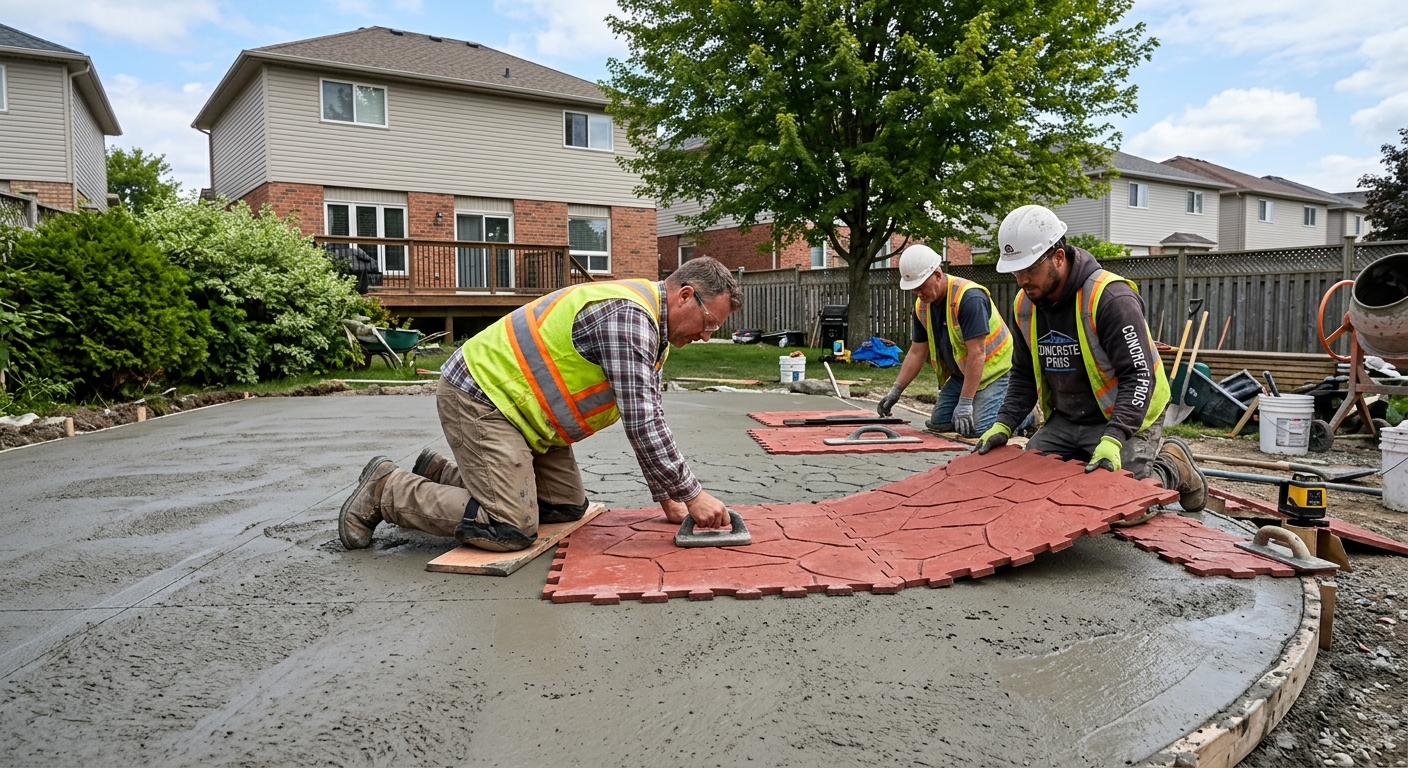
Concrete work options and costs in Canon Ridge
In Canon Ridge, concrete is one of the most cost-effective ways to handle driveways, patios, walkways, and structural foundation elements—especially for homeowners who want a durable surface that can live through Calgary-area winters. With a small local population of 2,019 residents (Statistics Canada, 2021 Census), most concrete demand is tied to ongoing builds, renovations, and replacement cycles across the broader Calgary region. In this market, concrete flatwork is particularly common for single-detached home lots and the accessory buildings that come with them—work that relies on correct frost protection and crack control.
Because Calgary sits in a cold continental climate, pricing reflects more than just the concrete itself. The design frost depth is engineered around about 1.2 m (roughly 4 ft), so footings and below-grade elements must extend to undisturbed soil to avoid frost heave and seasonal movement. Exterior slabs also see frequent freeze–thaw cycles, which is why contractors in the Canon Ridge area price air-entrained mixes and well-spaced control joints into the scope. Cold-weather scheduling matters, too: the exterior pour season is shorter, and late fall or early spring often requires winter-grade materials, insulated blankets, and sometimes temporary heat to protect curing.
Trade demand tends to run highest where new builds and tight-access sites overlap—around the newer development pockets near the Calgary-commuter belt—because excavation, staging, and rebar placement take longer in those conditions. Below is a practical cost comparison so you can line up expectations before you request itemised quotes.
| Application |
Typical Size |
Key Spec |
Finish Option |
Price Range |
| Concrete driveway (standard broom finish) |
400–600 sq ft |
Air-entrained exterior mix, reinforced with wire mesh or rebar (per engineer) |
Broom finish |
$12,000–$18,000 |
| Exposed aggregate driveway |
400–600 sq ft |
Air-entrained exterior mix, proper base and curing plan |
Exposed aggregate |
$15,000–$22,000 |
| Stamped concrete driveway or patio |
300–600 sq ft |
Air-entrained exterior mix, colour hardeners and protective finish |
Stamped pattern + release agent |
$15,000–$26,000 |
| Plain concrete patio or walkway |
200–400 sq ft |
Air-entrained exterior mix, compacted granular base |
Broom or smooth float with edging |
$5,000–$9,000 |
| Garage floor (interior slab) |
500–700 sq ft |
Vapour barrier (if required), fibre or mesh reinforcement (per spec) |
Smooth finish or broom finish |
$6,500–$12,000 |
| Foundation footings (structural, below frost) |
Typical house perimeter |
Excavate to undisturbed soil, engineered rebar and concrete strength |
Structural concrete (utility grade) |
$28,000–$45,000 |
Prices are estimates only and vary by project scope, site access and material selection.
What affects the price of concrete work in Canon Ridge
In Canon Ridge and the broader Calgary economic region, you can see the same “kind” of concrete project come in 30–50% apart because the quote usually reflects details like excavation depth, base thickness, reinforcement requirements, mix design, and finishing complexity—not just square footage. A simple broom-finished driveway can land near the $12,000–$18,000 range, while stamped or decorative systems add labour, materials, and careful curing, often moving into the $15,000–$26,000 band. Foundation footings are their own category; with the design frost depth around 1.2 m (roughly 4 ft), excavation and concrete volume typically drive the $28,000–$45,000 expectations.
Frost line depth and freeze–thaw cycles dictate nearly every spec here. Footings must be placed below the design frost depth to prevent frost heave and seasonal movement. For exterior slabs and flatwork, contractors typically specify air-entrained concrete (to survive repeated freezing and thawing) plus a proper granular base and control joints to reduce cracking and spalling. Calgary-area cold spells also shorten the practical pour season; cold-weather placement may require winter-grade admixtures, insulated blankets, and sometimes temporary heat to achieve curing. And because de-icing salt is common in our winters, sealing is a cost-effective step to slow deterioration at the surface.
In Canon Ridge, a few local examples that change price quickly: (1) if your driveway needs deeper removal for a thicker compacted base, excavation cost rises; (2) if soil conditions are wet or unstable, additional granular fill and compaction cycles add time; (3) if you choose exposed aggregate or stamping, you’re paying for colour materials, finishing labour, and stricter curing control. Even if the neighbourhood is growing, the climate doesn’t pause—so costs are often higher when crews schedule around late-season pours and curing risk.
| Price Factor |
Why It Matters |
Cost Impact |
| Frost line depth — determines footing depth and form height |
Controls how deep excavations and footings must go to resist frost heave |
Major increase on structural work; drives footing volume and labour |
| Site preparation — excavation, grading, compacted granular base |
Base thickness and compaction determine long-term settlement and cracking resistance |
Can swing pricing by thousands depending on soil and access |
| Reinforcement — rebar or wire mesh requirement |
Supports slab performance and controls cracking where engineers specify it |
Moderate-to-high for thicker or engineered slabs; material + placement labour |
| Mix design — air-entrainment and compressive strength spec |
Freeze–thaw durability depends on air content and strength requirements |
Higher for exterior specs and winter-grade curing needs |
| Finish type — broom vs. stamped vs. exposed aggregate |
Labour intensity and material additions change with decorative systems |
Stamped/exposed typically adds significant labour and material costs |
| Pour size and concrete truck access to site |
Shorter pour time and fewer re-handling steps reduce risk and labour |
Tight access or small staging can raise costs |
| Cold-weather curing precautions — heating and blankets |
Protects strength gain and prevents surface scaling in freezing conditions |
Can add line-item cost during shoulder seasons |
| Control joint pattern and sealing cost |
Limits random cracking and helps resist salt scaling and moisture ingress |
Small relative cost, but often essential for longevity |
Permits & regulations in Alberta
In Alberta, structural concrete work—things like foundation footings, foundation walls, and grade beams—typically requires a building permit. Engineered drawings are often reviewed through the municipal process because these elements are part of the structure that carries load. For concrete flatwork such as patios, walkways, and driveways, a permit often is not required by default; however, you should confirm if your scope affects lot grading, drainage, or impervious surface coverage rules, or if work encroaches toward the municipal right-of-way. When in doubt, ask the local authority before breaking ground so you don’t get delays after excavation.
For contractor compliance in Canon Ridge and across Alberta, start with the basics: (1) verify the company’s liability insurance—request a current certificate of insurance naming you as a certificate holder where possible; (2) confirm WSIB/WCB coverage (or the applicable exemption if they truly qualify—most homeowners should still see documentation); and (3) ask for references from similar-scale projects in the Calgary area so you can judge workmanship under freeze–thaw conditions.
Step-by-step homeowner checks: search the contractor’s business details online using Alberta’s public business/contractor information sources, then request updated COI documentation directly. For the clearance letter, ask their insurance/broker or coverage provider to supply the current status letter. Finally, confirm who is pulling the permit (if required) and whether engineering stamps are included for foundation elements.
Getting concrete right in Canon Ridge's freeze-thaw climate
Concrete fails in Canon Ridge when the job is detailed for a milder climate. The most common long-term issue is spalling and scaling from freeze–thaw exposure—usually tied to inadequate air-entrainment, rushed curing, or poor base prep that leads to settlement and cracking. To spec the job correctly, focus on five areas that directly relate to Calgary-area winter performance.
First, base preparation: the granular sub-base must be compacted to the right depth and properly graded to support the slab. For exterior slabs and any portion influencing drainage, base thickness and compaction matter because a settled slab creates cracks that let water in. Second, mix design: for exterior flatwork, specify air-entrained concrete with a target air content typically in the 5–7% range, plus minimum 32 MPa compressive strength (or per engineered spec for structural work). Third, control joints: spacing should be set to reduce random cracking—this is where many “cheap” quotes get thin, because joints require extra layout planning and finishing time. Fourth, curing: plan for at least 7 days of curing under proper conditions; cold-weather pours often need insulating blankets and/or approved heating methods to keep strength gain on track. Fifth, sealing: use a penetrating sealer applied after the concrete has fully cured—commonly around 28 days—to repel de-icing salts and reduce surface deterioration.
What to ask: “What air content are you placing, how are you protecting curing in cold weather, and what joint spacing do you follow?” If someone offers a lower price by cutting air-entrainment or skipping winter curing controls, you’ll often see deterioration sooner, especially on driveways. For a practical comparison, a stamped driveway can sit around the $15,000–$26,000 band versus a broom driveway closer to $12,000–$18,000; that premium is justified when decorative work includes correct base compaction, proper reinforcement, and meticulous curing—not when it’s treated like a purely cosmetic upgrade.
| Spec |
Why It Matters in Canon Ridge |
What to Ask For |
Impact if Skipped |
| Compacted granular base (depth?) |
Prevents settlement and cracking under freeze–thaw loading |
Confirm target base thickness, compaction testing if applicable, and drainage grade |
Cracks widen, water penetrates, higher risk of spalling |
| Air-entrained concrete mix (target air %?) |
Durability against repeated freezing and thawing |
Request specified air content (typically 5–7% for exterior flatwork) |
Scaling and spalling accelerate during winter seasons |
| Compressive strength (MPa rating) |
Strength gain supports load capacity and long-term performance |
Confirm minimum 32 MPa (or engineered requirement) |
Lower strength can lead to surface failure and premature cracking |
| Control joints (spacing per ACI guidelines) |
Controls where cracks form so they’re predictable and less damaging |
Ask for planned joint layout and spacing for your slab dimensions |
Random cracking occurs; water entry increases and repair becomes costlier |
| Minimum 7-day curing period |
Strength development is critical before the freeze–thaw cycle ramps up |
Confirm curing method and cold-weather protections if needed |
Weak surface layer can scale and deteriorate quickly |
| Penetrating sealer (when applied after cure) |
Reduces moisture and salt attack at the concrete surface |
Ask for sealer type and timing (commonly after full cure, often around 28 days) |
Higher risk of salt scaling and faster surface wear |
How to choose a concrete work contractor in Canon Ridge
Choosing the right concrete contractor in Canon Ridge is mainly about proving two things: they can build correctly under Alberta winter conditions, and they can document compliance. Start by verifying Alberta liability insurance—ask for a current certificate of insurance and confirm coverage limits are appropriate for your project. Next, verify WSIB/WCB coverage and request proof of current status (a clearance letter or documentation from their coverage provider). Don’t rely on verbal assurances; ask for documents before you sign.
For pricing, request 2–3 itemised written quotes instead of one lump sum. The best quotes break down excavation/site prep, granular base thickness, reinforcement type and placement, concrete mix design (including air-entrainment), finish labour, curing materials (blankets/heating where applicable), saw-cut control joints, and sealing (if included). Read the scope line-by-line for exclusions: Is disposal included? Are you getting saw-cut joints or just “formed” cracks? Is the permit pull included for foundation structural work? If you need a permit, make sure it’s clear who submits it.
Warranty matters, but define it: ask for workmanship warranty length and whether it covers cold-weather-related performance issues. Also ask about product/manufacturer warranties for decorative colourants or sealers and whether they’re transferable if you sell the home. For payment, keep it sensible: never pay more than 10–15% upfront; use a holdback until completion and final curing/sealing requirements are met. Finally, get a start date and completion estimate in writing—Alberta schedules shift quickly when temperatures drop.
- Ask for proof of current liability insurance before any demolition or excavation begins.
- Verify WSIB/WCB coverage with documentation, not just a certificate date.
- Confirm whether engineered drawings are included for foundation footings or structural grade beams.
- Require itemised quotes (labour, materials, base prep, reinforcement, curing, joints, sealing).
- Ask what air-entrainment target they place for exterior flatwork.
- Confirm control joint spacing and whether joints are saw-cut (not “afterthought” score marks).
- Discuss cold-weather curing plan: blankets, approved heating, and curing protection timing.
- Check whether disposal/hauling is included or billed separately.
- Request a concrete mix delivery plan and truck access method for your lot.
- Get a written warranty for workmanship and clarify what’s excluded (e.g., surface seal maintenance).
- Use a payment schedule with a holdback until final finishing and curing steps are complete.
- Verify schedule and weather triggers in writing so the pour isn’t rushed in late fall/early spring.
Concrete red flags in Canon Ridge: quotes that don’t mention air-entrainment for exterior slabs, missing or unclear joint spacing, “we’ll seal it later” with no plan/timing, no cold-weather curing method for shoulder-season pours, and contractors who ask for most payment up front without a holdback tied to completion.
Frequently asked questions — concrete work in Canon Ridge
How do I maintain concrete in Canon Ridge's freeze-thaw climate?
In Canon Ridge, maintenance is mostly about managing moisture and de-icing impact. Keep runoff from pooling on the slab—check that your driveway or walkway slopes away from the home and that surface drainage isn’t blocked. Use a penetrating sealer (typically applied after the concrete fully cures, often around 28 days) to help repel salt and slow surface scaling. During winter, sweep off snow promptly and avoid piling sharp, salty residue in one spot for long periods. If you see small surface cracks, don’t ignore them: prompt cleaning and appropriate crack repair can prevent water from entering and widening joints through freeze–thaw cycles.
What causes concrete to spall in Canon Ridge winters?
Spalling in Alberta winters is commonly tied to inadequate air-entrainment, improper curing, or a slab that settles due to poor base preparation. When freeze–thaw cycles repeat, water trapped in the concrete expands and breaks down the surface. If the mix wasn’t designed with durable air content, scaling can start as small patches and grow over multiple seasons. Curing issues matter too—pouring in cold conditions without insulation blankets or approved heat can prevent the concrete from reaching proper strength gain. Finally, if de-icing salts concentrate at the surface without a sealer, the surface is more vulnerable. In short, good spalling resistance comes from the full system: base prep, mix, joints, curing, and sealing—not just the finish.
What is rebar and when is it required in Alberta?
Rebar is short for reinforcing steel bars used to strengthen concrete elements. In Alberta, whether rebar is required depends on the structure type and engineering design, especially for foundation work. For foundation footings and foundation walls, rebar is usually specified by engineers and must be installed to match cover requirements and spacing so the concrete performs as intended below the frost depth. For flatwork like driveways and patios, reinforcement requirements can vary: some slabs use wire mesh, fibres, or rebar depending on slab thickness, soil conditions, and expected loads. The key is that reinforcement should be specified—not guessed—because the freeze–thaw environment in Calgary can turn minor cracking into a durability problem if the reinforcement and joint plan aren’t aligned.
How long does a concrete project take in Canon Ridge?
The timeline depends on the type of work and weather. For small flatwork like a plain patio or walkway, the active on-site work can be short—often a day or two for excavation, base prep, and the pour—followed by curing time before full use. Decorative work (like stamped concrete) usually takes longer because of colour placement, stamping, and careful finishing steps, plus stricter curing control in cold weather. A driveway project can take several days for demo, excavation, base compaction, reinforcing, forms, pour, finishing, and joint work. Even when the “pour day” is quick, curing requirements mean you shouldn’t rush access. As a cost reference, if your driveway budget is around $12,000–$18,000 for standard broom finish, schedule should still allow time for base work and weather protection; the cheaper rush jobs often lead to earlier surface scaling.
What is a concrete overlay and is it suited to Canon Ridge?
A concrete overlay is a new concrete layer placed over an existing slab (usually with preparation such as cleaning, removing weak areas, and creating a bond system). It can be suited to Canon Ridge when the existing concrete is still structurally sound—no major settlement, no widespread failures, and manageable cracking/joint conditions. However, overlays aren’t a cure-all. If the underlying slab has poor base support, water drainage issues, or significant movement, the overlay can crack or debond through the Alberta freeze–thaw cycle. Overlays also need correct mix and curing to resist salt and winter moisture. If you’re deciding between a full replacement and an overlay, ask your contractor to assess the slab conditions and explain the base and drainage story—not just the surface appearance.
How do I seal concrete to protect it in Canon Ridge?
Sealing in Canon Ridge is about timing and product choice. Wait until the concrete has cured fully—commonly around 28 days for exterior flatwork—then clean the surface and ensure it’s dry before applying a penetrating sealer. Penetrating sealers help reduce moisture and salt movement into the concrete, which is important where de-icing accelerates surface wear in freeze–thaw climates. Apply per manufacturer directions, including coverage rate and temperature limits. Re-seal schedules vary by product and traffic, but many homeowners plan reapplication every few years, especially for driveways that receive frequent winter salt. If your concrete is stamped or exposed aggregate, use a compatible sealer so you don’t dull colour or change texture more than expected.