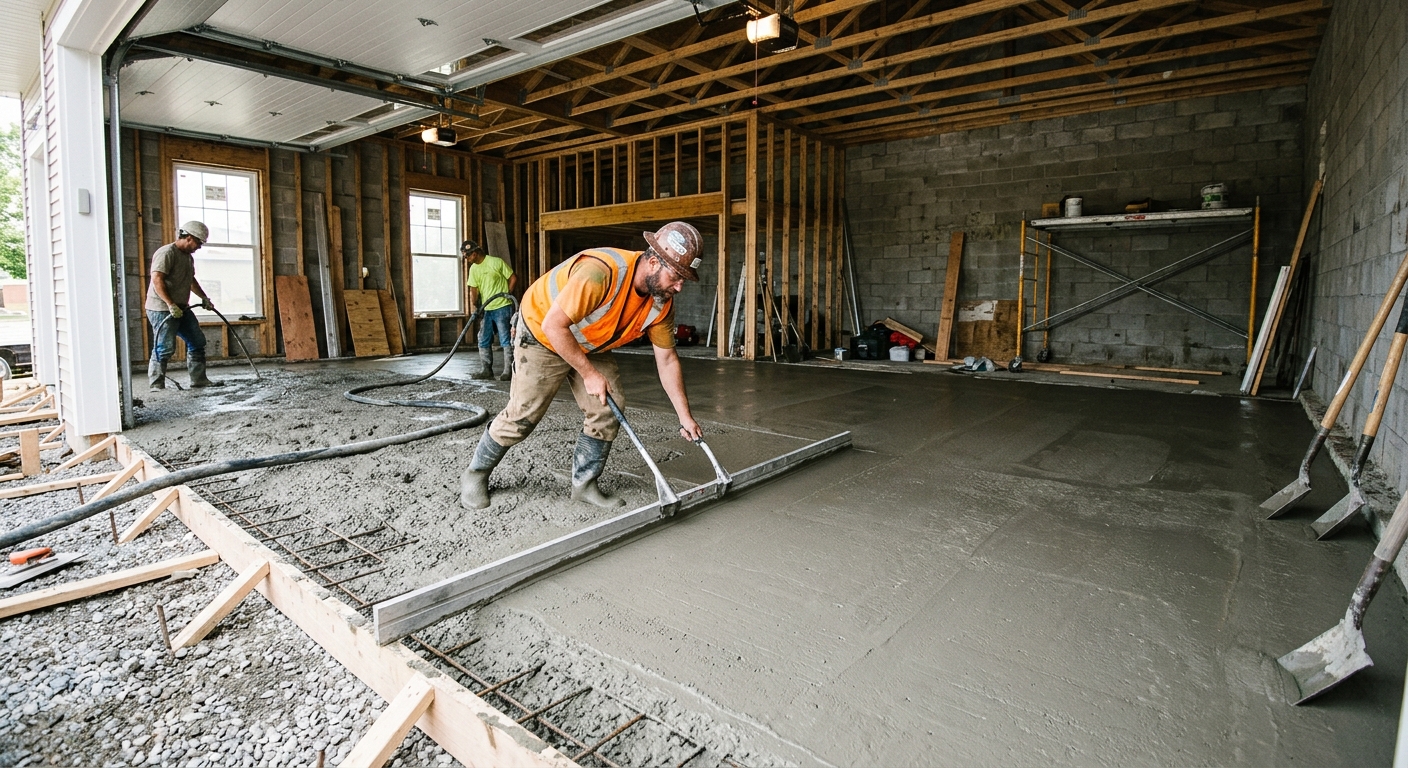
Concrete work options and costs in Banff Trail
In Banff Trail, Alberta, concrete flatwork is a practical, long-wearing choice—especially for driveways, patios and walkways that need to handle Calgary-area freeze–thaw cycles. As a neighbourhood with housing that supports home renovations and yard upgrades, concrete remains a common upgrade path for homeowners; Calgary’s wider market includes many single-detached homes, and this area’s population of 3,805 residents (Statistics Canada, 2021 Census) reflects a steady base of owners who keep improving their properties. In concrete terms, “improvements” here usually means replacing aged asphalt, adding a new patio, or rebuilding slabs that have started to heave or spall after winters with repeated cold snaps.
Prices in Banff Trail track the colder continental climate: local practice engineers footings to bear below the design frost depth (commonly around 1.2 m), and exterior slabs are typically air-entrained to resist freeze–thaw damage. The deeper excavation and higher foundation volumes compared with warmer provinces can push foundation budgets upward, while the shorter pour season increases scheduling competition and raises cold-weather curing costs (blankets, heat, and tighter supervision). On the finishing side, Edmonton-level bargains don’t travel well here—decorative work like stamping and exposed aggregate costs more because skilled finish crews and better aggregates are in demand, particularly around the Banff Trail community area and nearby shopping/streets where access and traffic control can affect labour time.
Below is a practical comparison of the common options and the typical price bands you’ll see when booking work in the Calgary region.
| Application |
Typical Size |
Key Spec |
Finish Option |
Price Range |
| Concrete driveway (standard broom finish) |
18 ft × 20 ft (360 sq. ft.) |
Air-entrained mix; compacted granular base; control joints |
Broom finish, saw-cut joints, optional sealer |
$12,000–$18,000 |
| Exposed aggregate driveway |
18 ft × 20 ft (360 sq. ft.) |
Air-entrained mix; washed/surface retardation or mechanical reveal |
Exposed aggregate with edging detail |
$14,500–$22,500 |
| Stamped concrete driveway or patio |
16 ft × 20 ft (320 sq. ft.) |
Air-entrained mix; integral release agent; adequate curing plan |
Stamped pattern with color hardener (single or two-tone) |
$15,000–$26,000 |
| Plain concrete patio or walkway |
12 ft × 16 ft (192 sq. ft.) |
Air-entrained mix; compacted base; joints as required |
Smooth/trowel then light broom or stamped as alternative |
$5,000–$9,000 |
| Garage floor (interior slab) |
20 ft × 20 ft (400 sq. ft.) |
Vapour barrier (as applicable); fibre or mesh; proper cure |
Broom finish, light aggregate finish, optional sealer |
$8,000–$14,000 |
| Foundation footings (structural, below frost) |
Typical house build: ~800–1,500 sq. ft. footing footprint |
Engineered rebar; excavation to design frost depth; concrete placement planning |
Structural finish (not a decorative surface) |
$28,000–$45,000 |
Prices are estimates only and vary by project scope, site access and material selection.
What affects the price of concrete work in Banff Trail
In Banff Trail, two quotes for the “same” concrete job can easily swing by 30–50% because Calgary-area pricing reflects more than just cubic yards. Labour availability, excavation difficulty, rebar detailing, site logistics (tight access, basement walks, or coordination with other trades), and the exact concrete spec (air entrainment, strength, curing method) all change the outcome. Decorative work also depends heavily on finish systems and the crew’s experience—stamping and exposed aggregate are labour-intensive and need careful scheduling to avoid cold-weather defects.
The main driver is Calgary’s cold continental climate and the region’s freeze–thaw cycles. Footings must extend below the design frost depth (about 1.2 m in Alberta practice) and exterior slabs need air-entrained mixes to survive repeated freeze–thaw. When freeze–thaw is frequent, the pour season gets tighter, so contractors may use winter-grade concrete, insulated blankets and sometimes temporary heat to maintain curing conditions—those precautions add cost, but skipping them increases long-term spalling risk. De-icing salt is another local reality: it accelerates surface breakdown if you don’t seal and maintain the concrete after cure.
Here are a few Banff Trail examples where costs rise or fall. If your driveway base is soft and needs deeper granular replacement and more compaction, your standard driveway band of $12,000–$18,000 can move toward the top end. Conversely, a small patio with straightforward access may land in the $5,000–$9,000 range, especially if the subgrade is already stable. With older housing stock in the Calgary region, you’ll also see more surprises like buried clay lenses, tree-root disruption, or poor drainage—any of which adds excavation and rework.
| Price Factor |
Why It Matters |
Cost Impact |
| Frost line depth |
Determines footing depth and required formwork height below grade |
Higher excavation and concrete volume; often the biggest foundation cost variable |
| Site preparation |
Excavation, grading, and compacted granular base control settlement and heave |
Soft soils or poor drainage can add extra granular material and labour |
| Reinforcement |
Rebar or wire mesh controls cracking and improves structural performance |
More bars, chairs, and placement labour increase cost |
| Mix design |
Air-entrainment and specified compressive strength improve durability outdoors |
Specialty mix and higher quality control can push pricing up |
| Finish type |
Broom vs. stamped vs. exposed aggregate changes crew skill and labour time |
Decorative systems usually move you from standard into premium bands |
| Pour size and concrete truck access to site |
Short pours, tight streets, or long wheelbarrow distances increase labour time |
May require additional handling or smaller batch strategies |
| Cold-weather curing precautions |
Heating and insulated blankets protect early-age strength development |
More equipment and monitoring; critical late fall/early spring |
| Control joint pattern and sealing cost |
Correct jointing reduces random cracking; sealing reduces salt scaling |
Extra saw-cutting and sealer material/work add cost but prevent failures |
Permits & regulations in Alberta
In Alberta, structural concrete work—think foundation footings, foundation walls, grade beams, and other load-bearing structural elements—typically requires a building permit and is often supported by engineered drawings that the municipality reviews. Concrete flatwork (driveways, patios, walkways) usually does not require a permit on its own, unless it affects lot grading, drainage direction, or municipal expectations around impervious surface coverage and right-of-way impacts. In Banff Trail, it’s smart to confirm with the local authority before breaking ground, especially if you’re changing slopes, touching a front boulevard area, or adding drainage changes.
Before you sign, verify insurance and coverage in practical steps. First, ask for the contractor’s proof of liability insurance—your goal is an active certificate of insurance (COI) showing they’re insured for the work and that your property isn’t being taken as a risk backstop. Next, ask about WSIB/WCB coverage (depending on the contractor’s status); a reputable Alberta concrete contractor should be able to provide a clearance letter or proof of active registration upon request. Then check licensing status through the province’s online resources (and confirm it matches the company name you’re contracting with).
Finally, request references for similar-scale projects in the Calgary region and ensure the proposal clearly states what’s included (base, reinforcement, curing methods, saw-cut joints, and sealing if offered). That’s how you protect your schedule and your foundation.
Getting concrete right in Banff Trail's freeze-thaw climate
Concrete fails in Banff Trail mainly when the slab can’t resist water and freezing temperatures. The most common story I see is surface spalling or scaling after winters—often linked to inadequate air-entrainment, rushed curing, or a base that wasn’t compacted to the right depth. Freeze–thaw cycles expand moisture in pores; if the concrete mix isn’t engineered for it, the surface breaks down and the damage accelerates when de-icing salts are used. Fixing failures later costs far more than spec’ing the right system up front.
To spec the job correctly in this Calgary-area climate, start with base preparation: compacted granular sub-base to the depth required for your soil conditions and frost considerations, with proper drainage grading. Next, require an air-entrained exterior mix—typically with about 5–7% air content for outdoor flatwork—and minimum 32 MPa compressive strength. Then plan control joints: saw-cut timing and spacing must be designed to keep cracking predictable rather than random. Curing is non-negotiable: aim for a minimum 7 days under proper conditions, and if temperatures drop, the contractor should use winter-grade measures, insulated blankets, and/or heating so early-age strength can develop. Lastly, sealing should be penetrating sealer applied after the concrete has cured—commonly at the 28-day mark—to repel meltwater and reduce salt impact.
For example, upgrading from a basic broom-finish driveway to proper air-entrainment, a better base, and correct joint timing might increase your driveway budget by a few thousand dollars, but it’s the difference between a slab that survives Calgary winters and one that needs replacement sooner. Your best ROI is usually in base and mix specs—not in flashy extras.
| Spec |
Why It Matters in Banff Trail |
What to Ask For |
Impact if Skipped |
| Compacted granular base (depth?) |
Controls settlement and helps prevent moisture-related movement during freeze–thaw |
Proposed base depth, granular type, compaction method and proof/QA approach |
Uneven settlement, cracking, and premature spalling |
| Air-entrained concrete mix (target air %?) |
Creates freeze–thaw durability by providing room for ice expansion |
Written mix design showing air content target (typically 5–7% for exterior flatwork) |
Scaling/spalling within a few seasons, especially with de-icing salts |
| Compressive strength (MPa rating) |
Strength gain supports durability and abrasion resistance in cold weather use |
Minimum 32 MPa (or higher if specified) and curing approach |
Surface weakness, raveling, and reduced long-term performance |
| Control joints (spacing per ACI guidelines) |
Turns random cracking into predictable crack lines that keep water out |
Joint layout plan, saw-cut timing, and sealing plan if joints are to be sealed |
Random cracking, trip hazards, and water intrusion |
| Minimum 7-day curing period |
Early-age curing affects strength development before first freezes |
Schedule showing cure protection; winter methods if temps are expected to drop |
Weaker concrete, surface scaling, and future cracking |
| Penetrating sealer (when applied after cure) |
Reduces water and salt penetration that drives deterioration |
Sealer type and timing (commonly after ~28 days of cure) |
Faster scaling and stain/efflorescence issues |
How to choose a concrete work contractor in Banff Trail
Choosing a concrete contractor in Banff Trail should start with verification—because freeze–thaw failures are usually spec-and-workmanship problems, not “bad luck.” First, confirm Alberta licence status where applicable for the contractor/company performing the work, then request proof of liability insurance. Ask for the certificate of insurance (COI) and confirm coverage limits and dates. Next, ask for WSIB/WCB coverage proof or a clearance letter; a legitimate contractor should be able to provide it without pressure or delays. Don’t accept “we’re covered through the builder” language—get documentation tied to the contractor you hired.
Then get 2–3 itemised written quotes. Your best quotes show labour and material breakdown (excavation, granular base, reinforcement, formwork, concrete supply, finish work, saw-cutting, curing blankets/heating if needed, and sealing). Avoid lump-sum only proposals with vague scope. Read exclusions carefully: Is disposal included? Who handles protection of nearby landscaping and drainage? Is the permit pull included (for structural work it matters), and are engineered drawings referenced when required?
Warranty matters too: ask for workmanship warranty length and what it covers (cracking, settlement, spalling) and whether it’s transferable if you sell. For payment schedule, never pay more than 10–15% upfront; hold back a portion until final completion. Finally, insist on a written timeline with start date, pour date conditions, and completion estimate—so cold snaps don’t become a “schedule surprise.”
- Request insurance COI and WSIB/WCB proof before signing.
- Confirm licence/registration for the company performing the concrete work.
- Get itemised quotes (materials, labour, equipment, and curing measures).
- Ask for the concrete mix design or at least the key specs (air-entrainment, strength).
- Ensure base prep details are written (granular type, depth, compaction requirements).
- Ask for reinforcement plan (rebar size, spacing, or mesh type) if applicable.
- Confirm control joint plan: layout and saw-cut timing.
- Ask how they handle cold-weather placement and curing (blankets/heating).
- Clarify who supplies and applies sealer if included, and the timing (after cure).
- Make disposal and dump fees explicit—no “allowance” guessing.
- Require a written start date and completion target, tied to weather conditions.
- Confirm warranty terms in writing, including coverage limits and process for claims.
Common concrete contractor red flags in Banff Trail include: no proof of WSIB/WCB or liability coverage, quotes that don’t specify air-entrainment or curing precautions, vague base-prep descriptions, pressure for large upfront payments, and “we can pour whenever” language without a winter curing plan.
Frequently asked questions — concrete work in Banff Trail
What is a concrete overlay and is it suited to Banff Trail?
A concrete overlay is a layer of new concrete (or sometimes a patch/leveling system plus topping) placed over an existing slab to restore levelness and appearance without full removal. In Banff Trail and across Alberta’s freeze–thaw climate, overlays can work when the original slab is still structurally sound—no significant settlement, widespread delamination, or severe cracking that indicates movement. The key is surface preparation: proper grinding, patching, and bonding system selection so moisture doesn’t get trapped between layers. Overlays are often chosen when you’re trying to stay within the lower end of flatwork budgets (for example, typical patio/walkway work often falls around $5,000–$9,000 depending on size), but you should still budget for remediation of any drainage or base issues first. If the original failure is from poor base or frost-related movement, removal and re-pour usually performs better long-term.
How do I seal concrete to protect it in Banff Trail?
In Banff Trail, sealing is mainly about reducing water and de-icing-salt intrusion that leads to scaling and spalling during repeated freeze–thaw cycles. Use a penetrating sealer (not just a surface film) designed for exterior concrete. Timing matters: let the concrete cure fully first—commonly about 28 days—then apply sealer when the slab is dry and temperatures are within the manufacturer’s range. Before sealing, the contractor should clean and repair any minor surface issues and confirm the surface is ready (no dust, salts, or loose material). Plan re-application as recommended by the product, since Alberta winters and salt use accelerate wear. If you’re budgeting, sealing is often a relatively small add-on compared with redoing a driveway—especially when your driveway option budgets typically land in the $12,000–$18,000 range for standard broom-finish work.
What is the difference between concrete and cement?
Concrete is the full building material made from cement plus water, aggregates (sand and gravel), and often admixtures like air-entraining agents. Cement is only one component—essentially the binder that reacts with water to form the paste that holds everything together. In Alberta, contractors specify concrete based on performance: air content for durability, compressive strength (commonly minimum 32 MPa for many exterior applications), and proper curing to get the strength gain you need before cold snaps. Homeowners sometimes hear “cement” and think it’s the same as “concrete,” but your quote should reference the concrete mix design rather than only the cement brand. That’s especially important in Banff Trail, where frost-related movement and freeze–thaw durability requirements drive the specifications and can change your final price and service life.
How much does concrete work cost in Banff Trail?
Concrete pricing in Banff Trail generally follows Calgary-area cost drivers: excavation depth for frost considerations, granular base prep, air-entrained mix requirements for exterior slabs, and cold-weather curing measures when the season is tight. For typical homeowner scopes, you’ll often see driveway projects in the $12,000–$18,000 range depending on size and access, while patios and walkways commonly land around $5,000–$9,000. If you want decorative work, stamped concrete is typically higher because of the labour and finishing systems—often starting around $15,000–$26,000 depending on area and detailing. Foundation footings are a different category due to structural excavation and engineering; those structural scopes often fall around $28,000–$45,000 as a band for budgeting. For the most accurate estimate, ask for an itemised quote with base, reinforcement, mix specs, curing plan, and sealing if included.
How deep must footings be for Banff Trail's frost line?
In Banff Trail, footing depth is governed by the design frost depth used in Alberta engineering practice and the local soil conditions. Calgary-area projects commonly plan around a design frost depth of about 1.2 m (roughly 4 ft), meaning footings for houses, garages, decks and retaining structures must bear on undisturbed soil below that depth to reduce frost heave and seasonal movement risk. Your exact depth should be determined by an engineered plan (or the appropriate structural design criteria for your project) and verified by site conditions like soil type, groundwater, and local frost exposure. If someone offers a “one size fits all” footing depth, it’s a red flag. The safer approach is to confirm the foundation design details in your permit/engineering documents and ensure excavation reaches the required bearing level before concrete placement.
Why does concrete crack in Banff Trail and how is it prevented?
Concrete can crack in Banff Trail mainly due to shrinkage, temperature swings, settlement, and—most importantly for longevity—how well the slab manages freeze–thaw moisture. Even well-built concrete will crack if joints and base prep aren’t properly engineered, but good design makes the cracks predictable and less harmful. Prevention starts with compacted granular base prep so the slab doesn’t move, and proper air-entrainment so freeze–thaw cycles don’t break down the surface. Control joints are also critical: they must be spaced appropriately and saw-cut on schedule so shrinkage cracks happen where you want them. Curing is the other major factor—if curing is rushed in colder weather, early-age strength can be compromised. Finally, sealing after full cure helps protect the slab from de-icing salt and moisture intrusion. When air-entrainment and jointing are done right, cracking risk drops significantly and the slab lasts much longer through Alberta winters.