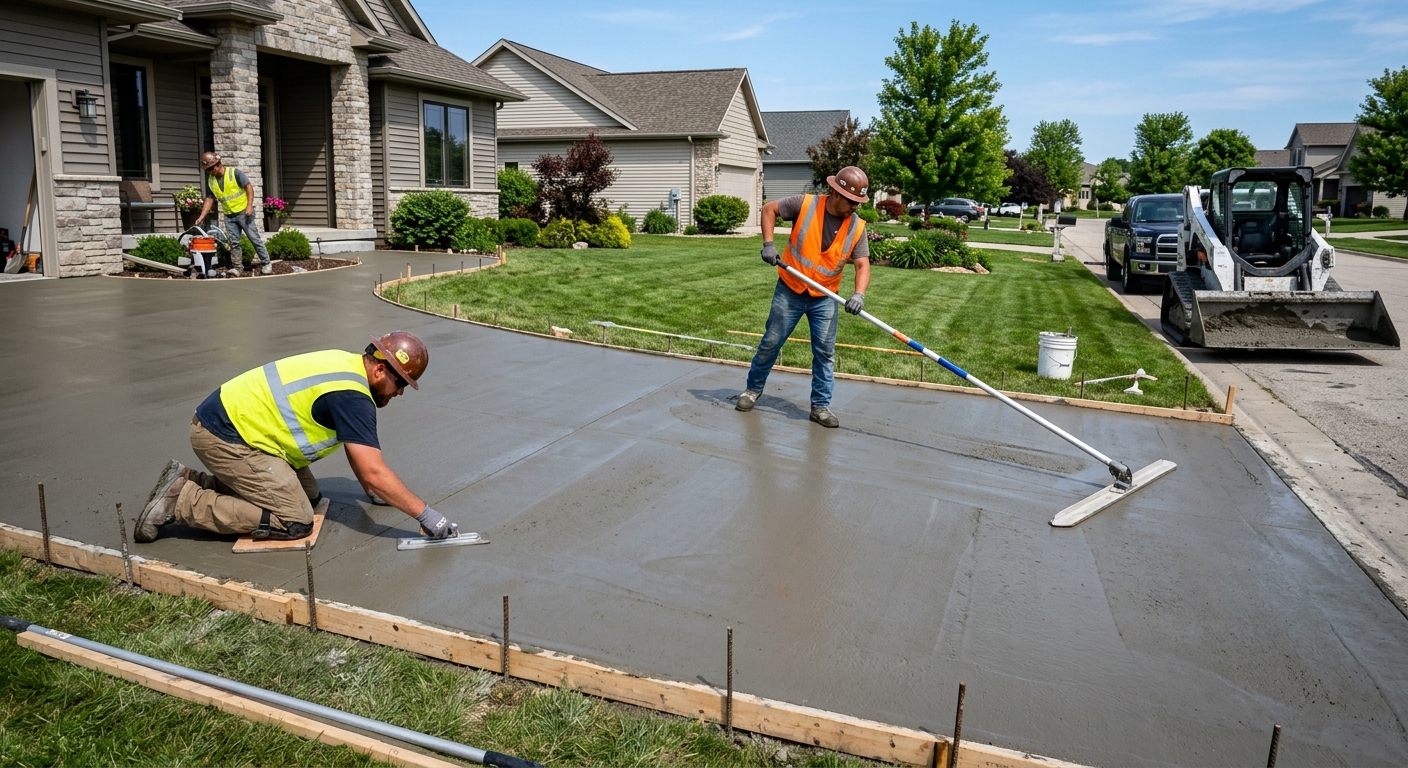
Concrete work options and costs in Stony Plain
Concrete work in Stony Plain is a regular part of home ownership—especially in a community where most homes are single-detached (58.1% of dwellings, Statistics Canada, 2021 Census). With 73.0% of households owning their homes, many projects are driven by upgrades like driveways, patios and walkways that need to handle Edmonton-area freeze–thaw cycles without heaving or premature surface wear. Stony Plain also has a meaningful amount of older housing stock (22.1% of homes built before 1981), which often means backyard grades, drainage patterns, and aging slab edges need attention before any new concrete is poured.
In the Edmonton economic region, cold continental conditions are a big cost driver: frost depths are commonly designed around 1.5 m or more, so exterior footings and deeper foundations require more excavation, forming, and backfill than in milder climates. Exterior flatwork is also more scheduling- and curing-sensitive. Concrete pours are typically pushed toward late spring through early fall, and contractors may need insulated blankets or heated enclosures for proper curing when temperatures swing. Labour demand can tighten during peak season, which is why you may see bids that differ substantially for the same spec.
In Stony Plain neighbourhoods such as the downtown/core and newer subdivisions around the perimeter (often with growing infill and lot builds), demand is especially strong for driveway replacement and patio expansions. Below is a practical cost comparison to help you align scope and finish choices before you request itemised quotes.
| Application |
Typical Size |
Key Spec |
Finish Option |
Price Range |
| Concrete driveway (standard broom finish) |
20 ft x 10 ft (about 200 sq. ft.) |
Air-entrained mix, compacted granular base, control joints |
Broom finish, basic edging |
$9,500–$16,000 |
| Exposed aggregate driveway |
20 ft x 10 ft (about 200 sq. ft.) |
Air-entrained mix, proper curing for durability |
Exposed aggregate (surface retarder or wash) |
$13,500–$20,500 |
| Stamped concrete driveway or patio |
20 ft x 10 ft driveway or 12 ft x 20 ft patio |
Air-entrained mix, integral colour, release agent + stamps |
Stamped pattern (random ashlar/stone look) |
$14,500–$24,000 |
| Plain concrete patio or walkway |
12 ft x 16 ft (about 192 sq. ft.) or 3 ft x 30 ft walkway |
Air-entrained mix, granular base, joints and slope |
Broom finish or smooth trowel top |
$4,000–$8,500 |
| Garage floor (interior slab) |
22 ft x 22 ft (about 484 sq. ft.) |
Vapour control considerations, minimum thickness per design |
Power trowel or broom finish |
$8,000–$18,000 |
| Foundation footings (structural, below frost) |
Typical two-storey home footprint (varies) |
Engineered rebar + formwork, below designed frost depth |
Structural concrete (no decorative finish) |
$28,000–$55,000 |
Prices are estimates only and vary by project scope, site access and material selection.
What affects the price of concrete work in Stony Plain
In Stony Plain, two contractors can quote the same-looking job and still be 30–50% apart because concrete pricing is sensitive to what’s happening below grade: excavation volume, base preparation, reinforcement detailing, and how the crew protects concrete during cure. The Edmonton-area market also compresses work into the late spring–early fall window, and that labour timing can increase scheduling premiums when multiple crews are booked at once. When ready-mix and crew availability tighten, your “plain” scope can become more expensive even if the visible finish is unchanged.
The biggest technical driver is frost and freeze–thaw. Footings must extend below the design frost depth to prevent frost heave, and exterior slabs need air-entrained concrete so they can survive repeated freeze–thaw cycles. That requirement influences mix design, admixtures and testing, and it’s why exterior flatwork often lands in the driveway/patio bands (for example, concrete driveway pricing commonly falls in the $9,000–$18,000 range, while patios/walkways commonly land in the $3,500–$9,000 range depending on prep and finish). Cold-weather curing precautions—insulated blankets or heated enclosures—also add real costs when pours happen near shoulder-season temperatures.
Local site conditions can raise or lower cost quickly in Stony Plain. A driveway tied to an existing culvert or constrained by mature trees can increase excavation time and equipment mobilization, pushing a broom-finished driveway toward the higher end of the $9,000–$18,000 band. Conversely, a straightforward replacement with good access and consistent soil can keep your patio project closer to $3,500–$9,000. For older homes (22.1% built before 1981), drainage and grade changes are common—fixing slope and tying into downspouts can be “extra” in a quote, but it’s often the difference between a slab that lasts and one that heaves or cracks.
| Price Factor |
Why It Matters |
Cost Impact |
| Frost line depth |
Determines footing depth and form height |
More excavation and rebar work can shift foundation/footings pricing substantially (often the largest variable) |
| Site preparation |
Excavation, grading, compacted granular base |
Bad soil, soft areas or poor base increases labour and granular supply; tight access adds equipment time |
| Reinforcement |
Rebar or wire mesh requirement |
Engineered reinforcement details can raise material and cutting/bending time |
| Mix design |
Air-entrainment and compressive strength spec |
Air-entraining admixtures and higher-strength specs add cost and may affect placement time |
| Finish type |
Broom vs. stamped vs. exposed aggregate |
Stamps/colours and retarder/wash steps add crew time and materials; usually not a small upgrade |
| Pour size and concrete truck access to site |
Can the crew place concrete efficiently? |
Long carry distances or limited access can require additional labour and may change placement logistics |
| Cold-weather curing precautions |
Heating and blankets to protect early-age strength |
Blankets, heaters, monitoring and scheduling can add a noticeable premium |
| Control joint pattern and sealing cost |
Controls cracking; sealing reduces de-icer damage |
Joint layout takes planning; sealing adds a separate material-and-labour step after curing |
Permits & regulations in Alberta
In Alberta, structural concrete work—especially items that support the building such as footings, foundation walls, grade beams and other structural elements—typically requires a building permit. Many projects also need engineered drawings reviewed as part of the permit process. Concrete flatwork like patios, walkways and driveways usually does not require a permit by itself, but you still need confirmation with the local authority if your project affects lot grading, drainage, or impervious surface coverage limits, and if it involves any municipal right-of-way or boulevard area.
For Stony Plain homeowners, a good way to protect yourself is to verify the contractor before work begins. Step-by-step: first, ask for proof of liability insurance (a certificate of insurance showing limits and the project address or insured particulars). Next, confirm WSIB/WCB coverage—request a clearance letter or equivalent proof showing the contractor is in good standing. Then, verify licensing/registration requirements through the appropriate Alberta online registry and ask the contractor for their company registration details and trade-related credentials. Finally, ask for references on similar concrete scopes in the Edmonton region (driveway replacements, exterior slabs and at least one foundation-related project if they claim structural capability).
If a contractor cannot provide insurance/WSIB/WCB documentation promptly, treat it as a major red flag—especially in an area where freeze–thaw failures can quickly become expensive.
Getting concrete right in Stony Plain's freeze-thaw climate
Concrete failures in Stony Plain are usually a “system” problem—base preparation, mix design, joints, and curing all have to work together. In a cold continental climate with frequent freeze–thaw cycles, the most common exterior issues are spalling (flaking), cracking from uncontrolled shrinkage or differential movement, and heaving caused by inadequate base or improper footing depth. To spec the job correctly, start with base preparation: the sub-base needs the right depth for local soil conditions and frost considerations, then be compacted properly before any concrete is placed.
Next, specify mix design. For exterior flatwork, ensure an air-entrained concrete mix targeting about 5%–7% air content and a minimum compressive strength typically around 32 MPa (confirm exact spec in writing). Without adequate air entrainment, water gets into the concrete and expands during freezing, accelerating spalling—this is the failure pattern you want to avoid. Control joints are also essential: they should be planned to limit random cracking, with spacing that aligns with accepted guidelines for the thickness and slab type. Curing matters just as much: plan for at least 7 days of proper curing conditions, and if temperatures drop, require insulating blankets or heating so the concrete reaches adequate early-age strength. Finally, sealing should be scheduled after curing—typically a penetrating sealer applied around 28 days post-pour—to help repel de-icing salts.
A real-world example: upgrading from a basic broom driveway to stamped concrete might add several thousand dollars, but if the job includes proper base, air-entrained mix, and correct jointing, the “extra” is mainly labour and finish materials rather than structural risk. Where homeowners should be cautious is paying for a decorative finish while accepting cuts to base depth, reinforcement, or curing protection—those shortcuts can cost far more than any stamping upgrade when freeze–thaw failures appear.
| Spec |
Why It Matters in Stony Plain |
What to Ask For |
Impact if Skipped |
| Compacted granular base (depth?) |
Prevents frost-driven movement and limits slab settlement |
Granular type, target depth and compaction requirements; who tests compaction |
Heaving, uneven slab, premature cracking and edge failure |
| Air-entrained concrete mix (target air %?) |
Resists freeze–thaw damage and spalling |
Air content target (commonly 5%–7% for exterior), admixture type and mix design sheet |
Surface spalling and scaling, especially with de-icing salts |
| Compressive strength (MPa rating) |
Controls durability and early-age performance in cold conditions |
Minimum 32 MPa (confirm project spec), documented mix design |
Weaker concrete that chips and wears faster |
| Control joints (spacing per ACI guidelines) |
Governs cracking locations in freeze–thaw exposure |
Joint layout plan, saw-cut timing, joint depth and sealant specs |
Random cracking and water migration under slabs |
| Minimum 7-day curing period |
Builds strength and reduces early surface vulnerability |
How curing will be maintained during cold snaps (blankets/heaters if needed) |
Surface weakness, dusting, and reduced long-term durability |
| Penetrating sealer (when applied after cure) |
Repels chloride/ice-melt exposure that drives spalling |
When it will be applied (around 28 days), product type and coverage rate |
Faster deterioration of the surface finish |
How to choose a concrete work contractor in Stony Plain
Choosing a concrete contractor in Stony Plain comes down to verification and clarity. Start by confirming Alberta coverage items. Ask for a current certificate of liability insurance and verify the coverage limits are appropriate for the job size. Then request WSIB/WCB clearance or proof of coverage—don’t accept “we’ll add you later.” Next, verify the contractor’s business registration and any applicable trade registration through the relevant Alberta online resources, and ensure the name on the quote matches the insured/legal entity on the insurance documents.
Then get 2–3 written, itemised quotes. You want the labour and materials broken out (excavation/base, reinforcement, forming, concrete supply, finish labour, jointing, sealing and disposal). A lump-sum quote can hide critical differences like whether drainage corrections are included, what thickness is allowed for, or whether truck access constraints will require additional labour. Carefully review exclusions: is the permit included where required, is old concrete disposal included, and is topsoil/landscaping reinstatement part of the scope or not?
Warranty should be in writing, including the workmanship warranty length and what it covers (cracks and spalling, settlement issues, finish delamination, etc.). Clarify the product/manufacturer warranty too, and whether it is transferable to you. For payment schedule, avoid paying more than 10–15% upfront. Use a holdback until substantial completion and final cleanup, and keep payment tied to milestones. Finally, get a start date and completion estimate in writing—especially during the short pour window when weather protection may be required.
- Ask for proof of liability insurance before the first site visit
- Confirm WSIB/WCB clearance (or equivalent proof) in writing
- Request mix design details: air-entrainment and minimum strength targets
- Get base depth and compaction expectations clearly stated
- Ensure a joint plan is included (locations, timing, and sealant where applicable)
- Confirm curing protection for cold nights (blankets/heaters if needed)
- Require truck access/placement method described, especially on narrow lots
- Get disposal and debris removal included in the scope
- Ask whether sealing is included and the timing (about 28 days after cure)
- Verify thickness and reinforcement requirements are not “allowances”
- Check warranty: workmanship coverage length and limitations
- Set a payment schedule with a holdback until final sign-off
Concrete red flags in Stony Plain include: skipping air-entrainment “to save money,” refusing to discuss frost-aware base depth and joints, quoting a foundation/footing price without engineered details, starting pours without a cold-weather curing plan, and offering big discounts without itemised scope—especially for exterior slabs that will face de-icing salts and freeze–thaw cycles.
Frequently asked questions — concrete work in Stony Plain
How long does a concrete project take in Stony Plain?
For typical Stony Plain projects, the on-site concrete work is often completed quickly, but the total timeline depends on curing and weather windows. A driveway replacement is commonly a 1–3 day active work period (demo, formwork, pour and finishing), followed by curing that affects when vehicles can be brought back. Exterior slabs should be planned around late spring through early fall, because Edmonton-area temperature swings can force crews to use insulated blankets or heating to protect early-age strength. Even when the pour is fast, you should budget for finishing, scheduling, and inspection steps. If sealing is included, that’s usually done after curing (often around 28 days post-pour), so the project “feels finished” sooner but the durability steps continue afterward. Typical driveway pricing in the $9,000–$18,000 band often corresponds to realistic scheduling and proper cure management.
What is a concrete overlay and is it suited to Stony Plain?
A concrete overlay is an added layer placed over an existing slab, usually to refresh surface appearance without full demolition. In Stony Plain, overlays can be a good option when the original slab is structurally sound—no major settlement, no widespread delamination, and cracking that’s not actively moving. The challenge in the Edmonton region is moisture movement and freeze–thaw: if the existing base is failing or drainage is poor, the overlay may look better at first but can still fail prematurely due to water pathways. An overlay also needs proper preparation, often including scabbling, cleaning, and sometimes bonding/patching systems. If you have significant heaving or the slab is already cracking extensively, full replacement tends to be the more durable route. If you’re trying to stay within driveway bands like $9,000–$18,000, overlays can reduce demo and new base scope—but only if the substrate is truly stable.
How do I seal concrete to protect it in Stony Plain?
In Stony Plain and across the Edmonton area, sealing is about reducing chloride and moisture ingress from de-icing salts and winter meltwater. The best practice is a penetrating sealer applied after the concrete has cured—commonly around 28 days post-pour—so the surface can dry properly. Before sealing, the contractor should clean the slab, ensure it’s dry and free of dust, and confirm the surface is ready for penetration. For exterior flatwork, penetrating sealers are usually preferred over surface-film sealers because they work deeper into the concrete pores. Also keep in mind that sealing isn’t a substitute for air-entrainment, correct joints, and adequate base prep. If any of those are compromised, you may still see spalling even with sealing. When sealing is included in your quote for a patio or walkway in the $3,500–$9,000 range, ask for the sealer product, coverage rate, and application timing.
What is the difference between concrete and cement?
Concrete is the final building material you see and drive on; cement is one component within concrete. Cement is the binder (a powder) that reacts with water to create the strength-giving paste. Concrete typically includes cement plus water, fine and coarse aggregates (sand and gravel), and often admixtures. In Edmonton-area freeze–thaw conditions, admixtures are especially important—air-entraining agents help create tiny air bubbles that allow freezing water to expand safely, reducing spalling risk. Concrete mixes are also specified by performance (like minimum compressive strength in MPa) and durability features, not just “cement type.” When contractors quote exterior work in Stony Plain—especially anything in the driveway band like $9,000–$18,000—you should ask what the mix design is (including air-entrainment and strength requirements) so you know you’re buying durability, not just the appearance of concrete.
How much does concrete work cost in Stony Plain?
Concrete cost in Stony Plain depends on size, thickness, base preparation, finish level, and access—plus weather-related curing precautions in the Edmonton region. As a practical guide, a standard broom-finished concrete driveway commonly lands in the $9,000–$18,000 range. Patios and walkways typically fall around $3,500–$9,000, with decorative stamped options often costing more because of extra materials and labour. For structural concrete like foundation footings (below frost), budgets commonly span $25,000–$60,000 depending on engineered details, excavation volume and reinforcement. If you’re seeing bids that differ by 30–50%, it’s often because one quote includes deeper base prep, proper reinforcement, air-entrained mix specs, or cold-weather curing protection while another does not. Always compare itemised quotes—not only total price.
How deep must footings be for Stony Plain's frost line?
For Stony Plain (Alberta/Edmonton area), footings must be placed below the local design frost depth to avoid frost heave. Practically, that means you’re often looking at frost-aware depths of about 1.5 m or more for residential structural supports, but the exact requirement should follow the project’s engineered drawings and local design assumptions. This is not a place to guess—footing depth links directly to excavation volume, formwork height, and reinforcement detailing. If a contractor suggests a shallower depth to reduce costs, that’s a major concern in freeze–thaw climates. In addition to depth, engineered specs may require certain concrete strengths and reinforcement placement. If your quote includes foundation footings in the $25,000–$60,000 band, ask to see the engineered footing dimensions and rebar schedule so you know the frost line requirement is actually being met.