Concrete work options and costs in Glenwood
In Glenwood, Alberta, most homeowners plan their concrete around practical flatwork: driveways, patios, walkways and garage floors, plus the foundation work that starts a new build. Glenwood’s population is 4,823 (Statistics Canada, 2021 Census), and that smaller local market means contractors often pull crews from the wider Calgary region when schedules line up. It also matters that, in the broader housing stock, single-detached homes remain a common target for flatwork upgrades—so demand for broom-finished driveways and repair work follows the same cycle as new builds and renovations.
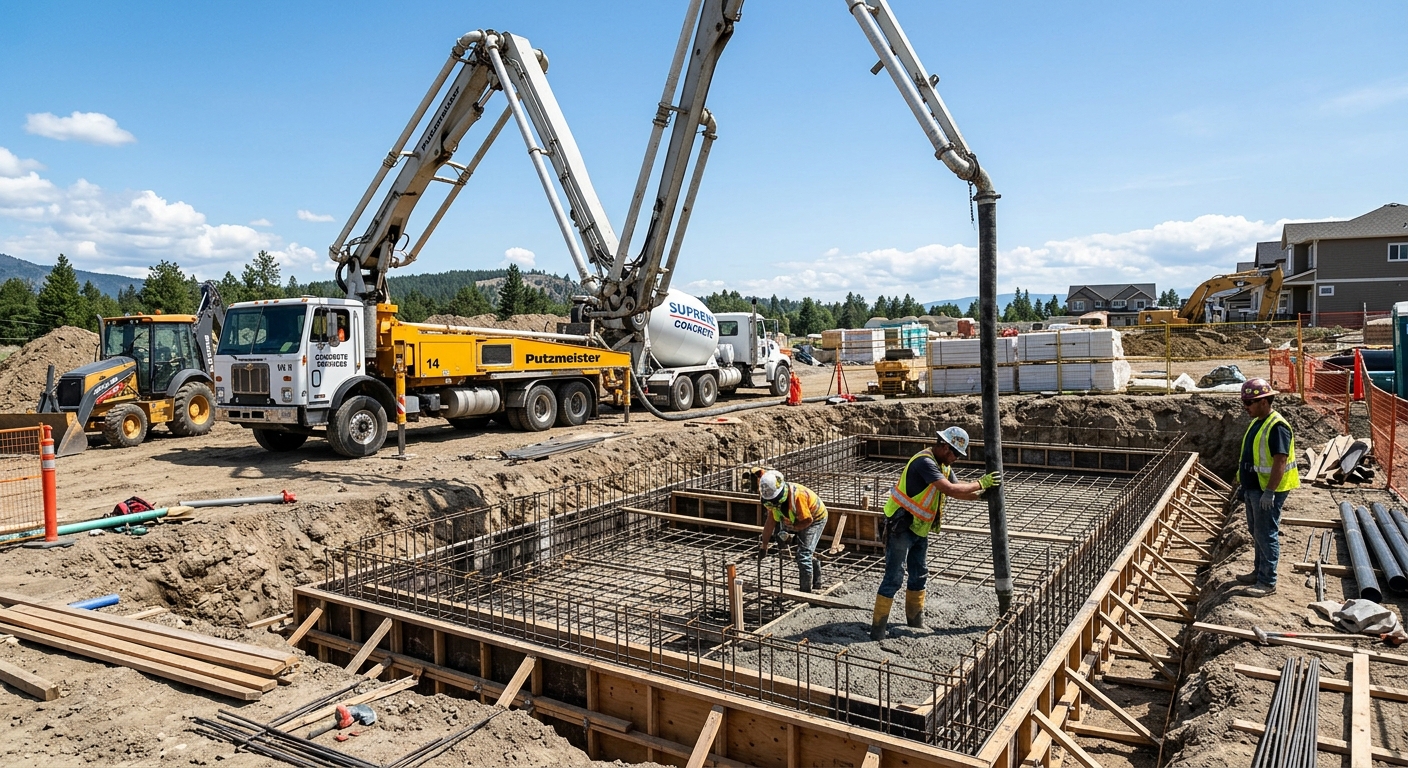
Concrete pricing in Calgary-area communities tracks the freeze–thaw reality more than in milder regions. With a design frost depth of about 1.2 m (roughly 4 ft) used in local engineering practice, footings for houses, garages, decks and retaining structures must bear on undisturbed soil below that level. That drives excavation and increases foundation volumes, so foundation / footings often come in higher than many homeowners expect. For exterior slabs, freeze–thaw cycles also require air-entrained mixes, careful granular base prep, and well-spaced control joints to limit cracking and spalling.
In Glenwood, you’ll feel these differences most on jobs in the areas with heavier redevelopment and infill—where driveways, walkways and basement entries tend to be upgraded together, keeping contractors busy and crews efficient. Next, use the table below to compare typical options and where your budget is likely to land.
| Application |
Typical Size |
Key Spec |
Finish Option |
Price Range |
| Concrete driveway (standard broom finish) |
24 ft x 10 ft (240 sq ft) |
Air-entrained mix, compacted granular base |
Broom finish, control joints |
$12,000–$18,000 |
| Exposed aggregate driveway |
24 ft x 10 ft (240 sq ft) |
Air-entrained mix, stronger surface tolerance |
Exposed aggregate finish |
$14,500–$21,500 |
| Stamped concrete driveway or patio |
20 ft x 12 ft (240 sq ft) |
Air-entrained mix, release agent & proper curing |
Stamped pattern, colour hardener |
$15,000–$26,000 |
| Plain concrete patio or walkway |
12 ft x 12 ft (144 sq ft) |
Air-entrained mix, compacted base, joints |
Float/screed with broom edge |
$5,000–$9,000 |
| Garage floor (interior slab) |
22 ft x 20 ft (440 sq ft) |
Vapour barrier, reinforced slab, proper curing |
Basic finish (trowel or broom) |
$13,500–$22,000 |
| Foundation footings (structural, below frost) |
House + garage style footing package |
Engineered footing depth below ~1.2 m frost |
Structural concrete, no decorative finish |
$28,000–$45,000 |
Prices are estimates only and vary by project scope, site access and material selection.
What affects the price of concrete work in Glenwood
In Glenwood and the wider Calgary region, it’s common to see quotes for the “same” concrete work land 30–50% apart. The difference usually isn’t the concrete itself—it’s what’s included in preparation, reinforcement detailing, curing approach, and how much engineering and labour time is required for frost and freeze–thaw durability. Even for driveways that sound straightforward, Calgary-area jobs must account for deeper frost design and the reality of frequent cold snaps, so contractors price for excavation, base thickness, and air-entrained durability—not just for the day of the pour.
The design frost depth of about 1.2 m (roughly 4 ft) means footings need to sit on undisturbed soil below that level to prevent frost heave and seasonal movement. Exterior flatwork also faces freeze–thaw cycles, which pushes mixes toward air-entrainment and requires good drainage and granular base prep. On top of that, the practical pour season for exterior slabs is shorter here, and cold-weather curing precautions—insulating blankets, sometimes temporary heat, and tighter scheduling—add cost. Where de-icing salt is used (common in Glenwood winters), sealing becomes more “worth it,” because it helps reduce surface breakdown.
Two concrete examples from local scopes: (1) A broom-finished driveway with standard joints can land in the $12,000–$18,000 band when access is easy and excavation isn’t heavy; (2) Adding stamped patterns or exposed aggregate typically increases labour, material handling, and finish controls, often moving you toward the $15,000–$26,000 stamped / decorative band. Foundation pricing tracks the same climate physics—if engineered drawings require deeper or wider footings due to soil conditions, that can push foundation / footing work closer to the upper end of the $28,000–$45,000 range.
| Price Factor |
Why It Matters |
Cost Impact |
| Frost line depth |
Determines footing depth and form height |
Deeper excavation and higher formwork raise costs, often the biggest driver for foundations. |
| Site preparation |
Excavation, grading, compacted granular base |
Poor drainage or excess over-excavation can add trucking, disposal, and labour. |
| Reinforcement |
Rebar or wire mesh requirement |
Rebar mats, chairs, and tying time add cost, but reduce slab cracking risks. |
| Mix design |
Air-entrainment and compressive strength spec |
Air-entrained cold-weather mixes can cost more and require better placement planning. |
| Finish type |
Broom vs. stamped vs. exposed aggregate |
Stamped/exposed work increases labour time and material handling during finishing. |
| Pour size and concrete truck access to site |
How many loads and how close trucks can park |
Long carries or crane/buggy transfers increase labour and scheduling fees. |
| Cold-weather curing precautions |
Heating and blankets |
Temporary heat/blankets can materially add to labour and consumable costs. |
| Control joint pattern and sealing cost |
Controls cracking and repels de-icing salt damage |
Good joint layout and sealer are small-ticket compared to surface failures. |
Permits & regulations in Alberta
In Alberta, structural concrete work generally needs a building permit and often engineered drawings reviewed by the municipality. That typically includes footings, foundation walls, grade beams and other load-bearing structural elements. Concrete flatwork—such as patios, walkways and driveways—usually does not require a permit unless it affects lot grading, impervious surface coverage limits, or impacts the municipal right-of-way. Even when a permit isn’t required, you should still confirm the rules before you break ground, particularly if your work changes drainage patterns toward a swale, ditch or neighbouring property.
For Glenwood homeowners, here’s a practical step-by-step way to verify a contractor before you sign:
1) Building permit scope: Ask the contractor what permits they pull and whether they include the permit processing in their quote. If structural concrete is involved, insist they coordinate it.
2) Alberta licensing (where applicable): Check the contractor’s registration details through the relevant provincial listings and ensure the company name matches the quote paperwork.
3) Liability insurance: Request a current Certificate of Insurance showing liability coverage and the effective dates. Make sure the coverage aligns with the project value.
4) WSIB/WCB coverage: Ask for proof of workers’ compensation coverage (or a clearance letter where applicable). This protects you from liability if a worker is injured on site.
5) References: Get at least 2–3 references on similar-scale concrete work (driveways/slabs or foundation footing packages) completed recently in Alberta’s climate.
Getting concrete right in Glenwood's freeze-thaw climate
Concrete failure in Glenwood usually comes down to three issues: weak base preparation, wrong mix for the freeze–thaw environment, and insufficient curing/maintenance. To spec the job correctly, start with the base: a compacted granular sub-base to the correct depth for the local soil and frost exposure. In Calgary-area conditions, the design frost depth is about 1.2 m, and exterior slabs are still sensitive to subgrade moisture movement, so the drainage and compaction plan matters as much as the pour day.
Next, the mix design: exterior flatwork should use air-entrained concrete (typically 5–7% air content) to reduce freeze–thaw damage, along with a minimum 32 MPa compressive strength spec. Then plan control joints: cracking is normal, but joint spacing controls where cracks land, helping prevent wide, unsightly cracks and water intrusion. Curing is critical—plan for at least 7 days of proper curing conditions, and in cold weather use cold-weather placement precautions like insulated blankets and, when required, temporary heat so the concrete reaches strength before it’s exposed to damaging temperature swings.
Finally, sealing: apply a penetrating sealer after the slab cure—commonly around 28 days post-pour—so de-icing salts are less likely to accelerate surface scaling. If you ignore air-entrainment, spalling risk increases substantially because freeze–thaw cycling damages the paste and exposes aggregate.
On cost justification: upgrading from a plain broom-finished patio (often within the $5,000–$9,000 band) to a stamped driveway (commonly $15,000–$26,000) can be worth it for curb appeal, but it shouldn’t mean cutting corners on the base, air content or curing. Those performance specs are what actually keep the surface serviceable through Glenwood winters.
| Spec |
Why It Matters in Glenwood |
What to Ask For |
Impact if Skipped |
| Compacted granular base (depth?) |
Stops frost-driven movement and reduces pumping under freeze–thaw |
Base thickness tied to engineered or soil-based requirements, plus compaction proof |
Settlement and cracking, often showing up first as uneven edges or joint openings |
| Air-entrained concrete mix (target air %?) |
Protects paste during repeated freezing and thawing cycles |
Confirm air content typically 5–7% for exterior flatwork |
Higher spalling and scaling risk, especially with de-icing salt |
| Compressive strength (MPa rating) |
Ensures the concrete achieves durable strength before exposure |
Minimum 32 MPa compressive strength |
Surface wear, early cracking and reduced long-term performance |
| Control joints (spacing per ACI guidelines) |
Limits uncontrolled cracking caused by drying shrinkage and thermal movement |
Joint spacing plan and saw-cut timing |
Random cracks that allow water ingress and faster freeze–thaw deterioration |
| Minimum 7-day curing period |
Strength gain requires stable curing conditions in cold snaps |
Cure protection plan; cold-weather blankets/heating if needed |
Surface scaling and reduced strength from premature freeze exposure |
| Penetrating sealer (when applied after cure) |
Reduces salt and water penetration from Glenwood winter maintenance |
Penetrating sealer applied about 28 days post-pour |
Faster surface degradation and more frequent patching |
How to choose a concrete work contractor in Glenwood
Choosing the right concrete contractor in Glenwood is mostly about proof: proof they can handle the freeze–thaw engineering details, and proof they’re insured and set up to protect your property. Start by verifying Alberta compliance. Ask for a current Certificate of Liability Insurance (with effective dates and coverage amount), and request proof of workers’ compensation coverage (WSIB/WCB clearance or documentation where applicable). If anything is missing or they won’t provide paperwork, that’s a major scheduling risk for you.
Next, get 2–3 itemised written quotes instead of one lump-sum. Ask for labour and materials breakdowns (excavation, forms, concrete supply, reinforcement, curing blankets/heating if applicable, saw-cutting, disposal, and sealer). A reliable contractor will also tell you exactly what’s excluded—common exclusions include removal of unsuitable soils, hauling/dump fees, or regrading to meet lot drainage requirements. If permits are required for structural components, confirm whether they pull the permit and include any related administrative steps.
Warranty matters too. Confirm workmanship warranty length and what it covers (cracks at control joints vs. random cracking, spalling, settlement), along with any product/manufacturer warranty for materials. Payment should be staged—never pay more than about 10–15% upfront. Hold back the remainder until the job is complete, cleaned, and any finish touch-ups are done. Finally, lock in a realistic timeline: request a start date and completion estimate in writing, including what they’ll do if temperatures drop during curing.
- Ask for proof of liability insurance and workers’ compensation coverage before work starts
- Require an itemised quote (materials + labour) and a separate line for reinforcement and base prep
- Confirm whether disposal and over-excavation (if soft soil is found) are included
- Get the mix spec in writing: air-entrainment target and minimum compressive strength
- Ask about cold-weather curing plan (blankets/heating) when temperatures trend down
- Verify control joint plan (spacing and timing for saw cuts)
- Require details on drainage—especially slopes away from the house
- Confirm reinforcement type and placement method (chairs/tie-wire) if it’s a reinforced slab
- Ask who supplies the sealer and when it’s applied (typically after full cure)
- Set a payment schedule with a holdback until final acceptance
- Request references for similar Glenwood/Calgary-region projects and ask to see photos in winter conditions
- Make sure the crew understands finishing approach for your chosen finish (broom vs stamped vs exposed)
Concrete red flags in Glenwood include contractors who won’t provide written mix specs, vague wording like “standard concrete” without air-entrainment, no documented curing plan for cold snaps, skipping control joints or delaying saw-cutting, and offering unusually low prices that omit proper base prep or reinforcement.
Frequently asked questions — concrete work in Glenwood
How do I prepare the base for a concrete slab?
For Glenwood, base prep is where quality shows up long after the pour. Your contractor should excavate to remove topsoil and any organic material, then grade and compact a compacted granular sub-base to a thickness that matches frost exposure and local soil conditions. Because Calgary-area projects are designed around roughly 1.2 m frost depth in typical engineering practice, you don’t want “builder’s fill” sitting near the surface where moisture movement can freeze and thaw. Ask for confirmation of the compaction standard and how they’ll handle soft spots—over-excavation and replacement sometimes costs extra, but it prevents settlement cracks later. Finally, ensure drainage slopes away from the house; pooling water accelerates freeze–thaw damage.
How do I compare concrete quotes?
When comparing concrete quotes in Alberta, look past the total price and compare scope line by line. For example, a broom-finished driveway often lands around $12,000–$18,000, but the gap usually comes from what’s included in excavation, granular base thickness, reinforcement, and curing precautions. Ask whether the quote includes air-entrained mix for exterior work, control joints, saw-cut timing, and disposal/hauling. If the job is in late fall or early spring, confirm whether cold-weather curing blankets or temporary heat are included. A stamped driveway may fall into the $15,000–$26,000 band; if it’s priced much lower than that, ask what they’re cutting—finish steps are labour-intensive, but curing and base spec are non-negotiable in freeze–thaw conditions.
Can concrete be poured in cold weather in Glenwood?
Yes, concrete can be poured in cold weather in Glenwood, but only when the contractor manages temperature and curing correctly. Calgary-area freeze–thaw cycles and night-time freezes can damage fresh concrete if it’s not protected during early strength gain. A reputable crew will use winter-grade practices—insulating blankets, sometimes heating, and monitoring concrete and air temperature to keep placement and curing within safe ranges. Ask what their cold-weather plan is, when they will start curing protection, and how long they’ll keep it covered. If you’re planning work near the edges of the season, you can also reduce risk by scheduling earlier in the week and ensuring trucks can place and finish promptly. Don’t accept “we’ll figure it out on site” without a written plan.
How do I maintain concrete in Glenwood's freeze-thaw climate?
Maintenance in Glenwood is about reducing water and salt penetration. Start with sealing: a penetrating sealer applied after full cure (often around 28 days post-pour) helps repel de-icing salts and reduces surface scaling. For daily care, use de-icers thoughtfully—more aggressive salting can speed up surface wear, especially on unsealed or older concrete. Keep drainage clear so water doesn’t sit at slab edges or against the foundation; pooled water freezes, expands, and stresses the slab and base. If you see early signs of spalling or minor joint gaps, address them promptly—small repairs cost far less than full replacements after freeze–thaw has undermined the edges. Also avoid heavy loads on new slabs until the concrete has reached adequate strength and the curing plan is complete.
What causes concrete to spall in Glenwood winters?
Spalling in Glenwood winters is most commonly tied to freeze–thaw damage, often worsened by inadequate air-entrainment, poor curing, and moisture entry. If the mix doesn’t have the right air-entrainment (typically 5–7% for exterior flatwork) the paste can’t accommodate freezing expansion, so you get surface cracking and chips lifting off. Moisture intrusion also accelerates problems when there are gaps at joints, inadequate base preparation, or poor drainage that lets water pool. De-icing salt then makes the surface more vulnerable by driving further deterioration. Cold-weather placement without proper blankets or heat can create a weak surface layer that fails early. The fix is preventative: specify air-entrainment, correct joint patterning, proper curing duration, and sealing to reduce salt penetration.
What is rebar and when is it required in Alberta?
Rebar is steel reinforcement embedded in concrete to control cracking and improve structural performance, especially for slabs and foundation elements that carry loads or experience freeze–thaw movement. In Alberta, whether rebar (or mesh) is required depends on engineering design, slab thickness, soil conditions, and how the slab will be loaded. For foundations and structural footings, reinforcement requirements are typically engineered and tied to structural design, and those elements generally require a permit and often engineered drawings. For exterior flatwork like patios and driveways, reinforcement may be specified for thicker slabs, heavy vehicle loads, or challenging soil/drainage conditions. Ask your contractor to include the reinforcement type (rebar vs. wire mesh), spacing, cover, and placement method in the quote. If they can’t explain why it’s needed for your slab, ask for the design basis.