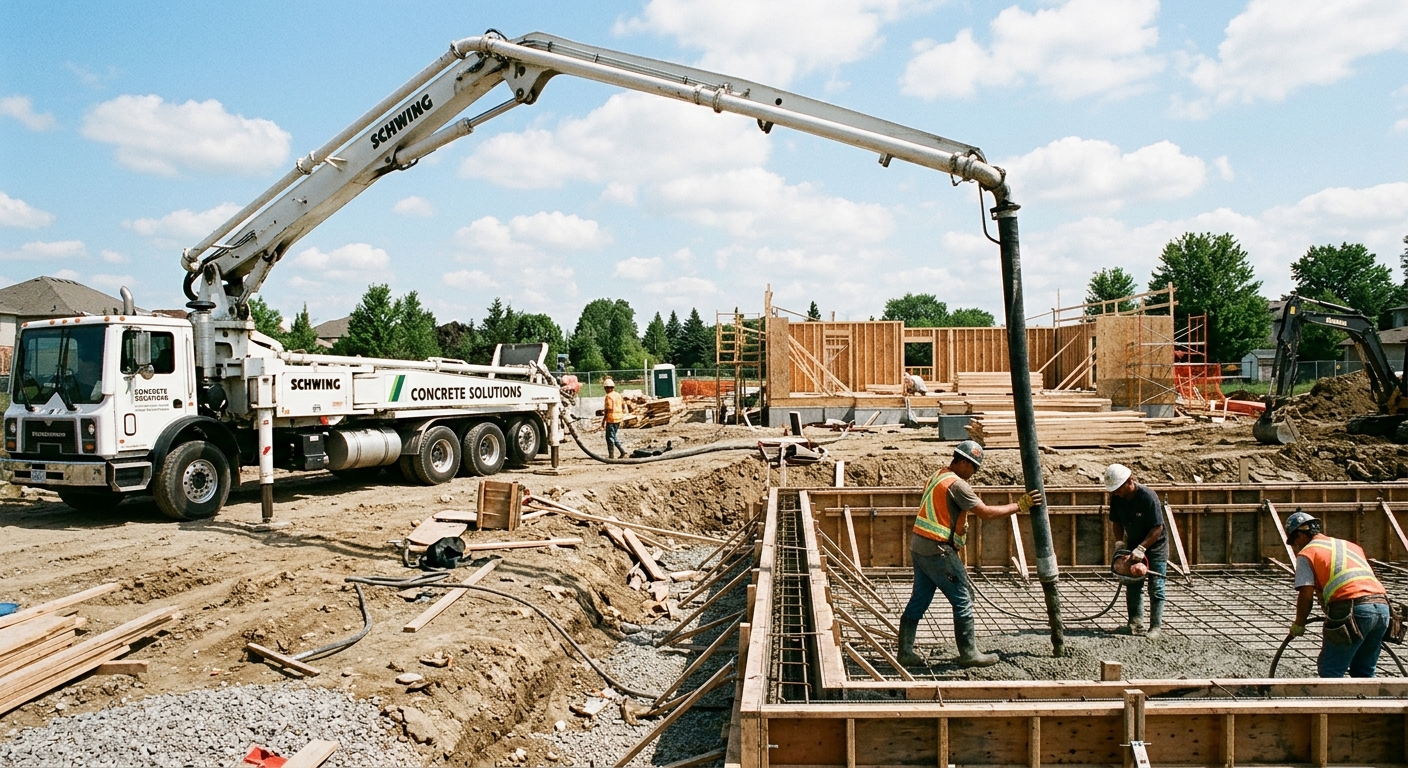
Concrete work options and costs in North Haven
North Haven, Alberta is a small community where concrete flatwork shows up fast—driveways, patios, and walkways are among the first improvements homeowners tackle. With a population of 2,365 (Statistics Canada, 2021 Census), the local market is tighter than Calgary proper, so timelines and availability can be influenced by how busy crews are with surrounding projects. Most homes rely on concrete for daily-use surfaces and weather protection, and that’s especially true for the neighbourhood of Township Road area / acreage edges where longer driveway runs and frost-sensitive soils are common. Calgary’s cold continental climate and the region’s deeper design frost depth (about 1.2 m, roughly 4 ft) mean concrete pricing reflects more excavation, deeper footings for structures, and careful freeze–thaw detailing.
Because freeze–thaw cycles are frequent, exterior pours are engineered with air-entrained mixes and well-spaced control joints to reduce cracking and spalling. The practical pour season can be shorter than in milder provinces, and when late fall or early spring placement is unavoidable, winter-grade mixes, insulating blankets, and sometimes temporary heat may be required to protect curing. Those added steps are why you’ll often see bigger swings in quotes than you would expect for “the same slab.” The best way to compare contractors in North Haven is to line up scope and finish type before you look at totals, which is exactly what the comparison table below is designed to do.
| Application |
Typical Size |
Key Spec |
Finish Option |
Price Range |
| Concrete driveway (standard broom finish) |
400–600 sq. ft. |
Air-entrained mix, compacted granular base, control joints |
Broom finish |
$12,000–$18,000 |
| Exposed aggregate driveway |
400–600 sq. ft. |
Air-entrained mix, base prep, careful finishing for texture |
Exposed aggregate (washed) |
$14,000–$22,000 |
| Stamped concrete driveway or patio |
300–500 sq. ft. |
Air-entrained mix, stamped pattern, release agent and sealer |
Stamped (pattern + colour) |
$15,000–$26,000 |
| Plain concrete patio or walkway |
200–400 sq. ft. |
Air-entrained mix, compacted base, expansion/control joints |
Plain steel-trowel or broom finish |
$5,000–$9,000 |
| Garage floor (interior slab) |
400–600 sq. ft. |
Standard reinforcement, vapour considerations, proper curing |
Broom-finish / light trowel |
$10,000–$16,000 |
| Foundation footings (structural, below frost) |
Per planed foundation footprint |
Excavate to design frost depth, engineered rebar, structural concrete |
Structural concrete (tamped/formed) |
$28,000–$45,000 |
Prices are estimates only and vary by project scope, site access and material selection.
What affects the price of concrete work in North Haven
In North Haven and the wider Calgary region, you can see 30–50% differences between quotes for “the same” concrete surface because the hidden work changes: excavation depth, base thickness, reinforcement amount, concrete mix requirements, and how the contractor plans for curing in cold snaps. Calgary’s crews also juggle schedule competition—if a contractor is booked solid, you may get a premium for reserving a truck and crew when weather allows placement. Concrete pricing is tightly linked to cold-weather engineering because the design frost depth (about 1.2 m here) requires footings and under-slab support to be designed around frost movement, not just topsoil conditions.
For exterior slabs and driveways, air-entrained concrete is standard in this climate to survive the freeze–thaw cycle, and that affects material selection and labour time. Placement in a shorter season means contractors may need winter-grade mixes, insulated blankets and/or temporary heating to hit cure requirements—skipping that isn’t just cosmetic; it increases long-term scaling risk. Finally, de-icing salt accelerates surface spalling, so sealing and proper surface finishing are more than “upsells” in North Haven.
Two real examples that move cost in this area: (1) A 500 sq. ft. driveway on a poorly compacted base (or with higher clay content) often ends up closer to $18,000 than $12,000 because excavation and granular replacement increase. (2) A stamped patio may land nearer $26,000 when extra subgrade prep and more colour/stamping labour are required for crisp edges and joints. Housing stock also matters—older properties often have uneven grades and buried services, which add time before a pour can start.
| Price Factor |
Why It Matters |
Cost Impact |
| Frost line depth — determines footing depth and form height |
Footings must bear below the design frost depth to prevent heave |
Higher excavation/formwork can add significant dollars |
| Site preparation — excavation, grading, compacted granular base |
Subgrade quality controls settlement and cracking |
Poor soil increases base replacement thickness and labour |
| Reinforcement — rebar or wire mesh requirement |
Controls cracking and improves load capacity |
More steel/wider spacing increases material and tie-in time |
| Mix design — air-entrainment and compressive strength spec |
Freeze–thaw durability depends on air content; strength ensures performance |
Specified air + higher performance mix increases material cost |
| Finish type — broom vs. stamped vs. exposed aggregate |
Texture and pattern affect labour time and curing/sealer steps |
Decorative finishes typically add hours and consumables |
| Pour size and concrete truck access to site |
Distance/constraints affect time, staging and possible pump needs |
Access limits can increase labour and equipment charges |
| Cold-weather curing precautions — heating and blankets |
Protects early-age strength gain and reduces scaling risk |
Winter measures can raise the total by a noticeable margin |
| Control joint pattern and sealing cost |
Joints manage cracks; sealing helps resist salt-related surface damage |
Proper joint layout + sealer adds scope but reduces callbacks |
Permits & regulations in Alberta
In Alberta, concrete work falls into two practical buckets: structural concrete that usually needs a permit and flatwork that typically does not—unless it triggers grade or lot coverage rules. For North Haven homeowners, the key structural items that usually require a building permit include concrete footings, foundation walls, and grade beams, especially when they’re part of a new foundation or major foundation repair. In most cases, engineered drawings are reviewed for structural requirements before construction proceeds.
Concrete flatwork like driveways, patios, and walkways commonly does not require a permit by itself. However, you should expect a permit or approval to come into play if the work affects lot grading, changes drainage, impacts impervious surface coverage limits, or touches municipal right-of-way and curb/sidewalk interfaces. When in doubt, confirm with the local authority before breaking ground—especially if your project includes re-grading, moving downspout discharge, or altering slopes toward neighbouring properties.
Step-by-step contractor verification in Alberta: (1) Ask for proof of liability insurance—review the certificate for coverage limits and jobsite applicability. (2) Verify workers’ coverage (WSIB/WCB) by requesting the clearance letter or account proof—don’t rely on verbal confirmation. (3) Check whether the contractor is eligible/licensed for the type of work they’re offering, and confirm that the name on insurance matches the contracting entity. (4) Request at least two references on similar foundation or slab scopes, then follow up on how they handled weather days and curing requirements.
Getting concrete right in North Haven's freeze-thaw climate
Concrete failures in North Haven are usually tied to one of five things: weak or inconsistent base preparation, inadequate air-entrainment, poor reinforcement detailing, control joints that don’t manage shrinkage and movement, or rushed curing during cold snaps. In Calgary’s freeze–thaw environment, the most common and expensive long-term problem is spalling—often linked to inadequate air-entrainment and early surface freeze.
To spec the job correctly, start with (1) base preparation: you want a compacted granular sub-base sized to suit the local soil and frost exposure, with the contractor excavating and re-compacting properly before any concrete arrives. Next, (2) mix design: request air-entrained concrete with a target of 5–7% air content for exterior flatwork and a minimum 32 MPa compressive strength. Then (3) control joints: spacing should be planned to limit random cracking patterns, with proper saw-cut timing. (4) curing should be planned for at least 7 days under suitable conditions; in late fall or early spring, ask whether the contractor will use insulated blankets and/or heating to keep the slab from freezing too early. Finally, (5) sealing: have a penetrating sealer applied at about 28 days after the pour so de-icing salts are less likely to attack the surface.
Budgeting matters. For example, choosing a broom-finish driveway might fit the $12,000–$18,000 band, while stamped options can climb toward $15,000–$26,000 because decorative finishing and additional sealer/colour steps take longer. If a quote is cheaper than the low end of the band, it’s often because curing measures, base depth, or air-entrainment spec are being minimized—those are the items you don’t want to compromise here.
| Spec |
Why It Matters in North Haven |
What to Ask For |
Impact if Skipped |
| Compacted granular base (depth?) |
Prevents settlement and reduces frost-related movement under slabs |
Confirm excavation depth and compacted base thickness; include compaction testing |
Cracking, uneven surface, and accelerated freeze–thaw damage |
| Air-entrained concrete mix (target air %?) |
Durability against freeze–thaw cycles depends on entrained air |
Target 5–7% air content for exterior flatwork; specify by mix design |
Spalling and scaling within a few winters |
| Compressive strength (MPa rating) |
Ensures the slab gains enough strength to resist loads and early damage |
Minimum 32 MPa compressive strength |
Surface failure, scaling, and reduced lifespan |
| Control joints (spacing per ACI guidelines) |
Manages shrinkage cracking so it happens where you expect it |
Ask for planned joint spacing and saw-cut timing |
Random cracks that allow water to penetrate and widen |
| Minimum 7-day curing period |
Early-age strength gain is sensitive to cold and wind |
Confirm curing method and whether blankets/heating are used when needed |
Frozen surface, weak bond, and premature deterioration |
| Penetrating sealer (when applied after cure) |
Salt exposure increases surface scaling risk in this climate |
Penetrating sealer applied after cure (commonly around 28 days) |
Faster salt damage, roughness, and flaking |
How to choose a concrete work contractor in North Haven
Choosing a concrete contractor in North Haven is mostly about proving they’ll execute the technical details that Calgary’s freeze–thaw climate demands—not just placing concrete. Start with verification: ask for their Alberta business details and request liability insurance (certificate of insurance) and WSIB/WCB coverage proof (clearance letter or acceptable account documentation). When you review the certificates, make sure the contracting entity name matches the invoice and that the coverage is active for the job dates.
Next, get 2–3 itemised written quotes instead of lump sums. You want a breakdown that shows excavation/base prep, reinforcement, concrete supply, finish labour, joints, sealing, and—if applicable—winter protection. The scope review should call out what’s excluded: permit/engineering expenses, disposal/haul-away, saw-cutting, patching existing concrete, and any regrading or drainage adjustments.
Warranty matters too. Ask for a clear statement of the workmanship warranty length and what it covers (and for how long). Also confirm whether there’s a product/manufacturer warranty on systems like sealers or decorative coatings, and whether it transfers if you sell the property.
Finally, payment terms should be reasonable. A good rule is to never pay more than 10–15% upfront, with a holdback until the work is complete and clean-up is done. Get the start date and a realistic completion window in writing—weather can delay pours, but competent scheduling prevents rushed curing.
- Ask for a site visit and written confirmation of measured dimensions (sq. ft. and thickness allowances).
- Require the concrete mix spec: air-entrainment and minimum compressive strength (MPa).
- Confirm base prep: excavation depth, granular type, and compaction method.
- Request reinforcement details: rebar size, spacing, or mesh (if applicable).
- Verify control joint plan: spacing and saw-cut timing.
- Ask how they protect curing in cold weather (blankets/heating when needed).
- Get an item for sealing if you’ll use de-icing salt (typically after cure).
- Confirm disposal/haul-away for excess soils and concrete waste.
- Check truck access plan: where the truck will park and how concrete is moved.
- Review warranty in writing: coverage, duration, and exclusions.
- Confirm the payment schedule: low upfront and holdback at substantial completion.
- Ensure the quote includes clean-up and edge finishing (not just “concrete placed”).
North Haven concrete red flags: (1) a quote that’s “too low” without explaining base depth, air-entrainment, or curing protection; (2) no written mix or air content spec for exterior work; (3) vague timelines that don’t account for temperature swings and curing; (4) refusing to provide insurance/WSIB/WCB proof or references; and (5) saying they’ll skip control joints “because it looks nicer.”
Frequently asked questions — concrete work in North Haven
When is the best time to pour concrete in North Haven?
In North Haven and the Calgary region, the best conditions are typically late spring through early fall, when daytime temperatures are stable and the risk of freezing at night is lower. That matters because curing is temperature-sensitive: if the slab surface freezes too early, you can get scaling and long-term durability issues even if the concrete looks fine initially. If you’re trying to schedule around weather, ask the contractor how they’ll manage cold-weather placement—insulating blankets, wind protection, and sometimes temporary heat. In practice, driveway and patio pours often move into a shorter window in late fall, which can affect scheduling and labour availability. Budget accordingly; for example, standard driveways are often in the $12,000–$18,000 band when site prep is straightforward and weather conditions are favourable.
How long does concrete take to cure?
Concrete curing has two layers: hydration time (when it gains strength) and weather protection time (when you must keep it from freezing or drying too fast). For most slabs, contractors plan for at least 7 days of curing before you expect normal handling, and the slab continues to gain strength beyond that. In Calgary’s freeze–thaw climate, the early days are critical: if you pour when nights are near freezing and curing is rushed, you’re more likely to see surface scaling later, especially with de-icing salt. If you’re adding a penetrating sealer, it’s commonly applied around 28 days post-pour after adequate cure. Ask your North Haven contractor to state their curing plan in writing, including whether they’ll use blankets/heating during any cold snaps.
Do I need a permit for concrete work in Alberta?
In Alberta, it often depends on whether your concrete is structural or simply flatwork. Concrete flatwork like driveways, patios, and walkways usually does not require a permit by itself, unless it affects lot grading, drainage, right-of-way, or impervious coverage rules. Structural work is different: items such as footings, foundation walls, and grade beams typically require a building permit and often engineered drawings reviewed through the municipal process. For North Haven homeowners, the safest approach is to confirm with your local authority before you break ground—especially if you’re changing slopes or directing runoff. Also verify your contractor carries liability insurance and WSIB/WCB coverage, since permit-related structural scopes are more risk-sensitive.
Concrete vs pavers for a patio in North Haven?
Concrete and pavers both work well for patios in North Haven, but freeze–thaw conditions push the design details. Concrete patios can be more consistent in long-term maintenance when you get the base prep, air-entrainment, control joints, and curing right. Pavers can be attractive and allow easier spot repairs, but they rely heavily on a well-constructed base and proper jointing; if drainage is off, you can get shifting or weed growth over time. Cost-wise, a plain concrete patio is commonly in the $5,000–$9,000 range for typical backyard sizes, while decorative stamped options generally cost more because of extra finishing steps. If your goal is a low-maintenance surface that handles de-icing salt better, properly specified concrete often offers better durability—if you’re willing to pay for correct air-entrainment and joint planning.
How long does a concrete driveway last?
A well-built concrete driveway in North Haven commonly lasts decades, but durability depends on specifications and how it’s maintained during Calgary’s winters. The big early-life factors are base preparation (so it doesn’t settle), air-entrainment (so it resists freeze–thaw), and control joints (so cracking is controlled rather than random). Sealing helps protect the surface from de-icing salt, which can accelerate spalling when the slab surface is unprotected. If you choose a standard broom-finish driveway without proper winter curing protection, you may see surface deterioration sooner, particularly after the first few cold seasons. Many homeowners aim to stay within the $12,000–$18,000 band for a typical scope, but the “cheapest” quote isn’t always the best value if it cuts out curing measures or air-entrainment.
What is air-entrained concrete and why does it matter here?
Air-entrained concrete is mixed with microscopic air bubbles that provide room for freezing water to expand inside the concrete. In North Haven’s freeze–thaw climate, this is one of the most important specifications for protecting your slab from scaling and spalling. Without adequate air content, water can damage the concrete surface repeatedly through winter cycles—even if the slab initially looks solid. That’s why Calgary-area contractors typically specify air-entrained mixes for exterior flatwork and why winter placement requires strict curing protection. When you compare quotes, ask your contractor to state the air-entrainment target (often around 5–7% for exterior flatwork) and confirm they’re meeting the strength and curing requirements for a durable result. This is also why the short pour season and cold-weather curing precautions show up directly in your total cost.