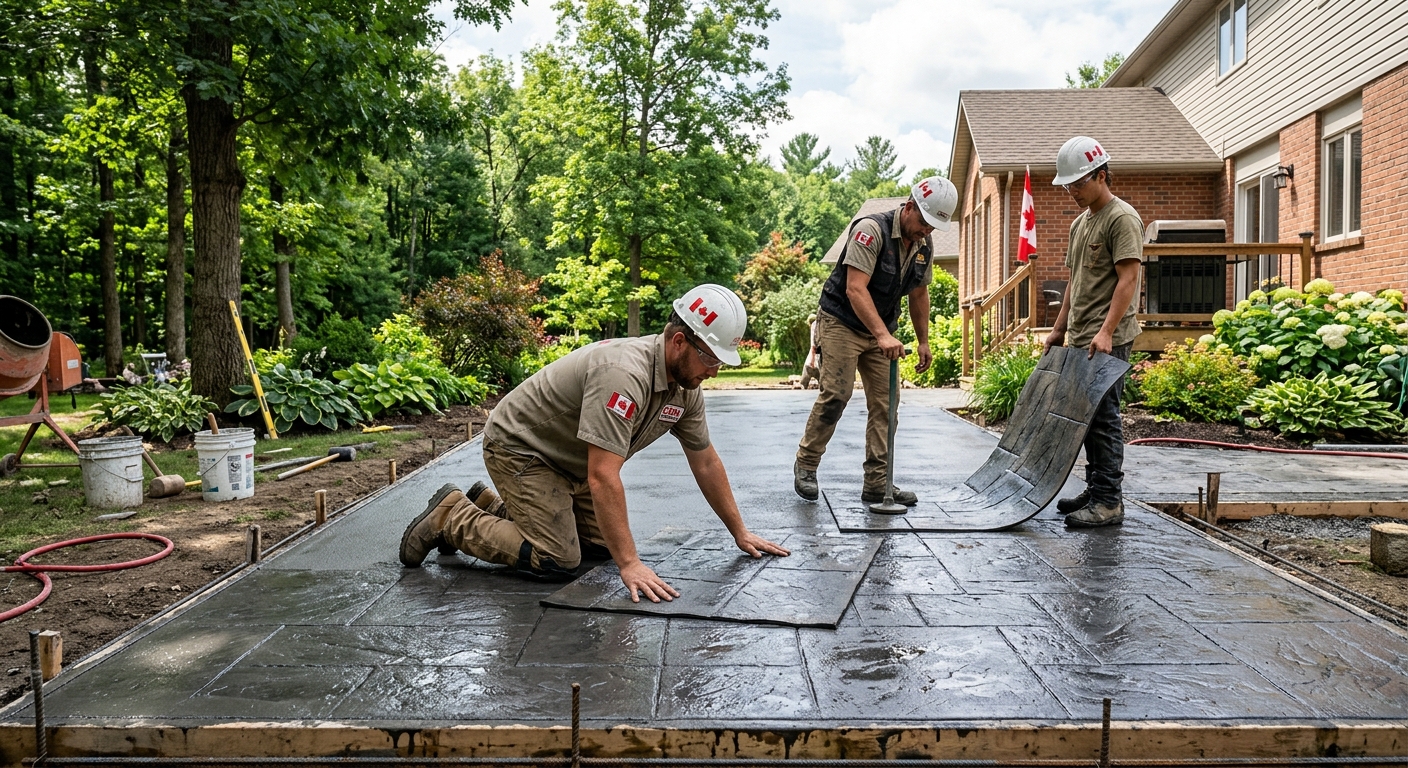
Concrete work options and costs in Greenfield
Greenfield homeowners typically choose concrete because it’s durable and low-maintenance, but the right option depends on how the slab will be used and how it will hold up through Calgary-area freeze–thaw cycles. With a population of 3,589 (Statistics Canada, 2021 Census), Greenfield is a smaller market, so demand is concentrated around active infill pockets and the established residential lots where driveways, patios, and walkways get added or replaced as properties age. In the Calgary economic region, many owners invest in concrete flatwork alongside renovations and new builds—work that’s especially in demand around neighbourhood pockets like ranch-style and newer subdivisions off major corridors (where access for trucks and staging is easier). That matters because more truckable sites generally reduce labour time and site logistics costs.
In this cold continental climate, costs are shaped less by “surface look” and more by engineering details: footings must bear below the design frost depth (about 1.2 m in Alberta practice), exterior concrete needs air-entrainment to resist scaling and spalling, and the short pour season means winter-grade curing steps may be required. These factors also affect contractor availability—teams schedule around proper base prep, curing blankets, and coordination with excavation and backfill. If you’re comparing bids, make sure each contractor is pricing the same thickness, reinforcement, and finish spec, not just the same overall footprint. Use the options below as a realistic baseline for Greenfield pricing, then line up your project requirements with the spec questions in the later sections.
| Application |
Typical Size |
Key Spec |
Finish Option |
Price Range |
| Concrete driveway (standard broom finish) |
20 m² (approx. 10 ft x 20 ft) |
4 in (100 mm) air-entrained; compacted base; joints as required |
Broom finish |
$12,000–$18,000 |
| Exposed aggregate driveway |
20 m² (approx. 10 ft x 20 ft) |
Air-entrained concrete; wash/exposure process; proper curing window |
Exposed aggregate |
$14,000–$21,000 |
| Stamped concrete driveway or patio |
30 m² (approx. 300 ft²) |
Air-entrained; integral/colour hardener; release agent; seal coat |
Stamped patterns |
$15,000–$26,000 |
| Plain concrete patio or walkway |
15 m² (approx. 160 ft²) |
4 in (100 mm) typical; compacted granular base; edge forms and joints |
Plain with broom edges |
$5,000–$9,000 |
| Garage floor (interior slab) |
45 m² (approx. 484 ft²) |
Interior air-entrainment optional per design; typical 4 in thickness; vapour control as needed |
Burnished or broom |
$10,000–$16,000 |
| Foundation footings (structural, below frost) |
Typical house footprint |
Designed footing size; excavation; formwork; rebar; below-design frost bearing |
Structural concrete |
$28,000–$45,000 |
Prices are estimates only and vary by project scope, site access and material selection.
What affects the price of concrete work in Greenfield
In Greenfield and across the Calgary region, quotes for the “same” concrete job can swing by 30–50% because contractors often price different engineering assumptions: footing depth and bearing conditions, base thickness and compaction, reinforcement level, and whether the concrete is winter-rated and properly cured. Even a driveway can change cost significantly if one quote includes full removal, new granular base, sub-drain provisions, air-entrained mix, and sealing, while another treats it as a simple pour. In practical terms, that’s how you’ll see a standard driveway budget land nearer the $12,000–$18,000 band in one proposal, while another comes in closer to the upper end once cold-weather protections and heavier preparation are included.
The biggest driver here is Calgary-area frost and freeze–thaw cycling. Local engineering practice uses a design frost depth of about 1.2 m (roughly 4 ft), so exterior structural elements—especially foundation footings for houses and garages—must extend below that depth to prevent frost heave and seasonal movement. Exterior slabs also require air-entrained concrete mixes to survive repeated expansion and contraction. Costs rise in late fall or early spring because contractors need a shorter, managed curing window: winter-grade practices like insulated blankets and, in some cases, temporary heat. De-icing salt accelerates surface breakdown, so sealing is often recommended to protect concrete over time. In some projects, the finishing choice also drives cost: stamped & decorative work commonly lands in the $15,000–$26,000 range due to labour intensity, while plain broom-finish work is usually the lower end.
Two local examples often explain bid gaps: (1) a driveway over heavier clay with a deeper granular replacement can push excavation and base prep higher; (2) a site with limited access for the concrete truck can add labour for wheelbarrowing or additional staging time. If you’re renovating older foundations or replacing slabs on older lots, deeper removal and regrading can mean more than “just concrete,” which is why foundation work frequently tracks the $28,000–$45,000 band.
| Price Factor |
Why It Matters |
Cost Impact |
| Frost line depth — determines footing depth and form height |
Footings must bear on undisturbed soil below design frost to prevent heave. |
Higher excavation and concrete volume; can move foundation budgets substantially (often the biggest driver). |
| Site preparation — excavation, grading, compacted granular base |
Concrete performs only as well as the sub-base; frozen/soft soils must be removed and replaced. |
More trucking, disposal, and granular material increases cost and schedule time. |
| Reinforcement — rebar or wire mesh requirement |
Reduces cracking and supports loads, especially for garage floors and structural elements. |
Labour to place/secure reinforcement plus material pricing. |
| Mix design — air-entrainment and compressive strength spec |
Freeze–thaw durability depends on air content and proper strength requirements. |
Engineered mix can cost more and may require specific delivery timing. |
| Finish type — broom vs. stamped vs. exposed aggregate |
Labour intensity, process steps, and seal requirements differ greatly by finish. |
Stamped/exposed can add significant labour; plain finishes usually cost less. |
| Pour size and concrete truck access to site |
Short pour seasons make scheduling tight; access affects how long labour must wait. |
Limited access increases labour time and may require additional manpower. |
| Cold-weather curing precautions — heating and blankets |
Proper curing prevents scaling and surface/structural defects. |
Adds material and time; can be the difference between “mid” and “high” bids late in the season. |
| Control joint pattern and sealing cost |
Joints manage shrinkage cracking; sealing protects against de-icing damage. |
More layout labour plus sealing materials and application scheduling. |
Permits & regulations in Alberta
In Alberta, concrete permits depend on what the concrete is doing structurally. Structural concrete work—such as footings, foundation walls, and grade beams—typically requires a building permit and is often tied to engineered drawings that the municipality reviews as part of the permitting process. For flatwork like patios, walkways, and driveways, a permit is usually not required on its own, unless the project affects lot grading, changes drainage patterns, or involves impervious surface coverage limits or municipal right-of-way requirements. Because each lot’s grading and drainage can be different in Greenfield, always confirm with the local authority before you start excavation or remove existing base.
Before signing a contract, verify the contractor is properly insured and eligible to perform the work. Step-by-step, a homeowner in Greenfield can: (1) check the contractor’s Alberta business/registration details via the provincial business registry or the contractor’s own registration references; (2) request a certificate of insurance (CGL) naming the homeowner or project as applicable, and confirm the policy’s active dates and coverage limits; and (3) ask for proof of WSIB/WCB coverage—then look for a clearance letter or proof of account status rather than a screenshot that may not be current. Also request references from similar-size jobs (a driveway and a foundation are priced and scheduled very differently).
Keep your expectations aligned: permits and engineered review add time to foundation projects, but flatwork can move faster if site drainage and right-of-way rules are satisfied.
Getting concrete right in Greenfield's freeze-thaw climate
Concrete fails in Greenfield mainly because freeze–thaw stresses the surface and because water moves through tiny cracks and joints. In a cold continental climate like Calgary’s, the job must be specified so it can survive repeated cycling: the base must be compacted to the right depth for local soil and frost conditions, the mix must be air-entrained, and joints must be placed to control where cracking happens. Then curing and sealing must be timed correctly; rushing cure in late fall or early spring is one of the most common reasons homeowners later see scaling or spalling.
Spec it like this for exterior flatwork: (1) Base preparation: compacted granular sub-base to the planned depth so the slab is supported below the seasonally affected soils; (2) Mix design: air-entrainment targeted for exterior exposure—commonly 5–7% air content—plus a minimum 32 MPa compressive strength; (3) Control joints: layout that limits random cracking—don’t rely on “the concrete will be fine”; (4) Curing: keep the slab in appropriate conditions for at least 7 days so strength development reaches the point where the surface can resist early damage; (5) Sealing: apply a penetrating sealer after the cure period (often at 28 days) to repel de-icing salt water. When you ask technical questions, specifically confirm air content, joint spacing, and what cold-weather plan the contractor uses—this is how you prevent spalling tied to inadequate air-entrainment.
On pricing, it’s normal that a stamped driveway will land above standard broom-finish work in Greenfield. For example, if a plain driveway is priced in the lower range of the $12,000–$18,000 band, switching to stamped decorative finish may push your project toward the $15,000–$26,000 range due to additional labour, colouring steps, and sealing. That increase is justified when the contractor still maintains the same base spec and durability requirements; if the decorative option skips base or air-entrainment details, you’re paying more for a system that won’t last.
| Spec |
Why It Matters in Greenfield |
What to Ask For |
Impact if Skipped |
| Compacted granular base (depth?) |
Provides stable support so the slab doesn’t move with seasonal moisture and frost action. |
Granular sub-base depth and compaction testing/verification plan. |
Uneven settlement, cracking, and premature joint failure. |
| Air-entrained concrete mix (target air %?) |
Freeze–thaw durability in Calgary-area cycles depends on proper air content. |
Confirm exterior air target (typically 5–7% for exposed flatwork) and mix design. |
Higher risk of scaling and spalling, especially with de-icing salts. |
| Compressive strength (MPa rating) |
Strength development affects abrasion resistance and load capacity in the first seasons. |
Minimum 32 MPa compressive strength (or higher if engineering calls for it) and test/verification method. |
Surface wear, reduced durability, and more cracking risk. |
| Control joints (spacing per ACI guidelines) |
Controls shrinkage cracking and keeps cracks from wandering into visible areas. |
Joint spacing, saw-cut timing, and alignment with patterns for appearance. |
Random cracking and difficult-to-repair cosmetic damage. |
| Minimum 7-day curing period |
Cold snaps slow curing; proper curing reduces early-age damage. |
Curing duration and how temperature affects curing on your pour date. |
Surface defects that show up months later as scaling or weakness. |
| Penetrating sealer (when applied after cure) |
Helps repel de-icing salt water that accelerates spalling. |
Sealer type and timing—often after cure, commonly at 28 days post-pour. |
Faster surface deterioration and more frequent repair cycles. |
How to choose a concrete work contractor in Greenfield
Choosing a contractor in Greenfield is about verifying durability details, not just comparing a low number. Start by confirming Alberta compliance and insurance: ask for the contractor’s current Alberta registration details, then request a certificate of liability insurance (CGL) and verify active coverage dates and limits. Next, ask for WSIB/WCB proof—ideally a clearance letter or documented account status—so you know they’re properly covered for workers on your site. If a contractor won’t provide these upfront, treat it as a red flag.
Next, get 2–3 itemised written quotes. You want labour and materials broken out with the same thickness and spec assumptions: base thickness, excavation and disposal, rebar or mesh, air-entrained mix requirements, joint pattern, and the finish process. Read the scope carefully for exclusions—does the price include removal of the existing slab, grading to final elevation, and protecting landscape edges? If disposal is excluded, your “low bid” can disappear quickly after haulage and tipping fees.
For warranties, separate workmanship warranty length from product/manufacturer warranties. Ask whether workmanship coverage transfers if you sell your home. Payment schedules matter too: never pay more than 10–15% upfront, and hold back a portion until you’ve received final cleanup, sealing (where included), and any punch-list items. Finally, insist on a written timeline with start date and estimated completion so concrete scheduling aligns with Calgary-area curing needs.
- Confirm insurance and WSIB/WCB proof before work starts.
- Ask for project references with similar finish type (broom vs stamped vs exposed).
- Require itemised pricing: excavation, granular base, rebar/mesh, concrete supply, finishing, sealing.
- Verify air-entrainment and minimum compressive strength are stated in writing.
- Confirm joint layout, saw-cut/scheduling, and where cracks are expected to form.
- Ask what happens in cold weather (blankets/heating) and how they manage curing temperatures.
- Check whether they include site access logistics for the concrete truck.
- Confirm disposal/haul-away is included or priced transparently.
- Require thickness specs (slab and base) rather than “typical” language.
- Clarify sealing scope and timing (28 days post-pour is common).
- Get warranty terms in writing, including workmanship vs materials.
- Use a payment schedule with a small deposit and holdback until final acceptance.
Red flags in Greenfield: contractors who won’t discuss air-entrainment and joint spacing, who propose a late-season pour without a cold-weather curing plan, who quote stamped concrete without explaining base prep and seal timing, who demand large upfront payments, or who provide only a lump sum without stating thickness, reinforcement, and curing/finishing details.
Frequently asked questions — concrete work in Greenfield
How deep must footings be for Greenfield's frost line?
In Greenfield and the Calgary region, footings are designed to bear below the frost depth to prevent frost heave and seasonal movement. Local engineering practice generally uses a design frost depth of about 1.2 m (roughly 4 ft) in Alberta conditions, which means excavations for structural footings must reach undisturbed soil below that depth before concrete is placed. The exact required depth can still vary by lot conditions (soil type, drainage, and engineering requirements), so your contractor should reference engineered foundation drawings and the frost criteria used for your design. For budgeting, this depth is why foundation/footing work commonly sits in the $28,000–$45,000 range: deeper excavation and more concrete volume are built into the scope.
Why does concrete crack in Greenfield and how is it prevented?
Concrete cracks in Greenfield mainly due to shrinkage and thermal movement, and those cracks can worsen if water gets into joints and the slab cycles through freeze–thaw temperatures. The best prevention is proper base preparation and a deliberate joint plan that controls where cracking happens. A well-supported slab with the correct granular base compaction reduces settlement-related cracking, while air-entrained exterior concrete helps limit freeze–thaw damage to the surface. Control joints should be spaced and timed correctly (often saw-cutting shortly after the concrete reaches the right stage). Finally, proper curing for at least 7 days helps strength development so the slab is more resistant to early-age damage. If you’re bidding a driveway near the $12,000–$18,000 band, make sure your quote includes joint pattern and curing details, not just a finish description.
Stamped vs broom-finish concrete — cost difference?
Stamped concrete costs more than broom-finish because it requires extra labour steps: colouring, release agent, moulding, careful finishing, and usually an enhanced sealing plan. In Greenfield, you’ll commonly see stamped driveways or patios priced higher—often moving toward the $15,000–$26,000 band—while broom-finish options for a standard driveway typically fall closer to the $12,000–$18,000 range. The important part is that the durability specs must stay consistent: air-entrainment, base prep, thickness, and joint layout are what make concrete survive Calgary freeze–thaw cycles, not the decorative stamp alone. When comparing bids, request the same thickness and the same air-entrainment requirement in both options; that way, the price difference reflects the finish, not hidden durability shortcuts.
When is the best time to pour concrete in Greenfield?
The best time to pour exterior concrete in Greenfield is when temperatures allow proper curing without excessive risk of freezing at early age. In the Calgary area, the practical pour season is shorter because late fall and early spring can bring sudden cold snaps. Contractors should plan around curing: if the forecast drops near freezing, they may need insulated blankets and, in some cases, temporary heat to protect the slab while it achieves early strength. Ask your contractor what cold-weather plan they use and how they’ll protect curing if night temperatures fall. If you’re trying to fit a project into shoulder season, expect some schedules and costs to shift upward because winter-grade precautions take labour and materials. A well-managed cure is the difference between a driveway that looks good for years and one that starts scaling or spalling.
How long does concrete take to cure?
Concrete curing has two “time horizons”: achieving early strength so it can be protected, and reaching longer-term strength for durability. For most structural and flatwork projects in Alberta, plan on a minimum 7-day curing period under appropriate conditions for early-age safety and strength development. Even then, many durability features—like readiness for full sealing performance—are commonly aligned with a longer cure period (often around 28 days) so the concrete is properly conditioned. In Greenfield’s freeze–thaw climate, curing conditions matter as much as the calendar: cold weather slows strength gain, which is why reputable contractors use insulated blankets and temperature monitoring when needed. When comparing quotes, ask what their curing method is, how long they’ll keep the slab protected, and whether sealing is included and timed correctly (usually after adequate cure).
Do I need a permit for concrete work in Alberta?
In Alberta, the permit requirement depends on whether the concrete is structural. Structural concrete—like footings, foundation walls, and grade beams—typically requires a building permit and often engineered drawings that are reviewed through the municipality’s process. Concrete flatwork such as patios, walkways, and driveways often does not require a permit by itself, unless your project affects lot grading, drainage, impervious surface limits, or municipal right-of-way requirements. For Greenfield homeowners, the safest approach is to confirm the specific scope before breaking ground, especially if you’re changing elevations, adding drainage, or replacing older slabs. Also, ensure your contractor carries liability insurance and provides WSIB/WCB proof; these are practical safeguards regardless of whether a permit is required.