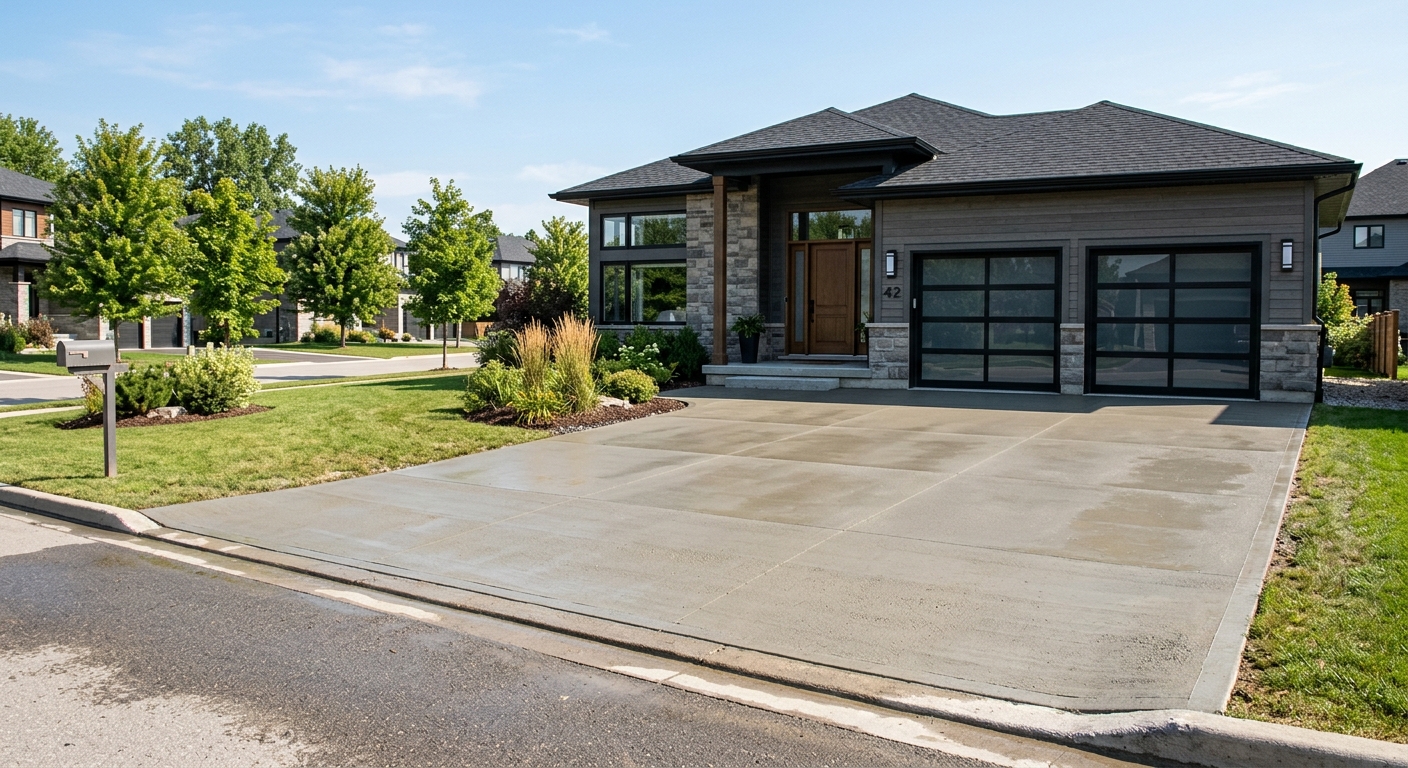
Concrete work options and costs in Chambery
Chambery, Alberta is a small community where homeowners still want classic, long-lasting concrete for driveways, patios, walkways and foundations—and the local demand shows up fast when winter weather and freeze–thaw cycles start to bite. The market here is anchored by households in low-rise neighbourhoods; in fact, Canada’s 2021 Census shows Chambery’s population at 2,064, which helps explain why contractors often schedule around a smaller pool of crews and trucking availability. In the broader Calgary region, most concrete flatwork demand comes from owner-occupied houses and attached/standalone residential properties, which is why driveways and exterior slabs remain the most common projects we price.
In the Calgary area, concrete pricing is shaped less by “premium or not” and more by engineering and curing reality. The region’s design frost depth is about 1.2 m (roughly 4 ft), so footings for houses, garages, decks and retaining structures have to sit on undisturbed soil below that level. On top of that, frequent freeze–thaw cycles drive air-entrained mixes, granular base prep and control-joint planning to reduce cracking and spalling. The practical pour season for exterior slabs is shorter, and cold-weather placement may require insulating blankets and/or temporary heat to protect proper curing—especially for outdoor surfaces.
In Chambery, you’ll typically see the strongest concrete interest around residential pockets like the Chambery Estates area, where new builds and upgrades to existing driveways and yard access are common. Next, compare typical scopes and ranges in the table below.
| Application |
Typical Size |
Key Spec |
Finish Option |
Price Range |
| Concrete driveway (standard broom finish) |
24 ft x 10 ft (240 sq. ft.) |
Air-entrained mix; reinforced if needed; control joints |
Broom finish, standard edging |
$12,000–$18,000 |
| Exposed aggregate driveway |
24 ft x 10 ft (240 sq. ft.) |
Air-entrained mix; proper timing for wash/exposure |
Exposed aggregate (salt-friendly finish) |
$14,500–$21,500 |
| Stamped concrete driveway or patio |
20 ft x 12 ft (240 sq. ft.) |
Air-entrained mix; reinforcement as required |
Stamped pattern (stone/brick look) |
$15,000–$26,000 |
| Plain concrete patio or walkway |
12 ft x 12 ft (144 sq. ft.) |
Air-entrained mix; compacted granular base |
Smooth trowel or broom-surface safety finish |
$5,000–$9,000 |
| Garage floor (interior slab) |
22 ft x 20 ft (440 sq. ft.) |
Vapour barrier; mesh or rebar based on thickness |
Float finish + light broom/texture as needed |
$7,500–$13,500 |
| Foundation footings (structural, below frost) |
Typical single-family house perimeter + interior pads |
Engineered footing depth; frost-set below design line |
Rebar cage + formwork to spec |
$28,000–$45,000 |
Prices are estimates only and vary by project scope, site access and material selection.
What affects the price of concrete work in Chambery
In Chambery and the wider Calgary region, quotes for the “same-looking” concrete job can swing by 30–50% because concrete isn’t just a material purchase—it’s an engineered system made to survive frost, freeze–thaw cycling and de-icing salt. Two contractors can both say “driveway,” but one may include proper base depth, reinforcement, air-entrainment targets and cold-weather curing protections while the other provides a thinner build-up or less detailed curing plan. Labour rates and scheduling also matter in Calgary, where crews and trucks are in higher demand during the short exterior pour window.
Here’s the big driver: frost depth. Local engineering practice assumes a design frost depth around 1.2 m, so footings for garages, decks, retaining elements and house foundations must bear on undisturbed soil below that depth to prevent frost heave. That automatically raises excavation volume and formwork height, which is why foundation/footings typically land in the $28,000–$45,000 band. For exterior slabs like patios and driveways, freeze–thaw cycles require air-entrained concrete mixes, well-spaced control joints and a granular base that’s compacted to spec; otherwise you see premature scaling and spalling.
Cost examples from typical Chambery projects: (1) A driveway that includes thicker base prep and reinforcement can cost more, but it’s often justified compared with a “minimum thickness” pour when the ground is soft or has been disturbed. (2) Stamped concrete usually costs more than broom-finish because labour is higher for forms/texture, but the price can be well-justified if you’re replacing multiple sections at once—especially when your total driveway footprint is in the $12,000–$18,000 range for standard broom finish. (3) In late fall or early spring, winter-grade curing precautions (insulating blankets and/or heat) can bump exterior slab pricing—often the difference between a surface that holds up and one that scales in a couple of seasons.
| Price Factor |
Why It Matters |
Cost Impact |
| Frost line depth |
Determines footing depth and form height |
More excavation and concrete; foundation pricing often sits in the higher band |
| Site preparation |
Excavation, grading, compacted granular base |
Soil conditions and access can add significant labour and hauling |
| Reinforcement |
Rebar or wire mesh requirement |
Improves crack resistance; adds material and tying/placement time |
| Mix design |
Air-entrainment and compressive strength spec |
Higher-spec air-entrained mixes reduce spalling risk but cost more |
| Finish type |
Broom vs. stamped vs. exposed aggregate |
Stamped/exposed requires extra labour and timing; broom is simplest |
| Pour size and concrete truck access |
Placement logistics and number of loads |
Limited access may force smaller pours and additional labour |
| Cold-weather curing precautions |
Heating and blankets |
Protects curing; can add day-by-day labour and materials |
| Control joint pattern and sealing cost |
Controls where cracks happen and repels salt |
Proper jointing/sealing reduces long-term surface deterioration |
Permits & regulations in Alberta
In Alberta, many homeowners assume “concrete is just concrete,” but the permit rules hinge on whether the work is structural and whether it affects drainage/grade. Structural concrete work—such as footings, foundation walls and grade beams—typically requires a building permit and often engineered drawings reviewed through the municipal process. Concrete flatwork like driveways, patios and walkways usually does not require a permit on its own unless it affects lot grading, stormwater drainage, impervious surface limits, or municipal right-of-way conditions. The safe approach in Chambery is to confirm with the local authority before you break ground, especially if you’re changing elevations or adding a new pad near a sidewalk/approach.
Before hiring, verify the contractor’s insurance and coverage:
- Ask for a certificate of liability insurance and confirm it’s current and matches the project address.
- Confirm WSIB/WCB coverage (and request proof in writing). If coverage can’t be shown, that’s a major risk.
- Request references on similar-scale Alberta residential work—particularly exterior slabs in freeze–thaw climates.
Step-by-step for Chambery homeowners: (1) Request the contractor’s documents before signing, (2) check the insurance certificate for validity and limits, (3) confirm coverage documentation for WSIB/WCB, and (4) ask which parts of your scope are permit-dependent (structural only vs grade/drainage impacts). This is also where itemization matters—permits, inspections, and disposal should be clear in your contract.
Getting concrete right in Chambery's freeze-thaw climate
Concrete fails in Chambery’s climate when the system isn’t built for freeze–thaw and salt exposure. The most common problem we see when a job is under-designed is spalling and scaling, often tied back to inadequate air-entrainment, weak base preparation or curing shortcuts. In a cold continental climate with a design frost depth around 1.2 m, your contractor can’t treat exterior slabs as “just flatwork.” The base must be compacted to the right depth for local soil, and joints must be spaced so cracking happens where it’s planned—not randomly across the surface.
To spec the job correctly in Chambery: (1) base prep—place and compact a granular sub-base to the required thickness for your soil and frost conditions; (2) mix design—use an air-entrained mix for exterior flatwork (target 5–7% air for many Alberta applications) and a minimum 32 MPa compressive strength; (3) control joints—plan the spacing and sawcut timing so shrinkage cracks are controlled; (4) curing—allow at least 7 days under proper conditions, and when temps are cold, use insulating blankets and/or temporary heat so curing doesn’t stall; (5) sealing—apply a penetrating sealer about 28 days after the pour to help repel de-icing salt.
Here’s a practical pricing example: if a broom-finish patio ends up in the $5,000–$9,000 band but the quote is missing explicit air-entrainment, base depth and joint/curing details, the “savings” can vanish quickly. A properly specified exterior slab in this region often costs more up front than a minimal build-up, but it prevents the early surface damage that becomes expensive to fix later.
| Spec |
Why It Matters in Chambery |
What to Ask For |
Impact if Skipped |
| Compacted granular base (depth?) |
Reduces frost heave and supports the slab through freeze–thaw |
Granular base depth tied to local soil + frost conditions; compaction method stated |
Uneven settlement, cracking, and premature edge failure |
| Air-entrained concrete mix (target air %?) |
Protects against freeze–thaw deterioration and spalling |
Air content target (commonly 5–7% for exterior flatwork) and confirmation of air-entrainment |
Scaling/spalling within a few winters, especially with de-icing salts |
| Compressive strength (MPa rating) |
Ensures durability under traffic, drainage, and thermal stress |
Minimum 32 MPa rating (or project-required strength) |
Surface wear, cracking, and reduced long-term structural performance |
| Control joints (spacing per ACI guidelines) |
Controls where shrinkage cracks form in freeze–thaw climates |
Planned joint spacing and sawcut timing (and whether joints are sealed later) |
Random cracking, water intrusion, and faster freeze damage |
| Minimum 7-day curing period |
Strength gain and durability depend on proper cure time/conditions |
What curing method is used; how cold-weather conditions are managed |
Weak surface, dusting, scaling, and reduced durability |
| Penetrating sealer (when applied after cure) |
Repels salts and reduces water penetration from melting cycles |
Apply penetrating sealer after 28 days post-pour (per product guidance) |
Faster spalling from salt exposure and moisture ingress |
How to choose a concrete work contractor in Chambery
Choosing the right concrete contractor in Chambery is mostly about verifying coverage and insisting on clear, written scope. In Alberta, you should confirm the contractor’s licensing status (where applicable for their scope), liability insurance, and WSIB/WCB coverage. How to check each: (1) request their current certificate of liability insurance and make sure it lists your project address or at least the correct entity; (2) request proof of WSIB/WCB coverage in writing; (3) verify the contractor’s business details match the quote/contract and check their references for similar exterior slabs or structural work.
Next, get 2–3 itemised written quotes. Ask for a labour/materials breakdown (not only a lump sum) that shows: concrete supply, excavation/haul-off, formwork, reinforcement, joints, finishing method, and curing/sealing requirements. Read exclusions carefully: is permit pull included where needed, is disposal included for removed concrete/soil, and does the quote include any traffic control or site protection?
Warranty matters too. Ask for the workmanship warranty length, and whether the product/manufacturer warranty is included and transferable if you sell the home. For payment, don’t front-load too much—aim for no more than 10–15% upfront, then hold back until substantial completion and cleanup.
Finally, demand a timeline in writing: start date, estimated completion, and what conditions could pause the pour (weather/curing temps).
- Clear scope in writing: slab thickness, base prep, reinforcement, and finish type.
- Specific air-entrainment and curing approach for exterior work.
- Itemised labour + materials (no “mystery line items”).
- Joint plan stated (spacing/sawcut timing) and sealing included or scheduled.
- Documented waste/disposal plan for removed concrete and contaminated soil.
- Insurance certificates provided before work begins.
- WSIB/WCB proof requested and reviewed (not just “we’re covered”).
- Reference checks for similar Alberta freeze–thaw projects.
- Payment schedule with holdback until final acceptance.
- Weather readiness plan for cold nights and curing protection.
- Permit responsibility spelled out (who applies, who pays, who schedules inspections).
- Warranty terms in plain language, including coverage limits and exclusions.
Concrete red flags we see in Chambery include: contractors who won’t specify air-entrainment or curing protections; quotes that don’t mention base depth/compaction or reinforcement; “cheap” sealed-joint claims without noting when and how sealing is applied; vague timelines like “weather permitting” with no curing plan; and payment schedules that request large deposits before forms, base prep and inspections are complete.
Frequently asked questions — concrete work in Chambery
What is the difference between concrete and cement?
In Alberta, homeowners often mix up the terms, so it’s worth clarifying. Cement is a powder (typically Portland cement) that reacts with water to form the binding paste. Concrete is the finished engineered material: cement plus water, plus aggregates (sand and gravel), sometimes with air-entraining admixtures and other additives. For Chambery’s freeze–thaw conditions, concrete’s “recipe” matters—especially for exterior driveways, patios and walkways where we typically specify air-entrainment to reduce spalling. That’s also why two driveway quotes can differ: one mix design is set up for durability in Calgary-area winters, while another may not be.
How much does concrete work cost in Chambery?
Concrete costs in Chambery generally track the Calgary-region price bands and climate engineering needs. As a quick reference, a standard broom-finish driveway commonly lands in the $12,000–$18,000 range, while a plain patio or walkway often sits around $5,000–$9,000 depending on size, base prep and access. If you’re talking foundation footings (structural work below the design frost depth), budgeting in the $28,000–$45,000 band is typical because excavation is deeper and the scope is engineered. Costs can swing due to soil condition, reinforcement needs, and winter curing precautions when you pour near the cold-weather edges of the season.
How deep must footings be for Chambery's frost line?
For Chambery-area projects, the key is the design frost depth used by Alberta engineering practice for your specific soil and foundation design. In this Calgary region, that design frost depth is about 1.2 m (roughly 4 ft). Footings and foundation elements must be built to bear on undisturbed soil below that depth to reduce frost heave and seasonal movement. Exact footing elevations are confirmed by your engineered drawings or geotechnical information, especially where soil type changes across the lot. If a proposal doesn’t clearly reference “below frost” and engineered footing depths, it’s a major question to ask before signing.
Why does concrete crack in Chambery and how is it prevented?
Concrete cracks in Chambery mainly due to shrinkage and temperature changes, then gets stressed further by freeze–thaw cycles. Even properly built slabs will crack—what matters is that the cracks are controlled through an intentional joint pattern. Prevention starts with compacted granular base prep, using an exterior-rated air-entrained mix, and installing control joints at appropriate spacing and timing. In Calgary-area conditions, de-icing salts and water intrusion can worsen small cracks, so sealing after curing is important. Proper curing (minimum 7 days, plus cold-weather protection if needed) also helps avoid early weakness. The best outcomes come from contractors who plan joints and specify air content, not just who pour and “hope for the best.”
Stamped vs broom-finish concrete — cost difference?
Stamped concrete usually costs more than broom-finish because it requires additional labour, materials and careful timing during placement and finishing. For homeowners in Chambery, broom-finish driveways often land in the $12,000–$18,000 band, while stamped concrete driveways or patios commonly fall into the $15,000–$26,000 band depending on square footage, pattern complexity and base prep. Stamping itself isn’t the only difference—often the contractor will also specify reinforcement and a consistent mix for durability in freeze–thaw winters. If you’re replacing an existing slab, it can be more cost-effective to choose the decorative finish during the replacement rather than later, when you’d be paying for additional demolition and rework.
When is the best time to pour concrete in Chambery?
The best time to pour concrete in Chambery is during the practical pour window when temperatures support proper curing without excessive artificial heating. In the Calgary region’s cold continental climate, the window for exterior slabs is shorter than in milder parts of Canada. If you pour too late in the season or in early spring, contractors may need insulated blankets and/or temporary heat to achieve suitable curing conditions and prevent surface scaling. For exterior work, the focus is not only air temperature—it’s also night temperatures, wind, and how long the slab can maintain curing conditions. A reputable crew will discuss their cold-weather curing plan upfront, including how they protect the slab so you get the durability you’re paying for.