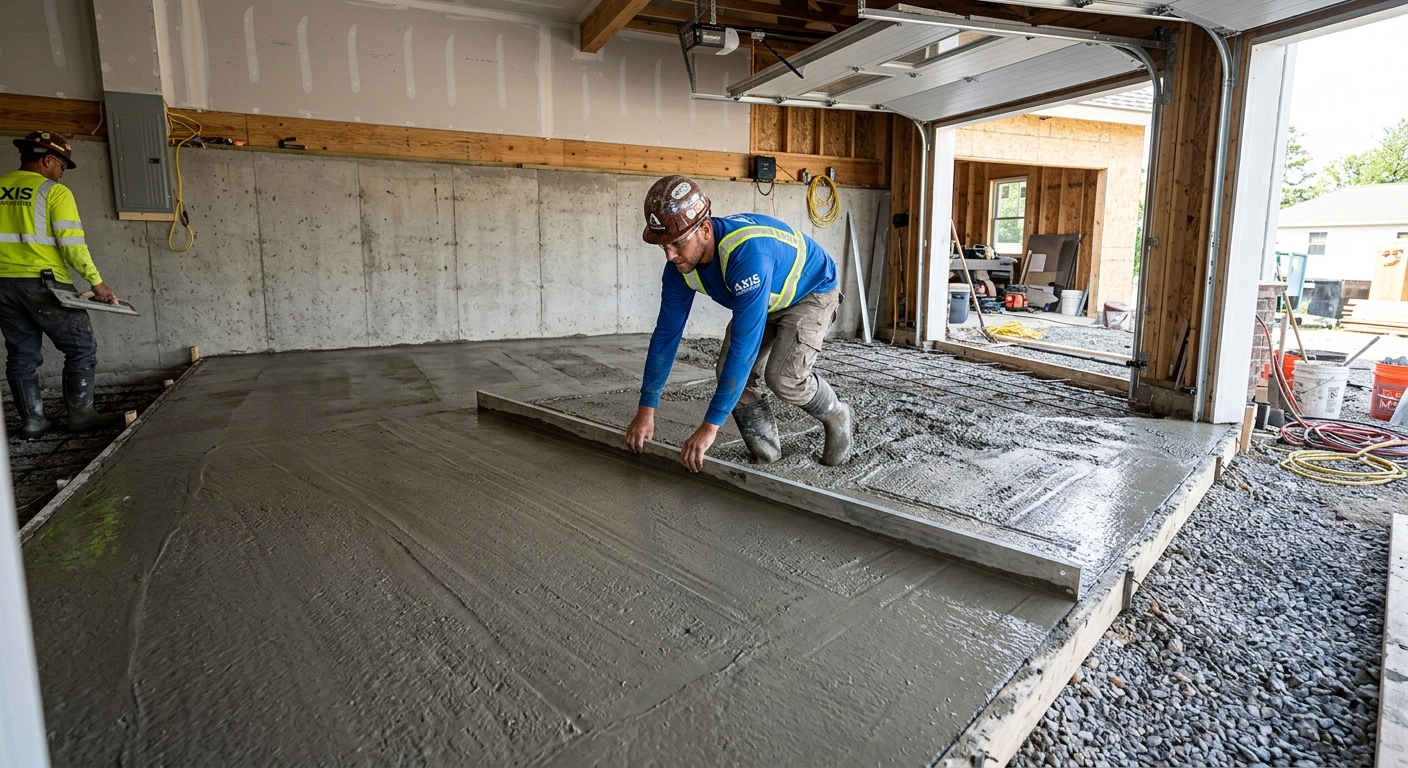
Concrete work options and costs in Hounsfield Heights/Briar Hill
In Hounsfield Heights/Briar Hill, concrete flatwork is a big part of how homes look and how weatherproof the property stays year-round. With a small local population of 2,470 people (Statistics Canada, 2021 Census), demand concentrates around established residential streets and infill upgrades, especially where homeowners expand driveways, add patios, or replace older slabs. In this market, concrete is most commonly chosen for single-detached and growing “renovation-and-refresh” projects where the existing grade and landscaping need a durable, low-maintenance finish.
Calgary’s cold continental climate drives pricing more than many homeowners expect. Design frost depth is a major driver: for most house-related exterior work, footings must bear below the design frost depth (about 1.2 m, roughly 4 ft) to limit frost heave and seasonal movement. On top of that, frequent freeze–thaw cycles mean exterior slabs need air-entrained concrete, properly graded and compacted granular base prep, and a control joint plan. That makes excavation and materials selection more intensive, and it also tightens the pour season for outdoor slabs.
Contractor availability also matters. In peak construction weeks around Calgary, schedules move quickly, so quoted timelines can affect labour allocation and sometimes pricing. In neighbourhood pockets like Mission/near the Hounsfield Heights edge—where older lots often have mature trees and more variable site access—excavation and disposal can add scope to the same concrete “size” of work. Use the comparison table below to benchmark typical options before you talk to contractors.
| Application |
Typical Size |
Key Spec |
Finish Option |
Price Range |
| Concrete driveway (standard broom finish) |
24 ft x 12 ft (~288 sq. ft.) |
Air-entrained mix, compacted granular base, control joints |
Broom finish |
$12,500–$18,500 |
| Exposed aggregate driveway |
24 ft x 12 ft (~288 sq. ft.) |
Air-entrained mix, washed aggregate exposure, sealed surface |
Exposed aggregate (surface wash) |
$14,500–$22,000 |
| Stamped concrete driveway or patio |
20 ft x 16 ft (~320 sq. ft.) |
Air-entrained mix, stamping mats, colour hardener |
Stamped & coloured |
$16,000–$26,500 |
| Plain concrete patio or walkway |
12 ft x 16 ft (~192 sq. ft.) |
Compacted base, air-entrained mix, joint layout |
Screed/straight trowel with light broom |
$5,200–$9,500 |
| Garage floor (interior slab) |
24 ft x 24 ft (~576 sq. ft.) |
Vapour barrier (as applicable), mesh/reinforcement, proper curing |
Light broom finish |
$13,000–$22,500 |
| Foundation footings (structural, below frost) |
Per linear footing length (typical house scope) |
Engineered footing specs, below design frost depth bearing |
Structural concrete (no decorative finish) |
$28,500–$46,000 |
Prices are estimates only and vary by project scope, site access and material selection.
What affects the price of concrete work in Hounsfield Heights/Briar Hill
In Hounsfield Heights/Briar Hill and the broader Calgary region, you can see 30–50% differences on “similar” concrete jobs because quotes aren’t just about concrete volume. They swing based on excavation difficulty, how deep and how much base prep is needed for the local soil and frost requirements, the reinforcement strategy, and the finish system (broom vs. stamped vs. exposed aggregate). Labour availability also plays a part—when crews are booked for frost-avoidance timelines, mobilisation and scheduling can change.
Frost line depth and freeze–thaw cycles dictate most of the technical cost drivers here. Footings and structural supports generally must extend to undisturbed soil below the design frost depth (about 1.2 m in typical Alberta design practice for many house elements). Exterior flatwork also has to be built to handle repeated wetting and freezing; that’s why air-entrained concrete is standard, and why granular base prep and control joints matter as much as the top finish. In colder months, the pour season is shorter and cold-weather curing precautions (insulated blankets, heaters, and curing control) may be required to achieve proper set and durability—adding cost. Finally, de-icing salt accelerates surface wear and can lead to spalling if the mix and sealing approach aren’t right, which is why sealing often shows up as a line item for driveways, patios, and walkways.
In Hounsfield Heights/Briar Hill specifically, older lots and mature landscaping can force deeper excavation and more disposal. That can push a “plain patio” scope closer to the upper end of the $5,000–$9,000 band. Conversely, if a contractor has easy truck access and keeps the work within a standard forming/reinforcement plan, driveway pricing may land closer to the lower end of the $12,000–$18,000 band. For example, upgrading from a broom-finish driveway to stamped concrete can be justified when you’re replacing the full surface and want curb appeal, but it’s usually not worth stamping a tiny repair area—staying plain often makes more sense for smaller walkways.
| Price Factor |
Why It Matters |
Cost Impact |
| Frost line depth — determines footing depth and form height |
Footings must bear below frost to prevent heave and movement |
Higher excavation + deeper structural concrete |
| Site preparation — excavation, grading, compacted granular base |
Correct base thickness and compaction control settlement and cracking |
Can add major labour and hauling/disposal costs |
| Reinforcement — rebar or wire mesh requirement |
Reinforcement supports slabs against shrinkage and wheel loads |
Material + tying labour; mesh alone often differs from rebar cages |
| Mix design — air-entrainment and compressive strength spec |
Air-entrainment improves durability through freeze–thaw cycles |
Winter-grade or higher-spec mixes cost more per cubic yard |
| Finish type — broom vs. stamped vs. exposed aggregate |
Finish systems change labour time, materials, and equipment |
Stamped/exposed typically increases price versus broom |
| Pour size and concrete truck access to site |
Smaller pours may require extra setups; access affects pump/truck placement |
Access limits can drive mobilisation and time premiums |
| Cold-weather curing precautions — heating and blankets |
Prevents early freezing and improves final strength development |
Heaters/blankets and added monitoring increase labour and materials |
| Control joint pattern and sealing cost |
Joints reduce random cracking; sealing helps manage salt abrasion |
Often a small line item that can prevent costly surface failures |
Permits & regulations in Alberta
In Alberta, structural concrete work such as footings, foundation walls, and grade beams typically requires a building permit and often engineered drawings that the municipality reviews as part of the foundation/structural permit process. For Hounsfield Heights/Briar Hill homeowners, that usually means your foundation work is tied to the broader permit package for the house addition, replacement, or major structural modification.
Concrete flatwork—patios, walkways, driveways, and garage slabs—typically does not require a permit by itself unless it impacts lot grading, alters drainage in a way that affects neighbouring properties, or changes impervious surface coverage/right-of-way considerations. Even when a permit isn’t usually required for the slab itself, you still need to ensure the work meets municipal grading and drainage expectations; the contractor should be able to explain what they’re assuming.
Before breaking ground, verify three basics: (1) the contractor’s liability insurance and (2) their WCB coverage (WSIB/WCB), and (3) their relevant business credentials. Step-by-step: ask for an up-to-date certificate of insurance (showing limits and project/owner name if possible), request their WCB clearance letter/confirmation, and confirm they’re insured for both labour and completed operations. Then check their business registration online (company name and trade details) and request references on similar Alberta foundation/flatwork scopes. If a permit is required for your structural elements, confirm who pulls it—ideally the contractor coordinates it—or ensure your builder does so through the proper channels.
Getting concrete right in Hounsfield Heights/Briar Hill's freeze-thaw climate
Concrete failures in Hounsfield Heights/Briar Hill usually come down to one thing: water and temperature working together against an unprepared system. Freeze–thaw cycles can scale and spall concrete when the base isn’t built to drain and support properly, when the mix lacks the required air-entrainment, or when curing is rushed in cold weather. In practical terms, spec the work as a system, not a single material.
Base preparation: build a compacted granular sub-base to the required depth for your soil conditions and local frost performance, then grade it to manage drainage away from the house. Mix design: use air-entrained concrete (commonly targeted at 5–7% air content for exterior flatwork) and a minimum 32 MPa compressive strength so the concrete resists freeze–thaw deterioration. Control joints: plan joint spacing to limit random cracking and keep cracks in the intended lines. Curing: plan for at least 7 days of proper curing under suitable conditions; in cold snaps, insulated blankets or temporary heating protect set and early strength gain. Sealing: apply a penetrating sealer after the concrete has cured (commonly around 28 days) to help repel de-icing salts and reduce surface breakdown.
Ask targeted questions: “What target air content are you using for an exterior driveway in Calgary weather?” and “How will you protect the pour from freezing during the first 48–72 hours?” A common misstep is insisting on the cheapest mix while expecting a decorative finish to “hide” surface problems—stamped concrete costs more (often in the $15,000–$26,000 band), but it still fails if air-entrainment and curing are compromised.
For a dollar example, homeowners replacing a standard broom-finish driveway often fall into the $12,000–$18,000 range. If a contractor proposes stamped concrete, that price jump can be justified when the entire surface is replaced, full reinforcement and base prep are included, and curing/blanketing is planned for the expected weather. If the scope is only partial repair or the schedule is “whatever date we can fit it in,” the cheaper broom option may be the smarter long-term value.
| Spec |
Why It Matters in Hounsfield Heights/Briar Hill |
What to Ask For |
Impact if Skipped |
| Compacted granular base (depth?) |
Prevents settlement and helps drainage through freeze–thaw |
“What base depth and compaction method will you use for my soil?” |
Cracking, uneven settling, accelerated spalling |
| Air-entrained concrete mix (target air %?) |
Improves freeze–thaw durability in Calgary winter conditions |
“What target air content (typically 5–7%) are you using for exterior slabs?” |
Surface scaling/spalling, pop-outs, faster deterioration |
| Compressive strength (MPa rating) |
Strength development affects long-term durability under traffic and freeze cycles |
“Confirm minimum 32 MPa and test/certification documentation.” |
Reduced performance, surface wear and premature failure |
| Control joints (spacing per ACI guidelines) |
Controls where cracks form during shrinkage and temperature changes |
“Show your joint layout plan and spacing.” |
Random cracking and costly surface repairs |
| Minimum 7-day curing period |
Ensures early strength gain before cold weather stress |
“How will you maintain curing temperature/moisture?” |
Scaling, weak surface, higher risk of damage from early freezes |
| Penetrating sealer (when applied after cure) |
Helps manage salt and water contact on exterior flatwork |
“When will you apply sealer—about 28 days post-pour—and what product?” |
Faster salt wear and deterioration of the top surface |
How to choose a concrete work contractor in Hounsfield Heights/Briar Hill
Choosing the right concrete contractor in Hounsfield Heights/Briar Hill is mostly about verification and scope clarity—because “concrete” isn’t one uniform product. Start with Alberta requirements: confirm they carry liability insurance and WCB coverage. How to check each: request a current certificate of insurance (and read the effective dates and coverage limits), then ask for their WCB clearance letter/confirmation for active coverage. You should also be able to provide references that match your scale—driveway replacement crews are different from structural foundation crews.
Next, get 2–3 itemised written quotes rather than a single lump sum. A strong quote breaks down labour and materials (excavation, haul/disposal, base, reinforcement, concrete, forming, finishing, saw-cutting/joints, and sealing if included). Read the exclusions line carefully: is topsoil replacement included? Is permit work included for foundations? Is disposal hauled away? Are crane/pump/truck access charges included, or treated as an add-on if the truck can’t get close? Also clarify whether the quote assumes winter-grade placement measures—heaters/blankets—if scheduling falls into colder periods.
Finally, check the warranty. Ask for the workmanship warranty length (and what it covers, such as spalling/structural cracking vs. surface cosmetic issues), confirm whether any product/manufacturer warranty is included, and whether the warranty is transferable if you sell the home. On payment, never agree to pay more than about 10–15% upfront; hold back the balance until the job is complete and cleaned up. Get a start date and completion estimate in writing so you can verify schedule realism.
- Ask for an itemised quote with line-by-line excavation/base/steel/mix/finishing
- Confirm the concrete mix is air-entrained for exterior work
- Ask how they’ll protect the pour from freezing during set (blankets/heaters if needed)
- Verify joint layout and saw-cut timing (don’t accept “we’ll do joints later”)
- Confirm whether sealing is included and when it’s applied (after cure)
- Check liability insurance and request the current certificate
- Confirm WCB coverage with a clearance letter/confirmation
- Look for references from nearby Calgary-area projects with similar weather exposure
- Ensure disposal/hauling is included if soil is removed
- Ask who pulls permits if your project includes structural concrete
- Agree on inspection milestones (base inspection, reinforcement inspection, final grading)
- Keep payment tied to progress; hold back until surfaces are cured and finished
Concrete red flags I see in and around Hounsfield Heights/Briar Hill: “no need for air-entrainment,” refusal to discuss curing/blankets in cold weather, vague joint spacing (or no joint plan), skipping base thickness/compaction details, and quotes that don’t state what’s included for sealing, disposal, or truck access.
Frequently asked questions — concrete work in Hounsfield Heights/Briar Hill
What is air-entrained concrete and why does it matter here?
Air-entrained concrete is mixed with tiny, evenly distributed air bubbles that give water a place to expand when it freezes. In Alberta and specifically around Hounsfield Heights/Briar Hill, that matters because freeze–thaw cycles happen repeatedly and can drive surface scaling and spalling if the concrete isn’t engineered to tolerate it. That’s why exterior driveway, patio, and walkway pours should use air-entrained mixes and appropriate curing control. If you’re comparing quotes, a broom-finish driveway in Calgary often falls around the $12,000–$18,000 band, but the “real” difference is usually the mix spec and whether the contractor can prove the curing/blanket plan. Always ask for the target air content and minimum compressive strength documentation.
How do I prepare the base for a concrete slab?
Base preparation is where most long-term durability is won or lost. For Hounsfield Heights/Briar Hill, the base needs to be excavated to the right depth, graded for drainage, and compacted with the correct granular base thickness so it doesn’t settle when the ground goes through freeze cycles. Ask your contractor what soil conditions they’re assuming and what base depth and compaction method they use. Good contractors will also describe how they’ll remove unsuitable material, install the granular sub-base, and finish grading before reinforcement is placed. This scope is often a major part of the variation between quotes and can move your driveway cost within the $12,000–$18,000 range. For patios/walkways, it’s usually one of the reasons quotes differ inside the $5,000–$9,000 band.
How do I compare concrete quotes?
To compare concrete quotes in Alberta, make them “apples to apples.” Ask for itemised labour and materials: excavation, base prep, reinforcement, concrete volume/spec, forming, finishing, saw-cut joints, curing precautions, sealing (if included), and disposal/hauling. Don’t compare only the total price—one contractor may include sealing and proper cold-weather curing while another might not, and that’s where durability costs are hidden. Also check whether reinforcement is mesh vs. rebar and whether it’s sized for the intended loads (especially for driveways and garage floors). If your goal is a decorative look, ensure stamped concrete quotes (often in the $15,000–$26,000 band) include the same base and reinforcement scope as the plain version. Finally, confirm schedule assumptions: if they’re planning a late-season pour without winter-grade measures, you should expect higher risk.
Can concrete be poured in cold weather in Hounsfield Heights/Briar Hill?
Yes, concrete can be poured in cold weather in Hounsfield Heights/Briar Hill, but only if it’s engineered for it. Calgary’s winter conditions can freeze the surface or halt early strength gain, which increases the risk of scaling and other surface issues. Contractors typically manage this with winter-grade mixes, temperature control, and curing protection such as insulated blankets and sometimes temporary heat. What you want to see in the quote is a clear plan: how they’ll protect the pour during the critical early set period (often the first 48–72 hours), how long curing will be maintained, and what equipment is included. If a contractor can’t explain curing precautions and dates, don’t treat the quote as equivalent to a summer placement. Your best protection is a written curing plan aligned to Alberta winter realities.
How do I maintain concrete in Hounsfield Heights/Briar Hill's freeze-thaw climate?
Maintenance in Hounsfield Heights/Briar Hill is about keeping water exposure and salt abrasion under control. First, keep the surface clean—sand and debris hold moisture against the concrete, and that can worsen freeze–thaw stress. Second, consider sealing: a penetrating sealer applied after the concrete has fully cured (commonly around 28 days post-pour) helps repel de-icing salts and reduces surface breakdown. Third, avoid over-aggressive de-icing: use appropriate products and apply them in a way that minimizes abrasion. Fourth, address minor issues early—small cracks and chips can be sealed or repaired before they allow water to migrate deeper. If you’re comparing options, remember that plain broom finishes (often $12,000–$18,000 for driveways) can last a long time when properly built and maintained, while stamped/exposed surfaces may require more disciplined care to keep their appearance.
What causes concrete to spall in Hounsfield Heights/Briar Hill winters?
Concrete spalls mainly when water gets into the surface and freezes, expanding behind weak or unprotected concrete. In Hounsfield Heights/Briar Hill winters, the most common causes are inadequate air-entrainment, poor base drainage or compaction, insufficient curing control, and delayed or skipped sealing when de-icing salt is used. If the mix doesn’t have the right air system (commonly around 5–7% air for exterior flatwork), freeze–thaw cycles can break the surface layer, leading to scaling and spalling. A rushed schedule—especially late fall or early spring pours without winter curing precautions—also raises risk. Sometimes reinforcement placement or a weak joint plan contributes by allowing movement where it shouldn’t happen. The best prevention is demanding specs, not just a lower initial price. For example, if someone offers a driveway near the low end but can’t explain curing and air-entrainment, it’s a red flag.