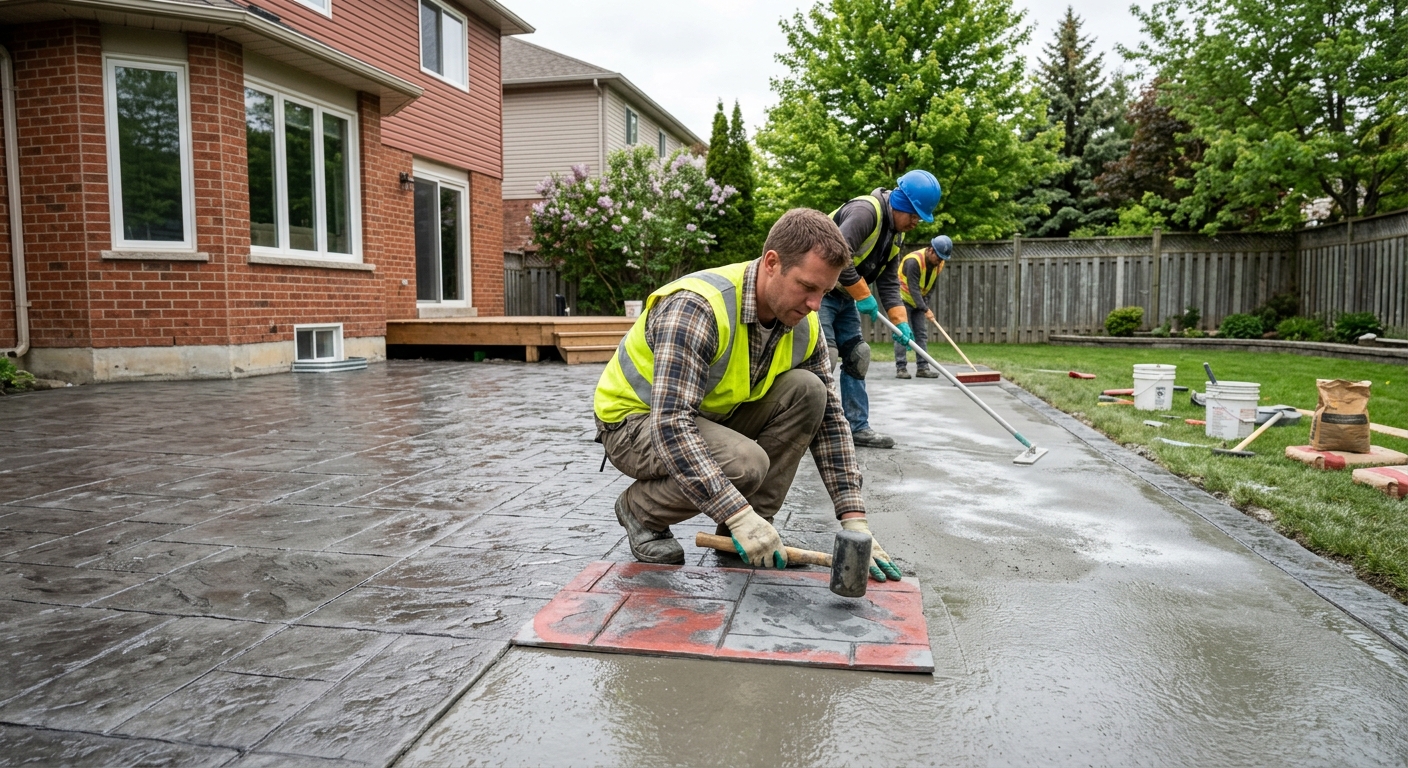
Concrete work options and costs in Carrington
Carrington’s concrete market is built around durability, and that matters because you’re shopping in a community of about 2,750 people (Statistics Canada, 2021 Census). Most homeowners are planning long-term improvements like driveways, patios, walkways, and—when they build or update foundations—footings that can withstand a hard freeze. In that context, concrete flatwork is a common scope, and in a smaller town like Carrington you’ll typically see contractors working between local builds and the broader Calgary area, which affects scheduling and availability.
The biggest cost driver in this part of Alberta is the engineered approach to frost and freeze–thaw. Practical design frost depth in Calgary-area conditions is roughly 1.2 m (about 4 ft), so excavation and footing volume are often higher than in milder regions. Exterior slabs also rely on air-entrained mixes and well-spaced control joints to reduce cracking and surface scaling. On top of that, Calgary’s short pour season for exterior work means projects may require cold-weather placement precautions (insulated blankets and sometimes temporary heat), especially when you’re scheduling late fall or early spring.
In Carrington, demand for concrete is especially steady around newer residential pockets where homeowners are expanding flatwork—think driveways and backyard patios on the same lots that are also getting landscaping and grading updates. If you’re comparing options, the best approach is to match the finish to how the slab will be used, then budget correctly for base preparation and curing. Use the guide below to sanity-check typical ranges, then we’ll break down the factors behind the differences in quotes.
| Application |
Typical Size |
Key Spec |
Finish Option |
Price Range |
| Concrete driveway (standard broom finish) |
24 ft × 10 ft (240 sq ft) |
Reinforced slab on compacted granular base; air-entrained concrete for exterior |
Broom finish, control joints, optional sealer |
$12,000–$15,500 |
| Exposed aggregate driveway |
24 ft × 10 ft (240 sq ft) |
Air-entrained mix; proper curing to support clean reveal |
Exposed aggregate with broomed edges; joints aligned for visual control |
$14,500–$18,000 |
| Stamped concrete driveway or patio |
24 ft × 10 ft driveway or 20 ft × 12 ft patio (240–240 sq ft) |
Air-entrained, higher labour density for stamping/finishing |
Stamp pattern + release, colour integral or overlay colour |
$15,000–$26,000 |
| Plain concrete patio or walkway |
12 ft × 20 ft (240 sq ft) patio or 3 ft × 30 ft (90 sq ft) walkway |
Exterior-rated mix; compacted base; control joints |
Float/steel trowel then light broom texture for slip resistance |
$5,000–$9,000 |
| Garage floor (interior slab) |
22 ft × 20 ft (440 sq ft) |
Vapour/film as needed; slab thickness and reinforcement per design |
Standard smooth finish with jointing; optional densifier |
$8,500–$14,500 |
| Foundation footings (structural, below frost) |
Typical single-family footprint (varies by design) |
Concrete placed on undisturbed soil below design frost depth; rebar per engineering |
Structural concrete only (no surface finish) |
$28,000–$45,000 |
Prices are estimates only and vary by project scope, site access and material selection.
What affects the price of concrete work in Carrington
For the same “size” of concrete, you can see quote differences of 30–50% across Calgary and Alberta because concrete pricing isn’t just the truckload—it’s the engineering, excavation, and labour tied to frost protection and durability. In a region where the design frost depth is about 1.2 m (roughly 4 ft), footings must bear on undisturbed soil below that depth to reduce frost heave. That means deeper excavation, more base and formwork, and more time for trades—costs you don’t feel in warmer provinces with shallower frost penetration.
Exterior slabs are also specified around freeze–thaw. The common-sense result is higher-spec air-entrained mixes, proper curing, and control joints placed to limit random cracking. When you pour during cold spells, cold-weather curing precautions (heating and insulated blankets) become a real line item, not an optional extra. And since de-icing salts accelerate surface damage, sealing and correct surface finish planning can prevent early spalling and scaling.
In Carrington, a driveway price can jump when the contractor has to remove and replace unsuitable fill, widen formwork for turning access, or excavate to meet the frost-based footing requirements. Conversely, a straightforward patio replacement over stable base and easy truck access can land closer to the lower end of the concrete patio/walkway band (for example, around $5,000–$9,000). Stamped or exposed finishes can also be cost-justified: when a stamped driveway is detailed correctly, it may sit near $15,000–$26,000 because the labour intensity is higher, not because the concrete itself is “different” in strength.
Finally, older housing stock in the area often means re-grading and tying into existing elevations (and sometimes drainage corrections). Those site realities are where extra dollars get spent, especially when there’s limited room for compaction equipment and spoil removal.
| Price Factor |
Why It Matters |
Cost Impact |
| Frost line depth — determines footing depth and form height |
Footings must extend below design frost depth for stability |
Higher excavation/formwork increases foundation costs materially |
| Site preparation — excavation, grading, compacted granular base |
Weak soil and poor grading lead to settlement and cracking |
Time and disposal can add a large swing to the quote |
| Reinforcement — rebar or wire mesh requirement |
Controls cracking and supports loading |
Material + placement labour can raise total cost |
| Mix design — air-entrainment and compressive strength spec |
Air-entrainment improves freeze–thaw durability |
Winter-grade and engineered mix can cost more per yard |
| Finish type — broom vs. stamped vs. exposed aggregate |
Finish requires additional labour and sometimes multiple steps |
Stamped/exposed usually sits at the upper price band |
| Pour size and concrete truck access to site |
Access controls how many pours/placements are needed |
More trucks/shorter access pathways increase labour |
| Cold-weather curing precautions — heating and blankets |
Cold slows strength gain and can cause scaling/spalling |
May add cost during fall/spring projects |
| Control joint pattern and sealing cost |
Joints and sealing protect against freeze–thaw cycling damage |
Better detailing costs more upfront, reduces failures later |
Permits & regulations in Alberta
In Alberta, structural concrete work generally requires a building permit. That typically includes concrete foundations and any structural elements like footings, foundation walls, and grade beams. These are engineered systems that affect load paths, frost protection and drainage, so municipalities often expect engineered drawings reviewed during the permit process. For concrete flatwork—driveways, patios, and walkways—permits usually are not required by default, but you may still need approvals if the work changes lot grading, impacts impervious surface coverage limits, or affects municipal right-of-way (for example, any work that encroaches on boulevard areas).
Before breaking ground in Carrington, confirm the scope with the local authority and keep a copy of the permit conditions if applicable. Also verify your contractor is properly insured and covered: ask for proof of liability insurance and proof of WSIB/WCB coverage before work begins. For an additional layer of safety, request references from recent projects of similar scale—especially exterior slabs poured in cold-season conditions around Calgary.
Step-by-step verification you can do as a homeowner: (1) check the contractor’s Alberta business and any applicable trade registration information through available online resources; (2) request a current certificate of insurance—ensure it shows liability coverage and includes your property’s address or project name if offered; (3) ask for a WSIB/WCB clearance letter or coverage proof (paper or electronic); and (4) confirm the company name on their insurance documents matches the name on the contract. If they can’t provide these, that’s a major red flag.
Getting concrete right in Carrington's freeze-thaw climate
Concrete failures in Carrington usually come down to one theme: moisture + freeze–thaw cycling, especially when base preparation or the mix spec isn’t tailored for Alberta winters. The most common visible problem is spalling—flaking, scaling and surface breakdown—often caused by inadequate air-entrainment, poor curing, and/or joints that don’t control where cracks form. Once water gets into micro-cracks, Calgary-area freeze cycles expand it, and the surface starts to deteriorate.
To spec the job correctly, start with base preparation: compacted granular sub-base to the appropriate depth for local soil conditions and frost protection. Then confirm mix design. For exterior flatwork, ask for an air-entrained concrete mix with air content typically in the 5–7% range for durability and a minimum 32 MPa compressive strength. Next, require an intentional control-joint plan—spacing and layout that limit random cracking, especially on driveways and long walkways. Curing is the next non-negotiable: proper curing should be at least 7 days under suitable conditions, and cold weather often requires heating or insulated blankets to reach proper strength. Finally, sealing matters in a salt environment: a penetrating sealer applied after cure (commonly at about 28 days) helps repel de-icing salts and reduces surface breakdown.
Here’s a practical dollars example. If a standard broom-finish driveway quote is in the low end of the concrete driveway band, around $12,000–$15,500, and a stamped driveway quote lands near $15,000–$26,000, the difference is usually labour and finishing steps—not “extra strength.” The right contractor should be able to explain exactly what changes: stamping labour, release/colour system, additional finishing time, and how joints are aligned so the pattern doesn’t hide defects. If they can’t, you’re paying for uncertainty.
| Spec |
Why It Matters in Carrington |
What to Ask For |
Impact if Skipped |
| Compacted granular base (depth?) |
Proper base reduces settlement and creates a stable frost-resistant layer |
Confirm removal/replacement plan and compacted granular base depth for your soil |
Settlement and cracking, premature edge failure |
| Air-entrained concrete mix (target air %?) |
Air voids improve freeze–thaw resistance in Alberta winters |
Specify exterior mix with 5–7% air (based on exposure class and design) |
Higher risk of spalling and scaling |
| Compressive strength (MPa rating) |
Strength gain protects the slab from early damage in a short cure window |
Minimum 32 MPa compressive strength |
Reduced durability; increased cracking under loads |
| Control joints (spacing per ACI guidelines) |
Controls where shrinkage cracks go so they don’t turn random |
Ask for planned joint layout and spacing suitable for slab dimensions |
Random cracking and water migration |
| Minimum 7-day curing period |
Cold weather slows strength gain; curing supports freeze resistance |
Require curing protection plan; keep traffic/loading off slab as scheduled |
Surface scaling, weakened slab at early age |
| Penetrating sealer (when applied after cure) |
Salt exposure accelerates surface breakdown without protection |
Confirm sealer type and application timing after ~28 days of cure |
Faster deterioration from de-icing salts and water intrusion |
How to choose a concrete work contractor in Carrington
Choosing the right contractor in Carrington starts with verification. In Alberta, confirm they carry liability insurance and have WSIB/WCB coverage (ask for proof such as a current clearance letter or coverage documentation). You should also verify the business identity on the documents matches the contract—mismatches are a common sign of “paper only” coverage. For licensing and trade registration, check the contractor’s available Alberta registry information where applicable and ensure they can clearly describe their role on structural vs flatwork scopes.
Then compare quotes properly. Get 2–3 itemised written estimates rather than one lump sum. Ask for a breakdown that shows labour, excavation/site prep, concrete and reinforcement, forms, and disposal. For anything structural (footings/grade beams), ask whether engineered drawings are included or referenced. Also confirm what’s excluded: permit pull (for structural work), trenching, re-grading beyond a set boundary, saw cutting, joint sealing, snow/ice removal for access, and concrete truck waiting time.
Warranty matters—workmanship warranties should be clear on length and what is covered (commonly surface issues tied to curing/base defects). Confirm whether manufacturer warranties for sealers or specialty products are included and whether they transfer to you. Payment scheduling should be conservative: never pay more than 10–15% upfront, and hold back a reasonable portion until the work is complete and cleaned up. Finally, insist on a written start date and a completion estimate; Calgary-area weather can shift schedules, but a clear plan shows competence.
- Request proof of liability insurance before signing.
- Request WSIB/WCB coverage proof or clearance letter.
- Make sure the company name on insurance matches the contract.
- Get at least 2–3 itemised quotes (labour + materials).
- Ask for the excavation and granular base plan—depth and compaction approach.
- Confirm reinforcement details (rebar vs mesh) and slab thickness.
- Verify air-entrainment and exterior mix spec, not just “standard concrete.”
- Ask about cold-weather curing plan (blankets/heating) if the pour is late fall or early spring.
- Confirm control joint layout and whether joints will be sealed (and when).
- Ask who handles disposal/hauling of removed soil.
- Review warranty terms in writing, including workmanship duration.
- Schedule payments: 10–15% max upfront; holdback until acceptance.
Concrete contractor red flags in Carrington: (1) vague scopes like “we’ll pour and finish” with no base depth, reinforcement or joint plan; (2) no proof of WSIB/WCB coverage or liability insurance; (3) skipping cold-weather curing when temps drop; (4) quotes that seem too low because they assume easy access and minimal excavation; and (5) warranties described verbally only, with no written coverage for defects related to curing/base.
Frequently asked questions — concrete work in Carrington
How do I prepare the base for a concrete slab?
Base preparation is where most slab problems start, especially in Alberta’s freeze–thaw climate. For a concrete slab in Carrington, you want the contractor to excavate to the required depth, remove any unsuitable topsoil/fill, and build a compacted granular sub-base in lifts. The goal is a stable, frost-resistant support layer that doesn’t pump or settle when water freezes. Your quote should identify the base depth and the granular material type, plus confirmation of compaction practices.
Because design frost depth in the Calgary region is about 1.2 m (roughly 4 ft), excavation is often more intensive than homeowners expect. If you’re comparing options, make sure both quotes include the same site prep scope; that’s why driveway pricing can swing widely, even within the $12,000–$18,000 driveway bands.
How do I compare concrete quotes?
When you compare concrete quotes in Carrington, don’t judge by price alone—judge by what’s included. Ask for itemised estimates that separate labour, excavation/site preparation, concrete supply, reinforcement, forms, saw cutting, and disposal. Confirm both bids specify the same concrete quality for exterior exposure (air-entrainment) and a similar compressive strength target.
Also compare the “durability extras” that matter here: control joint spacing, curing method, and sealing schedule. In cold-season conditions, the best contractors will include insulated blankets or temporary heating and explain how they’ll protect the slab so it reaches proper strength. If one quote is dramatically lower, it may be missing required prep or using a lower-spec approach that risks scaling/spalling later. For reference, a standard broom-finish driveway often falls around $12,000–$15,500 depending on scope and access.
Can concrete be poured in cold weather in Carrington?
Yes, concrete can be poured in cold weather in Carrington, but it must be placed and cured correctly. In a freeze–thaw region like Calgary’s economic area, cold slows cement hydration and can increase surface scaling if precautions aren’t taken. Contractors may use winter-grade mixes, insulated blankets, and sometimes temporary heating to protect the slab long enough for strength gain.
The key is your curing plan and timeline: you should expect at least a 7-day curing period under protected conditions, and the contractor should explain what temperatures trigger additional protection. If the pour is late fall or early spring, ask how they manage form protection, curing blankets, and the risk of early freezing. A good contractor will build those costs into the quote instead of “hoping for good weather.”
How do I maintain concrete in Carrington's freeze-thaw climate?
Maintenance in Carrington is about preventing water and salt from getting into vulnerable concrete surfaces. Start with sealing: many homeowners benefit from a penetrating sealer applied after full cure, commonly around 28 days post-pour, especially if you use de-icing salts. Sealer won’t make concrete invincible, but it helps repel moisture and reduces the risk of surface deterioration during freeze–thaw cycles.
For day-to-day care, avoid aggressive impact from shovels and don’t use de-icers excessively—choose salt strategies that your contractor recommends. Keep an eye on joints: if sealing is part of the job scope, ask when joint sealing should occur so joints remain the “controlled crack” rather than random pathways for water.
If you’re budgeting, maintenance decisions connect to upfront specs. A well-built broom-finish driveway in the $12,000–$15,500 range can last significantly longer when curing and sealing are done correctly.
What causes concrete to spall in Carrington winters?
Spalling in Carrington winters is usually caused by moisture getting into the concrete and then expanding as it freezes—especially at the surface. The most common technical reason is inadequate air-entrainment. When exterior slabs don’t have the right air void system, freeze–thaw pressure increases and the surface can scale and spall over time.
Other contributors include insufficient curing (strength not reached before cold), poor base preparation leading to movement, and joints that weren’t laid out to control cracking. De-icing salts can accelerate damage by increasing chemical exposure where moisture already exists. That’s why exterior work should include air-entrained mixes, proper curing protection, and sealing after cure where appropriate.
If you’re planning a driveway or walkway, ask the contractor specifically how they’ll manage air content, curing duration, and joint layout. Those items are often the difference between a slab that holds up and one that fails early—regardless of whether you choose a plain finish or a more decorative option.
What is rebar and when is it required in Alberta?
Rebar is steel reinforcement embedded in concrete to help the slab handle tension and reduce cracking. In Alberta, whether you need rebar (or mesh) depends on the slab thickness, the structural design, and the loading conditions—especially for exterior flatwork subjected to freeze–thaw movement and vehicle loads on driveways.
For typical interior garage floors and exterior driveways, reinforcement is commonly required, but the exact specification should match the design and engineering approach for your project. For structural foundation work—footings and grade beams—reinforcement is typically engineered and required below design frost depth. That’s where permits and engineered drawings are most important.
If you’re comparing foundation or driveway quotes, ask: what reinforcement is specified (rebar size, spacing, or wire mesh type), how it’s supported off the base to maintain cover, and whether the reinforcement matches the slab thickness. In Carrington-area conditions, correct reinforcement placement works together with correct air-entrained concrete and jointing to protect long-term performance.