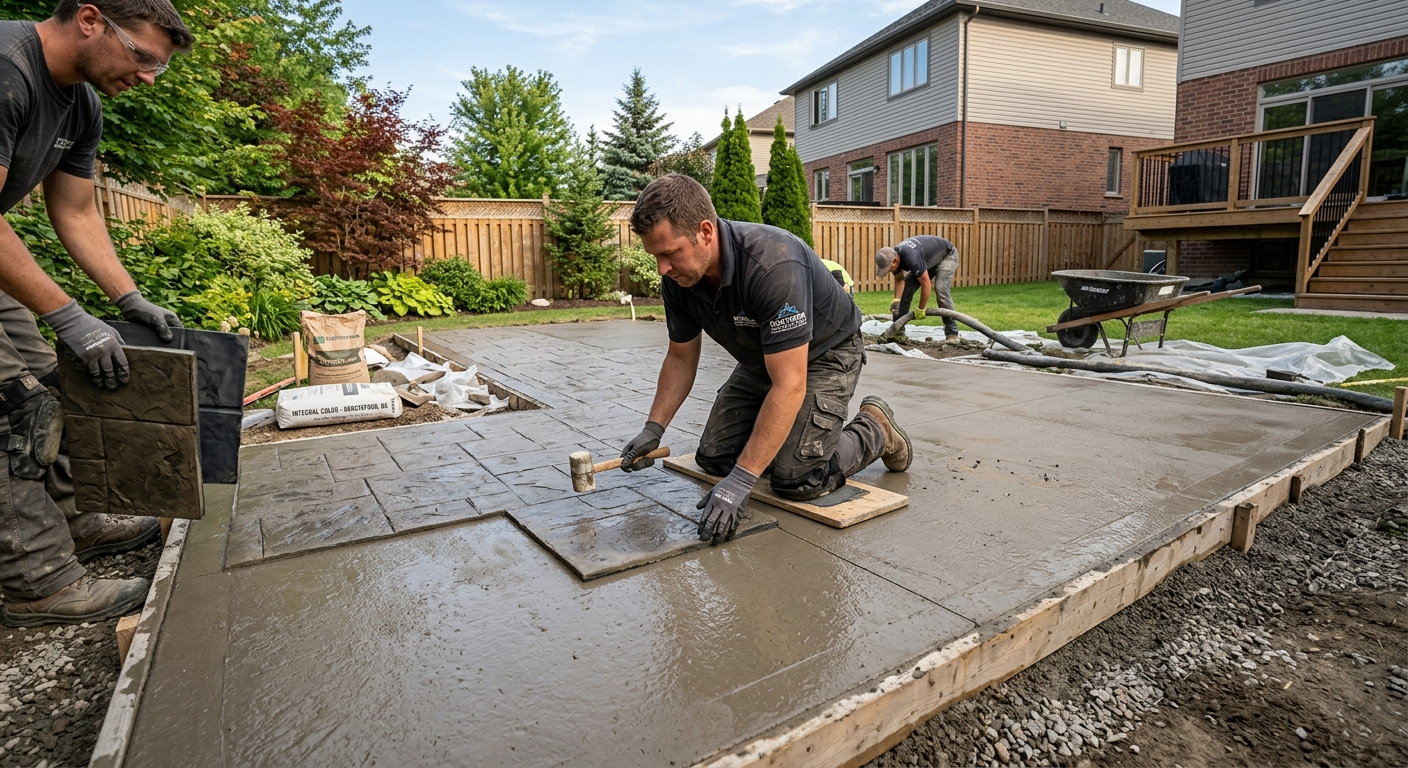
Concrete work options and costs in Kildare
Kildare, Alberta is a small community (population 2,694, Statistics Canada, 2021 Census) where concrete flatwork is a big part of home comfort and curb appeal—especially for the type of housing many buyers expect, including single-detached lifestyle properties that typically need driveways, patios, and walkways built to last. In Calgary’s broader market area, exterior concrete is also in steady demand because homeowners upgrade entryways and backyards year-round, but the actual construction window for quality exterior pours is shaped by the cold continental climate. Calgary’s freeze–thaw cycles are hard on surfaces, so engineered specs matter: contractors in the Calgary region plan for a deeper design frost depth (commonly engineered around about 1.2 m, roughly 4 ft) and they use air-entrained mixes and well-spaced control joints to reduce cracking, spalling, and scaling. The short practical pour season means scheduling and winter-grade curing precautions—insulating blankets, protective enclosures, and sometimes temporary heat—can add labour time and materials. That’s why two homeowners in Kildare can receive quotes that vary noticeably even when the drawings look similar.
In Kildare, demand is often especially strong around established residential pockets where people are adding parking, refreshing front entries, and improving backyard access to basements or garages—projects that rely on properly prepared bases and frost-safe foundation details. Next, compare typical applications, sizes, specs, and finish options in the table below so you can budget with more confidence.
| Application |
Typical Size |
Key Spec |
Finish Option |
Price Range |
| Concrete driveway (standard broom finish) |
400–600 sq ft |
Air-entrained exterior mix, compacted granular base, control joints |
Broom + integral colour (optional) |
$12,000–$18,000 |
| Exposed aggregate driveway |
400–600 sq ft |
Proper curing + aggregate exposure, air-entrained mix, sealed as applicable |
Exposed aggregate |
$14,000–$21,000 |
| Stamped concrete driveway or patio |
300–500 sq ft |
Reinforced slab as needed, air-entrained mix, colouring + release |
Stamps with colour options |
$15,000–$26,000 |
| Plain concrete patio or walkway |
200–350 sq ft |
Compacted base, air-entrained mix, joints at manageable spacing |
Broom finish or light trowel |
$5,000–$9,000 |
| Garage floor (interior slab) |
400–600 sq ft |
Vapour barrier (when required), fibre or mesh reinforcement, proper thickness |
Float/steel trowel (densifier optional) |
$10,000–$15,000 |
| Foundation footings (structural, below frost) |
Per house footprint; often 1–2 storey |
Designed excavation depth to undisturbed soil below frost line, rebar/engineering |
Structural concrete, formwork + labour |
$28,000–$45,000 |
Prices are estimates only and vary by project scope, site access and material selection.
What affects the price of concrete work in Kildare
In Kildare and the Calgary economic region, pricing can swing 30–50% for what looks like the “same” concrete project because concrete is a system—excavation, base preparation, reinforcement, mix design, placement, curing, and finishing all move together. A standard broom-finished driveway isn’t just about the slab thickness; it depends on how far down contractors must excavate to reach undisturbed bearing soil below the design frost depth (engineered around about 1.2 m in this region). That depth requirement tends to increase foundation and footing volumes and drives more labour, hauling, and forming. Freeze–thaw cycles also require air-entrained exterior mixes and a control joint strategy, which increases material and oversight costs. On top of that, the practical pour season is shorter, so cold-weather placement may involve winter-grade mixes and insulated blankets to protect curing—especially in late fall or early spring—adding both labour hours and equipment time. Finally, de-icing salt accelerates surface wear, so many good contractors include (or strongly recommend) sealing.
Concrete prices in Kildare also respond to “small” differences that add up: thicker slabs for heavy vehicles, limited truck access that requires more handwork, or rebar versus mesh based on engineered loads. For example, upgrading from a plain patio/walkway at about $5,000–$9,000 to stamped concrete typically moves you into the higher $15,000–$26,000 range once colouring, stamping labour, and reinforcement/finishing time are included. If the site already has good subgrade and simple access, your broom-finish driveway may land closer to the low end of $12,000–$18,000; if not, expect the quote to rise with extra excavation and base rebuild. Even housing age affects cost: older lots can have unsuitable fill or uneven grades, so you’re paying to correct the base before concrete ever gets poured.
| Price Factor |
Why It Matters |
Cost Impact |
| Frost line depth — determines footing depth and form height |
Exterior slabs/footings must bear below the design frost depth to limit frost heave |
Higher excavation + formwork can add thousands, especially on deeper frost-bearing soils |
| Site preparation — excavation, grading, compacted granular base |
Concrete lifespan depends on a stable, properly compacted base—not just the finished surface |
Unsuitable fill or poor access increases hauling, grading time, and granular supply |
| Reinforcement — rebar or wire mesh requirement |
Controls cracking and supports loads from vehicles, freeze–thaw movement, and settlement |
Rebar tying/placement raises labour; engineered requirements may force heavier steel |
| Mix design — air-entrainment and compressive strength spec |
Air-entrainment is crucial in cold freeze–thaw climates to reduce scaling and spalling |
Higher-spec mixes cost more per cubic yard and require correct placement/curing discipline |
| Finish type — broom vs. stamped vs. exposed aggregate |
Finish affects labour time, curing and finishing steps, and sometimes surface preparation |
Stamped/exposed finishes typically cost more than broom-finished flatwork |
| Pour size and concrete truck access to site |
More volume and limited access can extend placement time and labour intensity |
Narrow approaches may require extra labour and pump/shorter pour sequencing |
| Cold-weather curing precautions — heating and blankets |
Proper curing in cold weather prevents surface scaling and durability loss |
Insulated blankets, heaters, and monitoring can add measurable line-item cost |
| Control joint pattern and sealing cost |
Correct joint spacing reduces random cracking; sealing helps repel de-icing salt |
Better joint layout and sealer add cost but reduce long-term repairs |
Permits & regulations in Alberta
In Alberta, how you handle permits depends on what you’re building. In general, structural concrete work—such as foundation footings, foundation walls, and grade beams—requires a building permit and often engineered drawings that are reviewed as part of the permitting process. Concrete flatwork (patios, walkways, and driveways) usually does not require a permit by itself, unless it affects lot grading, drainage, impervious surface coverage limits, or the municipal right-of-way. Because details vary by site, confirm with the local authority before breaking ground.
For a homeowner in Kildare, use this step-by-step approach to verify your contractor’s credentials in Alberta:
- Start with licensing/registration: Ask the contractor for their applicable Alberta status and check the contractor’s details through the appropriate provincial registries for building trades (if they claim to be a licensed contractor for the scope).
- Request a certificate of insurance: Get current proof of liability insurance (coverage amount and effective dates must be current).
- Confirm workers’ coverage: Ask for WSIB/WCB coverage documentation and ensure it covers the workers who will be on-site.
- Check clearance letters (when applicable): Some scopes and municipalities require proof of standing—ask what they provide for similar projects.
- Verify similar-scale references: Ask for photos and addresses of recent driveway/patio/foundation work in comparable freeze–thaw conditions.
Before you sign, also ask whether permits (if required) are pulled by the contractor or by you—and what’s included in the quote for inspections and documentation.
Getting concrete right in Kildare's freeze-thaw climate
Concrete fails in Kildare mostly for predictable reasons: poor base prep, inadequate air-entrainment, rushed curing, and a finish that can’t handle de-icing salts plus Alberta’s frequent freeze–thaw cycles. To spec the job correctly, start with the base. Contractors should place and compact a granular sub-base to the depth needed for your soil conditions and to support the slab and any exterior structural requirements below frost considerations (often engineered around about 1.2 m in this region). Next, lock in the mix design. For exterior flatwork, specify air-entrainment (commonly targeted in the 5–7% air range for durability in freeze–thaw environments) and a minimum compressive strength such as 32 MPa, so you’re not buying “pretty” concrete that scales and spalls later. Then address cracking. Control joints must be cut or tooled to limit random cracking; spacing matters because jointing is how you tell concrete where to crack. Finally, curing and sealing are where many DIY or budget quotes fall short: plan for at least 7 days of proper curing under safe conditions, and apply a penetrating sealer after the full cure (often around 28 days) to repel de-icing salts.
If you’re choosing between options, here’s a practical value example. Moving from a plain patio/walkway to stamped concrete commonly shifts pricing toward $15,000–$26,000 due to stamping, colouring, and extra finishing steps. That upgrade is justified when you want aesthetics and higher overall craftsmanship, but it doesn’t replace durability specs—air-entrainment, base, joints, and curing must still meet the same freeze–thaw requirements. A “cheap stamp” with weak prep is still likely to crack and deteriorate.
Use these technical questions to avoid the most common failure: spalling from inadequate air-entrainment. Ask your contractor to state the air-entrained mix requirements in writing and confirm curing/blanket plans if temperatures drop.
| Spec |
Why It Matters in Kildare |
What to Ask For |
Impact if Skipped |
| Compacted granular base (depth?) |
A stable base prevents uneven settlement and reduces cracking under freeze–thaw movement |
Base thickness/depth based on site soil conditions and engineered frost considerations |
Early cracking, rocking edges, and increased chance of spalling |
| Air-entrained concrete mix (target air %?) |
Freeze–thaw resistance depends on microscopic air bubbles to manage ice expansion |
State target air content (typically 5–7% for exterior flatwork durability) |
Surface scaling and spalling within a few winters |
| Compressive strength (MPa rating) |
Adequate strength improves durability and load performance |
Minimum 32 MPa (or higher if engineered for your loads) |
Higher wear rate, faster surface degradation |
| Control joints (spacing per ACI guidelines) |
Joints guide cracking and protect appearance and long-term performance |
Joint spacing plan and where joints will be cut/tooled |
Random cracking and wider, harder-to-repair damage |
| Minimum 7-day curing period |
Curing supports proper strength gain—cold weather makes it even more important |
How curing will be protected; winter plans if temps drop |
Weaker surface, increased scaling risk, reduced service life |
| Penetrating sealer (when applied after cure) |
Helps repel salt and moisture that drive spalling in exterior climates |
Sealer type and timing (commonly after about 28 days) |
Faster surface breakdown from de-icing salts |
How to choose a concrete work contractor in Kildare
Choosing the right concrete contractor in Kildare starts with verification and tight paperwork. First, confirm the contractor’s Alberta standing for the scope they’re offering, and request proof of liability insurance plus WSIB/WCB coverage for the people who will work on your site. Don’t accept “we’re covered” verbally—ask for documents with effective dates, coverage limits, and the named insured that matches the contractor on your quote. Then, get 2–3 itemised quotes, not just a single total. You want separate lines for excavation/grading, granular base, reinforcement, concrete supply, finishing, and any protection/curing supplies for cold weather. Good quotes also spell out disposal (removed concrete/soil hauling), and whether a permit is included when required for structural work.
Next, review warranty details. Ask for the workmanship warranty length and what it covers (cracking due to proper curing vs. “cosmetic only”), plus whether manufacturers warranties for materials are transferable to you. Finally, agree on a payment schedule that protects you: never pay more than 10–15% upfront, and hold back a portion until the job is complete, cleaned up, and meets the agreed finish and timing. In this region’s freeze–thaw cycle, timelines matter—get the start date and completion estimate in writing, including how they’ll protect curing if temperatures drop.
- Request proof of liability insurance and confirm it’s current.
- Verify WSIB/WCB coverage for all crew members.
- Ask for a licence/registration reference relevant to the scope in Alberta.
- Get 2–3 itemised quotes with labour and materials separated.
- Confirm whether excavation and granular base are included, and specify base depth.
- Require the mix spec in writing (air-entrainment and strength).
- Ask who supplies reinforcement and whether rebar vs mesh is included.
- Clarify finishing scope: broom/colour, stamping, exposed aggregate steps.
- Confirm control joint layout and whether joints will be sealed (if applicable).
- Ask for the curing/blanket plan for cold nights.
- Make sure disposal/hauling and site clean-up are listed.
- Hold back final payment until measurements, finish quality, and cure protection are confirmed.
In Kildare, avoid contractors who won’t put air-entrainment and curing protection in writing, who cut corners on base prep, who offer stamped/coloured work without discussing joints and sealing, who ask for large upfront payments, or who can’t show recent, comparable driveway/patio durability in Alberta winters.
Frequently asked questions — concrete work in Kildare
Stamped vs broom-finish concrete — cost difference?
In Kildare and the Calgary region, stamped concrete costs more than a broom-finished slab because the finish steps are labour-intensive: colouring, stamping, careful timing, and added finishing attention. A broom-finished driveway typically sits around $12,000–$18,000 depending on size, access, and base depth. Stamped driveways and patios often fall into the higher band of $15,000–$26,000 once colouring, stamping labour, and any extra reinforcement/finishing time are included. The key point: the look upgrade doesn’t replace durability requirements. For exterior work in Alberta freeze–thaw conditions, you still need proper excavation, compacted granular base, air-entrained concrete, and correct control joint spacing—otherwise the stamped surface can still scale and spall over time.
When is the best time to pour concrete in Kildare?
For Kildare exterior concrete, the best timing is when you can maintain good curing temperatures without excessive protection—typically late spring through early fall. Calgary-area freeze–thaw cycles mean cold nights can arrive quickly, and cold-weather curing precautions (insulating blankets, protective enclosures, and sometimes temporary heat) may be necessary to protect the slab while it gains strength. That protection is doable, but it increases labour and materials, which is why quotes can change based on schedule. If a contractor is pushing a pour late in the season with minimal curing plan, that’s a red flag. The practical goal is to keep the first days of curing controlled, because rushing curing raises the risk of surface scaling and long-term durability issues—especially where de-icing salt is used on driveways.
How long does concrete take to cure?
Concrete needs two timelines: strength gain and full cure. As a homeowner in Alberta, plan around at least 7 days of curing before you treat the slab like it’s fully ready for heavier use, assuming normal conditions and temperature protection. Full cure typically occurs closer to 28 days, which is why penetrating sealer is often applied around that point for exterior flatwork to help repel de-icing salts. If you pour in colder weather in Kildare, contractors may use insulated blankets or heat to protect curing—this is part of doing the job correctly, not an upsell. If curing is compromised, the slab may look fine but be more vulnerable to early wear, scaling, and cracking as freeze–thaw cycles continue through winter.
Do I need a permit for concrete work in Alberta?
Often, yes for structural concrete, usually no for simple flatwork, but it depends on what you’re building. In Alberta, foundation footings, foundation walls, and grade beams typically require a building permit and engineered drawings that are reviewed as part of the process. Concrete patios, walkways, and driveways usually do not require a permit unless they affect lot grading, drainage, impervious surface coverage limits, or the municipal right-of-way. For Kildare property owners, the smart approach is to ask your contractor to confirm whether a permit applies to your exact scope and to document what’s included (permit pull vs homeowner responsibility). Also verify the contractor carries liability insurance and WSIB/WCB coverage before work begins.
Concrete vs pavers for a patio in Kildare?
Concrete and pavers can both work well in Kildare, but they behave differently under freeze–thaw. A basic broom-finished patio often lands around $5,000–$9,000, while decorative concrete may cost more depending on finish. Pavers cost can vary widely based on material grade and the base system, and they’re excellent when you want easier spot repairs. Concrete, on the other hand, gives you a monolithic surface and can look sleek—if the base, air-entrainment, joints, and curing are handled correctly. In Alberta’s climate, the biggest determinant isn’t the aesthetic choice; it’s whether you have correct drainage, compacted base prep, and durable freeze–thaw specs. Ask any contractor how they control joints and how they manage curing to reduce cracking and surface scaling.
How long does a concrete driveway last?
A properly built concrete driveway in Kildare can last decades, but performance depends on durability details. In Calgary-area freeze–thaw conditions, driveways are exposed to repeated ice cycles and frequent de-icing salt, which is why air-entrained exterior concrete, correct base prep, and a solid joint pattern matter. Sealing after the slab fully cures (often around 28 days) can help repel salt and slow surface deterioration. If a driveway is built with inadequate air-entrainment or if curing is rushed, you can see early scaling and spalling within a few winters. Typical service life varies widely based on site conditions and maintenance, but the best way to protect your investment is to budget for correct specs—not just a low bid.