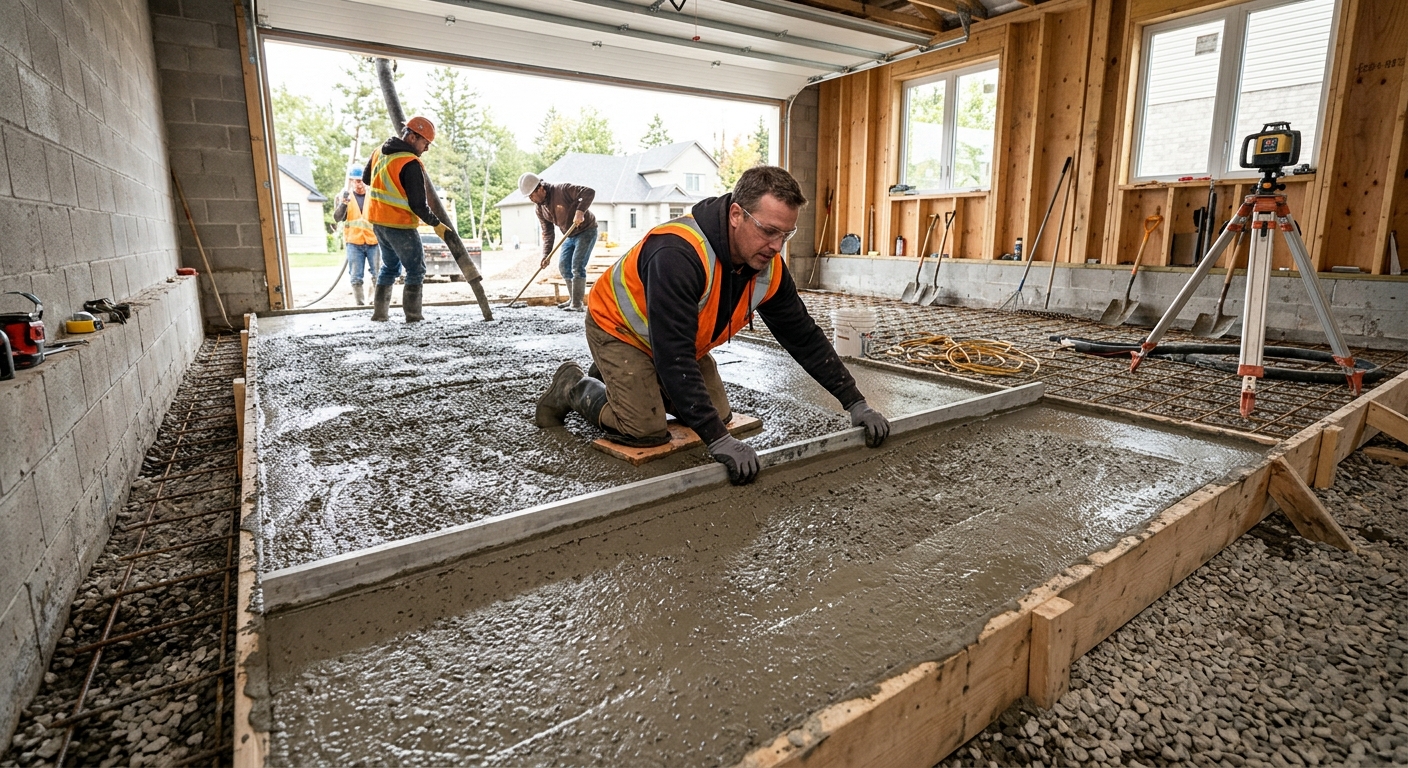
Concrete work options and costs in Garrison Woods
Garrison Woods, Alberta is a great place for durable concrete flatwork, but the climate makes specification and construction sequencing just as important as the finish. In this community of about 2,860 residents (Statistics Canada, 2021 Census), most homeowners rely on concrete driveways, patios, and walkways to handle daily wear—especially as many surrounding homes are tied to single-detached lifestyles that need dependable exterior surfaces. Calgary’s market conditions also influence availability and labour demand; competition is highest around high-turnover neighbourhoods in the region.
Local costs reflect Calgary’s cold continental weather: freeze–thaw cycles and frost depth drive deeper excavation and heavier foundation volumes than many milder areas. Engineering practice in the area uses a design frost depth of about 1.2 m (roughly 4 ft), so footings for houses, garages, decks, and retaining structures must bear on undisturbed soil below that level. That means more sub-base, more hauling, more forming, and more time on site—so even “similar” jobs can separate widely in price. Exterior slabs also need air-entrained concrete mixes, plus tight control joints and proper curing. In late fall and early spring, the pour season can be short, and winter-grade placement (blankets, sometimes heat) can add cost and scheduling pressure.
In Garrison Woods, I see especially strong demand for driveway upgrades and backyard patio slabs where residents are improving curb appeal and creating low-maintenance entertaining spaces. Below is a practical range to help you compare options before you request itemised quotes.
| Application |
Typical Size |
Key Spec |
Finish Option |
Price Range |
| Concrete driveway (standard broom finish) |
480 sq ft (20 ft x 24 ft) |
Air-entrained mix, fibre or rebar as needed |
Broom finish, basic edging |
$12,000 – $18,000 |
| Exposed aggregate driveway |
480 sq ft (20 ft x 24 ft) |
Air-entrained mix, wash-exposed surface |
Exposed aggregate (select stone size) |
$14,000 – $21,000 |
| Stamped concrete driveway or patio |
600 sq ft (e.g., 20 ft x 30 ft) |
Air-entrained mix, release agent system |
Stamped pattern + colour hardener |
$15,000 – $26,000 |
| Plain concrete patio or walkway |
240 sq ft (e.g., 12 ft x 20 ft) |
Proper base, air-entrained mix |
Light broom / smooth trowel (as specified) |
$5,000 – $9,000 |
| Garage floor (interior slab) |
520 sq ft (e.g., 22 ft x 24 ft) |
Vapour control as required, reinforcement |
Broom finish, optional sealer |
$9,000 – $14,500 |
| Foundation footings (structural, below frost) |
Approx. 1,200–1,600 ft of linear footing (project dependent) |
Engineered footing design, below 1.2 m frost depth |
Structural concrete / formwork |
$28,000 – $45,000 |
Prices are estimates only and vary by project scope, site access and material selection.
What affects the price of concrete work in Garrison Woods
In Garrison Woods and the broader Calgary region, it’s normal to see quotes for the “same” driveway or patio swing by 30–50%. The biggest drivers aren’t the concrete itself—they’re excavation depth, base preparation quality, reinforcement decisions, and how a contractor protects curing in cold weather. Two crews can quote the same stamped finish, but if one includes proper granular sub-base and frost-aware detailing (and the other cuts corners), the end result—and the labour time—will be very different.
Calgary’s design frost depth is about 1.2 m, meaning footings must extend below that depth to reduce frost heave and seasonal movement. For exterior slabs, freeze–thaw cycles dictate air-entrained mixes and well-placed control joints to control cracking and spalling. In colder months, the practical pour season tightens, and cold-weather placement often needs insulated blankets and/or temporary heating to reach proper curing. That’s where costs rise quickly: winter-grade mix, additional materials, and labour hours all stack up. Add de-icing salts, which can accelerate surface scaling when the surface isn’t sealed or the concrete isn’t properly air-entrained.
Here are a few real ways conditions in Garrison Woods change cost. First, a backyard patio on well-drained, undisturbed soil usually prices closer to the lower end of the patio band (about $5,000–$9,000). Second, the moment you’re doing heavier excavation to meet frost-safe base depth—or hauling out unsuitable soil—your foundation/footing scope can move toward the higher end of $28,000–$45,000. Third, if you’re upgrading from broom-finish to stamped or exposed aggregate, the surface system and crew time are higher, which is why decorative projects tend to land around $15,000–$26,000 depending on area and detailing.
| Price Factor |
Why It Matters |
Cost Impact |
| Frost line depth |
Footings must extend below the design frost depth to reduce frost heave |
Can add thousands where extra excavation and form height are required |
| Site preparation |
Excavation, grading, and compacted granular base affect settlement and cracking |
Higher on sloped lots, poor soils, or long material-haul distances |
| Reinforcement |
Rebar or wire mesh controls shrinkage cracking and supports loads |
Cost increases if structural reinforcement is required rather than “light” mesh |
| Mix design |
Air-entrainment and specified compressive strength improve freeze–thaw durability |
Upcharge for winter placement and engineered mix specs |
| Finish type |
Broom vs. stamped vs. exposed aggregate changes labour and materials |
Stamped/exposed typically pushes decorative work toward the higher band |
| Pour size and concrete truck access |
Large pours need efficient pumping/placing; access affects handling time |
Hard access can increase labour and pump/boom costs |
| Cold-weather curing precautions |
Heating, insulated blankets, and protection protect curing in low temperatures |
Can materially raise exterior slab costs in late fall/early spring |
| Control joint pattern and sealing cost |
Joints manage cracking; sealing helps repel salts and moisture |
Better spec reduces long-term spalling risk and maintenance |
Permits & regulations in Alberta
In Alberta, structural concrete work such as concrete footings, foundation walls, and grade beams typically requires a building permit, and engineered drawings are commonly required for review by the municipality. Concrete flatwork—like patios, walkways, driveways, and garage slab work—often does not require a permit by default. That said, permits can become necessary when the project affects lot grading, drainage, impervious surface coverage limits, or anything involving municipal right-of-way or elevations near property lines. Because every lot is unique, you should confirm requirements with the local authority before any excavation begins in Garrison Woods.
Before signing, verify the contractor is properly insured and accountable. Step-by-step: (1) confirm the company is licensed/registered where applicable for their scope (many concrete contractors work under trade contracting structures rather than a “concrete licence” alone); (2) request a current certificate of liability insurance naming you as the certificate holder if possible; and (3) ask for WSIB/WCB clearance or coverage evidence as applicable to their employees and subcontractors. You can also ask the contractor for documentation copies and check for clearance letters, expiry dates, and matching business name details.
Finally, insist on references for similar jobs in Calgary’s freeze–thaw conditions—driveways and exterior slabs are where curing and air-entrainment details get tested first. If a contractor can’t explain their footing depth logic (below the design frost depth) or their curing approach for cold weather, treat it as a red flag.
Getting concrete right in Garrison Woods's freeze-thaw climate
Concrete failures in Garrison Woods usually trace back to three things: poor base preparation, inadequate mix durability, and rushed curing. In our cold continental climate, freeze–thaw cycles push water through pores and along joints. If the concrete isn’t designed with the right air content, that internal pressure isn’t relieved, and you’ll see spalling or scaling after a few seasons—especially where de-icing salts are used. The good news is that you can spec the work to handle it.
Start with base preparation: compacted granular sub-base to the required depth for local soil conditions and frost considerations. For exterior slabs, the mix should be air-entrained (commonly 5–7% air content for exterior flatwork) and specified for a minimum 32 MPa compressive strength so it meets structural and durability expectations. Next, control joints: they should be cut or tooled on a consistent pattern so cracks happen where you want them. Curing is equally critical—aim for at least 7 days of proper curing under suitable protection conditions, particularly when temperatures dip. Finally, plan for sealing: a penetrating sealer applied after the concrete has cured (often at 28 days) helps repel moisture and de-icing chemicals.
Here’s where the price difference is justified. If you’re choosing between a lower-cost “broom finish only” driveway and a properly engineered exterior mix plus sealing, it can be the difference between repairs later and a surface that lasts. For example, a basic driveway might land around $12,000 – $18,000, while an upgraded spec with better base prep and protective curing practices can push you toward the higher end. That premium is often less than replacing a cracked and scaling section after freeze–thaw damage.
| Spec |
Why It Matters in Garrison Woods |
What to Ask For |
Impact if Skipped |
| Compacted granular base (depth?) |
Reduces settlement and helps manage moisture movement under freeze–thaw |
Confirm excavation depth, geotech assumptions, and compacted granular base thickness |
Uneven settlement, cracking, and premature surface failure |
| Air-entrained concrete mix (target air %?) |
Relieves freeze–thaw pressure and reduces scaling/spalling risk |
Ask for target air content (commonly 5–7% for exterior flatwork) and mix design documentation |
Higher chance of spalling in Alberta winters, especially with salts |
| Compressive strength (MPa rating) |
Supports durability and structural performance of the slab |
Ask for minimum 32 MPa (or engineered spec if structural) |
Weaker concrete, increased wear and cracking |
| Control joints (spacing per ACI guidelines) |
Directs shrinkage cracking and prevents random cracking paths |
Ask for joint layout/spacing and whether joints will be saw-cut or formed |
Random cracking and water ingress into slab edges |
| Minimum 7-day curing period |
Ensures strength gain and reduces early-age damage |
Confirm curing method and protection schedule for the temperatures on pour day |
Surface scaling, reduced strength, and long-term durability loss |
| Penetrating sealer (when applied after cure) |
Helps repel de-icing salts and moisture in freeze–thaw conditions |
Ask for penetrating sealer application after full cure (often around 28 days) |
Faster deterioration and higher maintenance cycle |
How to choose a concrete work contractor in Garrison Woods
Choosing the right contractor in Garrison Woods is mostly about proof, not promises. Start by verifying Alberta coverage requirements. Ask for: (1) liability insurance certificate (check limits, business name match, and expiry date), (2) WSIB/WCB coverage evidence or clearance letter for their workers, and (3) confirmation they can provide documentation for subcontractors too—because gaps in coverage are where homeowners get stuck. If a contractor can’t produce paperwork quickly, move on.
Next, get 2–3 itemised written quotes. I recommend itemising labour and materials separately (concrete mix class, air-entrainment spec, reinforcement type, base prep depth/aggregate, joints, forms, sealing) rather than a vague lump sum. Ask whether the quote includes permit pulls (for structural work) and includes disposal/haul-away. Scope exclusions—like “soil conditions not included” or “base depth by others”—can swing your final price by thousands.
Warranty matters in Alberta’s freeze–thaw world. Ask for the workmanship warranty length, what it covers (cracking that results from workmanship vs. normal shrinkage), and whether product/manufacturer warranties apply to sealers or admixtures. Also ask if warranties are transferable if you sell the home.
For payment, avoid large up-front deposits. A good rule is never more than 10–15% upfront, and hold back a portion until completion and final inspection items are done. Finally, require a clear start date and completion estimate in writing—concrete schedules get disrupted by weather, so you want the plan documented.
- Request current liability insurance and confirm limits and effective dates.
- Ask for WSIB/WCB clearance/coverage proof and verify it’s current.
- Get an itemised breakdown (labour, concrete, base materials, reinforcement, joints, sealing).
- Confirm excavation and compacted base depth is included, not “allowance-based only.”
- Ask what mix design is being used for air-entrainment and strength (exterior vs interior).
- Verify reinforcement plan: mesh vs rebar vs engineered structural details.
- Confirm joint pattern and whether joints are saw-cut to match the plan.
- Ask how cold-weather curing will be handled if temperatures are borderline.
- Confirm curing protection method (blankets/heaters if needed) and responsibility for delays.
- Clarify whether sealing is included and when it’s applied (after full cure).
- Make sure site access constraints (pumping/boom/finish logistics) are included or priced transparently.
- Ensure disposal/haul-away and any required reinstatement (topsoil/seed/sod) are specified.
Concrete red flags I watch for in Garrison Woods: vague quotes that don’t specify base depth or air-entrainment; refusal to provide insurance/WSIB/WCB documentation; “cheap” pricing that relies on thin base prep; no plan for curing protection in cold snaps; and contractors who cut control joints after the fact or don’t discuss sealing with de-icing salts.
Frequently asked questions — concrete work in Garrison Woods
What is air-entrained concrete and why does it matter here?
Air-entrained concrete is mixed with microscopic air bubbles designed to give freeze–thaw ice expansion somewhere to go. In Garrison Woods and across Alberta, the freeze–thaw cycle is relentless, and water gets into pores and along minor cracks. Without proper air entrainment, pressure builds during freezing, leading to surface scaling and eventual spalling—often worst where homeowners use de-icing salt on driveways and steps. That’s why qualified contractors specify air-entrainment for exterior flatwork and don’t treat it as optional. In price terms, the exterior driveway band of $12,000 – $18,000 assumes proper mix durability and exterior detailing, not just “plain” concrete. For cold-weather pours, the spec and curing protection matter even more to get strength gain before the temperature drops.
How do I prepare the base for a concrete slab?
Base preparation is the foundation of a good slab—literally. For patios, walkways, and driveways in Garrison Woods, your contractor should excavate to the planned elevation, remove unsuitable material, and then install compacted granular sub-base to support the slab and manage moisture movement. Compaction is key: it reduces settlement and helps the slab resist cracking through freeze–thaw seasons. Ask your contractor what base depth they’re building to and what material they’re using (often clean granular base in layers). Good quotes also spell out grading so water doesn’t pond near the slab edges. If the area has soft spots, heavy clay, or a slope, expect deeper excavation and more granular fill—this is one of the big reasons bids can vary 30–50%. Proper base prep is one of the best ways to protect your slab without needing expensive repairs later.
How do I compare concrete quotes?
Compare quotes like you’d compare building envelopes: look past the totals and confirm the scope. For exterior work in Alberta, ensure each quote specifies the same (1) concrete mix type and durability requirements (including air-entrainment), (2) reinforcement plan (mesh vs rebar vs engineered requirements), (3) compacted base depth and granular materials, (4) joint pattern (spacing and whether saw-cut is included), and (5) curing and protection methods for cold weather. Also check whether sealing is included, and when it will be applied—sealers are typically done after cure. Make sure haul-away/disposal and any site restoration (topsoil, seeding) are included, not left as “allowance.” If you’re comparing a standard driveway to stamped concrete, the decorative band of $15,000 – $26,000 usually reflects extra materials and labour time. A well-written itemised quote will make these differences clear before you sign.
Can concrete be poured in cold weather in Garrison Woods?
Yes, concrete can be poured in cold weather in Garrison Woods, but it must be engineered and protected to reach proper strength gain. In Calgary’s region, temperatures can drop quickly, and the freeze–thaw cycle becomes a risk to early-age concrete. Contractors typically use cold-weather practices such as winter-grade mixes, insulated blankets, and sometimes temporary heat, while closely monitoring curing conditions. The key is that curing needs to happen consistently—rushing the cure increases the risk of scaling and long-term durability issues. Ask your contractor what the plan is if temperatures fall below the recommended placement/curing range and who is responsible for monitoring. If you’re late in the season, scheduling can matter as much as materials. A good quote should mention curing protection steps, not just a promise to “pour anyway.” That’s where dependable contractors stand out.
How do I maintain concrete in Garrison Woods's freeze-thaw climate?
Maintenance is about keeping water and salts from attacking the surface. In Garrison Woods and throughout Alberta, the freeze–thaw cycle plus de-icing salt is a common combination that drives spalling and scaling. If your driveway or patio is exterior flatwork, ask for a penetrating sealer once the concrete has cured (commonly around 28 days). Reapply sealer on a schedule recommended by the product—timing depends on traffic, salt use, and exposure. For winter, use de-icers carefully: sand is often safer for the surface than aggressive salts, and shovelling promptly reduces salt saturation time. Regular sweeping prevents debris from trapping moisture at joints. Also watch for joint sealant failure around slab edges and address it early—small water paths become bigger freeze–thaw problems. If you follow those steps, concrete that’s built with air-entrainment and good joints typically outlasts cheaper alternatives.
What causes concrete to spall in Garrison Woods winters?
Concrete spalling in Alberta winters is usually a durability issue triggered by freeze–thaw and salt exposure. The most common causes are inadequate air-entrainment, excessive water in the mix, insufficient curing protection, and poor surface sealing—especially on exterior driveways and steps. When concrete has the wrong mix or isn’t cured long enough in the cold, it develops a weaker surface layer that can’t resist the internal expansion from freezing water. Salts then intensify the problem by increasing moisture movement at the surface and along microcracks. Poor base prep can also contribute indirectly by allowing slab movement, which opens joints and accelerates water intrusion. If you’re seeing early spalling, it’s often worth reviewing whether the original scope included a proper exterior mix spec and whether joints and sealing were done correctly. In many cases, a properly engineered driveway within the $12,000 – $18,000 band lasts far longer than a cut-price approach that skips durability details.