Concrete work options and costs in Edmonton
In Edmonton, concrete work is a year-round need, and the typical homeowner focus is usually on driveways, patios, and walkways—especially since 49.6% of local dwellings are single-detached homes. With 252,150 homeowner households (63.6% of households own), there’s steady demand for resurfacing and new flatwork as properties age, and Edmonton’s climate quickly exposes any weak spot in base preparation, drainage, or joint layout.
Pricing in Edmonton tends to be higher than milder regions because frost depths are commonly designed around 1.5 m or more. That means residential footings must extend below the local frost line to avoid frost heave, and exterior slabs are poured with air-entrained mixes to survive repeated freeze–thaw cycles across late fall, winter, and spring. The market also compresses the exterior pour window into late spring through early fall, so scheduling can bring labour premiums when crews are booked tight. If your home is in an older neighbourhood—Edmonton has a sizeable older housing stock, with 40.5% of homes built before 1981—retrofits often involve more excavation and coordination around existing utilities and mature landscaping.
Because driveway and slab failures are expensive to correct, Edmonton customers typically choose specs that prevent spalling and random cracking rather than chasing the lowest price. Below is a practical cost comparison to help you frame your project before you request itemised quotes.
| Application |
Typical Size |
Key Spec |
Finish Option |
Price Range |
| Concrete driveway (standard broom finish) |
18 m x 3.5 m (approx. 63 m²) |
Air-entrained concrete, compacted granular base, joints + sealant |
Broom finish |
$9,000–$18,000 |
| Exposed aggregate driveway |
18 m x 3.5 m (approx. 63 m²) |
Air-entrained mix, proper curing, mechanical/exposed aggregate finish |
Exposed aggregate |
$12,000–$22,000 |
| Stamped concrete driveway or patio |
15 m x 3.0 m (approx. 45 m²) |
Reinforcement as required, air-entrained concrete, integral colour |
Stamped pattern + sealer |
$12,000–$26,000 |
| Plain concrete patio or walkway |
3 m x 6 m (approx. 18 m²) |
Compacted granular base, air-entrainment, control joints |
Float/smooth + broom or light texture |
$3,500–$9,000 |
| Garage floor (interior slab) |
20 m x 10 m (approx. 20 m²) |
Vapour barrier as applicable, reinforcement, proper curing |
Steel trowel or broom-light texture |
$3,800–$10,500 |
| Foundation footings (structural, below frost) |
Typical single-detached footing system (project-dependent) |
Excavation to frost depth, formwork, rebar, engineered dimensions |
Structural concrete with inspection/engineering as required |
$25,000–$60,000 |
Prices are estimates only and vary by project scope, site access and material selection.
What affects the price of concrete work in Edmonton
In Edmonton, two quotes for what looks like the same concrete job can vary by 30–50% once you price in the real “cold-climate” details. In practice, the difference is usually not the concrete itself—it’s frost-aware excavation depth, the quality of the granular base, reinforcement decisions, and how aggressively the contractor plans for Edmonton’s freeze–thaw cycles. Edmonton’s older housing stock also matters: with 40.5% of homes built before 1981, many projects involve removal of older slabs, landscaping restoration, and tie-ins to existing grades, which increases labour and disposal.
The local frost-line requirement is a major driver. Footings and any frost-susceptible exterior elements need to be placed below the design frost depth (commonly designed around 1.5 m or more in Alberta) to prevent frost heave. For exterior slabs—driveways, patios, and walkways—air-entrained mixes are non-negotiable to reduce spalling during repeated expansion and contraction. Edmonton also has a shorter practical pour season for flatwork, so winter or shoulder-season work needs insulated blankets and heated enclosures to cure properly; that added cold-weather protection can move a typical broom-finish driveway from the lower end of the $9,000–$18,000 band toward the upper end.
Concrete finishing adds another swing. Stamping or exposed aggregate demands additional labour and materials, so you might see driveway or patio pricing move into the $12,000–$26,000 range—worth it when you want appearance, but not justified if you mainly care about durability. A practical example: if your grade is off and drainage directs water toward a foundation, correcting grading and drainage (and compacting the right granular base depth) is usually the cheaper fix compared to sealing and redoing the slab later.
| Price Factor |
Why It Matters |
Cost Impact |
| Frost line depth — determines footing depth and form height |
Deeper foundations resist frost heave and must be constructed below the design frost depth |
Higher excavation + more formwork; can materially increase total scope |
| Site preparation — excavation, grading, compacted granular base |
Freeze–thaw damage starts when water can’t drain and base isn’t compacted |
More base depth/hauling increases labour and disposal costs |
| Reinforcement — rebar or wire mesh requirement |
Controls cracking and improves load capacity on exterior flatwork |
Material + placement labour; increases cost but reduces failures |
| Mix design — air-entrainment and compressive strength spec |
Air entrainment (commonly 5–7% for exterior flatwork) reduces spalling in cold climates |
Ready-mix differences can add a moderate material premium |
| Finish type — broom vs. stamped vs. exposed aggregate |
Finish layers and labour time vary widely |
Stamps and exposed aggregate typically add significant labour/material |
| Pour size and concrete truck access to site |
Smaller pours and difficult access can mean extra labour or more staging time |
May add truck wait time, pumping or handwork charges |
| Cold-weather curing precautions — heating and blankets |
Proper cure is harder in Edmonton’s early/late season temperatures |
Can increase costs noticeably, especially for exterior work |
| Control joint pattern and sealing cost |
Joints manage shrinkage and movement; sealing repels de-icing salts |
More cutting/sealing adds line items, but reduces premature deterioration |
Permits & regulations in Alberta
In Alberta, permits and design reviews depend on what you’re building and how structural the work is. Structural concrete work—such as footings, foundation walls, and grade beams—requires a building permit and often engineered drawings that the municipality reviews as part of the permit process. Concrete flatwork like patios, walkways, and driveways usually does not require a permit unless it affects lot grading, stormwater management, impervious surface coverage limits, or municipal right-of-way conditions. Even when a permit isn’t required, your contractor should still coordinate with local requirements for drainage and access.
To verify your contractor in Edmonton, use a simple, step-by-step check before work starts:
- Confirm insurance: Ask for a current certificate of liability insurance. Make sure the coverage dates are valid and the limits are appropriate for construction work.
- Check WCB/WSIB coverage: In Alberta, verify workers’ compensation coverage documentation (or provide proof they are registered and in good standing).
- Look for licence/compliance: Verify the contractor’s business information through Alberta’s online public records where applicable, and confirm they can legally perform the type of work quoted.
- Ask for project references: Request recent Edmonton-area references for similar-scale concrete jobs, especially exterior flatwork.
- Match scope to permit needs: If you’re doing foundations/footings, require permit and inspection details in writing.
Bottom line: if the work ties into the structural system (footings/walls/beams), plan on permits. If it’s typical flatwork (patio/driveway/walkway), permits are less common—but drainage and grading rules still matter.
Getting concrete right in Edmonton's freeze-thaw climate
Concrete failures in Edmonton almost always come back to water, movement, and curing. Freeze–thaw cycles pull moisture in and out of the slab and base. If the granular base isn’t compacted to the right depth, or drainage routes water the wrong way, the slab can heave or crack. If the concrete isn’t properly air-entrained, trapped water expands during freezing and can cause surface spalling—one of the most common exterior problems we see on driveways and walkways.
To spec a durable Edmonton job, focus on five areas. First, base preparation: build a well-compacted granular sub-base sized for frost protection and your site conditions. Second, mix design: exterior flatwork should use air-entrained concrete with a target air content commonly in the 5–7% range and a minimum compressive strength of 32 MPa (project specs may be higher for heavier loads). Third, control joints: Edmonton slabs need correctly spaced joints to steer cracking where it’s least visible and most serviceable. Fourth, curing: plan for at least 7 days of proper curing conditions, and when cold nights arrive, cold-weather measures (insulating blankets and/or heated enclosures) help prevent early strength loss. Fifth, sealing: apply a penetrating sealer after the slab reaches cure—typically around 28 days post-pour—to repel de-icing salt and reduce moisture ingress.
Is the “extra” worth it? Often yes. For example, paying more for air-entrained exterior concrete and correct joint spacing is usually far cheaper than replacing a cracked driveway. If your base and joints are wrong, you can spend thousands chasing fixes; a properly built driveway in the $9,000–$18,000 band can last for years with routine sealing.
| Spec |
Why It Matters in Edmonton |
What to Ask For |
Impact if Skipped |
| Compacted granular base (depth?) |
Helps control frost movement and prevents water pumping under the slab |
Specify base thickness, granular type, and compaction method/verification |
Heaving, voids, and premature cracking |
| Air-entrained concrete mix (target air %?) |
Reduces freeze–thaw spalling risk during Edmonton winters and shoulder seasons |
Target air content commonly 5–7% for exterior flatwork (confirm on ticket) |
Surface scaling/spalling and faster deterioration |
| Compressive strength (MPa rating) |
Ensures adequate strength gain for Edmonton’s service conditions |
Minimum 32 MPa (or higher if your engineered design/load requires) |
Lower durability and increased cracking risk |
| Control joints (spacing per ACI guidelines) |
Controls shrinkage and movement so cracks don’t go random |
Joint spacing and whether joints will be cut on schedule |
Random cracking and more water ingress |
| Minimum 7-day curing period |
Cold spells can slow strength gain and increase surface damage |
Curing plan, including cold-weather protection if needed |
Weak surface, scaling, and early failure |
| Penetrating sealer (when applied after cure) |
Helps resist de-icing salt and moisture penetration |
Specify sealer type and application timing (around 28 days post-pour) |
More salt damage and reduced slab life |
How to choose a concrete work contractor in Edmonton
Choosing the right concrete contractor in Edmonton starts with verifying they can legally and safely perform the work—and that their paperwork matches what you’re paying for. First, confirm Alberta compliance by requesting proof of liability insurance (current certificate of insurance) and workers’ compensation coverage documentation. Next, ask for clear proof they’re registered and in good standing with workers’ compensation for their employees. Don’t accept verbal assurances; request the documents before signing.
Then get 2–3 itemised written quotes that break down labour and materials. You’re looking for line items like excavation, granular base and compaction, reinforcement (if included), formwork, concrete supply, finishing, saw cutting/control joints, disposal/hauling, and—if you want it—sealing. Make sure the scope clearly states what’s included and what’s excluded: permit pull (if required), winter protection/heating, pump services, backfill type, and restoration of sod/landscaping. Also verify the quote includes any required engineering/inspection coordination when doing structural elements.
Warranty matters in Edmonton freeze–thaw conditions. Ask for (1) workmanship warranty length, (2) product/manufacturer warranty details for sealers/finishes, and (3) whether any warranty is transferable to the next owner. For payment, never pay more than about 10–15% upfront. Use a holdback until the job is complete and clean-up is done, and confirm start date plus completion estimate in writing.
- Provide proof of liability insurance (with valid dates and coverage limits).
- Provide workers’ compensation coverage documentation.
- Show Edmonton-area references for similar exterior flatwork or foundations.
- Use itemised quotes with separate labour/material/disposal lines.
- Confirm who pulls permits for structural foundation work (if required).
- Specify base depth, granular type, and how compaction will be verified.
- Ask for concrete air-entrainment confirmation on the concrete ticket.
- Confirm reinforcement (rebar/wire mesh) is included where appropriate.
- Ask about control joint spacing and the cutting schedule.
- Ask the curing plan for cold nights and mention insulated blankets/heating if needed.
- Confirm sealing timing (typically around 28 days post-pour) if included.
- Verify payment schedule: small deposit, then progress payments with holdback.
Concrete red flags in Edmonton include: quotes that don’t mention air-entrainment for exterior flatwork, no clear plan for frost-aware base prep, missing joint/cutting timelines, unusually fast “cheap” schedules that ignore curing needs, and contractors who won’t provide insurance/WCB documentation or itemised scope.
Frequently asked questions — concrete work in Edmonton
Why does concrete crack in Edmonton and how is it prevented?
Cracking in Edmonton is mainly about shrinkage, thermal movement, and water. When freeze–thaw cycles drive moisture in and out, weak bases or poor drainage can let the slab lift and settle, increasing stress. Even properly built slabs can develop cracks as they shrink, but good work prevents random cracking by using the right control joint pattern and timing. Ask your contractor how they’ll handle base preparation and compaction before the pour, because a poorly compacted granular layer often shows up later as cracking or heaving. You should also confirm air-entrainment for exterior slabs and specify curing practices; in cold conditions, early strength gain matters. If you’re budgeting, a standard broom-finish driveway commonly lands in the $9,000–$18,000 band, but the cheapest quote usually skips the details that control cracking.
Stamped vs broom-finish concrete — cost difference?
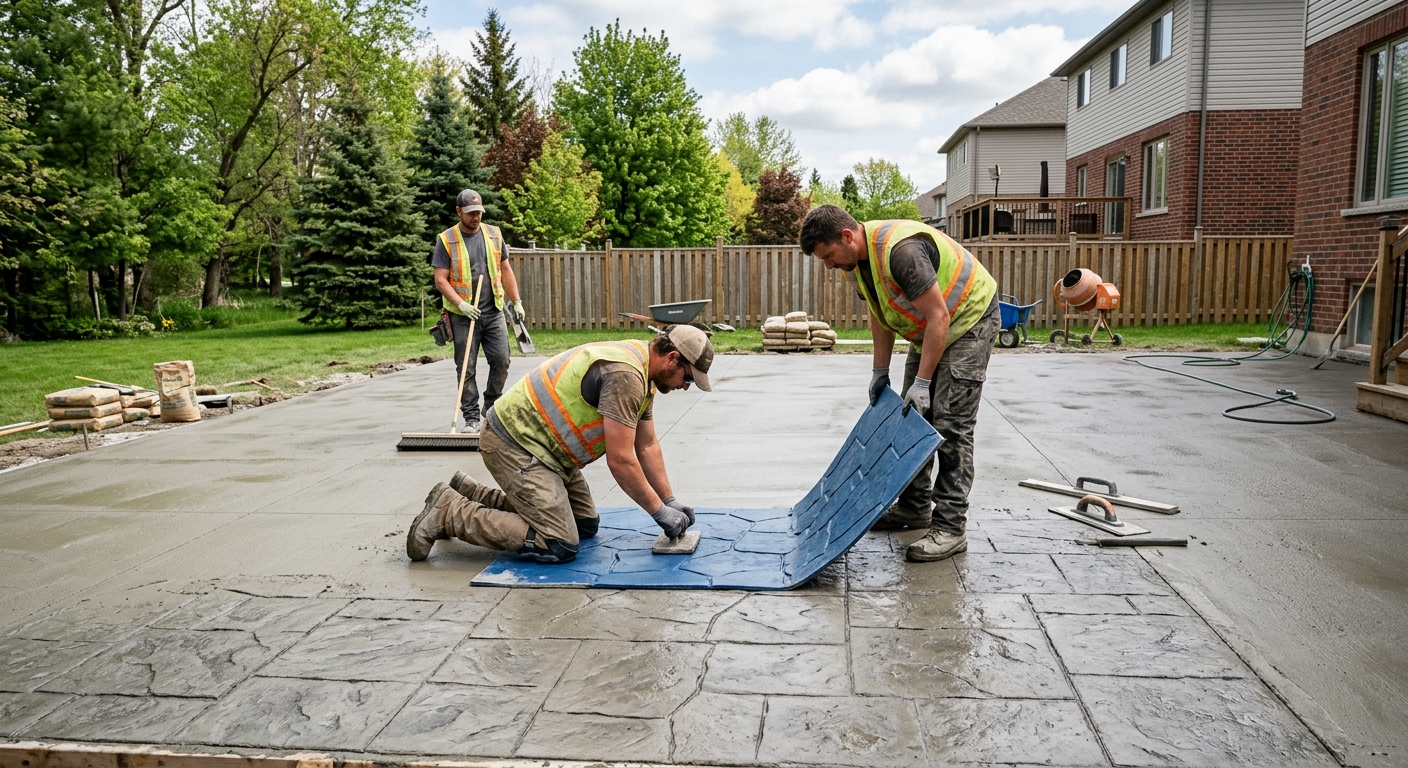
Stamped concrete costs more than broom-finish because the process includes extra steps: integral colour, stamping mats, release agent, and additional finishing/sealing time. In Edmonton, exterior durability still requires the same frost-aware base prep and freeze–thaw protective mix design, so you’re paying for appearance work on top of the structural essentials. As a practical reference, driveway or patio stamped options often run in the $12,000–$26,000 range depending on size and complexity, while a standard broom-finish driveway typically falls around $9,000–$18,000. Stamped looks great, but it’s not a substitute for proper joints and air-entrainment—skip those and you can still get spalling and cracking. If you want longevity first, start by ensuring the quote fully covers base, joints, reinforcement (if needed), curing, and sealing.
When is the best time to pour concrete in Edmonton?
The best time for concrete flatwork in Edmonton is usually late spring through early fall when air temperatures support proper curing. Pouring too early or too late increases the chance of slow strength gain or surface damage, especially during cold nights. That’s why many contractors build schedules around Edmonton’s freeze–thaw swing and plan cold-weather protection if there’s a risk—like insulated blankets or heated enclosures. If your project can wait, scheduling in a steadier temperature window often reduces cold-weather labour and material premiums. That said, foundation and footing work may happen on different timelines depending on permit/engineering readiness. For any exterior slab, ask the contractor to describe their curing plan and temperature precautions in the written quote, not just “we’ll cover it.”
How long does concrete take to cure?
Concrete curing is time-dependent and temperature-dependent. For most exterior projects in Edmonton, contractors should plan for at least a 7-day curing period where the slab stays protected and conditions are suitable for strength gain. However, many homeowners notice the bigger “performance milestone” at later curing—sealing is typically applied around 28 days post-pour with a penetrating sealer. That timing matters because Edmonton’s winters involve de-icing salts and repeated moisture cycling, and a properly cured, sealed surface resists salt-driven deterioration better. If cold weather hits, the cure schedule can require additional protection (blankets/heating) to reach the strength needed safely. When you receive a quote, make sure it states the curing duration and whether they include cold-weather measures if temperatures drop.
Do I need a permit for concrete work in Alberta?
In Alberta, permits generally depend on whether the concrete is structural or just exterior flatwork. Structural items such as footings, foundation walls, and grade beams typically require a building permit and often engineered drawings reviewed through the municipal process. Concrete flatwork like patios, walkways, and driveways often does not require a permit, unless it affects lot grading, stormwater/drainage compliance, impervious surface limits, or municipal right-of-way conditions. Before breaking ground in Edmonton, confirm the requirement with your contractor and the local authority—misunderstandings here can delay schedules. Also verify the contractor’s paperwork: they should carry liability insurance and workers’ compensation coverage and be able to show you how permit responsibility is handled where required. If the scope includes foundation work, don’t assume “it’s just concrete”—assume you’ll be in permit territory.
Concrete vs pavers for a patio in Edmonton?
Concrete and pavers both work for patios in Edmonton, but they fail differently. Concrete (when built with an Edmonton-ready granular base, air-entrained mix, correct joints, and proper curing) tends to crack in controlled ways and can be sealed for salt and moisture resistance. Pavers can handle some movement better at the surface, but they still require excellent sub-base and drainage; without proper base prep, you can get settlement and weed growth between units. Cost can be comparable or different depending on excavation depth, pattern complexity, and the number of transitions (steps, edging, and tie-ins). As a pricing anchor, a plain concrete patio or walkway is commonly in the $3,500–$9,000 band, and stamped/coloured options go higher. Ask both options to show you the base spec, joint/drainage approach, and how they handle Edmonton’s freeze–thaw moisture movement.