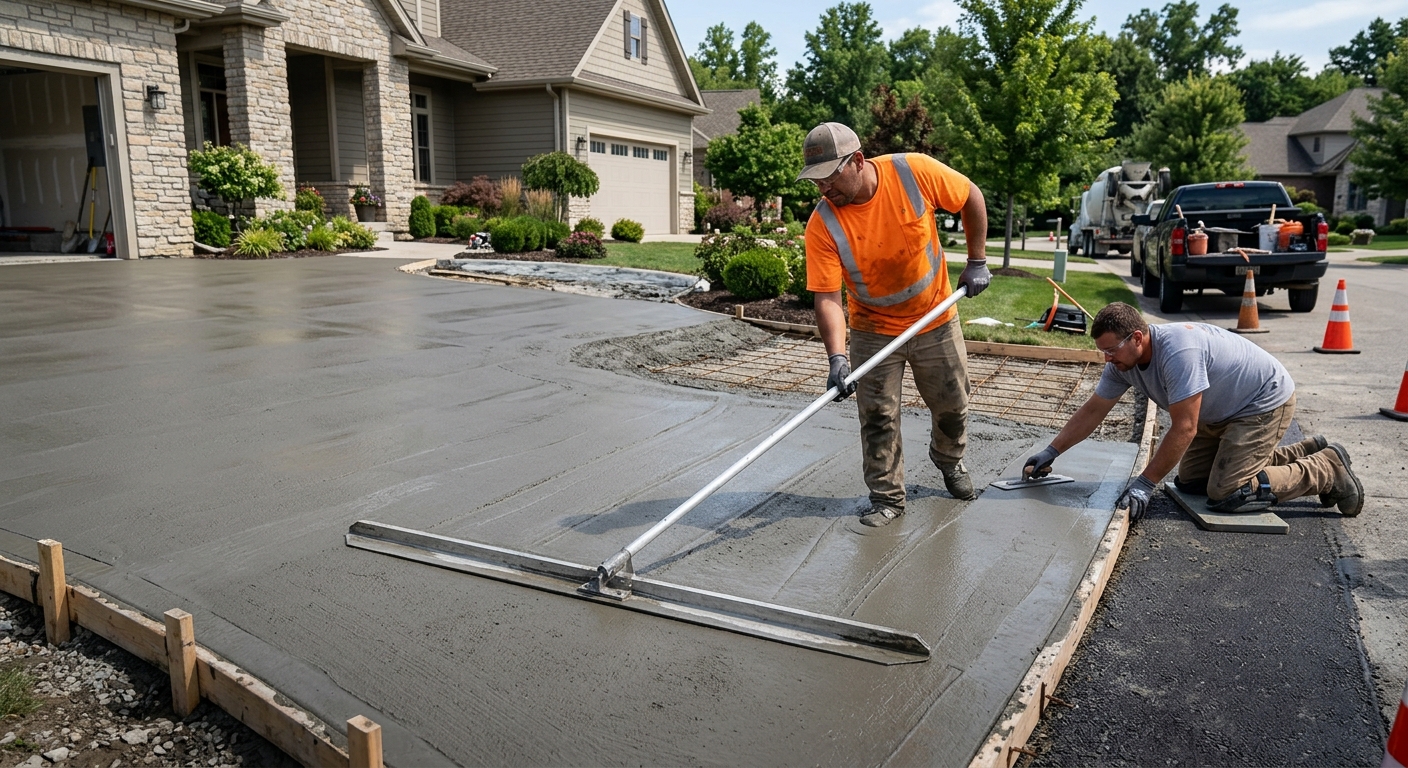
Concrete work options and costs in Jackson Heights
Jackson Heights, Alberta is a small community where concrete flatwork is a big part of how homes stay functional through the winter. In 2021, Jackson Heights had a population of 3,911 (Statistics Canada, 2021 Census), and the local housing mix includes many single-family properties that typically need driveways, patios, walkways, and sometimes interior garage slabs. In the Calgary area, a good portion of households are set up for regular exterior upgrades—so trades are busy during the short exterior pour season.
Calgary’s cold continental climate drives the way contractors price and engineer concrete. With a design frost depth of about 1.2 m (roughly 4 ft), footings for garages, decks, and retaining-type concrete elements must sit on undisturbed soil below that depth to reduce frost heave. Freeze–thaw cycles also mean exterior concrete needs air-entrained mixes, proper drainage, and a well-planned control joint layout. Because the curing window matters, late-fall and early-spring pours can require insulated blankets or temporary heat—costs that don’t show up in milder regions.
In Jackson Heights, demand is especially strong around residential pockets with frequent driveway and patio renewals, including areas like the older established streets near the community core where homeowners tend to upgrade aging flatwork before the next winter cycle. Next, here’s how common options typically price out so you can compare quotes apples-to-apples.
| Application |
Typical Size |
Key Spec |
Finish Option |
Price Range |
| Concrete driveway (standard broom finish) |
24 ft x 10 ft (240 sq. ft.) |
Air-entrained mix; compacted granular base; control joints |
Broom finish, edges sealed |
$12,000–$18,000 |
| Exposed aggregate driveway |
24 ft x 10 ft (240 sq. ft.) |
Air-entrained mix; stronger surface wear layer |
Exposed aggregate with sealer |
$15,000–$22,000 |
| Stamped concrete driveway or patio |
300 sq. ft. (typical pattern area) |
Air-entrained mix; engineered base; release agent |
Stone/brick stamp, colour hardener |
$15,000–$26,000 |
| Plain concrete patio or walkway |
12 ft x 12 ft (144 sq. ft.) |
Proper slope and drainage; air-entrained mix |
Float + broom finish |
$5,000–$9,000 |
| Garage floor (interior slab) |
24 ft x 22 ft (528 sq. ft.) |
Vapour barrier; compacted base; crack control plan |
Standard finish with steel trowel (depending on use) |
$10,500–$16,500 |
| Foundation footings (structural, below frost) |
Typical detached structure footprint (varies by plan) |
Engineered footing sizes; extends below frost depth |
Structural concrete, not decorative |
$28,000–$45,000 |
Prices are estimates only and vary by project scope, site access and material selection.
What affects the price of concrete work in Jackson Heights
In the Calgary region, it’s common to see quotes for the same concrete scope vary by 30–50% once you account for engineering, excavation, base prep, mix design, and cold-weather protections. Two contractors can both say “concrete driveway,” but one may include the right excavation depth and compacted granular base while the other underbuilds—especially around frost protection, drainage, and reinforcement. Once freeze–thaw starts doing its work, that early shortcut shows up as scaling or cracking, and it’s expensive to fix later.
Here’s the key driver: frost line depth and freeze–thaw cycles dictate every spec. In Alberta, footings and structural concrete elements must extend below the design frost depth to prevent frost heave—so excavation is more intensive and footing volumes are higher. Exterior slabs also require air-entrained concrete mixes to survive the freeze–thaw cycle, and cold placement may need winter-grade mix, insulated blankets, or temporary heat. That curing precaution is a real cost in this market because the exterior pour season is shorter and the temperature swings are sharper.
Local conditions can raise or lower your cost quickly. For example, a narrow driveway with limited truck access can add labour for forming and material handling; aggressive soil requiring additional granular replacement increases base material and compaction time; and heavy de-icing salt use increases sealing needs for the surface. If you’re choosing between standard broom and stamped options, the price jump is often justified: standard broom driveways typically land in the $12,000–$18,000 band, while stamped and decorative work often pushes into the $15,000–$26,000 band because of additional finishing steps, materials, and labour. Housing age matters too—many established homes have settled or cracked slabs, so demo and regrading can add a meaningful dollar amount even when the square footage is similar.
| Price Factor |
Why It Matters |
Cost Impact |
| Frost line depth |
Determines footing depth and form height |
Can add thousands via deeper excavation and more concrete |
| Site preparation |
Excavation, grading, and compacted granular base |
Direct labour and material cost; poor base prep leads to early failures |
| Reinforcement |
Rebar or wire mesh requirement for crack control and loading |
More steel + placement labour; essential for larger slabs |
| Mix design |
Air-entrainment and compressive strength spec |
Improves durability; correct mix can add cost but reduces long-term repairs |
| Finish type |
Broom vs. stamped vs. exposed aggregate |
Stamped/exposed requires more steps; usually higher labour intensity |
| Pour size and concrete truck access to site |
Impacts truck scheduling and labour handling |
Limited access often increases time, equipment, and staging |
| Cold-weather curing precautions |
Heating and blankets to protect curing |
Adds materials and labour; prevents scaling and surface damage |
| Control joint pattern and sealing cost |
Controls cracking and repels de-icing salts |
Seal and joint detailing add line-item cost but extend service life |
Permits & regulations in Alberta
In Alberta, structural concrete work—especially anything tied to a building’s primary load path—usually requires a building permit. Common examples include foundation footings, foundation walls, and grade beams. Many of these projects also require engineered drawings, and the municipality may review them as part of the permit process. For concrete flatwork (patios, walkways, and typical driveways), a permit is often not required unless the work affects lot grading, impervious surface coverage limits, drainage patterns, or the municipal right-of-way. If you’re unsure, confirm with your local authority before excavation starts—concrete is hard to “undo” once forms are set.
For homeowner verification in Jackson Heights, treat it like a three-check process: (1) contractor licence status, (2) liability insurance, and (3) WSIB/WCB coverage. First, ask for the contractor’s licensing details and check the appropriate online registry where provincial contractor information is maintained. Second, request a certificate of insurance showing current general liability with jobsite coverage; read the effective dates, and confirm it lists your address or at least “work at” the project location. Third, ask for proof of WSIB/WCB coverage (or the contractor’s equivalent proof of coverage), which you can verify using the certificate details provided. Finally, get references for similar concrete scopes—driveways and footings are different trades in practice, and you want examples matching your climate-driven durability goals.
Getting concrete right in Jackson Heights's freeze-thaw climate
Concrete failures in Jackson Heights are typically traceable to one of five things: insufficient base prep, inadequate air-entrainment, poor joint layout, rushing curing, or skipping sealing. Freeze–thaw cycles in the Calgary region are hard on exterior slabs, particularly where de-icing salts sit on the surface during freeze periods. To spec the job correctly, start with base preparation: build a compacted granular sub-base to the depth needed for the local soil conditions and frost considerations, then slope properly so water doesn’t pond. Next, focus on mix design. For exterior flatwork, specify air-entrainment (commonly 5–7% air content for durability) and a minimum 32 MPa compressive strength so the paste survives the expansion and contraction of freezing water.
Control joints matter for limiting random cracking. Plan joint spacing to reduce visible hairline cracks from temperature movement, and don’t treat joints as optional “later” work. Curing is another non-negotiable—aim for a minimum 7-day curing period under proper conditions, and in cold weather, ensure the contractor uses curing blankets or heat to maintain protection during the early strength gain phase. Finally, sealing: apply a penetrating sealer after the slab has cured (typically at 28 days) to repel de-icing salts.
For a practical cost example, upgrading from a plain patio finish to stamped concrete may add roughly $3,000–$6,000 depending on size and pattern complexity, often placing you in the $15,000–$26,000 decorative range for larger areas. That’s money well spent when the base, mix, joints, and curing are already being done right—stamping won’t “hide” spalling caused by inadequate air-entrainment.
| Spec |
Why It Matters in Jackson Heights |
What to Ask For |
Impact if Skipped |
| Compacted granular base (depth?) |
Prevents pumping, settlement, and frost-related movement during freeze–thaw |
Ask for the proposed base depth, soil handling plan, and compaction testing/inspection |
Cracking, uneven settling, and early surface failure |
| Air-entrained concrete mix (target air %?) |
Gives the concrete room to expand during freezing |
Ask for target air content (commonly 5–7% for exterior flatwork) and winter-grade mix if needed |
Spalling and scaling, especially with de-icing salts |
| Compressive strength (MPa rating) |
Improves structural durability through temperature swings |
Ask for minimum 32 MPa (and confirm test/cylinder process) |
Reduced strength development and higher cracking risk |
| Control joints (spacing per ACI guidelines) |
Limits random cracking from shrinkage and thermal movement |
Ask for joint spacing, saw-cut timing, and sealing plan |
Chaotic cracks and water ingress into slab edges |
| Minimum 7-day curing period |
Ensures strength gain before the slab faces harsher cold cycles |
Ask how curing will be protected if nights are cold (blankets/heating plans) |
Surface scaling and long-term durability issues |
| Penetrating sealer (when applied after cure) |
Repels de-icing salts and reduces freeze–thaw damage at the surface |
Ask for the sealer product type and timing (after curing, typically around 28 days) |
Faster spalling and staining from salt exposure |
How to choose a concrete work contractor in Jackson Heights
Choosing the right concrete contractor in Jackson Heights comes down to verification and transparency. First, check Alberta licensing information where applicable, then confirm the contractor carries current general liability insurance. Ask for the certificate of insurance and verify the jobsite location and coverage dates. Third, confirm WSIB/WCB coverage—don’t accept “we’ll be fine”; ask for proof (usually a certificate or clearance documentation) and keep it in your records for your files.
Next, request 2–3 itemised written quotes. The best quotes break down labour and materials clearly: excavation and disposal, granular base, rebar or mesh, formwork, concrete supply, finishing, saw cutting and joint sealing, and any cold-weather curing allowances (blankets/heat). Avoid quotes that lump everything into one number without telling you what’s included—especially if one contractor is charging less by cutting corners on base depth, air-entrainment, or curing.
Look for warranty terms. A workmanship warranty should be clear on duration and scope; separate product/manufacturer warranties may apply to sealers or admixtures. Clarify whether the warranty transfers if you sell your home. For payment, never let the contractor ask for more than about 10–15% upfront; use a holdback until the job is complete and walk-through items are corrected. Finally, get a start date and completion estimate in writing, including how weather will affect the schedule—this matters in Calgary’s cold curing environment.
- Ask for references on driveways and slabs completed within the last 12–24 months.
- Confirm the quote includes excavation limits, granular base depth, and compaction requirements.
- Require written specs for air-entrainment and concrete strength (not just “concrete mix”).
- Check that control joints and timing (saw cut) are included.
- Verify sealing is included (and when it will be applied after cure).
- Ask whether disposal of spoils and concrete washout is included.
- Confirm permit responsibilities: who pulls it, if required for the project scope.
- Make sure truck access assumptions are stated (distance/placement method).
- Get details on cold-weather curing precautions if temperatures drop.
- Review the payment schedule in writing and keep a holdback for completion.
- Ensure the contract lists exclusions clearly (existing slab removal, regrading, utility adjustments).
- Confirm who handles cleanup and any final surface adjustments.
Red flags to watch for in Jackson Heights: vague concrete “mix” wording with no air-entrainment mention, quotes that omit base depth and compaction, contractors who want large deposits before any scheduling or formwork planning, no written curing plan for cold nights, and promises of “guaranteed no cracks” without discussing joints and sealing.
Frequently asked questions — concrete work in Jackson Heights
How long does concrete take to cure?
In Jackson Heights and across the Calgary region, “cure time” depends on what you mean by cure. Concrete typically reaches sufficient strength for light foot traffic after about 24–72 hours, but that’s not the same as full cure. For durability—especially in freeze–thaw weather—plan for a minimum 7-day curing period under appropriate conditions so the slab can gain strength before winter stresses ramp up. Full cure is commonly considered around 28 days. If a pour happens in colder stretches, reputable contractors will protect curing with insulated blankets or heat; rushing curing is one of the fastest ways to see scaling or surface wear later. Always ask how they’ll protect the concrete overnight.
Do I need a permit for concrete work in Alberta?
In Alberta, the permit requirement is mostly about whether the concrete work is structural and tied to the building’s load path. Foundation footings, foundation walls, and grade beams typically require a building permit, and engineered drawings are often reviewed as part of the process. For standard concrete flatwork like patios, walkways, and typical driveways, a permit is often not required—unless the work affects lot grading, impervious surface coverage limits, drainage patterns, or involves municipal right-of-way impacts. For homeowners in Jackson Heights, the practical approach is simple: confirm scope with the local authority before excavation, and ask your contractor to state in writing whether they include permit pulling (when applicable). If drainage ties into your lot grading, treat it as “permit-possibly-required” until confirmed.
Concrete vs pavers for a patio in Jackson Heights?
Concrete and pavers both work well in Alberta when installed correctly, but concrete’s performance depends heavily on mix, base prep, joints, and curing. In Calgary-area freeze–thaw conditions, concrete patios usually rely on air-entrained mix and a controlled crack plan. Pavers can be more forgiving in some cases because individual units can be reset, but they still need compacted base and proper drainage to avoid shifting. Price-wise, a plain concrete patio or walkway typically lands around $5,000–$9,000 for many common sizes, while decorative stamped concrete can jump significantly depending on pattern and area. If you want a low-maintenance, monolithic surface that can be sealed against de-icing salts, concrete is often the better fit—provided the contractor specifies air-entrainment and a proper joint layout.
How long does a concrete driveway last?
A well-built concrete driveway in the Calgary region often lasts 20–30 years, sometimes longer, but that depends on how it was engineered for freeze–thaw and salt exposure. The biggest durability factors are a properly compacted granular base, air-entrained concrete, correct joint spacing, and timely curing. Sealing also helps repel de-icing salts; skipping it can accelerate surface spalling in the first few winters. Many driveways in established neighbourhoods get replaced not because the slab is structurally failing, but because the surface deteriorates and becomes difficult to maintain. When you’re comparing quotes for a driveway in Jackson Heights, don’t just compare totals—ask whether air-entrainment and curing blankets (if needed) are included. Typical driveway budgets often fall in the $12,000–$18,000 range for standard broom finish scopes.
What is air-entrained concrete and why does it matter here?
Air-entrained concrete includes tiny, intentionally created air bubbles that allow water inside the cement paste to expand when it freezes without breaking apart the concrete matrix. In Jackson Heights and the wider Calgary area, freeze–thaw cycles are frequent, and exterior slabs are exposed to de-icing salts. Without the right air-entrainment, the concrete paste can’t accommodate freezing expansion, which leads to scaling and spalling. This is one reason bids can differ: a lower-price quote may rely on less appropriate mix specs or skip cold-weather precautions. For exterior flatwork, contractors often target around 5–7% air content (final mix design depends on conditions), and reputable crews should specify that in writing. If you see a quote that doesn’t mention air-entrainment at all, that’s a major question to ask before you sign.
How do I prepare the base for a concrete slab?
Good slab base preparation is the foundation of a durable pour in Alberta. The process generally includes excavation to the required depth (based on frost considerations and soil conditions), grading for the right slopes, and installing a compacted granular sub-base. The crew should compact in lifts to achieve a stable surface—typically with a specified compaction expectation—so the slab won’t settle or pump during freeze–thaw. Drainage matters too: water should flow away, not pond at slab edges. For homeowners in Jackson Heights, the key is to ask for details: base depth, granular material type, whether existing unsuitable soil will be removed, and whether compaction is verified. When base prep is done properly, you protect your investment—whether you’re budgeting for a plain patio around $5,000–$9,000 or a larger driveway in the $12,000–$18,000 band.