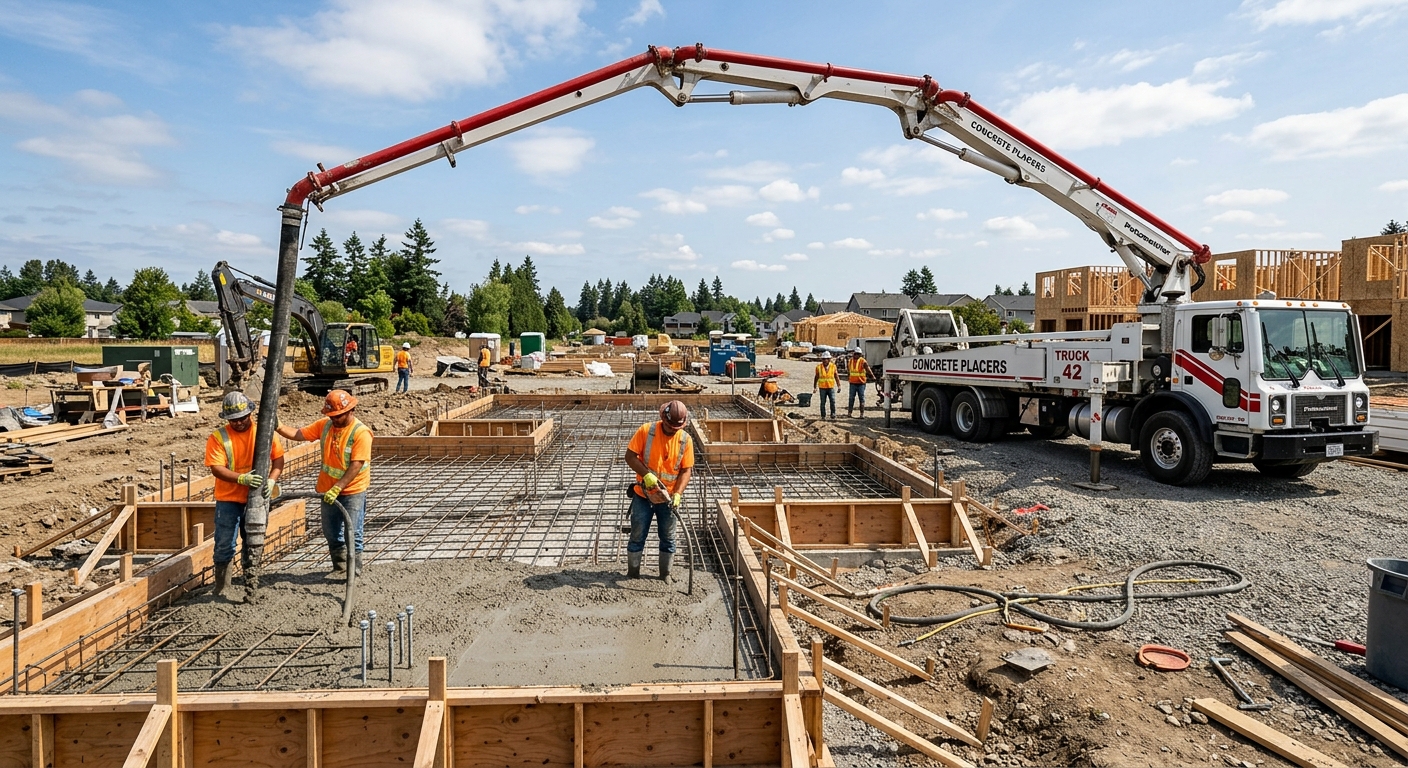
Concrete work options and costs in Inglewood
Inglewood, Alberta is a wonderful spot to raise a family, and it also happens to be a place where concrete flatwork gets real stress from the weather. With a population of about 6,255 people (Statistics Canada, 2021 Census), the area’s housing demand tends to cluster around established residential pockets where driveways, patios and walkways see heavy seasonal use. In Calgary’s broader housing market, many properties are owner-occupied, and that translates into repeat projects—repours, new slabs, and step/entry work—especially where families plan for long winters.
Concrete pricing in the Calgary region is shaped more by frost and freeze–thaw than by looks alone. Local engineering practice uses a design frost depth of about 1.2 m, meaning exterior footings for garages, retaining structures and foundation elements must be supported on undisturbed soil below that depth to limit frost heave and seasonal movement. On top of that, exterior slabs need air-entrained mixes, and cold-weather placement often requires winter-grade measures (insulated blankets, sometimes heat) to protect curing. Those steps are why you may see bigger quote differences than you’d expect for “the same” driveway.
In Inglewood, trade demand is especially common around the older, more established streets where renovations are frequent—entries, back patios, and expanded driveway pads are typical asks after winters expose spalling or uneven settlement. Below is a practical comparison of common concrete options and typical price ranges so you can line up quotes apples-to-apples.
| Application |
Typical Size |
Key Spec |
Finish Option |
Price Range |
| Concrete driveway (standard broom finish) |
400–550 sq. ft. |
Air-entrained exterior mix; compacted granular base; control joints |
Broom finish, lightly edged |
$12,000–$18,000 |
| Exposed aggregate driveway |
400–550 sq. ft. |
Air-entrained mix; proper curing; higher material handling |
Exposed aggregate surface (retarder wash) |
$14,500–$21,500 |
| Stamped concrete driveway or patio |
250–450 sq. ft. |
Air-entrained mix; base prep; integral color |
Stamped pattern + release + seal |
$15,000–$26,000 |
| Plain concrete patio or walkway |
200–350 sq. ft. |
Air-entrained mix; compacted base; joints where needed |
Float/trowel top, light broom edge |
$5,000–$9,000 |
| Garage floor (interior slab) |
400–650 sq. ft. |
Vapour barrier (if specified); exterior-grade mix for garage exposure; joints |
Broom finish with edge finishing |
$10,000–$16,000 |
| Foundation footings (structural, below frost) |
Varies (typical 2–3 bedroom house) |
Engineered rebar cage; excavation to design frost depth; concrete placement controls |
Structural concrete (not decorative) |
$28,000–$45,000 |
Prices are estimates only and vary by project scope, site access and material selection.
What affects the price of concrete work in Inglewood
If you’re getting multiple bids for concrete in the Calgary region, it’s common to see the same scope land 30–50% apart. The difference usually isn’t the “cement” alone—it’s excavation intensity, base preparation depth, reinforcement decisions, mix design requirements for freeze–thaw, and how crews manage curing in cold snaps. In Inglewood, the climate is the big driver: frost depth and freeze–thaw cycles dictate specs from the bottom up. Exterior work needs footings that extend below the local design frost depth (about 1.2 m) and slabs that are engineered to handle expansion/contraction. That means air-entrained concrete mixes are standard for exterior flatwork, and joints and sealing aren’t optional if you want fewer service calls.
Also, Calgary’s practical exterior pour season is shorter. When crews schedule late fall or early spring pours, they may add winter-grade mix adjustments, insulated blankets, and sometimes temporary heat to meet curing expectations. That protects against scaling and surface damage—failures that often show up months later and can cost more than the initial “savings” from a low bid.
Concrete sealing matters here too because de-icing salt accelerates surface spalling. If a contractor proposes a driveway in the $12,000–$18,000 range but skips proper curing time or doesn’t include a sealing plan (often applied after full cure), you’ll feel the difference during winter. Likewise, a stamped job in the $15,000–$26,000 band can be worth it when the contractor is thorough with base prep and uses correct colour/seal systems; poor base prep under decorative work is a fast track to patching.
Local conditions can raise cost in Inglewood—tight access for trucks, sloped yards needing deeper cuts, or older soils with fill and drainage issues. Conversely, simpler sites with good access and stable soil can keep costs closer to the lower end of the price bands for patios/walkways and standard driveways.
| Price Factor |
Why It Matters |
Cost Impact |
| Frost line depth — determines footing depth and form height |
Footings must bear on undisturbed soil below the design frost depth to prevent heave |
High: deeper excavations and taller forms increase labour and concrete volume |
| Site preparation — excavation, grading, compacted granular base |
Correct base thickness and compaction reduce settlement and cracking |
Moderate to high: extra hauling, disposal, and granular replacement add up |
| Reinforcement — rebar or wire mesh requirement |
Controls cracking and improves structural capacity for driveways and slabs |
Moderate: depends on slab type, thickness, and engineered requirements |
| Mix design — air-entrainment and compressive strength spec |
Air entrainment and strength targets reduce freeze–thaw damage and spalling |
Moderate: cold-weather and engineered mixes can cost more per yard |
| Finish type — broom vs. stamped vs. exposed aggregate |
Decorative finishes require extra steps and tight timing |
Moderate to high: stamped/exposed work adds crew time and materials |
| Pour size and concrete truck access to site |
Longer carries, crane/ramps, or limited access increases labour and scheduling constraints |
Moderate: access issues can turn a simple pour into a logistics problem |
| Cold-weather curing precautions — heating and blankets |
Protects strength gain and prevents early surface damage |
Moderate: winter blankets/heating add direct costs and coordination |
| Control joint pattern and sealing cost |
Joints manage cracking locations; sealing helps protect against de-icing salts |
Low to moderate: small material and time costs, big reduction in long-term issues |
Permits & regulations in Alberta
In Alberta, structural concrete work typically needs a building permit, and you’ll often see engineered drawings reviewed as part of the permit process. That includes footings, foundation walls, grade beams, and other structural elements that affect the load path of the home. Concrete flatwork—like patios, walkways, and driveways—usually does not require a permit on its own, unless it changes lot grading, impacts impervious surface coverage limits, or involves municipal right-of-way considerations (for example, work near a boulevard or drainage swales). Because requirements can vary by how the project ties into grading and drainage, always confirm with the local authority before breaking ground.
Before hiring a contractor in Inglewood, you should verify three things: (1) proper business licensing/registration for the contractor, (2) liability insurance, and (3) WSIB/WCB coverage. Here’s a homeowner-friendly way to check step-by-step:
- Ask for their certificate of liability insurance and verify coverage limits match the project scale.
- Request their clearance letter/status for workers’ compensation (WSIB/WCB) and confirm it applies to Alberta operations.
- Look up their Alberta-facing registration/licence information through the online registry tools available to the public.
- Match the quote scope to the insurance: if it includes excavation, sealing, or demo, make sure the contractor is covered for those activities.
- Get references for similar-size pours in the Calgary market, not just decorative work photos.
If they hesitate to provide insurance documents or references promptly, that’s a practical warning sign—especially in a freeze–thaw climate where quality and accountability matter.
Getting concrete right in Inglewood's freeze-thaw climate
Concrete can fail in Inglewood largely because water and freezing temperatures don’t play nicely together. When moisture enters a slab or surface paste and then freezes, it expands, stressing the concrete and leading to cracking or spalling. The most common causes are inadequate base prep, wrong mix design (especially missing or insufficient air entrainment), poor jointing, and rushed curing. In Calgary-area conditions, you have to spec this work around frost depth and repeated freeze–thaw cycles—not around summer assumptions.
To reduce problems, the “right” concrete scope usually includes five pieces: (1) base preparation—compact granular sub-base to the right depth for your soil and frost strategy; (2) mix design—air-entrained concrete with exterior air content typically around 5–7% and a minimum 32 MPa compressive strength target for durability; (3) control joints—planned spacing so cracks form where they’re intended; (4) curing—proper curing and protection for at least 7 days, with extra measures in cold conditions; (5) sealing—penetrating sealer applied after full cure (commonly around 28 days post-pour) to repel de-icing salts.
Ask whether your contractor is designing for Calgary winters, not just delivering a load of concrete. For example, if a standard broom-finish driveway is quoted near the $12,000–$18,000 range, but the contractor skips winter curing blankets or doesn’t include a sealing plan, you may save money initially and lose it later to surface scaling. On the other hand, spending toward the higher end (or moving into stamped territory like the $15,000–$26,000 band) is justified when the contractor upgrades the base, uses correct air entrainment, and seals on schedule—those details are what keep decorative surfaces looking good year after year.
When you compare quotes, always align the specs: base depth, air content target, joint layout, curing method, and sealing timeline. That’s how you avoid spalling from inadequate air-entrainment—an issue I see when bids don’t account for winter exposure.
| Spec |
Why It Matters in Inglewood |
What to Ask For |
Impact if Skipped |
| Compacted granular base (depth?) |
Controls settlement and reduces stress from freeze–thaw movement |
Base thickness and compaction method tied to your soil/frost strategy |
More cracking, uneven slab, and premature surface deterioration |
| Air-entrained concrete mix (target air %?) |
Air voids provide room for freeze expansion and limit scaling/spalling |
Exterior air content target, mix design sheet, and compliance confirmation |
Higher risk of spalling and scaling within a few winters |
| Compressive strength (MPa rating) |
Higher strength supports durability and helps the slab tolerate cycles |
Minimum 32 MPa target (or higher as specified) and test/traceability |
Lower long-term durability and increased cracking likelihood |
| Control joints (spacing per ACI guidelines) |
Helps cracks form in predictable locations instead of random breaks |
Joint spacing plan and timing (saw cut where applicable) |
Random cracking and wider repairs over time |
| Minimum 7-day curing period |
Strength gain and surface integrity are temperature- and time-sensitive |
Curing method and how they protect in cold weather |
Scaling, weak surface, and reduced performance even if it “looks fine” |
| Penetrating sealer (when applied after cure) |
Repels de-icing salts and reduces moisture intrusion |
Sealer type and timing after full cure (commonly ~28 days) |
Faster surface breakdown and more frequent touch-ups |
How to choose a concrete work contractor in Inglewood
Choosing the right concrete contractor in Inglewood is about verification, clarity, and alignment with Calgary’s freeze–thaw realities. Start with Alberta compliance: ask for their current certificate of liability insurance (and confirm it’s valid for your project period), and request proof of workers’ compensation coverage status for Alberta work (WSIB/WCB clearance or equivalent documentation). Then verify the contractor’s business registration/licence details through the public online registry tools available to homeowners. Don’t accept “we’re covered” verbally—get documents in writing before work begins.
Next, insist on 2–3 itemised written quotes. You want a breakdown that separates labour, equipment/excavation, materials (including the air-entrained mix and reinforcement), and finishing/sealing steps—rather than one lump number. Also read the scope carefully: what’s excluded (demo, removal, disposal, hauling, reinstate lawn/landscaping, permit pull if required), and does the quote include winter protection if the scheduled pour dates are near freezing?
Warranty is another area where quotes differ. Ask for (1) the workmanship warranty length, (2) whether any product/manufacturer warranty is included, and (3) whether warranties are transferable if you sell the home. For payment, never pay more than 10–15% upfront, and hold back a portion until the job is complete and inspected. Finally, get a written schedule: start date, weather contingencies, and completion estimate.
- Request insurance and workers’ compensation documents before signing.
- Confirm the crew and subcontractors match the named insured party.
- Get the concrete mix spec: air-entrainment target, strength target, and exterior use confirmation.
- Ask for base prep details: excavation depth, granular type, and compaction approach.
- Confirm reinforcement plan (mesh vs. rebar) for your slab thickness and loading.
- Verify joint layout and whether saw-cutting is included where needed.
- Ask how they handle cold-weather curing: blankets, protection, and timing.
- Confirm sealing is included or scheduled (penetrating sealer after cure).
- Check disposal and site restoration scope—what happens to excess soil?
- Request a truck access plan (pumping vs. carry distances) and included equipment.
- Get a written QC plan: slump/air testing and placement notes.
- Review payment terms: limit upfront; define final payment at substantial completion.
Red flags I see with concrete contractors in Inglewood include skipping air-entrainment discussions, refusing to provide insurance/WCB documentation, vague joint/curing timelines, quotes that don’t specify base depth/compaction, and “cheap” decorative work that doesn’t include proper sealing after full cure.
Frequently asked questions — concrete work in Inglewood
What is a concrete overlay and is it suited to Inglewood?
A concrete overlay is typically a thin resurfacing system poured or applied over an existing slab to improve appearance and smoothness without full removal. In Inglewood (and the Calgary region), overlays can be a good option when the original slab is structurally sound—meaning it’s not moving, sinking, or extensively failing at the joints and edges. The freeze–thaw climate makes bond and surface prep critical: if the old concrete is spalled or moisture is migrating, an overlay may only mask the problem. A proper assessment should include checking crack widths, joint condition, drainage patterns, and whether the surface has been cleaned/prepared to manufacturer requirements. Cost-wise, overlays can sometimes sit below a full new pour (often below the $12,000–$18,000 driveway band), but if you need significant prep or demo, full replacement can become the smarter value.
How do I seal concrete to protect it in Inglewood?
To protect concrete in Inglewood’s winter conditions, sealing is about reducing moisture and de-icing salt intrusion. For exterior slabs (driveways, patios, walkways), use a penetrating sealer designed for freeze–thaw exposure. Timing matters: seal after the concrete has fully cured—commonly around 28 days post-pour—so the sealer can’t trap excess moisture in the slab. Before sealing, confirm the surface is clean and dry, and avoid sealing over dust, curing compounds, or efflorescence. Also, consider how your household uses de-icer: even good concrete needs help from sealing and proper jointing. If a quote is near the lower end of the standard driveway range ($12,000–$18,000), ask whether sealing is included, what type of sealer is used, and whether it’s scheduled after cure.
What is the difference between concrete and cement?
Cement is one ingredient inside concrete. Concrete is the full composite material: cement plus water, sand, aggregate (like gravel), and typically air-entraining admixtures for exterior exposure. In Inglewood and across Alberta’s cold climate, the “concrete” performance depends heavily on mix design—especially air content and curing—so that freeze–thaw cycles don’t break down the surface. That’s why two “cement” purchases can’t be compared the way homeowners sometimes assume: durability comes from the complete mix and placement. When getting quotes, ask for the air-entrainment target and compressive strength target for exterior work, not just brand names. A driveway properly engineered for Calgary winters is built on those concrete specs, not simply how much cement is in the load.
How much does concrete work cost in Inglewood?
Concrete pricing in Inglewood follows Calgary-region realities: excavation depth tied to frost, granular base prep, and winter curing provisions can move your cost quickly. As a guide, concrete driveways typically run $12,000 – $18,000 for standard broom-finish work, and patios/walkways are often $5,000 – $9,000 depending on size and prep. Foundations/footings are a different category and commonly land around $28,000 – $45,000 when excavation goes to below frost depth and reinforcement is included. Decorative work like stamped concrete frequently falls into $15,000 – $26,000 depending on square footage and complexity. For any bid, compare itemised scope—base depth, reinforcement, curing protection, and sealing—because those are the true drivers of cost, and they’re where quotes diverge.
How deep must footings be for Inglewood's frost line?
In Inglewood (Calgary area), concrete footings for structures like houses, garages and retaining elements must typically extend below the local design frost depth to prevent frost heave and seasonal movement. The Calgary-region engineering practice commonly uses a design frost depth of about 1.2 m (roughly 4 ft). That doesn’t mean every single project uses one identical number—your engineering design and soil conditions can adjust specifics—but any serious foundation contractor should be taking excavation down to a frost-protected bearing depth. If someone proposes a much shallower footing “because it’s fine,” that’s a risk in Alberta’s freeze–thaw environment. This is also why foundation pricing is higher: deeper excavation and bigger concrete volumes are labor- and material-intensive, often aligning with the $28,000 – $45,000 band for footings when engineered reinforcement and below-frost excavation are included.
Why does concrete crack in Inglewood and how is it prevented?
Concrete cracks in Inglewood mainly due to shrinkage, temperature movement, and freeze–thaw stresses—especially when water finds its way into vulnerable areas. The right prevention is design-led: proper base preparation and compaction reduce settlement-related cracking, and correctly specified air-entrained concrete improves freeze–thaw durability. Control joints are the big one: joints should be placed so that cracking happens in planned locations rather than randomly through the slab. Timing also matters—joints typically need to be cut or formed in a schedule that controls crack timing. Curing is equally important: rushing curing in late fall or early spring can weaken the surface layer. Finally, sealing helps manage moisture and de-icer salt exposure. If you want to reduce future repairs, insist on a joint plan, correct exterior mix, minimum 7-day curing protection, and sealing after full cure—those steps directly address the cracking mechanisms Alberta winters trigger.