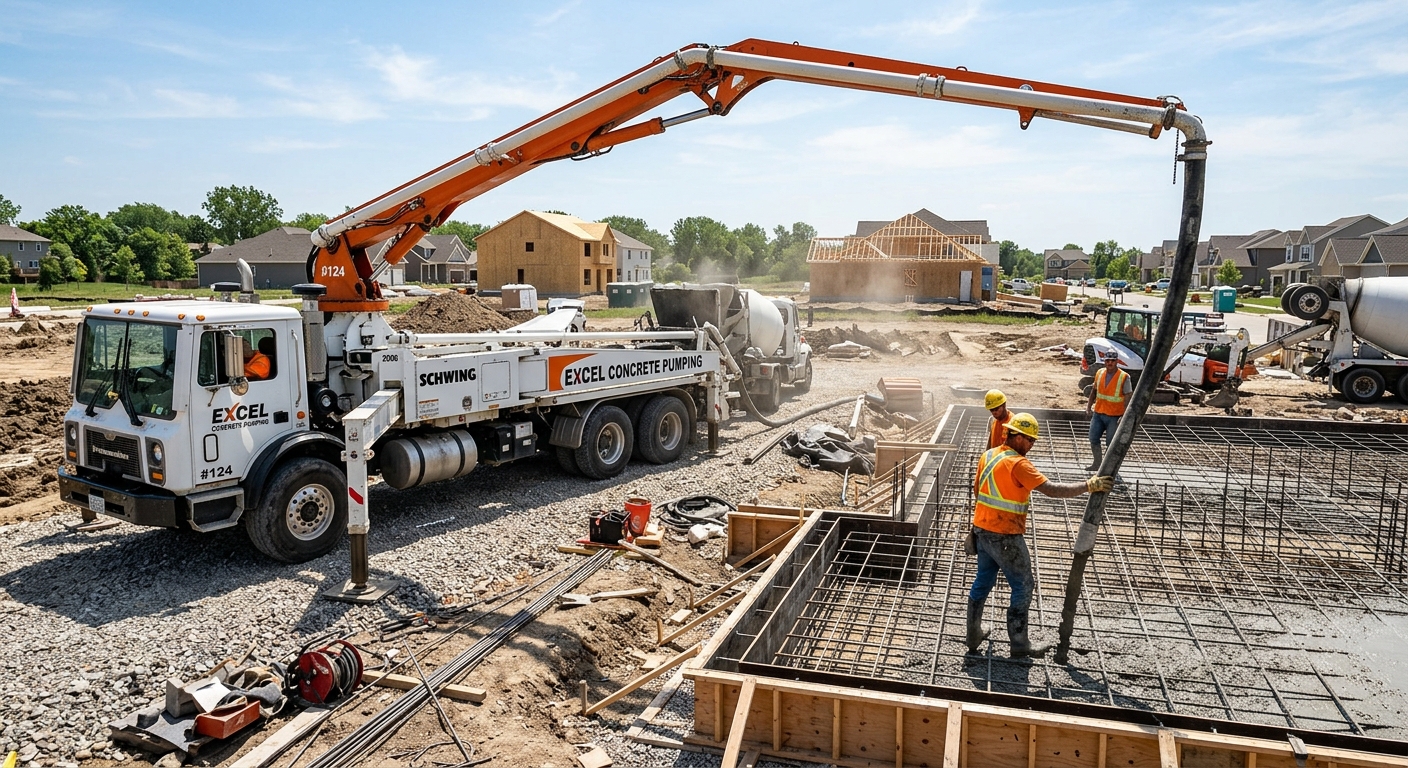
Concrete work options and costs in Silver Berry
Concrete work in Silver Berry, Alberta is priced with the local frost-and-freeze–thaw reality in mind. With a population of 8,089 (Statistics Canada, 2021 Census), we’re a smaller community, so the Calgary-area contractor pool often swings between “busy-season” demand and scheduling gaps. That matters because exterior concrete—driveways, patios, walkway slabs, and foundation footings—needs specific mix design, base prep, and curing time to stand up to the cold continental climate.
In Silver Berry, many homeowners are planning concrete flatwork as part of maintaining single-detached properties and improving curb appeal along the busiest local access routes toward the larger Calgary commuting corridors. The Calgary region’s design frost depth is roughly 1.2 m (about 4 ft), which drives excavation depth and footing volume—especially for garages, decks, and any retaining or below-grade work. On top of that, Calgary’s freeze–thaw cycles push crews to use air-entrained concrete, well-spaced control joints, and proper sealing, or you’ll see premature surface wear and spalling.
Concrete pricing can also shift simply because exterior pours have a tighter window than in milder provinces. Cold-weather placement often requires insulated blankets or temporary heat to reach safe curing conditions. If a contractor is backed up, crews may also schedule to protect curing performance, which can affect your final cost.
Below is a practical comparison of common options in Silver Berry so you can align expectations before you review quotes from Calgary-area crews, especially for high-demand residential pockets like the newer growth areas on the edge of the community.
| Application |
Typical Size |
Key Spec |
Finish Option |
Price Range |
| Concrete driveway (standard broom finish) |
20 ft x 10 ft (200 sq. ft.) |
Air-entrained mix, compacted granular base, rebar/wire mesh as required |
Broom finish with control joints |
$12,000–$18,000 |
| Exposed aggregate driveway |
20 ft x 10 ft (200 sq. ft.) |
Air-entrained mix, proper curing and wash timing control |
Exposed stone with sealer |
$14,500–$21,500 |
| Stamped concrete driveway or patio |
16 ft x 12 ft (192 sq. ft.) |
Air-entrained mix, higher cement paste quality for color/stamping |
Stamped pattern with release and color |
$15,000–$26,000 |
| Plain concrete patio or walkway |
12 ft x 10 ft (120 sq. ft.) |
Air-entrained mix, compacted base, jointing |
Float + broom/light texture |
$5,000–$9,000 |
| Garage floor (interior slab) |
22 ft x 20 ft (440 sq. ft.) |
Vapour barrier (as required), fibre and/or mesh, insulated base if needed |
Steel trowel or light broom depending on slip resistance needs |
$9,500–$15,500 |
| Foundation footings (structural, below frost) |
Typical two-storey house footing system |
Engineered dimensions, rebar cage, pour below design frost depth (~1.2 m) |
Structural concrete (no decorative finish) |
$28,000–$45,000 |
Prices are estimates only and vary by project scope, site access and material selection.
What affects the price of concrete work in Silver Berry
In Calgary and the surrounding region—including Silver Berry—two contractors can quote the same “driveway size” and still be 30–50% apart. The gap usually comes from what’s included: excavation depth and haul-away, the thickness of the granular base, rebar or wire mesh placement, concrete mix requirements for cold-weather curing, and how well the crew sequences curing and jointing. In a freeze–thaw climate, the specs aren’t optional; they’re what keep concrete from scaling, cracking, and spalling.
First, frost depth changes the entire foundation equation. Local practice uses a design frost depth of about 1.2 m, so footings for houses, garages, and retaining work must bear below that line to prevent frost heave. Second, freeze–thaw cycles dictate exterior slab design: you’ll need air-entrained concrete mixes to survive repeated wetting and thawing, plus a control joint pattern that limits random cracking. Third, the pour season for exterior slabs is shorter. If you’re placing concrete in late fall or early spring, contractors often need cold-weather curing precautions—insulated blankets and sometimes temporary heat—which increases labour and equipment.
Two examples common in Silver Berry: (1) if your driveway subgrade needs deeper cut-and-fill or additional base thickness, your driveway cost tends to move toward the higher end of the $12,000–$18,000 band; (2) if you choose stamped concrete, you’re paying for more premium mix, release agents, and skilled finishing time—often closer to the $15,000–$26,000 band. Also, older soil conditions and older neighbourhood lots with less stable drainage can require extra granular base and better slope/grading work—costing more up front but preventing long-term settlement.
Finally, keep in mind that de-icing salt accelerates surface breakdown in freeze–thaw conditions, so sealing is often recommended for driveways and walkways, particularly on higher-traffic routes.
| Price Factor |
Why It Matters |
Cost Impact |
| Frost line depth — determines footing depth and form height |
Footings must extend below design frost depth to reduce frost heave risk |
Major cost driver on foundations; deeper excavation increases volume and labour |
| Site preparation — excavation, grading, compacted granular base |
Weak or wet subgrade leads to settlement and cracking |
Can add significant labour and disposal; often shifts driveway/footing quotes |
| Reinforcement — rebar or wire mesh requirement |
Helps control cracking and improves load performance |
Material + placement time; usually small compared to base and excavation |
| Mix design — air-entrainment and compressive strength spec |
Exterior freeze–thaw needs air-entrainment to prevent scaling and spalling |
Extra quality and tighter batching requirements can raise material cost |
| Finish type — broom vs. stamped vs. exposed aggregate |
More labour, more consumables, and tighter timing |
Stamped and exposed typically sit at the higher bands |
| Pour size and concrete truck access to site |
Limited access increases hand placement and time |
May require smaller loads, labour premiums, or extended pour coordination |
| Cold-weather curing precautions — heating and blankets |
Ensures proper early strength gain before freeze events |
Often adds equipment and skilled labour in shoulder seasons |
| Control joint pattern and sealing cost |
Joints reduce uncontrolled cracking; sealing helps with salt exposure |
Added materials and labour, but lowers long-term repairs |
Permits & regulations in Alberta
In Alberta, structural concrete work such as foundation footings, foundation walls, grade beams, and other below-grade structural elements generally requires a building permit, and the municipality often expects engineered drawings and code-compliant installation details. For concrete flatwork—driveways, patios, walkway slabs, and similar non-structural work—permits are usually not required unless the work affects lot grading, alters drainage patterns, or triggers impervious surface coverage and right-of-way considerations.
Because rules can vary based on the exact scope and your lot’s drainage situation, the safest approach in Silver Berry is to confirm with the local authority before breaking ground. Even when a permit isn’t required, engineering and municipal requirements can still affect how deep excavation goes and where runoff should go.
Step-by-step, here’s how a homeowner should verify a contractor in Alberta:
- Ask the contractor for their proof of insurance (general liability) and the WSIB/WCB clearance or equivalent coverage documentation.
- Confirm they carry sufficient liability for concrete work (you want to see the certificate of insurance details).
- Check whether any structural permit drawings are prepared by a qualified professional where required.
- Request a clearance letter and verify it’s current (not expired).
- Look for references on projects with similar scale in the Calgary area, not just decorative jobs.
Online, you can also verify licensing information via Alberta’s contractor-related registry pathways where applicable, but insurance and WSIB/WCB documentation should always be included in your quote package before you sign.
Getting concrete right in Silver Berry's freeze-thaw climate
Concrete fails in Silver Berry most often due to a mismatch between the ground conditions, the concrete mix, and the freeze–thaw cycle. In our cold continental climate, inadequate base preparation allows pumping and settlement; weak or incorrectly specified concrete leads to scaling and spalling; and poor jointing creates random cracking that turns into pathways for water and de-icing salts. The fix is to spec and build the system correctly—sub-base, mix, joints, curing, and sealing—so the slab survives winter service.
Here’s how to spec the job so it performs:
1) Base preparation: require a compacted granular sub-base to the right depth for your soil and the frost considerations for exterior slabs. For driveways and patios, the goal is consistent support without voids or soft spots.
2) Mix design: insist on an air-entrained mix for exterior work. A common target is 5–7% air content for durability in freeze–thaw exposure, and at least 32 MPa compressive strength.
3) Control joints: layout joints so cracking happens where it’s expected, with spacing appropriate for the slab size and thickness.
4) Curing: plan for a minimum 7-day curing period under proper conditions. In cold weather, crews may need insulated blankets or temporary heat to prevent early freezing, otherwise you can lose surface durability.
5) Sealing: apply a penetrating sealer only after the slab has cured—commonly around 28 days—so it can repel salt-laden meltwater.
To show where the price difference is justified: a basic broom-finish patio may land in the $5,000–$9,000 band, but if you cut corners on base thickness or air-entrainment, the “savings” can lead to premature surface damage that costs more later. Stamped concrete looks great, yet it’s not a free upgrade—if the base and curing aren’t right, even premium finishes can still crack and spall.
Ask your contractor point-blank for air-entrainment details, the curing plan, and the joint layout—those are the questions that prevent the most common failure: spalling from inadequate freeze–thaw durability.
| Spec |
Why It Matters in Silver Berry |
What to Ask For |
Impact if Skipped |
| Compacted granular base (depth?) |
Provides stable support and reduces frost-related movement and settlement |
Granular base thickness and compaction requirements before placement |
Uneven settlement, cracking, and premature slab failure |
| Air-entrained concrete mix (target air %?) |
Freeze–thaw durability depends on correct air-void system |
Specify air-entrainment target of 5–7% for exterior flatwork |
Scaling and spalling within a few winters |
| Compressive strength (MPa rating) |
Ensures slab reaches adequate early and long-term strength |
Minimum 32 MPa compressive strength spec |
Lower strength, higher surface wear, and increased cracking risk |
| Control joints (spacing per ACI guidelines) |
Controls where cracks form under temperature and moisture swings |
Proposed joint spacing and layout for your slab dimensions |
Random cracking and water intrusion at uncontrolled cracks |
| Minimum 7-day curing period |
Cold snaps can freeze surface layers before strength develops |
Cooling/warm-weather plan; curing protection if temperatures drop |
Weak surfaces, scaling, and reduced long-term durability |
| Penetrating sealer (when applied after cure) |
Helps repel salt and water penetration during freeze–thaw cycles |
Penetrating sealer applied after cure (commonly ~28 days) |
Salt-laden meltwater accelerates surface breakdown |
How to choose a concrete work contractor in Silver Berry
Choosing a contractor in Silver Berry is mostly about verifying the basics and then confirming the technical details that protect concrete in Calgary’s freeze–thaw climate. First, verify Alberta coverage and financial responsibility. Ask for a current certificate of insurance (general liability) naming you as an additional insured where possible, and confirm the contractor has WSIB/WCB coverage for their workers—request proof and ensure dates are current. If a contractor hesitates or provides old documents, walk away.
Next, get 2–3 itemised written quotes—not just a single lump sum. You want a breakdown of labour and materials (concrete supply, rebar/wire mesh, formwork, granular base, excavation/disposal, and finishing items like stamping or sealing). This makes it easier to compare who actually includes the right base thickness, reinforcement placement, air-entrainment requirements, and curing protection.
Read the scope carefully for exclusions: is permit support included (if required), is disposal/haul-away included, what’s excluded if you find unsuitable subgrade, and who supplies traffic management if concrete trucks can’t access directly? Also ask about warranty terms. A workmanship warranty should be clearly stated (and ideally cover workmanship defects), and you should confirm whether any product/manufacturer warranties are transferable to you.
For payment, never agree to more than about 10–15% upfront. Use a milestone schedule tied to measurable progress and hold back a portion until the job is complete and cleaned up.
Finally, insist on a written timeline: start date, concrete delivery day, and estimated completion—especially if cold-weather curing measures are part of the plan.
- Proof of current general liability insurance (certificate of insurance).
- WSIB/WCB clearance or equivalent current coverage document.
- Written confirmation of permit responsibility for structural concrete scope.
- Itemised quote: excavation, granular base, reinforcement, concrete supply, finishing, sealing.
- Concrete mix specification: air-entrainment target and compressive strength.
- Base prep details: granular thickness and compaction expectations.
- Joint plan: spacing and where control joints will be located.
- Curing plan for cold weather: blankets/heat protection if needed.
- Access plan: how trucks will reach the pour area and how materials will be handled.
- Disposal included or clearly excluded (spoils/old concrete/over-excavation).
- Clear warranty duration for workmanship and how issues are handled.
- Payment schedule with a holdback until final grade, cleanup, and curing steps are done.
Concrete red flags I see in Silver Berry: contractors who won’t specify air-entrainment, quotes that ignore base thickness and compaction, “too good to be true” pricing for stamped or heated pours, vague curing timelines, and crews that push payments without a signed scope and schedule.
Frequently asked questions — concrete work in Silver Berry
How much does concrete work cost in Silver Berry?
In Silver Berry, concrete pricing follows Calgary’s freeze–thaw requirements, so you should expect costs to reflect excavation depth, base prep, and air-entrained mix specifications—not just square footage. As a quick guide, a standard broom-finish concrete driveway commonly ranges from $12,000–$18,000, while a plain patio or walkway is often around $5,000–$9,000 depending on size and site access. For decorative upgrades, stamped concrete driveway or patio work typically falls in the $15,000–$26,000 band. Foundation footings are a different category because they must be engineered and poured below the local design frost depth, often landing around $28,000–$45,000 for typical footing systems.
How deep must footings be for Silver Berry's frost line?
For Silver Berry and the broader Calgary region, the design frost depth used for foundation planning is roughly 1.2 m (about 4 ft). That depth matters because footings must bear on undisturbed soil below the frost line to reduce frost heave and seasonal movement. In practice, the exact footing depth and dimensions are usually confirmed by your engineered foundation design and site conditions—soil type, drainage, and slope can influence the final layout. When you get quotes in Alberta, ask whether the contractor is following the engineered drawings for depth, rebar placement, and concrete strength. This is one reason foundation quotes can vary: a deeper excavation and higher footing volume directly increase labour, formwork, and concrete quantities.
Why does concrete crack in Silver Berry and how is it prevented?
Concrete cracks in Silver Berry mainly because temperature and moisture movement are constant here. Freeze–thaw cycles expand and contract the slab system, and water exposure from melt cycles and de-icing salt accelerates deterioration if water can enter cracks. Prevention is about controlling where the slab cracks rather than trying to stop cracking completely: proper granular base prep to reduce settlement, air-entrained exterior concrete for freeze–thaw durability, and a control joint pattern spaced to limit random cracking. Curing also plays a big role—if concrete freezes early, strength development can be compromised, making cracking and surface scaling more likely. Ask your contractor for the joint spacing plan and curing protection. For exterior slabs, sealing after cure helps reduce salt-driven surface breakdown, which keeps small cracks from turning into bigger maintenance issues.
Stamped vs broom-finish concrete — cost difference?
Stamped concrete costs more than broom-finish because it’s not just a different surface texture—it’s additional labour, finishing steps, and materials. Stamped work typically sits at the higher end for driveway or patio projects; in Silver Berry, stamped concrete often falls around $15,000–$26,000, while broom-finish driveways are commonly around $12,000–$18,000 for similar basic sizes. The premium can be justified when the contractor also builds the same “durability basics” under the stamp: correct air-entrainment, joint layout, and proper curing. If the contractor cuts those parts to reduce cost, stamped concrete can still crack or spall. So compare quotes on base prep, mix spec, curing plan, and sealing—not just the decorative finish.
When is the best time to pour concrete in Silver Berry?
In Silver Berry, exterior concrete pours are best scheduled during the warmer part of the year when temperatures allow proper curing without extensive heating or insulation. Late fall and early spring can still work, but only if your contractor plans cold-weather curing measures—insulated blankets, temporary heat if needed, and protection long enough to prevent early freezing. The “best time” is the window where the crew can complete finishing and curing properly with stable temperatures. If you’re considering a patio, walkway, or driveway, ask how they manage curing protection when nighttime temperatures drop. For slab durability, rushing the curing stage is a common mistake in Calgary-area schedules and can lead to surface scaling. Planning ahead reduces cost surprises because you’re less likely to pay for additional cold-weather equipment and adjustments.
How long does concrete take to cure?
Concrete cure time has two different meanings: strength gain and finishing readiness. For durability in Silver Berry’s climate, plan for a minimum 7-day curing period under proper conditions before you treat the slab as fully protected. That early curing window is when cold snaps can do the most damage if the surface freezes before strength develops. For sealing, many contractors apply penetrating sealer after the slab has fully cured—commonly around 28 days—so the sealer can soak in and repel water and salt effectively. If you’re comparing quotes, don’t accept “it’ll be fine in a couple of days” for exterior flatwork. Ask what temperature protections are used during curing and whether blankets/heating are included when temperatures are borderline. That’s what separates long-lasting slabs from recurring repairs.