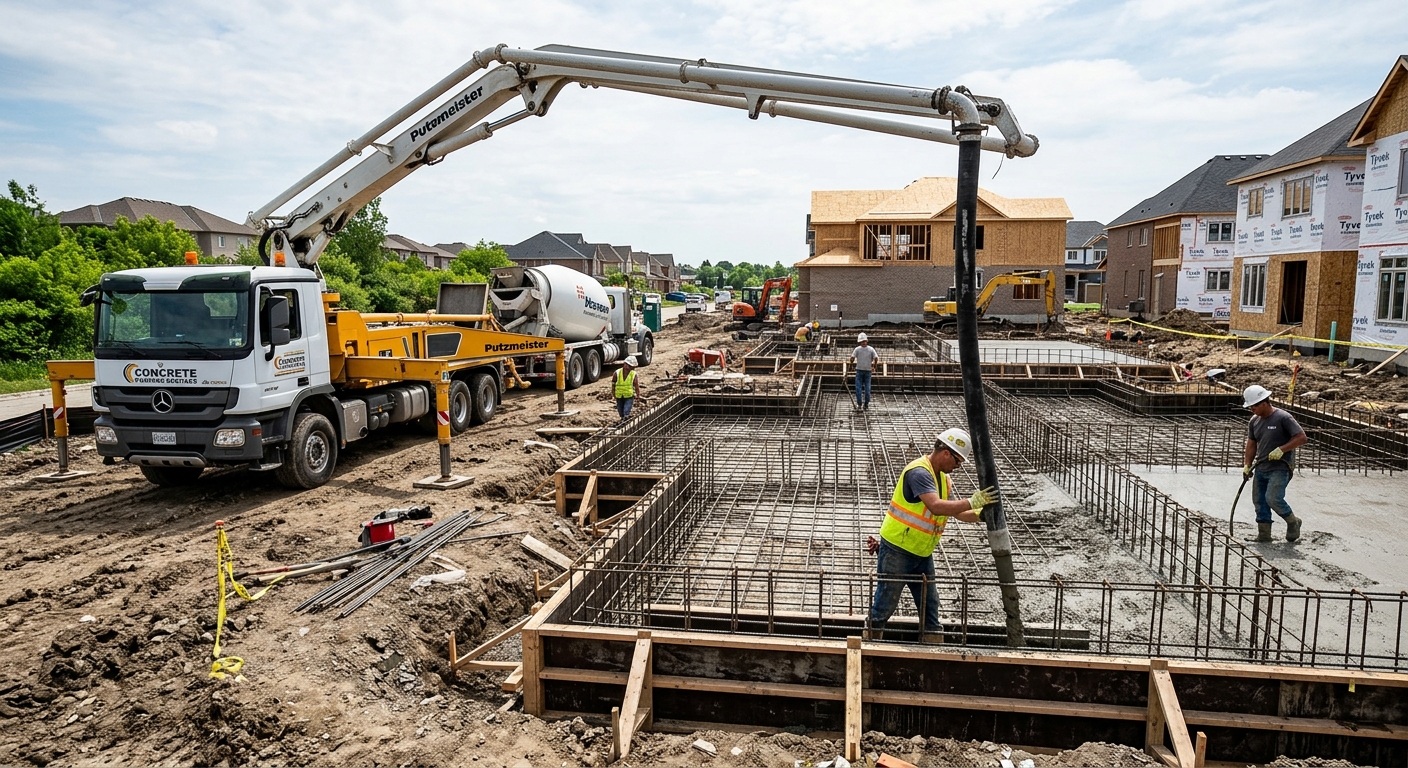
Concrete work options and costs in Sunnyside
In Sunnyside, concrete is a year-round discussion because your flatwork and foundation are constantly dealing with Calgary-area freeze–thaw. With a small community profile—Sunnyside’s population is about 4,000 (Statistics Canada, 2021 Census)—you’ll often see crews scheduling around the tight exterior work windows and the demand spikes from nearby Calgary neighbourhoods. Sunnyside homes are commonly set up for driveways, patios, and walkways that must survive winter de-icing and spring thaw, and that’s why many homeowners budget for engineered base prep and air-entrained concrete.
Calgary’s cold continental climate drives up costs compared to milder parts of Alberta, mainly because the design frost depth is deep (engineered around roughly 1.2 m). Footings and exterior slabs need to bear on undisturbed soil below that frost zone, and that means more excavation, higher formwork, and larger foundation volumes. Regular freeze–thaw cycles also increase the importance of granular base prep, proper mix design, and control joints—especially for driveways and patios where surface scaling and random cracking show up first. On top of that, the practical pour season is shorter outdoors, so colder-weather placement may require winter-grade mixes, insulated blankets, and in some cases temporary heat to protect curing.
In Sunnyside, trade demand is especially strong around the more mature pocket near the older infill streets close to the central commercial corridor, where many properties have retrofit driveways, add rear patios, or re-do entry walkways. If you’re planning a new driveway, updating a patio, or addressing foundation needs, use the cost ranges below as a starting point before you compare quotes in detail.
| Application |
Typical Size |
Key Spec |
Finish Option |
Price Range |
| Concrete driveway (standard broom finish) |
16 ft x 24 ft (384 sq. ft.) |
Air-entrained, compacted base, control joints |
Broom finish |
$12,000–$18,000 |
| Exposed aggregate driveway |
16 ft x 24 ft (384 sq. ft.) |
Air-entrained, proper retarder/wash technique |
Exposed aggregate texture |
$14,500–$21,500 |
| Stamped concrete driveway or patio |
12 ft x 20 ft (240 sq. ft.) |
Air-entrained, color hardener, release agent |
Stamped patterns |
$15,000–$26,000 |
| Plain concrete patio or walkway |
10 ft x 16 ft (160 sq. ft.) |
Air-entrained, compacted base, joints |
Broom or smooth-trowel/edged |
$5,000–$9,000 |
| Garage floor (interior slab) |
20 ft x 22 ft (440 sq. ft.) |
Vapour barrier, thickened edges (as required) |
Standard finish |
$10,500–$16,500 |
| Foundation footings (structural, below frost) |
Typical house build (varies by layout) |
Engineered footing depth and reinforcement |
Structural concrete only |
$28,000–$45,000 |
Prices are estimates only and vary by project scope, site access and material selection.
What affects the price of concrete work in Sunnyside
It’s common to see concrete quotes for the same project vary by 30–50% in Calgary and across Alberta because the real cost drivers aren’t just the slab itself—they’re the engineering and ground-up steps needed to make the concrete perform through Alberta winters. In a deep-frost, freeze–thaw climate like Sunnyside’s, identical-looking driveways can cost very differently depending on footing depth, granular base thickness, reinforcement decisions, mix design, finishing method, and curing precautions.
Here’s the big reason: the design frost depth is deeper in Alberta. Footings must extend below the design frost zone to prevent frost heave and seasonal movement. Exterior slabs also need air-entrained concrete to survive repeating freeze–thaw cycles. Cold-weather placement adds cost because contractors may need insulated blankets and temporary heat to achieve proper curing, especially when late fall or early spring temperatures threaten the curing window. And de-icing salts in winter can accelerate surface spalling if the mix and finishing aren’t spec’d correctly—this is why sealing and a durable surface build matter.
Local conditions also change labour time and therefore price. For example, a driveway retrofit on a constrained street with limited truck access may require more handwork and staging, pushing you toward the upper end of the $12,000–$18,000 driveway band. A patio that’s easy to access and built on a clean, stable subgrade may land closer to $5,000–$9,000. Foundation work can swing even wider because older Sunnyside lots may have variable soil or less predictable excavation, and the extra volume for below-frost excavation directly affects your footing budget.
| Price Factor |
Why It Matters |
Cost Impact |
| Frost line depth |
Determines footing depth and form height |
Major cost driver; deeper engineered excavation increases concrete and labour |
| Site preparation |
Excavation, grading, compacted granular base |
Can add significant time if soils are soft, wet, or require removal/replacement |
| Reinforcement |
Rebar or wire mesh requirement |
Costs increase with steel volume and placement labour; avoids structural failures |
| Mix design |
Air-entrainment and compressive strength spec |
Air-entrained/winter-grade mixes cost more but reduce scaling and spalling |
| Finish type |
Broom vs. stamped vs. exposed aggregate |
Decorative finishes add labour, materials, and longer finishing schedules |
| Pour size and concrete truck access to site |
How far concrete must be moved on grade |
Poor access increases labour and can require alternate staging plans |
| Cold-weather curing precautions |
Heating and blankets |
Temporary heat/blankets and monitoring increase cost in late/early season pours |
| Control joint pattern and sealing cost |
Crack control and surface protection |
Proper joints and sealing add materials and labour but reduce long-term repairs |
Permits & regulations in Alberta
In Alberta, structural concrete work typically needs a building permit, and many projects also require engineered drawings reviewed through the municipal process. That includes footings, foundation walls, grade beams, and any concrete elements that form part of the structural system. By contrast, concrete flatwork—like driveways, patios, and walkways—often does not require a permit unless it affects lot grading, drainage, impervious surface limits, or work occurs within/near a municipal right-of-way. Because rules can be triggered by drainage changes and coverage, it’s always smart for a Sunnyside homeowner to confirm with the local authority before the first excavation.
Step-by-step, here’s how you verify a contractor in Sunnyside (and across Alberta): (1) ask for their contractor business information and proof of registration/licensing where applicable; (2) request a Certificate of Insurance showing general liability coverage—make sure your property address is listed correctly and liability limits are current; (3) confirm WSIB/WCB coverage (or applicable equivalent coverage for the business structure) and request a clearance letter where available; (4) verify they can provide references for similar-scale jobs (driveways, slabs, or footings); and (5) ensure the quote aligns with the required permits/engineering steps for structural scopes.
If the contractor won’t show documentation before you sign, slow down—proper insurance and coverage protect you when the excavation, forming, and concrete placement get messy (and they always do at some point).
Getting concrete right in Sunnyside's freeze-thaw climate
Concrete fails in Sunnyside when the foundation of the job (base prep), the concrete recipe, and the finishing/curing don’t match Calgary-area winter realities. The most common problem I see is spalling—surface scaling and peeling—usually tied to inadequate air-entrainment, rushing curing, or insufficient drainage and base support. When water gets into the concrete and then freezes repeatedly, freeze–thaw expands it, and the surface breaks down over time.
To spec the job correctly, start with base preparation: use a compacted granular sub-base to the right depth for local soils and frost performance, and keep grading stable so meltwater drains away. Next is mix design: exterior flatwork should target 5–7% air content (air-entrainment) and typically minimum 32 MPa compressive strength to meet durability expectations in cold weather. Then control joints: place joints to limit random cracking and align them with your traffic and stress lines. Curing matters as much as the pour—plan for at least 7 days of proper curing conditions, and if you’re pouring near cold snaps, cold-weather blankets/heating may be necessary to avoid weak early strength. Finally, sealing: apply a penetrating sealer about 28 days after the pour to help repel de-icing salt intrusion.
For a dollars-and-cents example, upgrading from a basic broom-finished driveway setup to a correctly spec’d air-entrained mix plus proper sealing often costs less than chasing repairs later. If a standard driveway is priced around the lower $12,000–$18,000 band, a well-prepped, properly cured job is usually the better value than “saving” on base depth or skipping sealing—because the next winter is when the cheaper spec shows up as flaking and repairs.
| Spec |
Why It Matters in Sunnyside |
What to Ask For |
Impact if Skipped |
| Compacted granular base (depth?) |
Supports load and reduces water movement that drives freeze–thaw damage |
Base depth and compaction method tied to local soil and frost performance |
Settlement, cracking, pumping, and faster surface deterioration |
| Air-entrained concrete mix (target air %?) |
Creates resistance to freeze–thaw scaling and spalling |
5–7% air content for exterior flatwork |
Higher risk of surface scaling and spalling over winters |
| Compressive strength (MPa rating) |
Ensures early and long-term strength for durability |
Minimum 32 MPa at required age and proper curing conditions |
Weak concrete, reduced performance, and higher cracking risk |
| Control joints (spacing per ACI guidelines) |
Limits uncontrolled cracking from shrinkage and temperature movement |
Joint layout plan and spacing information |
Random cracks, water ingress, and accelerated deterioration |
| Minimum 7-day curing period |
Early strength gain controls durability and reduces surface weakness |
How they protect curing in cold weather (blankets/heating if needed) |
Surface scaling and long-term strength shortfalls |
| Penetrating sealer (when applied after cure) |
Helps resist de-icing salt intrusion common in Calgary winters |
Penetrating sealer applied about 28 days post-pour |
Faster salt damage and increased spalling risk |
How to choose a concrete work contractor in Sunnyside
Choosing the right contractor in Sunnyside is about verifying capability and reducing the “unknowns” that make freeze–thaw failures more likely. Start with Alberta verification: ask for their contractor registration/licence details where applicable, then request a Certificate of Liability Insurance (general liability) with current dates and appropriate coverage limits. Next, confirm WSIB/WCB coverage for workers and request a clearance letter or proof of standing. If they can’t provide these documents promptly, that’s a red flag.
Then get 2–3 itemised written quotes. You want line items that separate labour, concrete supply, excavation/grading, reinforcement, formwork, finish work, curing protection, and disposal. A quote that only lists a lump sum usually hides the real risks—like insufficient base depth, missing air-entrainment details, or no plan for cold-weather curing. Carefully read exclusions: is the permit responsibility spelled out? Is disposal included? Who handles broken-up concrete removal and haul-away? Make sure the scope clarifies where the contractor ties the new concrete into existing grades.
Finally, review warranty and payment terms. Ask for a workmanship warranty length and confirm whether product/manufacturer warranties apply (and whether they’re transferable if you sell the home). For payment, avoid large deposits—typically stay around 10–15% upfront, with a holdback until completion and punch list items are done. Timeline should be written: request a start date window and completion estimate, especially because Calgary exterior work schedules can shift with temperature swings.
- Request the contractor’s proof of insurance (Certificate of Liability) before signing.
- Confirm WSIB/WCB clearance or standing with paperwork, not just verbal assurance.
- Ask what frost-depth and base-thickness standard they’re building to for your soil conditions.
- Ensure the quote states air-entrainment expectations for exterior concrete.
- Verify reinforcement details (mesh vs rebar; thickness and cover).
- Check whether control joints and their spacing are included in the scope.
- Confirm curing protection plan (blankets/heating) if the pour date is near cold snaps.
- Ask if sealing is included (and when sealer is applied relative to curing).
- Get an itemized breakdown for excavation, granular base, and compaction.
- Confirm disposal/haul-away of excess soil and concrete is included or priced separately.
- Set payment schedule: 10–15% deposit maximum and keep a completion holdback.
- Get a written schedule with date ranges and crew availability.
Concrete contractor red flags in Sunnyside: vague scope with no air-entrainment or curing details; refusing to provide insurance/WSIB/WCB proof; cheap “no joint” promises (or no joint layout plan); skipping or downplaying base prep; and pressuring you into paying the full amount before finishing and sealing.
Frequently asked questions — concrete work in Sunnyside
How do I compare concrete quotes?
Start by comparing like-for-like scope, not just the total price. In Sunnyside, make sure each quote spells out base prep, compacted granular thickness, reinforcement (if needed), concrete mix details (including air-entrainment for exterior flatwork), and control joint layout. Ask whether cold-weather curing measures are included—if you’re anywhere near late fall or early spring, missing blankets/heating can lead to weak early strength and surface scaling. Also confirm what’s included for cleanup and haul-away, and whether sealing is offered after cure. A driveway at around $12,000–$18,000 can range widely based on access and base depth, so insist on itemised line items to see why.
Can concrete be poured in cold weather in Sunnyside?
Yes, concrete can be poured in cold weather in Sunnyside, but it must be engineered and protected so it cures properly. Calgary’s freeze–thaw conditions mean the window for outdoor curing is shorter, and contractors may need winter-grade mixes plus insulated blankets and sometimes temporary heat to maintain curing temperatures. The key is protecting the concrete long enough to develop early strength and avoid frost damage during the first days. When you get a quote, ask for their cold-weather plan: what temperature triggers extra protection, how they monitor the pour, and whether materials are adjusted for winter placement. If a contractor says “we’ll pour anytime with no precautions,” that’s not typical for durable exterior work.
How do I maintain concrete in Sunnyside's freeze-thaw climate?
Maintenance in Sunnyside is mostly about keeping water and salts from attacking the surface. After your pour has cured fully, apply a penetrating sealer about 28 days post-pour (timing matters). Use de-icing salts carefully—choose concrete-friendly products when possible and avoid over-salting. Keep drainage directing meltwater away from the slab edges, because trapped water accelerates freeze–thaw movement under and within the concrete. Inspect seasonally for small chips at joints or edges; quick patching reduces how far water can travel. If you have a driveway or walkway, re-check joint condition yearly and keep them clean—blocked joints increase random cracking and spalling risk.
What causes concrete to spall in Sunnyside winters?
Spalling typically comes from freeze–thaw pressure plus weak or water-permeable surfaces. In Sunnyside and the Calgary area, the two most common contributors are inadequate air-entrainment (so water freezes and expands without relief) and poor curing early on, especially if cold weather protection is skipped. De-icing salts then push the damage faster by penetrating and weakening the surface layer. Base and drainage issues matter too: if water sits at slab edges or joints, the freeze–thaw cycle is more severe. That’s why a correctly designed exterior mix (including target air content) and proper joint spacing are not optional. If you see spalling starting within a season or two, it often points back to the mix, curing, or sealing decisions.
What is rebar and when is it required in Alberta?
Rebar (reinforcing steel) is used to strengthen concrete where tensile forces and cracking potential are highest. In Alberta, it’s typically required for structural elements like foundation footings, foundation walls, and grade beams, and it’s specified based on engineering drawings and loads—not guesswork. For exterior flatwork such as standard driveways and patios, some designs use wire mesh or rebar, while others rely on slab thickness and proper base preparation; the decision depends on thickness, soil conditions, and loading. If you’re doing a structural concrete scope in Sunnyside that touches the building foundation, you should expect engineered reinforcement requirements and a permit process. For any concrete work, ask the contractor to show you the reinforcement details and where it sits (cover and spacing).
How long does a concrete project take in Sunnyside?
Timelines vary by scope and season, but most concrete work involves planning around excavation, forms, pour day, and curing. A typical driveway or patio usually requires base prep and compaction first, then a pour and finishing, with curing protection as needed. Even though the visible work can be completed in a day or two, you should assume additional time for curing before heavy loads. Cold-weather pours may require additional days of protection to reach adequate early strength. As a homeowner, plan for at least several days from site prep through usable curing, and for sealing coordination after cure. For budgeting, it can also explain price differences: crews that can pour in optimal conditions without interruption often deliver closer to the lower end of the $5,000–$9,000 patio/walkway band or the $12,000–$18,000 driveway band.