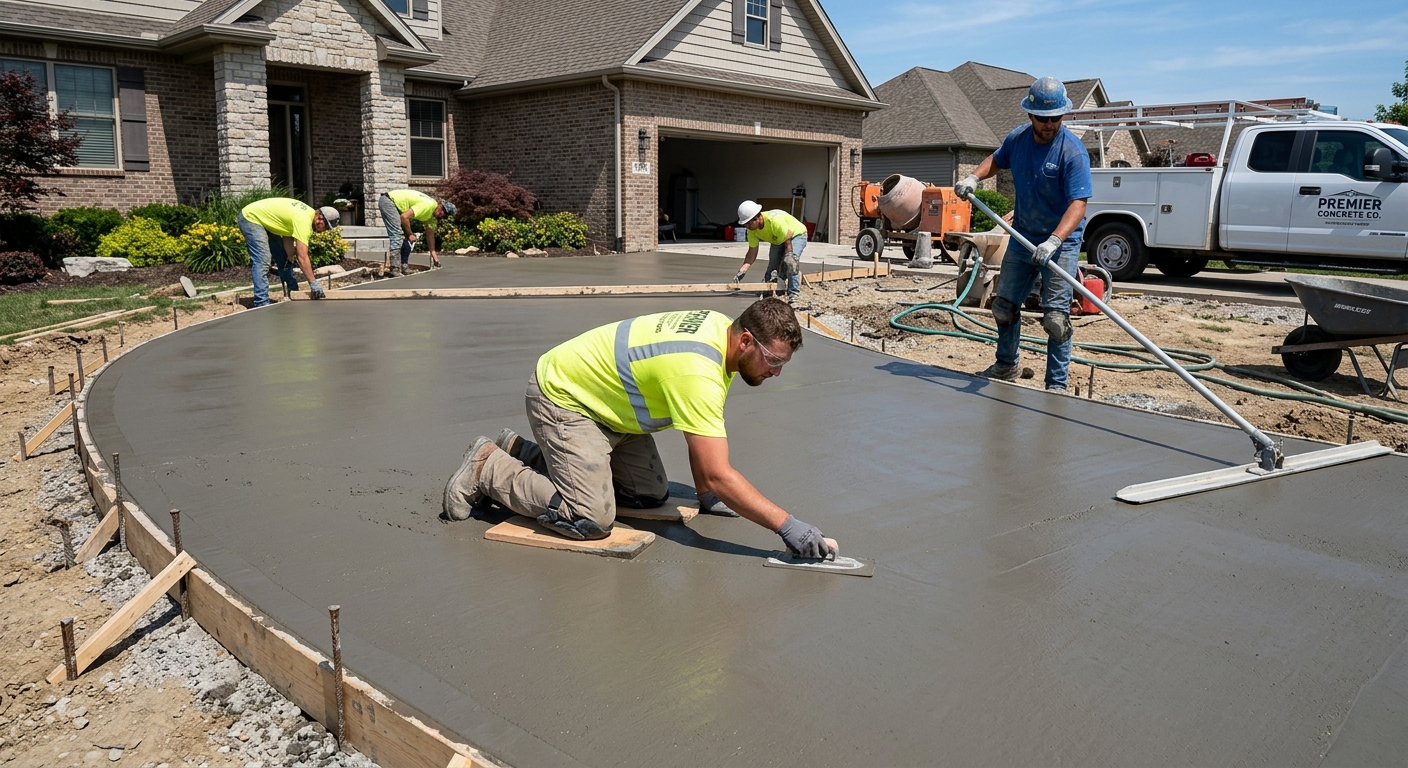
Concrete work options and costs in Belmont
Belmont, Alberta is a small community (population 5,198, Statistics Canada, 2021 Census), and most homeowners are planning concrete flatwork for daily life—driveways, patios, walkways, and garage slabs—around the same kind of house styles you see throughout the Calgary region. In many Belmont neighbourhood pockets, concrete work is especially in demand as properties are refreshed and more upgrades are done at the same time as landscaping and drainage improvements. Because the local housing market is shaped by winter-ready construction expectations, contractors price concrete by how it will perform through Calgary’s deep freeze–thaw cycles, not just by square footage.
In our cold continental climate, the design frost depth in Alberta is typically about 1.2 m (roughly 4 ft). That means exterior foundation and support elements must bear on undisturbed soil below this depth to reduce frost heave and seasonal movement. It also affects driveways, retaining structures, and any work tied into grading. Frequent freeze–thaw cycles require air-entrained mixes, well-prepared granular base, and thoughtful control-joint spacing to reduce cracking and surface scaling. Add in a shorter effective pour season for exterior slabs and you’ll see higher costs for cold-weather placement, including winter-grade materials, insulation blankets, and sometimes temporary heat to achieve proper curing.
To help you compare apples to apples, here are typical price bands homeowners in Belmont often see for common concrete projects—then you can match your scope to the spec level in the table.
| Application |
Typical Size |
Key Spec |
Finish Option |
Price Range |
| Concrete driveway (standard broom finish) |
400–600 sq. ft. |
Air-entrained mix, compacted granular base, wire mesh or rebar as specified |
Standard broom |
$12,000–$18,000 |
| Exposed aggregate driveway |
400–600 sq. ft. |
Air-entrained mix, heavier finishing process, consistent grading |
Exposed aggregate |
$15,000–$22,500 |
| Stamped concrete driveway or patio |
300–600 sq. ft. |
Air-entrained mix, release agent, colour hardener (or integral colour) |
Stamped + coloured |
$15,000–$26,000 |
| Plain concrete patio or walkway |
200–400 sq. ft. |
Air-entrained mix, compacted sub-base, reinforcement as needed |
Broom or light trowel |
$5,000–$9,000 |
| Garage floor (interior slab) |
500–700 sq. ft. |
Vapour barrier (where required), slab reinforcement, smooth finish |
Power trowel or broom (as planned) |
$9,500–$15,500 |
| Foundation footings (structural, below frost) |
Variable by house plan |
Engineered design, excavate to frost depth, reinforced concrete |
Structural concrete |
$28,000–$45,000 |
Prices are estimates only and vary by project scope, site access and material selection.
What affects the price of concrete work in Belmont
Homeowners in Belmont often see quotes for the same-looking concrete job that vary by 30–50% across Calgary and Alberta. The biggest reason is that “concrete” isn’t one product—it’s a system. Contractors price for soil conditions, excavation depth, frost protection requirements, mix design (including air content), reinforcement, finishing method, and how they’ll cure the slab so it doesn’t scale or spall after the first winter.
In this region, frost line depth and freeze–thaw cycles dictate nearly every spec. Exterior work needs footings and supports that reach below the design frost depth (about 1.2 m in Alberta practice). That increases excavation and concrete volume versus warmer areas. Driveways and exterior slabs must also use air-entrained concrete to survive repeated freezing and thawing; otherwise, surface scaling and spalling risk rises sharply. Cold-weather placement further increases cost because the pour season is shorter and proper curing may require winter-grade measures such as insulated blankets and controlled heat to reach adequate strength before exposure to severe temperature swings. Finally, de-icing salts intensify deterioration—this is why sealing is commonly recommended after curing.
Two local examples show how Belmont conditions move the needle. First, a broom-finished driveway on firm, well-drained soils can land closer to the lower end of the $12,000–$18,000 band, while the same footprint on a tougher site with additional removal, thicker base, and more reinforcement often pushes the price toward the high end. Second, moving from a plain walkway toward stamped or exposed aggregate typically adds labour and material complexity; stamped & decorative concrete commonly sits in the $15,000–$26,000 range when colour, stamping, and higher-spec finishing are included.
| Price Factor |
Why It Matters |
Cost Impact |
| Frost line depth — determines footing depth and form height |
Footings must bear below frost heave potential to keep foundations stable |
Can significantly increase excavation and concrete volume (major cost driver) |
| Site preparation — excavation, grading, compacted granular base |
Proper base compaction prevents settlement and cracking under traffic and freeze–thaw |
More haul-away, deeper base, and grading work increases labour and equipment time |
| Reinforcement — rebar or wire mesh requirement |
Reinforcement helps control cracking and supports slab strength where loads concentrate |
Extra material and labour for layout/tie-in, especially on driveways and slabs |
| Mix design — air-entrainment and compressive strength spec |
Air-entrainment is critical for exterior durability through freeze–thaw cycles |
Specialty mix requirements add material cost and may require scheduled cold-weather placement |
| Finish type — broom vs. stamped vs. exposed aggregate |
Finishes affect labour time, curing handling, and surface longevity |
Stamped/exposed typically costs more due to colour, release, or surface-processing steps |
| Pour size and concrete truck access to site |
Large placements require efficient logistics; poor access increases labour and labour time |
Extra time for staging, smaller loads, and potential hand placement elevates costs |
| Cold-weather curing precautions — heating and blankets |
Cold conditions slow strength gain and increase scaling/spalling risk |
Winter blankets, heaters, and monitoring add direct costs |
| Control joint pattern and sealing cost |
Joints guide cracking; sealing helps repel de-icing salts after cure |
More sawing accuracy and sealant/materials add cost but reduce long-term repairs |
Permits & regulations in Alberta
In Alberta, structural concrete work such as footings, foundation walls, grade beams, and foundation underpinning generally requires a building permit, and it’s commonly supported by engineered drawings reviewed by the municipality as part of the permit process. For concrete flatwork—patios, walkways, driveways—most projects don’t require a permit purely for the slab itself. However, you may need approvals if the work affects lot grading, stormwater handling, impervious surface coverage limits, or anything in/near municipal right-of-way conditions (for example, if you’re tying into a road approach or changing drainage patterns). The safest path in Belmont is to confirm with the local authority before breaking ground, especially if you’re elevating surfaces, lowering grades, or changing how water leaves your property.
Step-by-step, Belmont homeowners should verify the contractor’s qualifications before signing:
- Check contractor licensing/registration as required for the trade/business model using provincial listings and the contractor’s own documentation.
- Ask for a Certificate of Insurance (liability) showing the effective dates and that you’re named as the certificate holder or additional insured where applicable.
- Confirm WSIB/WCB coverage (or the appropriate worker protection documentation) to protect you and the crew if an injury occurs on site.
- Request references on similar-scale foundation or flatwork projects within the past 12–24 months.
- Verify that the permit process (if required) is included—who pulls it, who coordinates with the engineer, and what inspection milestones apply.
Getting concrete right in Belmont's freeze-thaw climate
The main reason concrete fails in Belmont’s winters is not the mix alone—it’s the whole performance chain: base preparation, air-entrainment, reinforcement placement, jointing, and curing. Freeze–thaw cycles expand water in pores; if the slab doesn’t have the right air content (commonly 5–7% for exterior flatwork), it’s more likely to scale, spall, and lose surface durability. In Alberta, another frequent culprit is poor base compaction or excavation that doesn’t respect the frost depth concept (about 1.2 m in local practice for bearing below frost heave potential). When the slab settles or lifts due to seasonal movement, cracks follow—then de-icing salt penetrates and accelerates deterioration.
To spec the job correctly, start with base prep: compacted granular sub-base to the right depth for local soil conditions and frost considerations. Next, require air-entrained concrete and a minimum 32 MPa compressive strength for exterior durability targets. Control joints should be spaced to encourage cracking in predictable lines rather than random cracking across the slab. For curing, don’t treat it as “just wait”—minimum 7-day curing under proper conditions is important, and cold-weather placement may require insulating blankets or temporary heat so the concrete reaches strength before harsh temperature swings. Finally, apply a penetrating sealer after the concrete has cured (often around 28 days) to help repel de-icing salts.
On price: a plain walkway is often in the $5,000–$9,000 band, while stamped or more decorative approaches land in the $15,000–$26,000 range. That difference is justified when you’re paying for higher labour, colour systems, and surface processing that can look high-end for years when the underlying base and curing are done right—rather than paying extra for a finish over a slab that’s not engineered for freeze–thaw.
| Spec |
Why It Matters in Belmont |
What to Ask For |
Impact if Skipped |
| Compacted granular base (depth?) |
It prevents settlement and helps protect the slab from frost-related movement |
Base type and compacted depth, including frost considerations and disposal/haul-away plan |
Uneven support leads to cracking and premature failure |
| Air-entrained concrete mix (target air %?) |
Air voids give freeze–thaw a place to expand without damaging paste |
5–7% air content for exterior flatwork and documented mix design |
Higher risk of scaling and spalling on sidewalks, driveways, and patios |
| Compressive strength (MPa rating) |
Strength gain ensures durability before exposure to harsh cycles |
Minimum 32 MPa compressive strength spec (or higher if required by design) |
Soft surface, increased wear, and structural weakness over time |
| Control joints (spacing per ACI guidelines) |
Joints manage where the slab cracks so it doesn’t fracture randomly |
Joint layout drawings and sawing timing for predictable cracking lines |
Random cracking and wider repairs in freeze–thaw winters |
| Minimum 7-day curing period |
Proper curing allows strength to develop and reduces surface scaling |
Curing method and confirmation of temperature protection measures |
Surface damage, reduced durability, and higher long-term maintenance |
| Penetrating sealer (when applied after cure) |
Sealers help repel de-icing salts and reduce moisture-driven deterioration |
Confirm sealer type and timing (commonly around 28 days post-pour) |
Faster spalling and staining; more frequent rework |
How to choose a concrete work contractor in Belmont
Choosing the right concrete contractor in Belmont is mostly about proof: proof they can build for freeze–thaw durability, proof they have the coverage to protect you, and proof their quotes match the scope you actually need. In Alberta, always ask for liability insurance and worker protection coverage documentation (commonly WSIB/WCB coverage, depending on the contractor’s structure). To verify, request a current certificate of insurance and make sure it lists your name/address as the certificate holder or additional insured where applicable. For coverage, ask for confirmation of active account status and, if provided, a clearance letter or proof of standing.
Next, get 2–3 itemised written quotes rather than one lump sum. You want a breakdown that shows labour, concrete supply, excavation/grading, reinforcement, finishing, control joints, curing method, and disposal. Confirm what’s excluded: do they remove old concrete? Is snow and debris cleanup included? Is the permit process included where required? Is sealing included and at what stage? Also, clarify warranty terms—workmanship warranty length, any product/manufacturer warranty, and whether it transfers if you sell your home.
Payment schedules should be conservative. A common practice is to never pay more than 10–15% upfront, with the remainder tied to milestones. Hold back money until you’ve reviewed the finished slab, verified saw-cut timing and joint layout, and confirmed curing/sealer steps where promised. Finally, request a start date and completion estimate in writing, because Belmont crews often coordinate around short exterior pour windows.
- Ask for proof of active Alberta insurance and worker coverage before work begins.
- Require itemised pricing (labour, materials, excavation, reinforcement, finishing, disposal).
- Confirm who pulls permits (if required) and which inspections are expected.
- Verify mix design: air-entrainment and strength specs for exterior durability.
- Review joint plan: where joints will be and sawing schedule.
- Ask how they handle cold-weather curing (blankets/heaters/temperature monitoring).
- Confirm base preparation method: excavation depth, granular type, compaction testing.
- Check reinforcement placement: tie-in at edges and correct spacing per design.
- Request examples of similar Belmont or Calgary-area projects in your finish style.
- Clarify sealing: product type and timing (often around 28 days after pour).
- Use a milestone-based payment plan with holdback until completion.
- Get everything in writing: scope, schedule, warranty, and exclusions.
Concrete red flags we see in Belmont: vague quotes that don’t mention air-entrainment or strength; refusal to discuss base depth/compaction; crews pouring late fall without winter curing measures; no plan for control joints or sealing; and warranty language that’s shorter than the typical freeze–thaw performance period without clear coverage details.
Frequently asked questions — concrete work in Belmont
What causes concrete to spall in Belmont winters?
Concrete spalls in Belmont winters primarily because water gets into the concrete and then expands during freeze–thaw cycles. In Calgary-area conditions, repeated temperature swings can damage the cement paste if the mix isn’t properly engineered—especially if exterior flatwork doesn’t have the right air-entrainment. Spalling also accelerates when de-icing salts are used on an unsealed or under-cured surface, because moisture and salts migrate to the surface and disrupt the material over time. Another common cause is poor base preparation or settlement due to frost-related movement, which creates cracking paths for water to enter. If you’re building a driveway or walkway, pay attention to the durability specs and sealing timing; otherwise, you may be fighting repairs long before projects in the $12,000–$18,000 driveway band should be due for maintenance.
What is rebar and when is it required in Alberta?
Rebar is short for reinforcing bar—steel bars embedded in concrete to help resist tensile forces and control cracking. In Alberta, whether rebar (or mesh) is “required” depends on the design, soil conditions, loading, and whether the concrete element is structural (like foundation footings and grade beams) versus decorative flatwork (like patios and driveways). Structural concrete work is typically designed by an engineer and reviewed through permitting, so reinforcement is specified on drawings. For exterior slabs, reinforcement is often used when loads are higher (garage slabs, driveways) or when the layout and base conditions warrant it. A contractor should be able to point to the plan details and explain where steel will sit and how it will be supported so it’s in the correct position. If they can’t explain the reinforcement basis, ask directly—especially in a freeze–thaw climate.
How long does a concrete project take in Belmont?
In Belmont, timelines depend heavily on weather and curing requirements. A typical small flatwork job—like a plain patio or walkway—can take roughly 3–7 working days including excavation, base prep, formwork, pour, finishing, and initial curing considerations. A driveway often takes longer because of thicker sections, reinforcement, and more finishing steps; think more like 1–2 weeks from first site work to final cleanup, assuming weather cooperates. Cold weather affects schedules: crews may need insulated blankets or temporary heat to meet curing targets before exposure to freezing temperatures, which can extend the calendar even if the labour days stay similar. Foundation/footings follow a different rhythm due to inspections and formwork. If your project is in the exterior season, planning early can help you avoid late fall pours that increase curing risk.
What is a concrete overlay and is it suited to Belmont?
A concrete overlay is a new concrete layer poured over an existing concrete surface (after preparation), often used to improve appearance or renew a damaged slab without full removal. It can be suited to Belmont only when the existing slab base is structurally sound, properly prepared, and not experiencing significant settlement or widespread cracking that will reflect through the overlay. In Calgary-area freeze–thaw conditions, the overlay system must address moisture pathways and proper bonding; otherwise, you can end up with early delamination or accelerated surface deterioration. Overlays are also limited by thickness, jointing, and drainage; the finished surface can raise levels and affect grading toward eaves or landscaping. If you’re considering upgrading appearance, it may be more cost-effective long-term to replace rather than overlay when the original is already spalling. For many homeowners, choosing a new slab approach in the $5,000–$9,000 patio/walkway range is easier than gambling on overlay performance through multiple winters.
How do I seal concrete to protect it in Belmont?
To protect concrete in Belmont’s freeze–thaw winters, sealing is about reducing moisture and de-icer salt penetration. For exterior flatwork, most contractors recommend applying a penetrating sealer after the concrete has cured—commonly around 28 days post-pour—when surface moisture conditions are suitable for bonding. Before sealing, the slab should be clean and dry; many failures happen when sealer is applied over dust, curing residue, or damp surfaces. Choose a penetrating sealer appropriate for freeze–thaw durability and local de-icing exposure. After sealing, maintain by cleaning regularly and avoiding aggressive de-icers that are harsher on concrete surfaces. Sealing pairs best with correct mix design and air-entrainment—because sealing can slow moisture entry, but it can’t fully compensate for a mix that wasn’t engineered for Calgary-area winter cycles.
What is the difference between concrete and cement?
In plain terms, cement is a component of concrete. Concrete is the full engineered material made from cement, water, sand/aggregate (like crushed stone), and often chemical additives. Cement is the binding material that hydrates and helps the mixture harden into a stone-like mass. Many people say “cement” when they mean “concrete,” but the difference matters because concrete performance depends on the entire mix design—not just the cement. In Belmont and across the Calgary region, the durability conversation is really about the whole concrete system: the air-entrainment level, strength target (often minimums like 32 MPa for exterior durability targets), water-cement ratio, and curing method. Even with high-quality cement, if air-entrainment and curing aren’t right for freeze–thaw conditions, you can still see scaling and spalling over time.