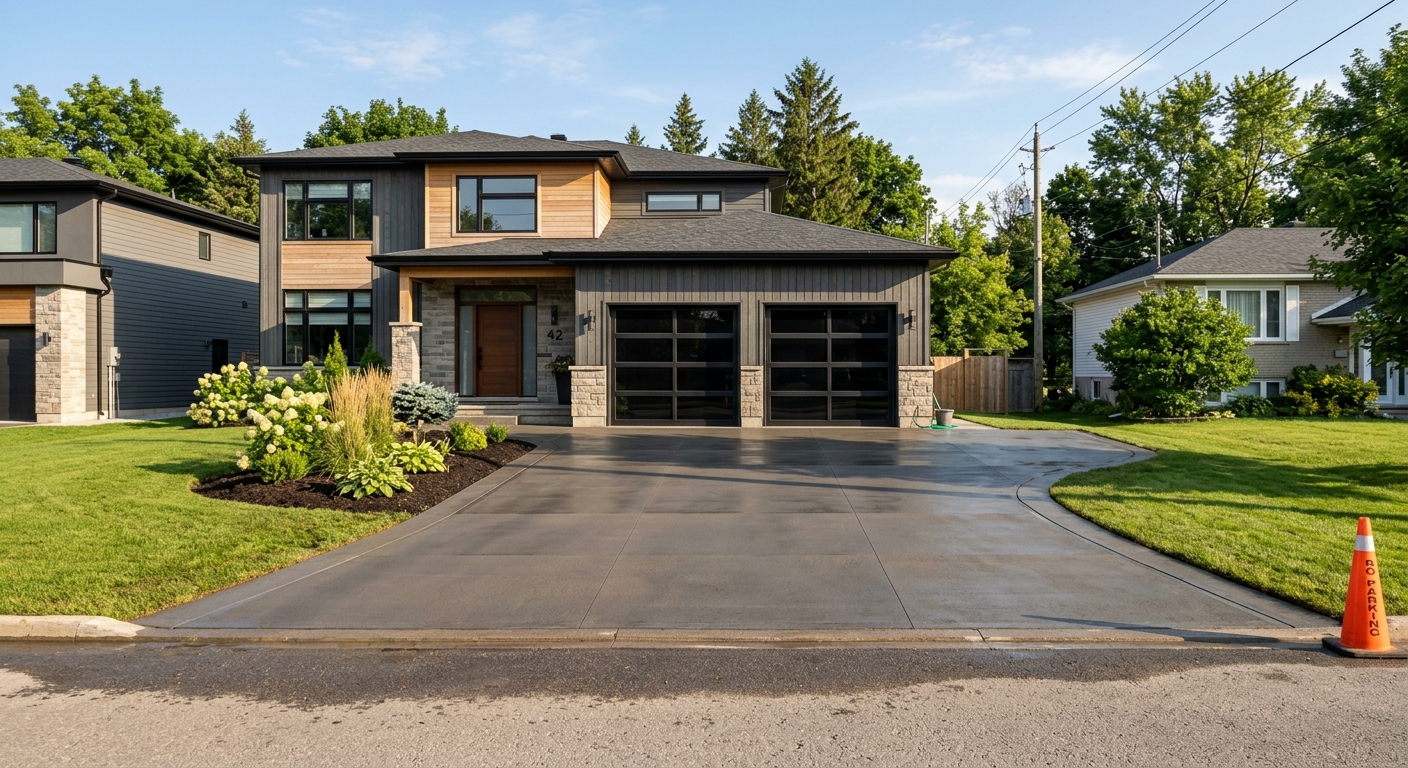
Concrete work options and costs in Parkallen
Parkallen, Alberta is a small community within the Calgary economic region, and it’s a market where concrete flatwork is very practical: driveways, patios, and walkways need to handle long winters and plenty of freeze–thaw. With a population of 2,219 (Statistics Canada, 2021 Census), the pace is steady rather than hectic, so contractors who are organized with scheduling and curing procedures tend to stand out. Parkallen’s housing stock is largely family-oriented and owner-driven, with single-detached homes making up 85.7% of the local dwelling structure mix (Statistics Canada, 2021 Census), which directly supports demand for standard-bred concrete driveways and attached-garage slabs.
In the Calgary area, pricing reflects how frost depth and freeze–thaw cycles change the engineering and placement details. Local practice typically assumes a design frost depth around 1.2 m (about 4 ft), so footings and structural base prep are more intensive than in milder provinces. For exterior flatwork, contractors commonly use air-entrained concrete and plan control joints and curing carefully to reduce spalling and surface scaling. The pour season is also shorter in cold snaps, so late-fall and early-spring pours often require winter-grade mixes, insulating blankets, and sometimes supplemental heating—costs that show up in your estimate.
Within Parkallen, work is especially in demand around newer residential pockets off main access routes where homeowners are adding driveways, replacing older asphalt, or upgrading garage approaches. Next, here’s how the common options typically price out so you can compare quotes apples-to-apples.
| Application |
Typical Size |
Key Spec |
Finish Option |
Price Range |
| Concrete driveway (standard broom finish) |
24 ft x 12 ft (288 sq. ft.) |
Air-entrained exterior mix; reinforced where specified; control joints |
Broom finish |
$12,000–$18,000 |
| Exposed aggregate driveway |
24 ft x 12 ft (288 sq. ft.) |
Air-entrained mix; properly graded base; jointing plan |
Exposed aggregate (cure & wash) |
$14,500–$21,500 |
| Stamped concrete driveway or patio |
24 ft x 12 ft driveway or 12 ft x 16 ft patio (varies) |
Air-entrained mix; densifier/colour system; reinforcement as required |
Stamped pattern + colour |
$15,000–$26,000 |
| Plain concrete patio or walkway |
10 ft x 20 ft (200 sq. ft.) or 3 ft x 12 ft (36 sq. ft.) |
Air-entrained exterior mix; compacted sub-base; edge protection |
Smooth float or light broom |
$5,000–$9,000 |
| Garage floor (interior slab) |
24 ft x 24 ft (576 sq. ft.) |
Vapour barrier (as applicable); reinforcement per design; proper curing |
Float finish + optional hardener |
$12,000–$20,000 |
| Foundation footings (structural, below frost) |
Varies by home footprint |
Engineered footing sizes; poured below design frost depth (~1.2 m regional assumption) |
Structural concrete (no decorative finish) |
$28,000–$45,000 |
Prices are estimates only and vary by project scope, site access and material selection.
What affects the price of concrete work in Parkallen
In Parkallen and across Calgary’s concrete market, two contractors can price the “same” concrete project 30–50% apart because the real work isn’t just the cement—it’s what happens before and after the pour. Quote gaps typically come from excavation and disposal scope, the depth/quality of the granular base, the amount of reinforcement, and whether the contractor is engineering for winter performance. In a freeze–thaw environment, those details matter for durability, and they cost money up front.
First, frost depth drives foundation and footing costs. Local engineering assumes a design frost depth around 1.2 m (about 4 ft), meaning form height, excavation volume, and concrete tonnage increase when compared with shallower regions. Second, freeze–thaw cycles dictate an exterior mix design: exterior flatwork should be air-entrained to survive repeated expansion and contraction. Third, Calgary’s colder placement and curing window can shorten the practical pour season. Cold-weather curing precautions—insulating blankets, tenting, and sometimes heaters—add cost but are often the difference between a driveway that lasts a decade and one that scales early. Finally, de-icing salt accelerates spalling if the slab is under-specified; sealing helps, but it’s not a substitute for correct air content and curing.
In Parkallen, cost can move up or down based on site conditions. For example, if your driveway replacement requires hauling and disposal of unsuitable soil and you need a deeper compacted granular base, you can easily land toward the upper end of $12,000–$18,000 for standard driveways. If you want stamped work, labour time and finish labour typically push you into $15,000–$26,000, especially with colour hardeners and more labour-intensive joints and edges. Conversely, a smaller, well-prepped patio may stay near the $5,000–$9,000 band if the base is straightforward and truck access is easy.
| Price Factor |
Why It Matters |
Cost Impact |
| Frost line depth |
Determines footing depth and form height |
Higher excavation and concrete volume typically add several thousand dollars to structural work |
| Site preparation |
Excavation, grading, compacted granular base |
Unexpected soil removal or low compaction can increase costs materially due to extra material and labour |
| Reinforcement |
Rebar or wire mesh requirement |
Adding steel (and chairs/ties for placement) increases material and labour, but improves longevity |
| Mix design |
Air-entrainment and compressive strength spec |
Winter-grade/air-entrained mixes and higher strength requirements raise material costs |
| Finish type |
Broom vs. stamped vs. exposed aggregate |
Decorative systems increase labour time, tooling, and often include extra products |
| Pour size and concrete truck access to site |
Hauling distance, placement method, and manpower |
Restricted access may require pump/extra finishing crew or additional trips |
| Cold-weather curing precautions |
Heating and blankets |
Shorter pour season means added curing gear and time in shoulder months |
| Control joint pattern and sealing cost |
Limits random cracking and protects against salt |
More joints and sealing add line-item cost, but reduce long-term maintenance |
Permits & regulations in Alberta
In Alberta, structural concrete work—like foundation elements that support the building—typically requires a building permit, and many projects are reviewed using engineered drawings by the municipality before construction proceeds. That includes work such as footings, foundation walls, and grade beams. Concrete flatwork is usually treated differently: patios, walkways, and driveways generally do not require a permit unless they affect lot grading, change stormwater flow, or relate to impervious surface coverage and any right-of-way considerations.
For Parkallen homeowners, the practical step is to confirm scope with your municipality before excavation—especially if you’re changing drainage routes, raising slab elevations, or replacing a driveway that may tie into municipal area requirements. On the contractor side, verify they carry liability insurance and have appropriate worker coverage (WSIB/WCB) so you’re not exposed if something goes wrong during excavation or the pour.
Here’s a simple step-by-step verification routine: (1) ask for the contractor’s certificate of liability insurance—the certificate should list your details as the job/site and show current coverage; (2) request proof of WSIB/WCB coverage (clearance letters or active account confirmation); (3) look up licensing information via Alberta’s public resources for contractor status; and (4) confirm they can provide references for similar footing and slab projects done within the last few years. If they can’t produce documents quickly, that’s a warning sign—especially in Alberta where winter performance depends on proper planning and insured site practices.
Getting concrete right in Parkallen's freeze-thaw climate
Parkallen’s biggest concrete risks are spalling, surface scaling, and random cracking caused by freeze–thaw expansion combined with poor base prep or under-specified mix design. In cold continental climates like Calgary’s, the slab expands when moisture freezes and contracts when it thaws. If air content is too low or curing is rushed, the surface can weaken and “flake,” particularly when homeowners use de-icing salt. Poor base preparation is equally damaging: if the compacted granular sub-base isn’t built to the right depth and doesn’t provide stable support below frost influence, slabs can settle unevenly and crack.
To spec the job correctly, focus on five core points. (1) Base preparation: compacted granular sub-base built to the project requirement and engineered for local soil and frost behaviour. (2) Mix design: air-entrainment is critical; exterior flatwork typically targets about 5–7% air and should be minimum 32 MPa compressive strength for durability. (3) Control joints: create intentional weak lines so cracks form where you can manage them. (4) Curing: plan for at least 7 days of proper curing conditions; in cold weather, insulating blankets or heat may be needed to protect the slab’s early strength development. (5) Sealing: apply a penetrating sealer after curing (commonly at about 28 days) to help repel de-icing salts.
Ask direct questions to avoid the most common failure—spalling from inadequate air-entrainment. For cost realism: upgrading from a plain broom-finished driveway toward exposed aggregate often costs more upfront, but the improved surface texture and finish system can be justified if your contractor is also doing the correct air-entrained mix, jointing, and curing. If a quote difference is driven only by finish (not specs), that’s a red flag—durability should come first, especially here where winters are long.
| Spec |
Why It Matters in Parkallen |
What to Ask For |
Impact if Skipped |
| Compacted granular base (depth?) |
Stable support reduces movement that leads to cracking during freeze–thaw cycles |
Specified granular base thickness and compaction testing/approval approach |
Settlement cracks, uneven slab, and faster deterioration |
| Air-entrained concrete mix (target air %?) |
Protects concrete from freeze–thaw damage and helps prevent surface scaling/spalling |
Target air content around 5–7% for exterior flatwork |
Higher risk of spalling, especially with de-icing salt |
| Compressive strength (MPa rating) |
Ensures the slab reaches adequate strength for durability in winter service conditions |
Minimum 32 MPa specification |
Reduced long-term performance and premature surface wear |
| Control joints (spacing per ACI guidelines) |
Controls where cracks form and limits random cracking under thermal stress |
Joint layout plan and spacing tailored to slab size and geometry |
Random cracks that allow moisture ingress and freeze–thaw weakening |
| Minimum 7-day curing period |
Cold weather slows strength gain; proper curing increases weather resistance |
Protection plan for cold snaps; confirm blanket/heating approach if needed |
Surface scaling, reduced strength development, and durability loss |
| Penetrating sealer (when applied after cure) |
Helps repel salt and moisture from de-icing cycles common in Alberta |
Confirm sealer type and application timing (commonly after about 28 days) |
Faster deterioration from salt intrusion and moisture cycling |
How to choose a concrete work contractor in Parkallen
Start by verifying Alberta compliance and job-site readiness. Ask for a current certificate of liability insurance (ensure it covers the work and is active for the project period). For worker coverage, request proof of WSIB/WCB clearance or an active account confirmation—this protects you if a worker is injured during excavation, rebar placement, or pumping. Then confirm their contractor status using Alberta’s public resources and ask how they manage permits and engineered drawings when structural concrete is involved.
Next, don’t accept vague quotes. Get 2–3 itemised written estimates that break labour and materials separately and list key specs: air-entrained mix, reinforcement plan (if required), base depth, joint layout, curing method, and whether sealing is included. Carefully read what’s excluded: disposal/hauling, frost-proofing allowances, removal of existing asphalt, geotextile/sub-drain provisions, and any permit pull scope. In Parkallen, these omissions are common reasons for budget surprises.
Review warranty and schedule. Look for a workmanship warranty (how long, what it covers, and whether it’s transferable with the property). Product/manufacturer warranty should match what’s being installed. For payment, don’t allow large deposits: keep upfront to 10–15%, then hold back until key milestones are complete. Finally, get the start date and completion estimate in writing, including what happens if a cold snap delays curing.
- Provides a written scope with dimensions, thickness, and reinforcement notes
- Lists concrete mix requirements (air-entrainment and strength) rather than “standard mix”
- Confirms base preparation depth and compaction expectations for your site
- Includes disposal/hauling details for removed concrete/soil (or states it’s excluded)
- Explains curing plan for Alberta temperatures (blankets/heating if near cold thresholds)
- Shows control joint plan and sealing timing (28 days is commonly required)
- Provides proof of liability insurance and WSIB/WCB coverage before signing
- States whether permits are required for any grading or drainage changes
- Includes warranty length for workmanship and product warranty terms
- Uses a milestone-based payment schedule with a holdback
- Has recent references for similar Parkallen/Calgary freeze–thaw projects
- Visits the site or reviews elevations before quoting—no “phone-only” pricing
Concrete red flags in Parkallen include contractors who: promise a finish without discussing air content and jointing, quote a low price while skipping base depth/compaction details, can’t provide insurance/WSIB documentation, pressure you for high upfront deposits, or propose pouring exterior concrete late in cold weather without a written curing/heating plan. These issues are where winter failures start and where rework becomes expensive.
Frequently asked questions — concrete work in Parkallen
What causes concrete to spall in Parkallen winters?
Concrete spalling in Parkallen is usually a freeze–thaw story combined with salt exposure and early-age weaknesses. When water gets into the surface and then freezes, the expansion can break the outer paste—especially if the concrete wasn’t properly air-entrained or if curing was rushed during cold snaps. In Calgary’s climate, exterior slabs are also repeatedly hit by de-icing salts, which can intensify scaling and surface breakdown when the concrete isn’t designed for winter service. Another common cause is inadequate base prep: small movements from an unstable granular base lead to cracking, which then gives moisture a path in.
If you’re comparing quotes near $12,000–$18,000 for a driveway, make sure the lower number isn’t cutting corners on air content, joint spacing, or curing protection. Ask what winter-grade measures they use and how they plan to maintain proper curing before expecting long-term durability.
What is rebar and when is it required in Alberta?
Rebar is reinforcing steel placed inside concrete to help control cracking and improve load capacity, especially for slabs, driveways, and structural components. In Alberta, whether rebar (or wire mesh) is required depends on the design, the slab thickness, expected loads (like vehicles), and the soil/base preparation. For structural work—such as foundation footings—reinforcement is typically engineered and required because these elements carry structural loads and must meet design expectations below the frost influence zone.
For exterior flatwork like driveways and garage approaches in Parkallen, reinforcement may be specified depending on thickness, geometry, and where vehicles turn or park. A reputable contractor will reference the slab design details and explain where steel is placed and supported (chairs/ties), rather than “dropping in mesh” loosely. If a quote ignores reinforcement for a heavier-use driveway, it can undercut the price initially, but it can increase cracking risk later—particularly through Calgary freeze–thaw cycles.
How long does a concrete project take in Parkallen?
Timing depends on what you’re building, how accessible the site is, and the weather. For typical Parkallen exterior flatwork, the critical steps are excavation/base prep, formwork/edges, reinforcement placement (if required), the pour, then curing. The actual pour day can be short, but the full project timeline can stretch because contractors must allow time for proper base work and follow through with curing protection. In winter conditions, cold-weather curing precautions—blankets or heat—can extend the schedule to ensure strength gain and reduce surface scaling risk.
Most driveway and patio projects involve at least several working days end-to-end, with curing requirements shaping when you can return for finishing and safe access. When comparing quotes in the $12,000–$18,000 driveway band or the $5,000–$9,000 patio band, ask how many days they allocate for curing and when you can expect to walk or drive on the slab.
What is a concrete overlay and is it suited to Parkallen?
A concrete overlay is a new concrete layer placed over an existing slab—often to improve appearance and cover surface wear without fully removing the original concrete. In Parkallen, an overlay can be suited when the existing slab is structurally sound (minimal settlement, no major spalling that goes deep, and no significant base failure). If the original slab is already moving or failing due to poor base support, an overlay may hide the problem temporarily while the movement continues underneath.
Overlays require careful surface preparation: cleaning, grinding, and often bonding practices to ensure the new concrete adheres and works as intended. You still need the winter durability specs—air-entrainment, control joints, and curing—because freeze–thaw and salt exposure are still present. Given local engineering around deeper frost influence (regional frost depth assumptions around 1.2 m for structural context), it’s best to have a contractor evaluate the existing slab condition before spending overlay money.
How do I seal concrete to protect it in Parkallen?
Sealing in Parkallen is mainly about repelling moisture and reducing salt-driven surface breakdown. The key is timing and product choice. Most penetrating sealers are applied after the concrete has cured sufficiently—commonly around 28 days—so the slab isn’t still releasing moisture that could interfere with bonding. Prior to sealing, the surface should be clean, dry, and free from dust or curing compounds (depending on what was used).
When contractors quote exterior flatwork, sealing may be included or offered as an add-on. If you’re comparing options around $12,000–$18,000 for driveways, ask whether sealing is part of the package and what type they use (penetrating vs film-forming) and when they plan to apply it. In Alberta freeze–thaw climates, skipping sealing can shorten maintenance intervals, but sealing alone can’t compensate for poor air-entrainment or inadequate curing during the pour.
What is the difference between concrete and cement?
Concrete is the final building material you see and pour: it’s a mixture of cement, water, aggregates (sand and stone), and often admixtures like air-entrainers. Cement is only one component in that mix. In Alberta and across Calgary, when contractors talk about “concrete,” they’re usually referring to the whole engineered mix design—especially important for Parkallen’s exterior projects where air content and winter curing practices affect durability.
That’s why two “concrete” quotes can differ substantially even if the price per square foot sounds close: the cement type, water/cement ratio, air-entrainment target, and the compressive strength requirement are what drive long-term performance under freeze–thaw and de-icing salt. If you want the right spec, ask about the air-entrained mix (typically 5–7% air for exterior flatwork) and the minimum strength (often 32 MPa) rather than focusing only on the term “cement.”