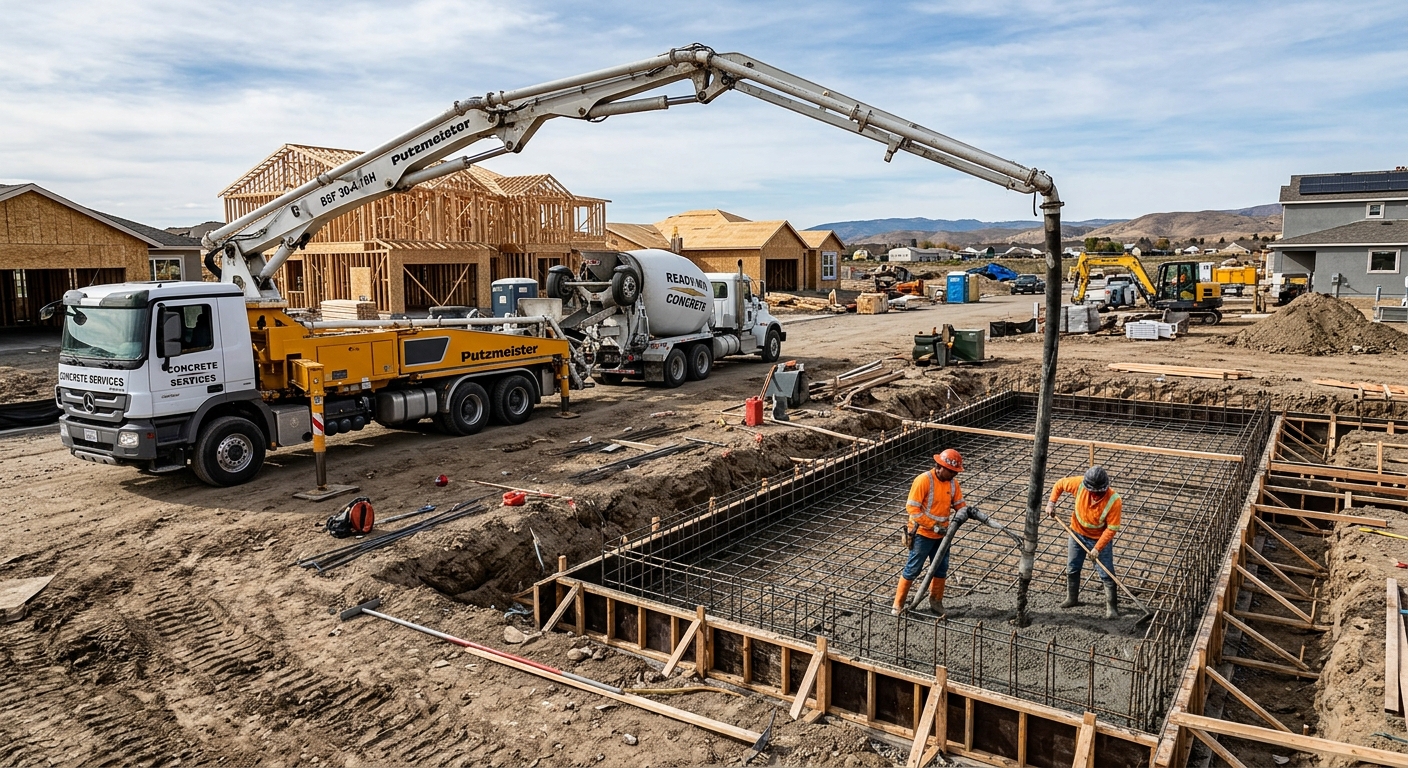
Concrete work options and costs in La Perle
In La Perle, concrete is a practical choice for driveways, patios, walkways and foundations—especially for homeowners building for the long haul. With a population of 5,099 (Statistics Canada, 2021 Census), La Perle is small enough that many concrete crews pull work from the broader Calgary service area, which can affect scheduling and pricing. The majority of local lots are improved with single-detached style home patterns, so surface concrete flatwork demand is steady year to year. That matters because flatwork pricing in the Calgary region is tightly linked to how busy contractors are during the short exterior pour window.
Calgary’s cold continental climate also pushes costs higher than in milder parts of Alberta. Concrete here has to be engineered around a deeper design frost depth (about 1.2 m), freeze–thaw cycles, and a shorter practical pour season for exterior slabs. In winter months, contractors may need winter-grade mixes, insulated blankets, or temporary heat to achieve proper curing—these steps protect against scaling and long-term surface damage. Salt from winter roads and sidewalks is another driver, which is why proper sealing and jointing are emphasized for exterior slabs and driveway aprons.
In La Perle, this trade is especially active for homes near newer development pockets and growing residential streets where driveways, garage floors and backyard patios go in shortly after foundation stages are completed. With those local realities in mind, the table below compares common options and realistic price ranges you’ll see in bids.
| Application |
Typical Size |
Key Spec |
Finish Option |
Price Range |
| Concrete driveway (standard broom finish) |
16 ft x 24 ft (384 sq ft) |
4 in slab, air-entrained, rebar/wire as specified |
Broom finish + control joints |
$12,000–$18,000 |
| Exposed aggregate driveway |
16 ft x 24 ft (384 sq ft) |
Air-entrained, vibrated, special aggregate mix |
Exposed aggregate + sealer |
$15,000–$22,000 |
| Stamped concrete driveway or patio |
12 ft x 18 ft (216 sq ft) |
Air-entrained, integral colour, release system |
Stamp pattern + border saw cuts |
$15,000–$26,000 |
| Plain concrete patio or walkway |
10 ft x 20 ft (200 sq ft) |
4 in thick, granular base + control joints |
Float/trowel with light broom |
$5,000–$9,000 |
| Garage floor (interior slab) |
22 ft x 22 ft (484 sq ft) |
4 in slab, vapour barrier as required, fibre or mesh |
Standard float + light finish |
$6,500–$12,000 |
| Foundation footings (structural, below frost) |
Typical house/garage footprint |
Engineered size, excavation to undisturbed soil |
Structural concrete + rebar |
$28,000–$45,000 |
Prices are estimates only and vary by project scope, site access and material selection.
What affects the price of concrete work in La Perle
In La Perle and across the Calgary region, quotes for the “same” concrete project can swing by 30–50% because concrete pricing isn’t just about slab thickness—it’s about what the site demands before the truck even arrives. The biggest drivers are frost depth engineering, how much excavation and base prep is required, the reinforcement spec, and how much time it takes to place and cure the concrete correctly in cold-weather conditions. When crews are busy, scheduling and mobilization also move the number.
Here in Calgary’s cold continental climate, the design frost depth is about 1.2 m. That means footings, grade beams and any exterior structural support must bear below frost to reduce frost heave and seasonal movement. Exterior flatwork must be built with air-entrained concrete mixes to survive the freeze–thaw cycle and control joints spaced to manage shrinkage cracking. In colder weeks, contractors may use winter-grade mixes, insulating blankets, and sometimes temporary heat so concrete can reach the early strength needed to resist early-age damage. Salt exposure from winter road maintenance can also accelerate surface spalling, so sealing decisions become cost-effective long-term.
Two practical examples from La Perle help explain the variation. First, a driveway on heavy clay or poor drainage typically needs more excavation and deeper granular base; that can push a standard broom driveway (often in the $12,000–$18,000 range) toward the upper end. Second, a stamped concrete patio that starts around the $15,000–$26,000 band can rise further if the sub-base requires additional rebuild or if you want tighter patterns that increase labour and formwork time. Even small timing differences—pouring early spring vs. late fall—can change labour and curing add-ons by hundreds to a few thousand dollars.
| Price Factor |
Why It Matters |
Cost Impact |
| Frost line depth — determines footing depth and form height |
Footings must extend below design frost to prevent heave and seasonal movement |
Can add major excavation/formwork cost; often shifts foundation pricing within the $28,000–$45,000 band |
| Site preparation — excavation, grading, compacted granular base |
Stability depends on removing unsuitable soils and building a proper compacted base |
Labour + disposal can raise driveway/patio costs by 10%–25% on challenging lots |
| Reinforcement — rebar or wire mesh requirement |
Engineered slabs and thicker exterior sections need appropriate crack control and load capacity |
Adds material and placement labour; can change price by $500–$3,000 depending on spec |
| Mix design — air-entrainment and compressive strength spec |
Freeze–thaw durability relies on air entrainment and meeting required strength |
Winter/cold-weather mixes can raise per-cubic-yard cost and truck minimums |
| Finish type — broom vs. stamped vs. exposed aggregate |
Decorative work requires specialized labour, timing, and added materials |
Stamped/exposed options typically move projects into the higher bands ($15,000–$26,000 for larger patios/driveways) |
| Pour size and concrete truck access to site |
More concrete + difficult access means more handling time and possible pumping/extra equipment |
Access issues can add $1,000–$5,000 depending on distance and pumping needs |
| Cold-weather curing precautions — heating and blankets |
Correct curing in Alberta winter conditions reduces scaling and long-term deterioration |
Can add several hundred to several thousand dollars; more common in late fall/early spring |
| Control joint pattern and sealing cost |
Jointing manages cracks; sealing helps repel de-icing salts and reduces spalling risk |
Small-line-item costs, but often worth it to extend service life of exterior slabs |
Permits & regulations in Alberta
In Alberta, structural concrete work typically requires a building permit, and many foundation designs also involve engineered drawings reviewed as part of the municipal process. That generally includes footings, foundation walls, and grade beams—any portion of the foundation that supports the building structure. Concrete flatwork like patios, walkways and driveways often does not require a permit, unless it impacts lot grading, drainage plans, impervious surface limits, or municipal right-of-way requirements (for example, work that touches boulevard areas or changes drainage patterns). In La Perle, it’s still smart to confirm with the local authority before breaking ground—especially if you’re changing slopes, adding stairs, or tying into existing drainage infrastructure.
Before you hire, verify your contractor carries liability insurance and WSIB/WCB coverage (required for trades and workers depending on the scope). Step-by-step for La Perle homeowners:
- Ask for the contractor’s certificate of liability insurance and ensure it matches the legal business name.
- Request WSIB/WCB clearance information (or proof of active coverage) before start.
- Confirm any municipal permit responsibilities in writing (who pulls the permit, if applicable).
- For licensing: look up the contractor and business registration through appropriate Alberta online resources and ensure the entity name matches the quote/contract.
- Check references on similar jobs (driveways/patios or foundations) done in Calgary-area freeze–thaw conditions.
When in doubt, ask your contractor to explain exactly what is included—permit support, engineering paperwork, and inspection touchpoints for structural concrete.
Getting concrete right in La Perle's freeze-thaw climate
Concrete failures in La Perle are usually about durability details, not basic workmanship alone. In a freeze–thaw environment, the top drivers are insufficient base preparation, the wrong concrete mix (especially air-entrainment), poor curing, and inadequate jointing/sealing. When water gets into surface pores and joints, it expands as it freezes. That’s how you get scaling and spalling, even when the slab “looks fine” the first winter or two.
To spec correctly for Calgary-area performance, the job should include: (1) base preparation with a compacted granular sub-base built to the required depth for local soil conditions and frost considerations; (2) a mix design with air-entrainment suitable for exterior exposure—commonly in the 5%–7% air range—plus meeting at least a 32 MPa compressive strength requirement; (3) control joints placed to limit random cracking so cracks land where you can maintain them; (4) curing for a minimum of 7 days under proper conditions, with cold-weather measures like insulated blankets or temporary heat when temperatures drop; and (5) penetrating sealer applied after full cure (typically around 28 days) so the surface repels de-icing salts.
These choices protect your investment. For example, if a broom-finished driveway is bid at the $12,000–$18,000 range, choosing decorative stamping doesn’t automatically make it stronger—it mainly changes appearance and workmanship complexity. The real durability value comes from correct mix and curing; skipping air-entrainment may save short-term, but it often costs more later due to surface scaling and early repairs.
If you want fewer headaches, ask the contractor to show you how they’ll address spalling risk: air content targets, curing plan for the pour date, and a joint/sealing approach designed for winter salt exposure.
| Spec |
Why It Matters in La Perle |
What to Ask For |
Impact if Skipped |
| Compacted granular base (depth?) |
Stable support reduces settlement and cracking under freeze–thaw movement |
Compaction method and target sub-base depth based on your soil conditions |
Settlement-driven cracking, voids under slab, and early edge deterioration |
| Air-entrained concrete mix (target air %?) |
Air voids protect paste from freeze–thaw damage and surface scaling |
Target air range (commonly 5%–7% for exterior flatwork) and mix documentation |
Spalling/scaling risk increases significantly after winters with salt |
| Compressive strength (MPa rating) |
Strength supports loads and reduces early-age vulnerability |
Minimum 32 MPa rating and confirmation it matches project specs |
Higher risk of damage during curing and reduced long-term performance |
| Control joints (spacing per ACI guidelines) |
Regulates cracking so it doesn’t become random and uneven |
Joint layout plan and spacing appropriate for slab thickness and dimensions |
Uncontrolled cracking, water infiltration, and more difficult repairs |
| Minimum 7-day curing period |
Early strength gain is essential in a cold climate where temps can swing |
Curing method and how they protect the slab during cold snaps |
Surface damage, weakness at edges, and potential long-term durability issues |
| Penetrating sealer (when applied after cure) |
Helps repel de-icing salts and limits moisture movement into the surface |
Penetrating sealer plan applied after cure (commonly around 28 days) |
Faster surface deterioration and higher maintenance/patching costs |
How to choose a concrete work contractor in La Perle
Choosing the right contractor in La Perle is about proof, not promises. Start with Alberta compliance: ask for their certificate of liability insurance and confirm it’s active for the policy term covering your project dates. For worker protection, request proof of WSIB/WCB coverage (or clearance where applicable) before work begins. Then verify their business identity matches the quote and contract—so you’re not dealing with a mismatch between the company that bid and the company doing the work.
Next, get 2–3 itemised written quotes. You want labour and materials broken out (concrete volume, rebar/wire, excavation, base materials, finishing labour, jointing and sealing). A common problem in Calgary-area pricing is that some bids include everything up front while others hide key items in “allowances.” Ask whether a permit is included if structural work is involved, and whether disposal, site cleanup, and protection of adjacent landscaping are part of the scope.
Warranty is another area where differences show up. Ask for the workmanship warranty length, what it covers (often surface scaling and minor cracking management), whether any product manufacturer warranties apply, and whether warranties are transferable if you sell the property.
Finally, payment scheduling matters. Never pay more than 10%–15% upfront. Hold back a portion until the final grade, finish, joints, and cleanup are complete. Insist on a written timeline with the start date, curing/weather contingency plan, and a realistic completion estimate—especially important in late fall/early spring when freezing nights can disrupt curing.
- Confirm liability insurance and WSIB/WCB coverage before signing.
- Use itemised quotes (labour, materials, disposal, and finishes separated).
- Ask for concrete mix details: air-entrainment and specified compressive strength.
- Request the joint layout plan and spacing rationale for cracking control.
- Verify base prep requirements: excavation limits, granular base, and compaction method.
- Ensure finishing plan matches exposure: broom vs stamped vs exposed aggregate.
- Ask how they handle cold-weather curing (blankets/heat) and who decides when conditions are met.
- Confirm sealing is included or excluded, and when it would be applied after cure.
- Check whether truck access, pumping, or hauling distances are accounted for.
- Get a written warranty and clarify what maintenance/re-caulking is expected.
- Review payment milestones tied to inspection and completion—not “final invoice on day one.”
- Require a start date and a completion window in writing.
Concrete red flags I commonly see in La Perle include: refusing to discuss air-entrainment targets, no written joint plan, vague curing protection during cold weather, “lump sum only” quotes without excavation/base detail, and warranties that don’t specify what will be repaired if spalling or premature cracking shows up.
Frequently asked questions — concrete work in La Perle
When is the best time to pour concrete in La Perle?
For La Perle, the best time is typically late spring through early fall, when daytime temperatures support proper curing and you can meet the early strength requirements without expensive winter measures. In Calgary-area conditions, freeze–thaw cycles are frequent, so pouring too late in the season can force contractors to add insulated blankets or temporary heat. That raises costs and can still increase the risk of surface scaling if curing is rushed. If you’re comparing options, a plain patio or walkway often fits the $5,000–$9,000 band when conditions are right; decorative or driveway work can drift toward the higher end when winter protection is required. Ask your contractor to commit to a curing plan based on your pour date and the forecast—not just the calendar.
How long does concrete take to cure?
Concrete curing has two phases that homeowners often mix up. You’ll usually see “finish-ready” strength within 24–48 hours for typical pours, but true durability comes from continued curing under proper conditions. In Alberta’s freeze–thaw climate, we plan for at least a 7-day curing period with good temperature control so the concrete develops enough early strength. Full curing generally takes longer (commonly around 28 days) before you apply a penetrating sealer designed to repel de-icing salts. That sealer timing matters—sealing too early can trap moisture and reduce performance. If you’re budgeting, this schedule can affect when you can safely use your driveway or patio; for many projects in the $12,000–$18,000 driveway range, the “usable” timeline influences driveway access during construction and curing.
Do I need a permit for concrete work in Alberta?
In Alberta, structural concrete work like footings, foundation walls, and grade beams usually requires a building permit and often engineered documentation reviewed through the municipality. Concrete flatwork—patios, walkways and driveways—often doesn’t require a permit unless it affects lot grading, drainage, impervious surface limits, or municipal right-of-way conditions. For La Perle homeowners, the safest approach is to ask your contractor what portion is considered structural versus decorative/flatwork and whether any municipal approvals are required for your specific lot and drainage. A concrete quote should state who is responsible for permits if any are triggered. Before breaking ground, confirm with the local authority so you’re not surprised by inspection requirements later.
Concrete vs pavers for a patio in La Perle?
Both can work well, but concrete usually wins when you want a solid, smooth surface that holds up well to Alberta’s salt exposure and freeze–thaw cycles—if it’s built with the right air-entrained mix, proper base compaction, and control joints. Pavers can be easier to repair in small sections and offer design flexibility, but they still rely on well-draining base layers and correct jointing between units. Cost-wise, a plain concrete patio or walkway commonly lands around the $5,000–$9,000 band depending on size and base prep needs. If you want a high-end look, stamped concrete usually moves into the higher range (often $15,000–$26,000 for larger stamped areas). The best choice depends on your budget, desired appearance, and how your yard drains during spring melt.
How long does a concrete driveway last?
A well-built concrete driveway in La Perle commonly lasts 20–30 years, sometimes longer, but the lifespan depends heavily on freeze–thaw durability details. In Calgary-area winters, air-entrained concrete, properly compacted base, correct joint spacing, and timely curing are what prevent early scaling and spalling. Sealing after the concrete has cured (often around 28 days) helps repel de-icing salts, which can otherwise accelerate surface deterioration. Driveway longevity also depends on traffic loads and how water drains off the edges—standing meltwater can worsen freeze damage. If your driveway budget is in the $12,000–$18,000 range, ask what’s included for base prep, reinforcement, joint pattern, and sealing so you’re comparing durability, not just thickness.
What is air-entrained concrete and why does it matter here?
Air-entrained concrete is mixed with microscopic air bubbles that provide room for freezing water to expand without damaging the cement paste. In La Perle and the wider Calgary economic region, freeze–thaw cycles are a constant threat, and de-icing salts can push moisture movement at the surface. That combination makes air-entrainment essential for exterior flatwork like driveways, patios and walkways. Typical exterior targets are often in the 5%–7% air range, along with a specified compressive strength (commonly at least 32 MPa). If a contractor cuts corners on air content or curing, you may see scaling or spalling within a few winters—even if the slab still looks solid initially. When you request quotes, ask them to state the air-entrainment target and the cold-weather curing plan for your pour date.