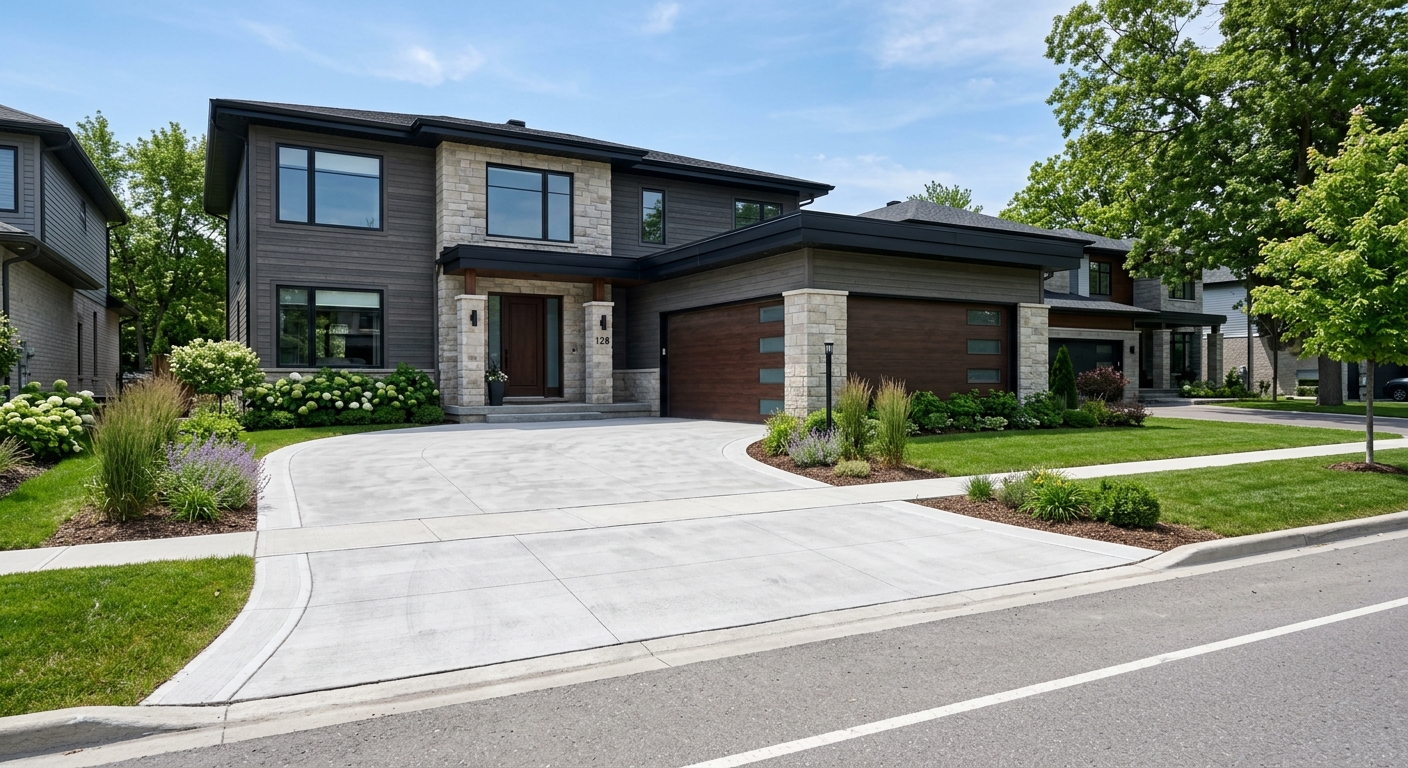
Concrete work options and costs in Camrose
Concrete contractors in Camrose help homeowners protect one of their biggest investments: driveways, patios, walkways, garage slabs and foundations. In Camrose, where about 62.4% of dwellings are single-detached homes (Statistics Canada, 2021 Census), exterior flatwork is especially in demand—particularly in winter-proofing projects around older neighbourhoods and established streets. Camrose–Drumheller’s cold continental winters also push costs higher than in milder parts of Canada. With a frost line around 1.2 m, structural footings and any foundation-related concrete must be placed below the design frost depth to prevent frost heave, which means more excavation, more forming and more concrete volume. Freeze–thaw cycles then demand exterior durability specs: air-entrained concrete mixes, proper drainage and correctly spaced control joints to manage cracking from temperature swings.
Demand tends to be concentrated near high-traffic residential areas such as the Eastview and Westview parts of town, where homeowners commonly update driveways and entry paths to handle icy conditions. The shorter pour season—from late spring to early fall—also tightens scheduling and affects unit costs, because winter work (or shoulder-season pours) may require heated enclosures, insulated blankets and slower finishing for safe placement. On the foundation side, almost half the housing stock was built before 1981 (Statistics Canada, 2021 Census), so re-lifts, repairs and foundation upgrades show up regularly, especially when drainage has changed.
Below are typical budget ranges homeowners in Camrose can expect, moving from basic broom-finished driveways up to decorative options.
| Application |
Typical Size |
Key Spec |
Finish Option |
Price Range |
| Concrete driveway (standard broom finish) |
16 ft × 24 ft (384 sq ft) |
Air-entrained exterior mix, compacted granular base, control joints |
Broom finish, basic sealer optional |
$7,500–$10,800 |
| Exposed aggregate driveway |
16 ft × 24 ft (384 sq ft) |
Air-entrained exterior mix, proper curing to expose aggregate |
Exposed aggregate surface |
$10,500–$15,500 |
| Stamped concrete driveway or patio |
12 ft × 20 ft (240 sq ft) |
Air-entrained mix, integral colour, control joints |
Stamped pattern (field + border) |
$6,200–$9,600 |
| Plain concrete patio or walkway |
10 ft × 16 ft (160 sq ft) |
Air-entrained mix, compacted base, drainage slope |
Float + broom edge, lightly textured surface |
$2,000–$3,200 |
| Garage floor (interior slab) |
20 ft × 22 ft (440 sq ft) |
Vapour barrier (as required), mesh or rebar, proper subgrade compaction |
Light broom / smooth trowel as specified |
$7,200–$11,200 |
| Foundation footings (structural, below frost) |
Varies by house; typical per linear ft |
Excavation below frost depth, forming, reinforcing, waterproofing details if required |
Structural concrete, poured below grade |
$180–$260 |
Prices are estimates only and vary by project scope, site access and material selection.
What affects the price of concrete work in Camrose
In the Camrose–Drumheller region, two contractors can quote noticeably different prices for what sounds like the same job—often 30–50%—because the “real work” is in the hidden parts: excavation, base prep, frost-protected depth, and the cold-weather steps needed for curing. A 384 sq ft driveway can look similar on paper, yet costs swing based on how deep the granular base is placed, how much rebar is required, whether the contractor is using a true air-entrained exterior mix, and how well drainage is handled so water can’t freeze under the slab.
Frost line depth and freeze–thaw cycles dictate the specs in this part of Alberta. Exterior footings and foundation pours must be set below the frost line (commonly around 1.2 m locally), which drives deeper excavation, taller forms and higher concrete quantities than you’d see farther south. Exterior flatwork also needs air-entrainment to resist scaling and spalling through repeated freezing and thawing. The short pour season—from late spring to early fall—can compress schedules and raise unit costs, because winter work usually requires heating, insulated blankets and slower placement. Plus, de-icing salt accelerates surface damage; that’s why sealing is often recommended as part of a durable system.
For example, a broom-finished driveway may land near the $14–$22 per sq ft band for properly prepared exterior work, but an exposed aggregate or stamped option pushes higher labour and material costs. On a foundation-side project, deeper excavation below design frost depth can add thousands versus a “surface patch” approach—especially when soil conditions require extra granular backfill and compaction. If your home was built before 1981, drainage may have changed over time, and that can affect base conditions and the amount of removal/renewal required—ultimately influencing your total budget.
| Price Factor |
Why It Matters |
Cost Impact |
| Frost line depth — determines footing depth and form height |
Ensures structural concrete is below the frost movement zone to prevent heave |
Can increase costs by several thousand dollars on foundation work due to deeper excavation and forming |
| Site preparation — excavation, grading, compacted granular base |
Controls settlement and prevents moisture trapping under slabs |
Major driver; poor base prep often forces later repairs, raising long-term cost |
| Reinforcement — rebar or wire mesh requirement |
Improves slab strength and crack control, especially under driveways |
Adds material and labour; often shifts pricing by hundreds to over a thousand |
| Mix design — air-entrainment and compressive strength spec |
Air-entrainment helps resist freeze–thaw scaling and spalling |
Usually a modest price increase but big durability payoff |
| Finish type — broom vs. stamped vs. exposed aggregate |
Decorative finishes require additional labour, tools and controlled curing/exposure |
Commonly moves driveway budgets from broom ranges toward stamped/exposed premium ranges |
| Pour size and concrete truck access to site |
Controls batching/delivery efficiency and labour time for placement |
Tight access can add pump/placing time or extra crew hours |
| Cold-weather curing precautions — heating and blankets |
Ensures proper strength gain when temperatures are low |
Can add significant line-item cost in shoulder-season or winter pours |
| Control joint pattern and sealing cost |
Limits random cracking and protects against salt-related surface deterioration |
Small compared to concrete volume, but often changes the system’s lifespan |
Permits & regulations in Alberta
In Alberta, structural concrete work typically needs a building permit, and municipalities often require engineered drawings for things like foundations. That usually includes footings, foundation walls, grade beams and other primary structural elements designed to carry loads. For concrete flatwork—like patios, sidewalks, driveways and garage slabs—permits are often not required unless the project affects lot grading, stormwater management, or impervious surface/driveway placement within municipal requirements. If your plan ties into drainage changes, regrades a yard, or impacts lot drainage flow, it’s smart to check before breaking ground.
Step-by-step, here’s how a Camrose homeowner can verify a contractor is properly covered in Alberta:
- Ask for a copy of their liability insurance certificate (COI) showing the current coverage term and the insured business name.
- Confirm they have Workers’ Compensation coverage (WSIB/WCB as applicable) so you aren’t stuck with worker-related costs if an injury happens on site.
- Check that they carry the right endorsements for concrete work (not just general contracting), and request proof rather than “we have coverage.”
- Ask for references on similar-scale projects (driveways around similar size, or foundation/footing work below frost depth), and follow up with at least one recent customer.
- Get the permit approach in writing: whether the contractor will pull the permit, or whether you will, and who is responsible for inspections.
When you’re ready, we recommend you verify these items before scheduling the pour—especially in Camrose, where the cold-weather window affects timelines and site protection requirements.
Getting concrete right in Camrose's freeze-thaw climate
Concrete failure in Camrose usually comes down to one of five things: moisture, inadequate base preparation, insufficient durability in freeze–thaw conditions, poor jointing, or curing problems. To spec the job correctly, start with the base: a compacted granular sub-base placed to the right depth for local soils and frost conditions, with the correct slope and drainage so water can’t sit beneath the slab. Next, the mix design should be air-entrained for exterior flatwork—commonly in the 5–7% air range—so the concrete can tolerate freeze–thaw cycles without scaling and spalling. For strength, exterior slabs should meet a minimum compressive strength such as 32 MPa (or higher where required by the project spec).
Third, control joints are what you can plan for. In Alberta temperature swings, joints placed at an appropriate spacing limit random cracking and give the slab a “preferred crack” path. Fourth, curing is where many DIY or corner-cut quotes fall apart. In Camrose, low temperatures slow strength gain, so you need at least 7 days of proper curing conditions, and when it’s cold, the contractor should protect and heat/insulate as needed to keep the pour curing safely.
Finally, sealing matters for salt exposure: apply a penetrating sealer after the concrete has fully cured (often around 28 days post-pour) so de-icing salts don’t accelerate surface breakdown. Ask your contractor specific questions about air-entrainment, base depth, joint spacing, curing protection, and whether they’ll provide proof the mix meets the stated strength. For example, if stamped concrete costs you an extra $6,200–$9,600 for a typical 240 sq ft area versus a broom-finished slab in the $14–$22 per sq ft band, it’s usually justified by the finish. If the contractor can’t clearly explain the durability specs, though, skip the decorative upgrade and invest in the base, air-entrainment and joints first.
| Spec |
Why It Matters in Camrose |
What to Ask For |
Impact if Skipped |
| Compacted granular base (depth?) |
Prevents settlement and keeps water from freezing under the slab in winter |
Documented excavation depth and compacted granular layer thickness, plus compaction testing/verification |
Premature cracking, uneven settlement and potholes |
| Air-entrained concrete mix (target air %?) |
Reduces freeze–thaw damage and scaling in Camrose’s cold winters |
Confirm air content target (commonly 5–7% for exterior flatwork) and that it’s air-entrained |
Surface spalling and scaling within a few winters |
| Compressive strength (MPa rating) |
Ensures slab strength gain for load and durability under freeze–thaw |
Minimum 32 MPa (or project-required higher spec) stated on the quote |
Higher risk of early wear, scaling and cracking |
| Control joints (spacing per ACI guidelines) |
Manages temperature-related shrinkage and movement |
Joint spacing and layout plan before the pour, including how joints align with driveway features |
Random cracking and difficult-to-repair damage |
| Minimum 7-day curing period |
Cold weather slows strength gain, increasing the chance of damage if cured too quickly |
How they will protect the slab during curing (covers, heat/insulation if needed) |
Surface weakness, increased cracking risk, reduced long-term performance |
| Penetrating sealer (when applied after cure) |
Repels salt and water intrusion that worsens freeze–thaw deterioration |
Sealer type and application timing (often after full cure, commonly around 28 days post-pour) |
Faster surface breakdown and higher maintenance needs |
How to choose a concrete work contractor in Camrose
Choosing the right concrete contractor in Camrose starts with coverage and clarity. In Alberta, verify liability insurance by requesting a current certificate of insurance listing the contractor’s legal business name and coverage dates. Then confirm Workers’ Compensation coverage (WSIB/WCB as applicable) so your property isn’t exposed to liability if someone is injured on site. If they can’t provide certificates quickly, treat that as a warning sign.
Next, get 2–3 itemised written quotes. You want a labour and materials breakdown, not just a lump sum, so you can compare base preparation scope, reinforcement, mix specifications, truck access method and curing protection. Read the exclusions carefully: is demolition included, is spoil removal/disposal included, is saw-cutting and jointing included, and who is responsible for any permit work if it’s required for your foundation or drainage-related scope? Make sure the quote includes protection of the slab during curing (especially in cold snaps) and whether sealing is included as a scheduled line item.
Warranty is another area where homeowners get surprised. Ask for the workmanship warranty length (how long they stand behind cracking/spalling) and whether any product/manufacturer warranty applies to admixtures, curing compounds, or decorative overlays. Confirm if warranties are transferable to a future buyer.
Finally, payment terms: never pay more than 10–15% upfront. Use a holdback until the job is complete and accessible for your inspection.
- Ask for start date, curing plan and completion estimate in writing.
- Confirm air-entrained mix for exterior flatwork and the target specification.
- Ask for base depth and compaction method, not just “granular base.”
- Confirm reinforcement plan (mesh vs rebar, thickness, and placement).
- Review joint spacing and show you the layout.
- Ask whether the contractor will protect the slab for at least 7 days of curing conditions.
- Clarify disposal: demolition debris removal and concrete haul-off.
- Confirm truck access plan and whether pumping is included if needed.
- Request photos of similar completed work in Camrose or nearby communities.
- Ask for a line item on sealing (if included) and the timing (often around 28 days post-pour).
- Check that the quote includes drainage details (slopes, tie-ins, and downspout management where relevant).
- Ensure the warranty details are written and not just “we stand behind our work.”
Red flags in Camrose: vague quotes that don’t specify air content or curing protection; “we’ll pour whenever” without a cold-weather plan; no proof of insurance/Workers’ Compensation; skipping control joints or joint sealing discussions; and promises of decorative results without describing the base, reinforcement and curing method. If you’re comparing pricing, remember that broom-finished driveway budgets often sit around the $14–$22 per sq ft band—if a quote is drastically below that without explaining the trade-offs, be cautious.
Frequently asked questions — concrete work in Camrose
How deep must footings be for Camrose's frost line?
In Camrose, footings must be placed below the local design frost depth to prevent frost heave and movement. In this part of Alberta, a frost depth around 1.2 m is commonly used as a reference point for planning excavation depth, though your exact depth can vary based on soil conditions, foundation design and engineering requirements. Structural concrete for footings and foundation elements typically requires a permit and engineered drawings reviewed for compliance, so the final footing depth should come from that design. When you’re getting quotes, ask the contractor to confirm excavation depth aligns with the engineered spec and that they’re forming/pouring below frost, not “close enough.”
Why does concrete crack in Camrose and how is it prevented?
Cracking is normal in concrete because it shrinks as it cures and expands/contracts with temperature changes—Camrose’s freeze–thaw cycles make that movement more noticeable. Cracks often start when the slab isn’t tied to a durable plan: weak or wet base preparation, inadequate air-entrainment, poor drainage, or joints that are missing or poorly spaced. Prevention comes from a system: compacted granular base, air-entrained exterior mix, correct reinforcement placement, and control joints set at an appropriate spacing so the slab cracks where you want it. After curing, sealing helps protect the surface from salt impacts. If you’re budgeting, remember that an exterior driveway with proper specs may align with the $14–$22 per sq ft band—cutting corners on joints or air content is what leads to early cracking and repair.
Stamped vs broom-finish concrete — cost difference?
Stamped concrete costs more because it adds colour, stamping labour and extra steps to control the surface texture and finishing timing. In Camrose, homeowners often compare stamped work to a broom-finished driveway or patio because both look good when done right—but stamped requires more production time and usually a tighter finishing window in cold-stretch conditions. A broom-finished exterior driveway is commonly budgeted in the $14–$22 per sq ft range, while decorative options typically push into the $20–$35 per sq ft band for stamped and decorative concrete (depending on site prep and design complexity). A practical rule: if your base, drainage and joint plan aren’t solid, spend your first dollars there—not on the stamp. Decorative finishes will only last if the underlying slab system is built for freeze–thaw durability.
When is the best time to pour concrete in Camrose?
The best window in Camrose is generally late spring through early fall, when temperatures support proper curing without excessive heating and insulating. Cold snaps reduce concrete strength gain rate, which increases the risk of surface damage if protection isn’t planned. For that reason, contractors often schedule pours to avoid late fall conditions where blankets, heaters and slower curing become necessary. If you must pour near colder weather, reputable crews will propose a cold-weather curing plan (enclosures, blankets, temperature monitoring) to achieve the design strength. For homeowners, the best approach is to plan in advance and get quotes early so your contractor can secure scheduling—because the short pour season can raise unit costs when demand is high.
How long does concrete take to cure?
Concrete curing time depends on temperature and the mix design, but for typical exterior work in Alberta, a minimum curing period of at least 7 days is commonly required for safe strength development, especially under winter-risk conditions. That doesn’t mean the slab is fully ready on day 7 for every use, but it’s the minimum practical benchmark for durability protection during the critical early phase. Decorative finishes and moisture-sensitive details often require more time for performance stability. For sealing, many homeowners choose penetrating sealers applied after full cure—commonly around 28 days post-pour—so the concrete is dry enough and ready to accept sealer without trapping moisture. Ask your contractor what their curing plan is, whether they’ll protect the slab if temperatures drop, and how they’ll verify conditions during curing in Camrose.
Do I need a permit for concrete work in Alberta?
Often, yes for structural concrete, and typically no for simple flatwork—though it depends on the scope. In Alberta, structural concrete work such as footings, foundation walls and grade beams usually requires a building permit, and engineered drawings may be required to be reviewed. For concrete flatwork like patios, walkways and driveways, permits usually aren’t required unless the work affects lot grading, stormwater management, or municipal impervious surface/right-of-way requirements. Since rules can change based on how the work impacts drainage and the site, confirm with the relevant municipal authority before starting. On top of permits, verify the contractor’s liability insurance and Workers’ Compensation coverage, and ask for proof they’re working legally and safely on projects in Camrose.