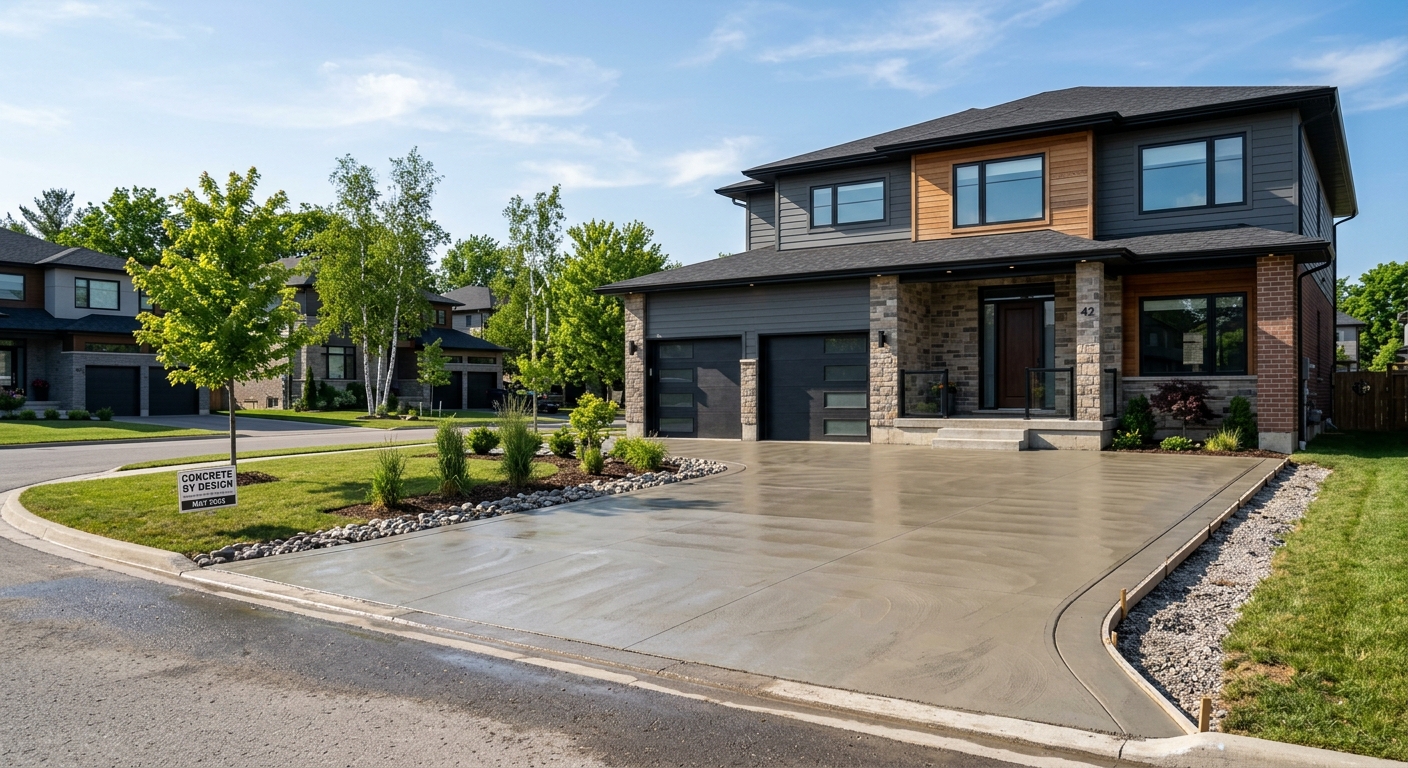
Concrete work options and costs in Gariepy
Gariepy homeowners typically choose concrete because it performs well for years when it’s engineered for Calgary’s deep frost and constant freeze–thaw. Gariepy has a population of 1,882 (Statistics Canada, 2021 Census), and most local demand comes from owner-occupied residential streets where driveways, patios, and walkways are a major part of curb appearance. In the broader Calgary economic region, single-detached and similar homes drive steady demand for flatwork—so contractors here tend to be busy, which can affect scheduling windows and material availability.
Costs in this area are shaped by frost depth and the practical pour season. Calgary-area design practice commonly assumes a frost depth around 1.2 m (roughly 4 ft), so exterior footings and any structural base elements generally require deeper excavation than many warmer markets. Freeze–thaw cycles also mean every exterior slab should be air-entrained, with a well-compacted granular base and properly spaced control joints to reduce cracking and spalling. When you add Calgary’s colder months—where cold-weather placement often requires winter-grade curing blankets or temporary heat—the price can move quickly between “simple” and “engineered” scopes.
In Gariepy, concrete work is especially in demand in established residential pockets near active infill and renovation zones—areas where driveways get replaced, patios are added, and backyard walkways connect to garages and decks. If you’re comparing options now, the table below gives a realistic range for common projects, then we’ll break down what most often drives those differences.
| Application |
Typical Size |
Key Spec |
Finish Option |
Price Range |
| Concrete driveway (standard broom finish) |
24 ft x 10 ft (240 sq. ft.) |
Air-entrained exterior concrete, control joints, compacted granular base |
Broom finish |
$12,000–$18,000 |
| Exposed aggregate driveway |
24 ft x 10 ft (240 sq. ft.) |
Air-entrained mix, proper curing to support aggregate exposure |
Exposed aggregate |
$14,500–$21,500 |
| Stamped concrete driveway or patio |
20 ft x 15 ft (300 sq. ft.) |
Air-entrained exterior mix, colour hardener/antiquing as selected |
Stamped pattern + integral colour or hardener |
$15,000–$26,000 |
| Plain concrete patio or walkway |
12 ft x 16 ft (192 sq. ft.) |
Air-entrained exterior concrete, compacted base, joints as required |
Float/wood finish with light broom edges |
$5,000–$9,000 |
| Garage floor (interior slab) |
22 ft x 22 ft (484 sq. ft.) |
Vapour barrier (if specified), reinforced slab, internal curing practices |
Smooth/trowel finish |
$10,500–$16,500 |
| Foundation footings (structural, below frost) |
House perimeter + piers (project dependent) |
Reinforced footings bearing below design frost depth |
Structural finish (typically formed) |
$28,000–$45,000 |
Prices are estimates only and vary by project scope, site access and material selection.
What affects the price of concrete work in Gariepy
In Gariepy and across Calgary, it’s common to see quotes for the “same” concrete work come back 30–50% apart. The difference usually isn’t the concrete itself—it’s the engineering details, base preparation, reinforcement choices, and winter execution. In a colder continental climate, a contractor who designs for frost protection and freeze–thaw durability needs more excavation, more granular base, and more careful curing practices than a crew that treats concrete as a quick surface replacement.
Here’s the key: frost line depth dictates every exterior foundation and many slab specs. Local engineering practice uses a design frost depth around 1.2 m (roughly 4 ft), so footings for houses, garages, retaining elements, and any structures must bear on undisturbed soil below that depth to prevent frost heave and seasonal movement. Exterior slabs also need air-entrained concrete to survive the freeze–thaw cycle, and Calgary’s shorter pour season can require cold-weather curing precautions—winter-grade mixes, insulated blankets, and sometimes temporary heat—to reach proper strength and avoid surface scaling. De-icing salt further accelerates spalling if the mix and sealing aren’t right, which is why sealing decisions show up in cost.
Two examples that regularly change the number for Gariepy homeowners: (1) changing from a broom-finished driveway to stamped concrete can add labour, finishing time, and material steps; (2) choosing to remove and replace a weak/soft base under a driveway may be higher up-front, but it’s often less expensive than later repairs. Depending on scope, a driveway can land near the $12,000–$18,000 band for standard work, while stamped/decorative projects frequently trend toward the $15,000–$26,000 band once colour and labour-intensive finishing are included.
| Price Factor |
Why It Matters |
Cost Impact |
| Frost line depth |
Footings must extend below design frost depth to resist heave |
Higher excavation and form height can add major cost |
| Site preparation |
Excavation, grading, and compacted granular base determine stability |
Underbuilt bases often create later failures and rework |
| Reinforcement |
Rebar or wire mesh controls cracking in the right locations |
Cost rises with heavier reinforcement and better placement |
| Mix design |
Air-entrainment and specified strength protect against freeze–thaw |
Exterior air-entrained mixes and higher specs can increase material cost |
| Finish type |
Broom is simpler; stamped/exposed aggregate takes extra steps |
Stamped and aggregate finishes typically add labour and consumables |
| Pour size and concrete truck access to site |
Smaller pours with limited access may require pumps or extra handling |
Pump fees, waiting time, and extra labour can shift pricing |
| Cold-weather curing precautions |
Heating/blankets help achieve curing where temperatures drop |
Winter precautions can add a noticeable premium |
| Control joint pattern and sealing cost |
Joints limit random cracking; sealing helps protect from salt |
Sealing materials and labour can be a smaller line item that prevents big failures |
Permits & regulations in Alberta
In Alberta, structural concrete work generally requires a building permit, and in many cases you’ll need engineered drawings reviewed through the municipal process. That typically includes concrete for footings, foundation walls, and grade beams—any work that forms part of the building’s structural system. Concrete flatwork like patios, walkways, and driveways usually does not require a permit, unless your project affects lot grading, drainage, or the municipal limits around impervious surfaces or how water is directed on the property.
For Gariepy homeowners, the safest approach is to confirm with the local authority before breaking ground—especially if you’re removing or raising a slab, changing drainage patterns, or adding a new driveway approach. Permits aren’t something you want to discover late after excavating.
Then verify your contractor properly:
- Ask for proof of liability insurance and WSIB/WCB coverage (or the relevant Alberta coverage proof for the contractor structure).
- Confirm the contractor is licensed/registered as required for concrete and related construction activities in Alberta, and that the permit-ready documents (where applicable) are provided.
- Request clearance letters or current coverage documentation before work starts, not after mobilization.
- Check references on similar projects (driveways, exterior slabs, and any recent cold-weather placements).
Step-by-step, you should (1) obtain a quote with a clear scope, (2) confirm whether a permit applies to your scope, (3) ask for a COI/coverage documents, and (4) verify licensing/registration through the appropriate Alberta online registry before any excavation begins.
Getting concrete right in Gariepy's freeze-thaw climate
Concrete fails in Gariepy’s freeze–thaw climate most often due to inadequate base support, insufficient air-entrainment, poor jointing, or rushed curing. To avoid spalling and scaling, the job needs the right build-up from the ground up. First is base preparation: the slab must sit on a properly compacted granular sub-base to the right depth for local soil conditions and frost considerations. If the base settles or holds water, freeze–thaw will amplify movement and crack lines.
Second is mix design. For exterior flatwork in Calgary-area conditions, air-entrainment is essential—typically targeting about 5–7% air content for freeze–thaw durability—and the mix should meet a minimum compressive strength such as 32 MPa (project-dependent). Third is control joints: spacing should be planned to limit random cracking; joints that are too wide or missing leave the slab to crack where it wants, not where you designed.
Fourth is curing. In cold weather, you need minimum 7-day curing under proper conditions. That may include insulating blankets and, when necessary, temporary heat so the slab develops strength instead of staying weak at the surface. Fifth is sealing: apply a penetrating sealer after the concrete has cured—commonly around 28 days after the pour—to help repel de-icing salt and reduce surface damage.
When homeowners ask me whether they should spend on “extra” spec items, I’ll give a practical example: upgrading from a plain exterior finish to a higher-performance spec with correct air entrainment and sealing might add a few hundred to about $1,000+ across a driveway scope, but it’s typically a lot cheaper than grinding, patching, and full replacement after a couple of harsh winters.
If you want to prevent the most common failure we see here—spalling from inadequate air-entrainment—ask your contractor about mix details, air content targets, curing plan, joint spacing, and sealing timing.
| Spec |
Why It Matters in Gariepy |
What to Ask For |
Impact if Skipped |
| Compacted granular base (depth?) |
Prevents settlement and water retention through freeze–thaw cycles |
Base type and target depth; compaction method and lift thickness |
Cracking, uneven slabs, and early deterioration |
| Air-entrained concrete mix (target air %?) |
Improves freeze–thaw resistance and reduces scaling/spalling risk |
Specified air content target (commonly 5–7% for exterior) |
Surface scaling and spalling, especially after salting |
| Compressive strength (MPa rating) |
Strength development supports long-term durability |
Minimum 32 MPa (or project-specific requirement) documentation |
Weak surfaces, raveling, and faster wear |
| Control joints (spacing per ACI guidelines) |
Controls crack locations during shrinkage and temperature change |
Planned joint layout and spacing; saw-cut timing |
Random cracking and water infiltration |
| Minimum 7-day curing period |
Cold nights can slow strength; proper curing reduces defects |
Curing plan for cold weather (blankets/heating if needed) |
Scaling, cracking, and reduced long-term performance |
| Penetrating sealer (when applied after cure) |
Helps repel de-icing salts and protects surfaces from salt-driven damage |
Penetrating sealer; timing after cure (commonly around 28 days) |
Faster surface erosion and spalling near edges/joints |
How to choose a concrete work contractor in Gariepy
Choosing a contractor in Gariepy is mostly about verifying capability and accountability—not just the lowest line on a quote. In Alberta, always confirm the contractor has the correct licensing/registration for the work they’re proposing, carries liability insurance, and has WSIB/WCB coverage appropriate to their company structure. You should be able to request a current certificate of insurance and a coverage proof/clearance letter before work starts. If a contractor can’t provide documents quickly, that’s a risk flag.
Next, get 2–3 itemised written quotes. I recommend you ask for a breakdown that separates labour vs. materials and lists inclusions like excavation, disposal, reinforcement, formwork, concrete supply, finishing, and curing protection. A lump-sum quote can hide missing items—especially under driveways and exterior slabs where base depth, mesh/rebar placement, and jointing details determine long-term performance.
Read the scope carefully: does the quote include permit pulling (if required), topsoil removal, granular base supply, and disposal? What’s excluded—landscaping restoration, electrical/controls for heated slabs, patching existing asphalt/stone, or winter curing equipment? Clarify all of it.
Warranty matters too. Look for a workmanship warranty length in writing, and distinguish it from product/manufacturer warranties for sealers or specialty systems. Also confirm whether warranties are transferable if you sell.
Finally, payment schedule: never pay more than 10–15% upfront, and use a holdback until job completion and cleanup. Get a written start date and completion estimate, especially because Calgary-area cold spells can shift finishing and saw-cut timing.
- Verify Alberta licensing/registration for the proposed work.
- Request liability insurance proof (COI) and confirm coverage is active.
- Confirm WSIB/WCB coverage documents/clearance letter before excavation.
- Ask for recent references on similar freeze–thaw exterior flatwork in the Calgary area.
- Require itemised quotes: excavation/base, reinforcement, concrete supply, finishing, curing, sealing.
- Ensure disposal/haul-away is included if soil/old slab removal is in the scope.
- Ask how deep the compacted granular base will be and how it will be compacted (compaction method).
- Confirm air-entrainment and minimum strength in writing for exterior slabs.
- Review joint plan: spacing, where joints will land, and saw-cut timing.
- Ask for a cold-weather curing plan if pouring near fall/spring temperature swings.
- Check the warranty terms: workmanship duration, exclusions, and product warranty limitations.
- Use sensible payment terms: small deposit (10–15%), then holdback until completion.
Concrete contractor red flags in Gariepy: vague scopes (“concrete and finish” with no base depth or reinforcement), no written curing plan for cold-weather placement, skipping or minimizing air-entrainment for exterior work, pressure to pay large deposits early, and missing documentation for insurance/WSIB/WCB. If you see two or more of those, keep shopping.
Frequently asked questions — concrete work in Gariepy
How long does a concrete driveway last?
In Gariepy and across the Calgary region, a well-built concrete driveway commonly lasts 20–30 years, and sometimes longer, when it’s engineered for freeze–thaw. The biggest determinants are base preparation, air-entrained concrete, proper joints, and curing. If your driveway is exposed to de-icing salt and the slab wasn’t sealed after cure, surface scaling and spalling tend to show up earlier near joints and edges. A standard broom-finished driveway typically sits in the $12,000–$18,000 range; the lower end usually means a simpler finish and scope. When homeowners stretch into stamped work around $15,000–$26,000, the durability still depends on the specs below the finish—air content, reinforcement, and curing—not just the look. For Alberta, I recommend asking for the air-entrainment and joint plan up front.
What is air-entrained concrete and why does it matter here?
Air-entrained concrete is designed to tolerate freeze–thaw. It includes microscopic air bubbles that give expanding water somewhere to go during freezing, which reduces internal pressure and lowers the risk of scaling and spalling. In Alberta’s cold continental climate, that’s critical for exterior flatwork like Gariepy driveways, patios, and walkways. Without the correct air-entrainment, the surface can break down after a few winters—especially where de-icing salts concentrate. That’s why reputable crews specify an exterior air-entrained mix for slabs and then pair it with proper curing (minimum 7 days) and control joints. When you’re comparing quotes near the $12,000–$18,000 driveway band, ask whether the quote explicitly calls for air-entrainment and the target strength (often minimum 32 MPa). If it doesn’t, treat the lower price cautiously.
How do I prepare the base for a concrete slab?
Good base preparation is the foundation of a long-lasting slab in Gariepy. The contractor should excavate to the required elevation, remove unsuitable material, and build a compacted granular sub-base in lifts, then verify compaction before placing reinforcement and concrete. For Calgary-area projects, the goal is to prevent water pooling and settlement through the freeze–thaw cycle. The exact depth varies with soil and design, but you should insist on the plan in writing: granular type, target depth, lift thickness, and compaction method. If the base prep is underbuilt, you can get cracking or uneven surfaces even if the concrete finish looks good on day one. For exterior projects priced in the $5,000–$9,000 patio/walkway band, base quality is often where “savings” appear—so don’t let that section be the vague one. Ask your contractor what they’re compacting, how deep it is, and how they manage drainage.
How do I compare concrete quotes?
To compare concrete quotes fairly in Gariepy, don’t start with the total price—start with the scope details. Ask each contractor for an itemised quote that separates excavation and granular base, reinforcement, concrete supply, formwork, finishing, curing protection (especially in cold weather), jointing, and disposal/haul-away. Then compare technical specs: air-entrainment (for exterior), minimum compressive strength (often at least 32 MPa), and the control joint layout and saw-cut timing. Also check inclusions like sealing (often applied after cure, commonly around 28 days) if the driveway/patio will see de-icing salt. A quote around $12,000–$18,000 may look great, but if it doesn’t specify air-entrainment or proper base depth, the lower number can turn into expensive repairs later. A stamped option around $15,000–$26,000 might cost more, but you should still see the same durability specs under the decorative finish.
Can concrete be poured in cold weather in Gariepy?
Yes, concrete can be poured in cold weather in Gariepy, but it must be done with a cold-weather plan. Calgary-area crews often adjust by using winter-grade practices: insulating blankets, controlled curing temperatures, and sometimes temporary heat so the slab develops strength without surface scaling. The risk of failure rises when concrete is placed too cold or when curing is rushed—especially during late fall or early spring temperature swings. If your contractor doesn’t discuss blankets/heating and curing timing in writing, that’s a major concern. For exterior slabs, curing is critical and affects durability around joints and edges. For planning, ask what the temperature thresholds are for placement and what steps they’ll take if temperatures drop overnight. Even for a standard driveway scope in the $12,000–$18,000 range, cold-weather precautions can shift the final cost if they’re needed.
How do I maintain concrete in Gariepy's freeze-thaw climate?
Maintenance in Alberta’s freeze–thaw climate is mostly about managing salt exposure, water, and small defects before they expand. Start with sealing: a penetrating sealer applied after the concrete has cured—commonly around 28 days—helps repel de-icing salts and reduces surface damage near edges and joints. Keep an eye on joint lines for sand/soil washout; if joints open or deteriorate, water can get underneath and worsen cracking. Avoid harsh de-icing practices where possible and use de-icer that’s appropriate for concrete surfaces. Don’t power-wash aggressively right after a pour—give it time and follow the product cure guidance. For homeowners, a simple seasonal inspection can prevent bigger repairs. If you bought into a driveway or patio option in the $5,000–$9,000 or $12,000–$18,000 range, staying ahead of sealing and joint maintenance is one of the best ways to protect your investment through Calgary’s winters.