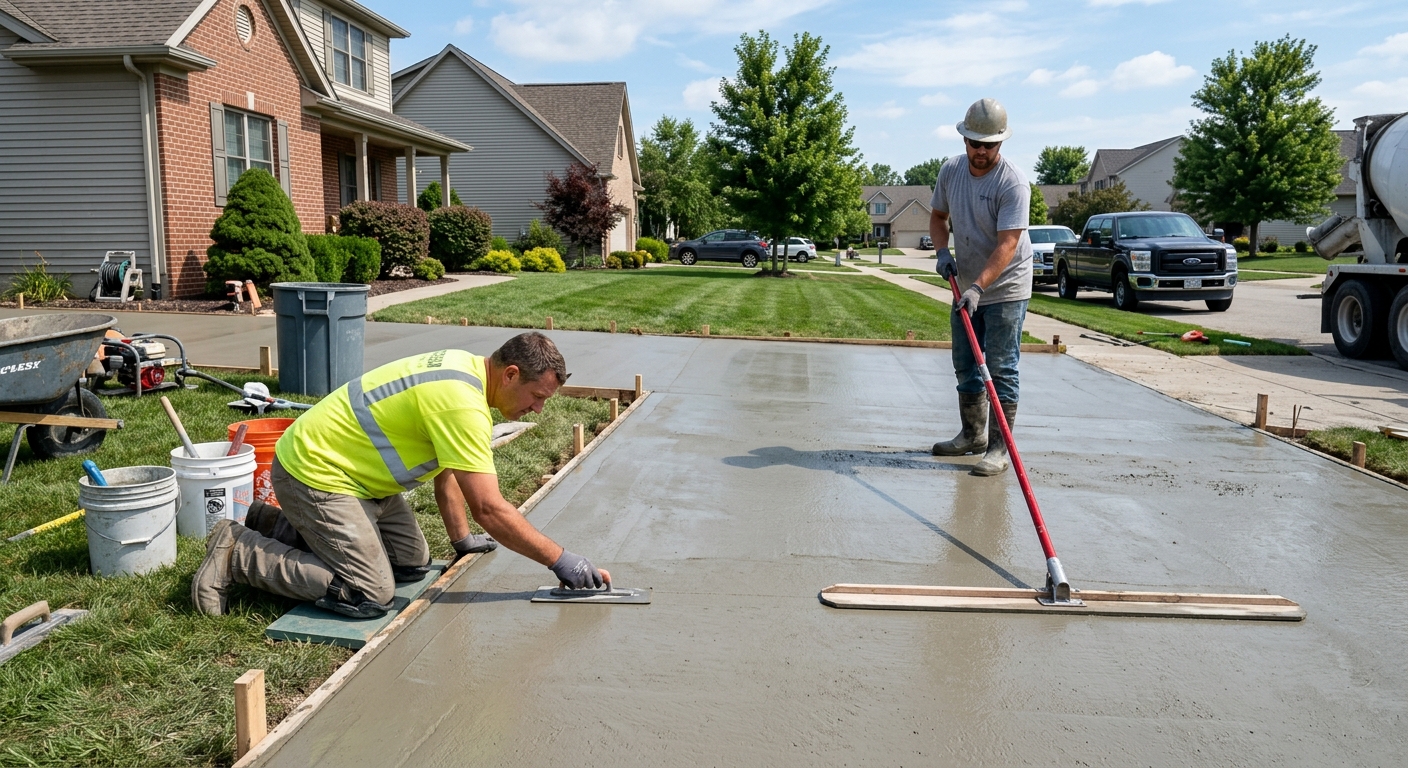
Concrete work options and costs in Lymburn
Lymburn, Alberta is where many homeowners want durable concrete flatwork—driveways, patios and walkways that can stand up to winter grit, freeze–thaw cycles and spring thaw. In the Calgary economic region, concrete is in steady demand because the local housing mix is heavily weighted toward single-detached homes, and Lymburn’s population is 5,914 (Statistics Canada, 2021 Census). Those households typically need new or upgraded flatwork as landscaping matures, garages are finished, and driveways get replaced after years of traffic and salt. You’ll notice especially strong activity around newer infill pockets and established streets near the main service corridors—areas where access for equipment is tighter and excavation has to be planned well.
In Calgary-area conditions, the frost depth and freeze–thaw performance drive almost every line item in a quote. Footings for structural work generally must extend below the design frost depth, and exterior slabs need properly air-entrained mixes plus engineered base prep. Add cold-weather concrete placement limits and the fact that exterior pour season can be shorter, and you get pricing that can climb faster than in milder regions. Contractor availability also shifts when multiple crews are booked for overlapping driveways, garage pads and foundation phases—timing matters in a cold climate.
Below is a realistic snapshot of what typical projects cost in Lymburn, using the current regional price bands for this concrete tier, and the spec-level differences that usually explain the range.
| Application |
Typical Size |
Key Spec |
Finish Option |
Price Range |
| Concrete driveway (standard broom finish) |
24 ft x 18 ft (432 sq ft) |
Air-entrained slab, compacted granular base |
Broom finish, control joints, sealer optional |
$12,000–$18,000 |
| Exposed aggregate driveway |
24 ft x 20 ft (480 sq ft) |
Air-entrained mix, exposed-top process |
Exposed aggregate, upgraded finish materials |
$14,000–$21,000 |
| Stamped concrete driveway or patio |
20 ft x 20 ft (400 sq ft) |
Air-entrained mix, integral colour |
Stamped pattern, release agent, sealer |
$15,000–$26,000 |
| Plain concrete patio or walkway |
12 ft x 16 ft (192 sq ft) |
Air-entrained slab, compacted granular base |
Float/screed with light broom, joints as needed |
$5,000–$9,000 |
| Garage floor (interior slab) |
22 ft x 20 ft (440 sq ft) |
Interior slab thickness, vapour barrier as applicable |
Steel trowel or light broom, joints as required |
$10,000–$16,000 |
| Foundation footings (structural, below frost) |
Perimeter +/- 600 sq ft of footing area |
Below frost depth bearing on undisturbed soil |
Reinforced concrete footings, engineered layout |
$28,000–$45,000 |
Prices are estimates only and vary by project scope, site access and material selection.
What affects the price of concrete work in Lymburn
In Lymburn (Calgary region), quotes for the “same” concrete job can swing by 30–50% because the work that matters most—excavation depth, base prep, reinforcement, mix design, and cold-weather curing—gets priced differently when the site is challenging or the spec is upgraded. A driveway that looks similar on the street can require vastly different footing and slab design once you factor in soil condition, how deep the granular base must go, and how much the contractor needs to protect the pour from winter temperatures.
Two big drivers are the frost line depth and freeze–thaw cycles. In Alberta, structural footings must bear below the design frost depth to prevent frost heave and seasonal movement. That typically means deeper excavation and higher concrete volumes than warmer areas. Exterior slabs—driveways, patios and walkways—also need air-entrained concrete so the hardened paste survives freeze–thaw cycling without scaling. On top of that, the practical pour season can be shorter, and contractors may use cold-weather curing precautions (insulated blankets and sometimes temporary heat) so the concrete develops strength properly instead of surface scaling. Finally, in Calgary-area winters, de-icing salt accelerates surface wear, which is why sealing is often a practical add-on.
In Lymburn, a typical example is a standard broom driveway versus stamped work: broom-finish projects commonly land in the $12,000–$18,000 band, while stamped concrete tends to climb into the $15,000–$26,000 range because of colour, stamping labour and more robust sealing. Another common cost difference is site access: if a crew has to haul out unsuitable soil and replace base to a deeper engineered depth, you may see the lower end of the price band move toward the middle or upper end quickly. If the house is older and the yard grades are off, you often spend more on re-grading and drainage before the concrete can be built right.
| Price Factor |
Why It Matters |
Cost Impact |
| Frost line depth |
Determines footing depth and form height |
Deeper excavation increases concrete, steel detailing and labour; pushes foundation/footing costs toward the band high end |
| Site preparation |
Excavation, grading, compacted granular base |
Bad soil or incorrect grades raise disposal and import costs; often the biggest swing factor for driveways |
| Reinforcement |
Rebar or wire mesh requirement |
Extra steel, chairs/tie-wire and labour add cost; reduces cracking in thicker or heavier-load slabs |
| Mix design |
Air-entrainment and compressive strength spec |
Winter-grade and specified air content can raise per-m3 cost and affects truck scheduling |
| Finish type |
Broom vs. stamped vs. exposed aggregate |
Labour and materials for colour, stamps or exposure treatment usually move you from “standard” into the decorative band |
| Pour size and concrete truck access to site |
Impacts batching time and whether pumping/long wheelbarrows are needed |
Pumping, smaller pours, or reloading can add labour and equipment charges |
| Cold-weather curing precautions |
Heating and blankets to protect early strength gain |
Blankets, tarping and heaters add daily costs; skipping them risks premature scaling |
| Control joint pattern and sealing cost |
Controls cracking and reduces salt-driven surface damage |
More joints/sawcutting is extra labour; sealing adds material but can extend service life |
Permits & regulations in Alberta
In Alberta, structural concrete work—especially anything tied to the building’s load path—typically requires a building permit and often engineered drawings reviewed by the municipality. That includes concrete footings, foundation walls, grade beams and other structural foundation components. Concrete flatwork (patios, walkways, exterior steps, and driveways) usually does not require a permit by default, unless it affects lot grading, drainage/impervious surface coverage limits, or the municipal right-of-way (for example, work near a sidewalk cut or driveway tie-in). Because requirements can vary depending on how the work impacts drainage and servicing, confirm directly with the local authority before you break ground.
For your Lymburn project, verify contractor coverage step-by-step. First, confirm the contractor is legitimately licensed/registered for the type of work they’re doing in Alberta (check the province’s business/licensing resources and the company’s stated trade classification where applicable). Next, ask for a current certificate of insurance showing general liability with property damage and appropriate limits, plus an endorsement naming you (if offered) or at least confirming coverage is active for the period of work. Finally, request proof of WSIB/WCB clearance or registration documentation (not expired) and ask whether they have clearance letters for the job date range. Then ask for references on similar-scale Calgary-area concrete work (driveways/patios or foundation phases), because performance in freeze–thaw conditions comes down to how well they build and cure.
Getting concrete right in Lymburn's freeze-thaw climate
Concrete fails in Lymburn most often because it’s built on the wrong base and/or cured improperly for Alberta’s freeze–thaw routine. When water can sit in poorly compacted granular layers, it expands and pushes on the slab. When the concrete mix lacks proper air entrainment, freeze–thaw cycles cause surface scaling and can progress toward deeper deterioration—especially where de-icing salts are used. The fix is to spec the job with a system: (1) compacted granular sub-base to the right depth for local soil and frost considerations; (2) a mix designed for exterior exposure with air entrainment and the required strength; (3) a control joint plan that limits random cracking; (4) curing that protects early-age strength during cold snaps; and (5) sealing after the cure period to repel salts and reduce surface damage.
To avoid the most common spalling pathway, don’t just say “air-entrained” vaguely—ask for the target air content and a minimum 32 MPa compressive strength for exterior flatwork. Also, in Lymburn, allow a minimum 7-day curing period under proper conditions, and plan sealing at about 28 days after pour when the slab has cured enough to accept the penetrating sealer. If you’re comparing finishes, remember that paying for stamped concrete doesn’t automatically buy durability—durability comes from base, mix, joints and curing. Still, a stamped job can be justified: if a standard broom driveway is around $12,000–$18,000, and stamped is around $15,000–$26,000, the extra usually covers colour work, stamping labour and higher-quality finishing steps plus sealing expectations. If someone offers “stamped looks” at broom pricing without the same spec discipline, that’s where you can get burned.
| Spec |
Why It Matters in Lymburn |
What to Ask For |
Impact if Skipped |
| Compacted granular base (depth?) |
Prevents pumping and frost-related movement |
Engineered granular sub-base depth based on site soil and slab type |
Settlement and cracking; uneven surface and early slab failure |
| Air-entrained concrete mix (target air %?) |
Resists scaling from freeze–thaw and salt exposure |
Confirm target air content typically 5–7% for exterior flatwork |
Spalling risk rises significantly after a few winters |
| Compressive strength (MPa rating) |
Ensures the slab reaches adequate strength under local conditions |
Minimum 32 MPa rating for exterior flatwork |
Surface deterioration, increased cracking and reduced long-term performance |
| Control joints (spacing per ACI guidelines) |
Limits random cracking patterns |
Ask for the joint spacing plan based on slab thickness and panel sizes |
Wider random cracks that allow water ingress |
| Minimum 7-day curing period |
Builds strength before traffic and winter stress |
Confirm curing method and temperature protection plan |
Reduced strength gain and increased scaling during cold weather |
| Penetrating sealer (when applied after cure) |
Repels de-icing salts and reduces surface wear |
Apply after cure (commonly around 28 days post-pour) |
Faster surface deterioration and higher maintenance costs |
How to choose a concrete work contractor in Lymburn
Choosing the right concrete contractor in Lymburn is mostly about proof and process. Start with Alberta verification: confirm the contractor is properly registered/licensed for the scope they’re offering, and that they can provide a current certificate of insurance (general liability) for the job period. Then verify WSIB/WCB coverage: ask for clearance letters or proof of account status that covers the work timeline. Don’t accept “we’re covered” without documents you can review.
Next, get 2–3 itemised written quotes. You want a breakdown that separates labour and materials (concrete supply, reinforcement, excavation/granular base, sawcutting joints, finishing, curing protection, disposal, and sealing). Avoid lump sums that don’t describe exclusions. Ask whether the quote includes permits (when required), debris disposal, and whether the contractor accounts for truck access limitations (pumping vs. wheelbarrow distance, extra labour for tight gates). For durability in Calgary’s freeze–thaw climate, insist on a clear spec: air-entrainment target, minimum strength, and curing plan for any late-season pours.
Review warranty terms carefully. A workmanship warranty length should be stated clearly, and separate it from product/manufacturer warranties. Also ask whether the warranty transfers if you sell the home. For payment, never pay more than 10–15% upfront; use a holdback until the job is complete and deficiencies are corrected. Finally, require a written start date and an estimated completion timeline—concrete scheduling is weather-sensitive in Alberta, so clarity protects you from indefinite delays.
- Request proof of insurance (certificate of insurance) before booking a pour date.
- Verify WSIB/WCB clearance or registration documents for the job period.
- Confirm the scope in writing: excavation depth, base thickness, and reinforcement details.
- Ask for concrete specs: air-entrainment target and minimum MPa rating.
- Confirm control joint layout and whether sawcutting timing is included.
- Ask about cold-weather curing: blankets/heating plan if temperatures drop.
- Get sealing included or excluded—timing matters (after the cure period).
- Ensure disposal, grading reinstatement, and turf restoration are specified.
- Check truck access logistics: pumping costs, line-of-site limitations, and staging.
- Require a written schedule with start and finish dates.
- Use itemised labour/material quotes rather than only a lump sum.
- Set payment terms: 10–15% max upfront and holdback until final walk-through.
Red flags I see too often in Lymburn: (1) “No need for air-entrainment” or they won’t state the mix spec; (2) no curing plan for cold snaps (just “we’ll pour anyway”); (3) vague base prep details like “some gravel” without compaction depth; (4) quoting stamped/stained work without explaining sealing and joint planning; and (5) refusing to put exclusions in writing or asking for large upfront payments.
Frequently asked questions — concrete work in Lymburn
How do I seal concrete to protect it in Lymburn?
In Lymburn and the Calgary region, sealing helps because winter de-icing salts and melt cycles drive surface wear. The key is timing: you typically apply a penetrating sealer after the concrete has cured properly—often around 28 days post-pour—so the concrete can open/settle and the sealer can do its job. Before sealing, the slab should be clean, dry, and free of curing compounds, dust and construction residue; otherwise the sealer won’t absorb evenly. Use a product intended for exterior concrete exposed to freeze–thaw and salt, and keep vehicles off until the manufacturer’s cure/recoat window is met. If your quote is targeting a standard driveway in the $12,000–$18,000 range, ask whether sealing is included or an add-on, because that choice affects long-term appearance and maintenance.
What is the difference between concrete and cement?
Homeowners in Alberta often mix up the terms, so here’s the practical difference. Cement is one ingredient—typically Portland cement—that reacts chemically to bind the mix together. Concrete is the finished material, made from cement plus water, sand, gravel (or another aggregate), and sometimes admixtures for things like air entrainment, strength gain timing, or workability in cold weather. For Lymburn projects, what matters is the concrete mix design: exterior flatwork should be air-entrained to withstand freeze–thaw cycles, and it should meet a specified minimum strength (commonly 32 MPa for exterior flatwork). A contractor who only talks about “cement quality” without stating the concrete spec is usually less reliable for Alberta’s winter performance.
How much does concrete work cost in Lymburn?
Typical pricing in Lymburn depends on scope, access and finish. For a driveway with a standard broom finish, many projects land in the $12,000–$18,000 range depending on square footage, base prep needs and whether sealing is included. If you’re doing decorative stamped concrete, budgets often shift upward into the $15,000–$26,000 range because of colour, stamping labour and finishing steps. Plain patios and walkways commonly fall in the $5,000–$9,000 band. If you’re building structural footings below frost, those projects typically sit around $28,000–$45,000 depending on how much excavation and reinforcement is required. In Alberta, deeper frost-related excavation, air-entrained mix requirements, and cold-weather curing precautions are major reasons the same-looking job can vary a lot between bids.
How deep must footings be for Lymburn's frost line?
In this part of Alberta, footings must extend below the design frost depth to reduce frost heave risk and seasonal movement. Calgary-area engineering practice uses an approximate design frost depth around 1.2 m (roughly 4 ft). In practice, the exact required depth is set by your engineered foundation design and local soil conditions, because contractors must bear on undisturbed soil below the frost influence zone. That’s why two homes on different grades or with different soils can have different excavation volumes and different footing costs even if the foundation footprint looks similar. If you’re planning a foundation pour in Lymburn, make sure your drawings specify footing elevations/depths, and that the contractor confirms how they’ll verify bearing depth during excavation before concrete goes in.
Why does concrete crack in Lymburn and how is it prevented?
Cracking is common in exterior concrete because concrete shrinks as it cures and expands/contracts with temperature changes—then freeze–thaw cycling adds stress when water gets trapped in micro-spaces. In Lymburn, the biggest prevention tools are engineered base prep, correct concrete mix, and a deliberate control joint plan. Properly compacted granular base reduces movement, and air-entrained concrete helps resist freeze–thaw scaling. Control joints are designed to create preferred crack locations so cracks are narrower and easier to manage. Another prevention piece is curing: cold-weather placement without proper protection can lead to surface weakness and more cracking risk. If you want fewer visible cracks over time, ask your contractor to explain the joint spacing plan and joint cutting timing, and whether sealing is included to reduce salt-driven surface deterioration.
Stamped vs broom-finish concrete — cost difference?
Stamped concrete generally costs more than broom-finish because it uses additional materials and more labour-intensive finishing. A broom-finished driveway is usually in the $12,000–$18,000 range for typical sizes, while stamped concrete driveway or patio work often falls into the $15,000–$26,000 range. The difference covers integral colouring, stamping tools and release processes, plus the careful timing required to achieve crisp impressions. Importantly, the “look” does not replace the engineering: both options should still use air-entrained mix for Alberta freeze–thaw, a properly compacted granular base, correctly placed control joints, and adequate curing. If a contractor promises stamped durability without discussing air content, curing blankets/heating in cold weather, and sealing timing (about 28 days post-pour), that’s a warranty risk.