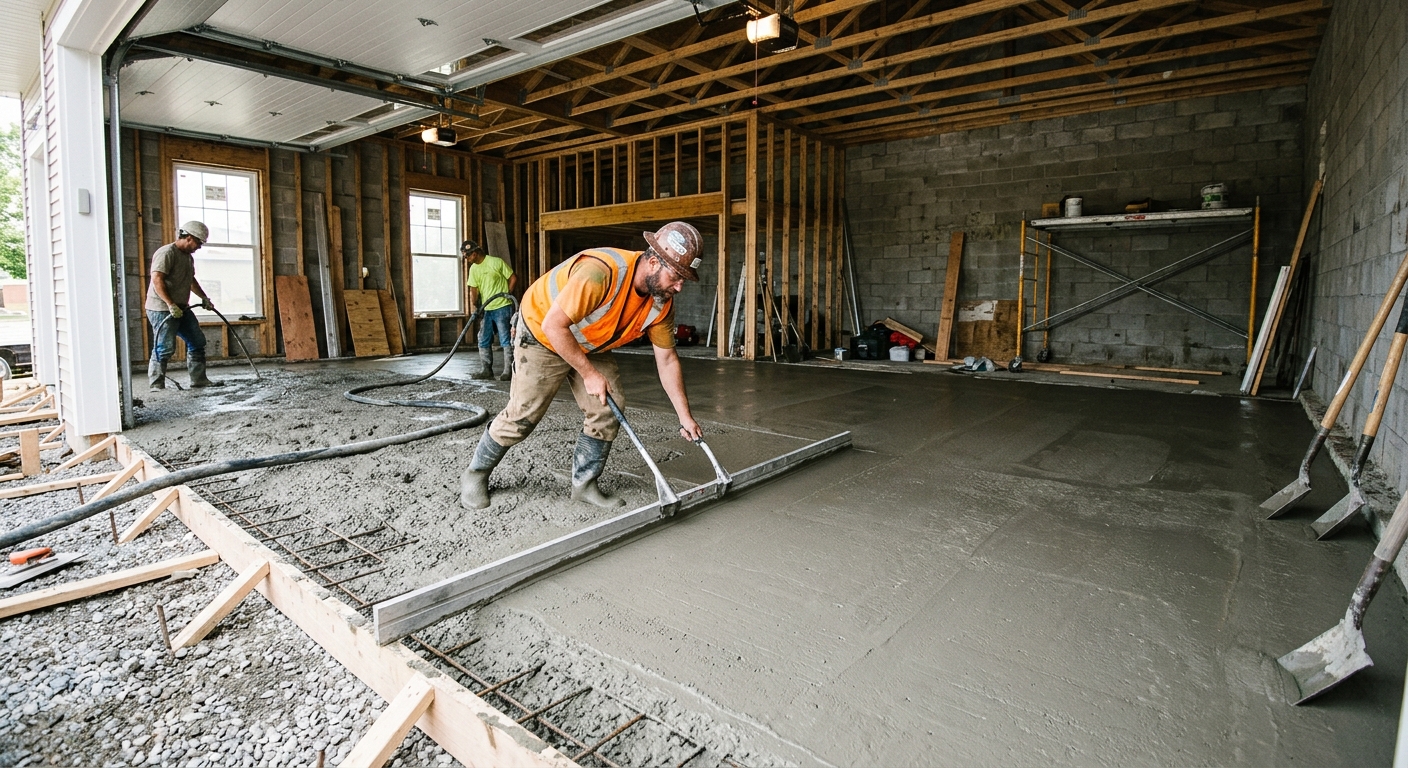
Concrete work options and costs in Strathearn
Concrete work in Strathearn matters because you’re building for real freeze–thaw, not just “winter.” With a population of 2,622 (Statistics Canada, 2021 Census), the local market is smaller than Calgary, so contractor scheduling can be tighter—especially for exterior flatwork tied to limited pour windows. Most homeowners here are maintaining or upgrading typical residential sites, and that means the concrete you see most often is driveways, patios, walkways and garage slabs.
Costs in this Calgary economic region don’t move only with material prices. They track frost depth requirements, how much excavation and granular base prep your site needs, and whether the crew can place and cure concrete properly during cold snaps. Alberta’s design frost depth is commonly engineered to around 2.4 m for many residential applications, so foundation work often involves deeper, higher formwork and more concrete than people expect. For exterior slabs, air-entrained mixes and a careful control-joint plan are standard to reduce spalling and scaling as temperatures swing.
In Strathearn, you’ll typically see the busiest demand around established residential pockets where driveways and walkways are due for replacement (often after older asphalt deteriorates). If you’re planning any upgrade that ties into a future landscaping plan—grade adjustments, new deck steps, or a retaining section—tell your contractor early so the concrete spec matches your soil and drainage.
Below is a practical starting point to compare options before you request itemised quotes.
| Application |
Typical Size |
Key Spec |
Finish Option |
Price Range |
| Concrete driveway (standard broom finish) |
400–600 sq. ft. |
Air-entrained mix, compacted base, joints |
Broom finish |
$12,000–$18,000 |
| Exposed aggregate driveway |
400–600 sq. ft. |
Air-entrained mix, consistent wash schedule |
Exposed aggregate |
$15,000–$22,000 |
| Stamped concrete driveway or patio |
300–500 sq. ft. |
Air-entrained mix, release agent, colour hardener |
Stamped pattern |
$15,000–$26,000 |
| Plain concrete patio or walkway |
200–350 sq. ft. |
Air-entrained mix, base compaction, joints |
Plain float + broom edge |
$5,000–$9,000 |
| Garage floor (interior slab) |
500–700 sq. ft. |
Vapour barrier (as spec’d), mesh/rebar if required |
Broom or trowel finish |
$10,500–$16,500 |
| Foundation footings (structural, below frost) |
Varies by plan; often 20–40 yd³+ |
Engineered rebar, excavate below design frost depth |
Structural concrete |
$28,000–$45,000 |
Prices are estimates only and vary by project scope, site access and material selection.
What affects the price of concrete work in Strathearn
For the “same” concrete job, quotes in Strathearn can land 30–50% apart because Calgary-region projects differ in excavation depth, reinforcement needs, access for the concrete truck, and how much winter protection a contractor must use to cure concrete correctly. In a smaller town, the second contractor might also be busier—so you’ll see pricing reflect scheduling urgency and crew availability.
In this cold continental climate, frost depth and freeze–thaw cycles dictate specs down to the mix and base. Footings for houses, garages, and retaining structures must be placed below the design frost depth (often about 2.4 m in Alberta) on undisturbed soil to avoid frost heave and seasonal movement. Exterior slabs then need air-entrained concrete to survive repeated temperature swings and de-icing exposure; without it, you’ll see surface scaling and spalling. Because the pour season for exterior work is shorter, crews may need cold-weather curing precautions—insulated blankets, windbreaks, or temporary heat—to protect strength gain. That “engineering + winter logistics” is a real cost driver that shows up in the price you’re quoted.
Two examples from Strathearn: if your driveway ties into a sloped approach, grading and drainage work can push you toward the upper end of the $12,000–$18,000 driveway band because additional base and subgrade stabilization are required. On the other hand, a small, well-prepped patio on a flat yard usually stays nearer $5,000–$9,000 if reinforcement is minimal and truck access is straightforward. When homeowners choose stamped concrete (often $15,000–$26,000), the added cost is justified by labour-intensive finishing, colour compounds and pattern tooling—not by concrete strength.
| Price Factor |
Why It Matters |
Cost Impact |
| Frost line depth |
Determines footing depth and the amount of excavation and form height |
Can add major cost to foundation/footing work (often pushing totals toward the upper foundation band) |
| Site preparation |
Excavation, grading and compacted granular base determine stability and longevity |
Often shifts exterior slab pricing across the driveway/patio bands |
| Reinforcement |
Rebar or wire mesh spacing is selected based on loads and slab design |
Material + labour increase; can be the difference between a mid- and high-tier quote |
| Mix design |
Air-entrainment and compressive strength targets control freeze–thaw durability |
Higher-spec mixes raise material cost and require correct placement |
| Finish type |
Broom vs. stamped vs. exposed aggregate changes labour intensity and waste |
Stamped/exposed finishes typically move projects toward the top of their ranges |
| Pour size and concrete truck access to site |
Smaller pours may reduce efficiency; tight access may require line pumping or extra handling |
Access issues can add mobilisation fees and labour time |
| Cold-weather curing precautions |
Heating, insulating blankets and wind control protect strength gain in winter conditions |
Can noticeably increase costs during late fall/early spring |
| Control joint pattern and sealing cost |
Proper joints reduce random cracking; sealing helps repel de-icing salts |
Improves durability; small line item cost but big risk reduction |
Permits & regulations in Alberta
In Alberta, structural concrete work typically requires a building permit and often engineered drawings reviewed through the local municipal process. That includes footings, foundation walls, grade beams, and other structural elements that affect a home’s load path. For homeowners in Strathearn, the practical takeaway is simple: if the concrete is part of the structure (or changes structural support), expect permit and engineering involvement.
Concrete flatwork—patios, walkways, driveways and similar exterior slabs—usually does not require a permit by default. However, you should still confirm if your plan impacts lot grading, drainage, or impervious surface coverage limits, or if it encroaches into municipal right-of-way. Also, if you’re replacing a driveway that changes runoff direction toward a neighbour’s property or into a ditch, the municipality may want details before construction.
To verify a contractor, start with their insurance paperwork and coverage letters. Ask for: (1) a certificate of liability insurance naming your property (or showing adequate coverage limits), and (2) WSIB/WCB coverage confirmation where applicable. Step-by-step, you can check the contractor’s ability to work by reviewing their certificate of insurance, confirming coverage is current (not expired), and asking for a clearance letter or proof of standing. Finally, request references on similar-scale concrete jobs in cold climates—driveway replacements and exterior slab work are a strong indicator they understand frost and curing. If anything is unclear, pause and get it in writing before excavation begins.
Getting concrete right in Strathearn's freeze-thaw climate
Concrete failure in Strathearn is usually a “systems problem,” not a single mistake. Most commonly, exterior slabs spall because freeze–thaw attacks the surface, and the mix didn’t have the right air-entrainment, or the base wasn’t prepped to the correct depth and compaction for local soils. To spec the job correctly in the Calgary market, focus on five things: base preparation, mix design, control joints, curing and sealing.
First, base preparation means compacted granular sub-base to the required depth for your site conditions (enough thickness to support the slab and manage frost movement). Second, specify an air-entrained mix with about 5–7% air content for exterior flatwork, plus a minimum compressive strength target of 32 MPa. Third, control joints should be laid out to limit random cracking—especially on driveways and walkways that experience heavy thermal movement. Fourth, curing matters: aim for a minimum 7-day curing period under proper conditions, and in cold weather don’t skip blankets or heat when temperatures drop below what the mix requires for strength gain. Fifth, seal after cure—typically 28 days post-pour—using a penetrating sealer to repel de-icing salts.
Ask yourself what you’re paying for. For example, a plain broom-finish patio might land near the $5,000–$9,000 band if access is good and joints/reinforcement are straightforward. A stamped option can move toward the $15,000–$26,000 range because patterning and colour processes add labour and set-up; it’s justified when you want the look, but it doesn’t replace the durability essentials.
When you interview contractors in Strathearn, use these specs as your checklist. If they can’t clearly explain air, base and curing, that’s where spalling risk starts.
| Spec |
Why It Matters in Strathearn |
What to Ask For |
Impact if Skipped |
| Compacted granular base (depth?) |
Supports the slab and reduces frost-related movement |
Documented sub-base depth and compaction testing method |
Settlement, cracking, and premature failure |
| Air-entrained concrete mix (target air %?) |
Protects against freeze–thaw damage and surface scaling |
Air content target (about 5–7% for exterior flatwork) |
Spalling risk increases significantly |
| Compressive strength (MPa rating) |
Ensures the concrete reaches designed strength for loads |
Minimum 32 MPa (or higher if engineered) |
Reduced durability and higher cracking probability |
| Control joints (spacing per ACI guidelines) |
Controls where cracking occurs as temperatures cycle |
Proposed joint spacing and saw-cut timing |
Random cracks and wider, unsightly failures |
| Minimum 7-day curing period |
Strength development is critical during cold spells |
Temperature plan: blankets/heat if needed and curing duration |
Surface scaling and structural weakness |
| Penetrating sealer (when applied after cure) |
Repels de-icing salts and reduces moisture penetration |
Application around 28 days post-pour after full cure |
Faster deterioration around edges and high-traffic areas |
How to choose a concrete work contractor in Strathearn
Start with verification. In Alberta, confirm the contractor has the right coverage for the type of work and people they bring onto your site. Ask for a current certificate of liability insurance and read the dates—no expired documents. Next, request proof of WSIB/WCB coverage (or a clearance letter where applicable) so you’re not left paying if a worker is injured. If they can’t provide documents quickly and clearly, that’s a major warning sign.
Then get 2–3 itemised written quotes. You want a breakdown that separates labour, concrete supply, reinforcement, base prep, excavation, and any finishing and curing measures—especially cold-weather provisions. Avoid quotes that only provide a single lump sum without explaining what’s included. Confirm exclusions too: is disposal included for removed concrete? Is permit coordination included if the work is structural? Will they test or document base compaction? Clear scopes reduce change orders after the excavator has already started.
Warranty matters. Ask for the workmanship warranty term, what it covers (cracks, scaling, spalling), and whether product/manufacturer warranties apply to sealers or admixtures. Also ask if warranties are transferable if you sell the home. Finally, use sensible payment terms: never pay more than 10–15% upfront, and keep a holdback until the job is complete, cleaned up, and any sealing or final finishes are done.
Get the start date and completion estimate in writing, including how weather impacts the schedule. In Strathearn, cold snaps can pause work—good contractors plan around that rather than rushing.
- Ask how they engineer frost protection for footings and what depth they’re designing to.
- Confirm the mix is air-entrained for exterior slabs and that they meet a minimum 32 MPa target.
- Require an itemised quote (materials, labour, excavation, base prep, finishing, sealing).
- Ask who is responsible for saw-cut timing and the proposed control joint pattern.
- Request a curing plan for temperature drops (blankets/heating/wind control).
- Confirm reinforcement details: wire mesh vs rebar, spacing, and whether it’s dowelled where needed.
- Check truck access and placement method; ask if pumping or small-load pours are needed.
- Verify liability insurance is current and adequate for concrete operations.
- Verify WSIB/WCB clearance or standing documentation before work starts.
- Confirm disposal/haul-away is included for demo debris and excavation spoils.
- Clarify sealing: product, prep steps, and whether it’s included after full cure (often 28 days).
- Ensure the contract lists warranty length and exactly what defects are covered.
Red flags in Strathearn: contractors who won’t discuss air-entrainment and curing; quotes that omit base thickness/compaction; offering “cheap” finishing that skips control joints; refusing to provide insurance/WSIB/WCB proof; and pressuring you to pay large deposits before any protection and subgrade prep are complete.
Frequently asked questions — concrete work in Strathearn
How do I seal concrete to protect it in Strathearn?
In Strathearn, sealing is one of the simplest ways to protect exterior concrete from de-icing salts and moisture. Typically, you wait until the concrete is fully cured—often about 28 days post-pour—then apply a penetrating sealer designed to repel water without trapping vapour. Before sealing, the surface should be clean and dry; remove dirt, curing compounds (if any) and any previous coatings. Ask your contractor whether they’ll do a proper prep wash and whether they recommend reapplication timing based on traffic and winter exposure. For a common example, homeowners who invest in exterior work near the $5,000–$9,000 patio/walkway range often lose the most value when they skip sealing and then see edge scaling after a harsh freeze–thaw season.
What is the difference between concrete and cement?
Cement is one ingredient inside concrete. Concrete is the full mixture—cement plus water, sand and gravel (or crushed stone), and often admixtures such as air-entrainers for freeze–thaw durability. In Alberta’s climate, that air-entrainment is a big deal for exterior slabs, because it helps protect the hardened concrete as temperatures swing and water inside the pores freezes. When contractors talk about mix design, they’re really specifying the full concrete recipe, not just the cement. So if you hear “we used good cement,” ask instead for the concrete’s air content target and the compressive strength requirement (commonly a minimum 32 MPa for exterior work). That’s what drives performance in a cold continental climate like Strathearn and the Calgary region.
How much does concrete work cost in Strathearn?
Typical Strathearn pricing generally aligns with the Calgary-region bands for the scope. For exterior flatwork, a concrete patio or walkway often falls around $5,000–$9,000 depending on size, base preparation, reinforcement and access. Driveways are usually higher because of excavation and base thickness; a broom-finish driveway is commonly in the $12,000–$18,000 range. If you want a decorative look, stamped concrete driveway or patio work often moves into the $15,000–$26,000 band because patterning, colour compounds and labour intensity increase. Foundation/footings for structural work is engineered and excavation-heavy, so it commonly lands around $28,000–$45,000. In colder months, costs can climb when contractors must add winter curing protection and scheduling precautions.
How deep must footings be for Strathearn's frost line?
For Strathearn and the wider Alberta region, footings are designed to bear below the local design frost depth to reduce frost heave risk. In practice, that design frost depth is commonly engineered around 2.4 m for many residential situations. The exact required depth depends on your soil conditions, groundwater, and the engineered foundation design. That’s why you shouldn’t “guess” depth from general rules—your structural drawings or geotechnical recommendations govern. When contractors quote foundation / footing work, ask what depth they’re excavating to and how they confirm the bearing is on undisturbed soil. If a contractor offers a shallower depth without engineering justification, that’s a serious durability red flag in Alberta’s freeze–thaw climate.
Why does concrete crack in Strathearn and how is it prevented?
Concrete cracks mainly because it shrinks as it cures, moves with temperature changes, and interacts with the soil. In Strathearn’s cold freeze–thaw environment, inadequate base preparation or incorrect mix and curing can make movement worse. Prevention starts with a properly compacted granular base and air-entrained concrete for exterior slabs. Next, control joints are essential: they’re designed to “tell” the concrete where cracking should occur rather than letting random cracks form. Joint timing also matters—saw-cut too early or too late can affect the crack pattern. Finally, curing and sealing help reduce surface deterioration. When you choose a contractor, ask how they’ll handle joints and curing in winter conditions so your driveway and patio hold up through Alberta temperature cycles.
Stamped vs broom-finish concrete — cost difference?
Stamped concrete costs more than a broom-finish because it’s labour intensive and requires extra materials and steps. With stamped work, the crew uses pattern tools, release agents, and often colouring/sealers to achieve consistent texture and appearance. Broom-finish concrete is simpler: it’s typically placed, floated, edged and broomed for slip resistance. In Strathearn, that difference usually shows up clearly in the price bands: broom-finish driveways are commonly around $12,000–$18,000, while stamped concrete driveway or patio projects often land in the $15,000–$26,000 range. The durability side doesn’t automatically improve with stamping—air-entrainment, base prep, curing and sealing are still what protect against freeze–thaw scaling.