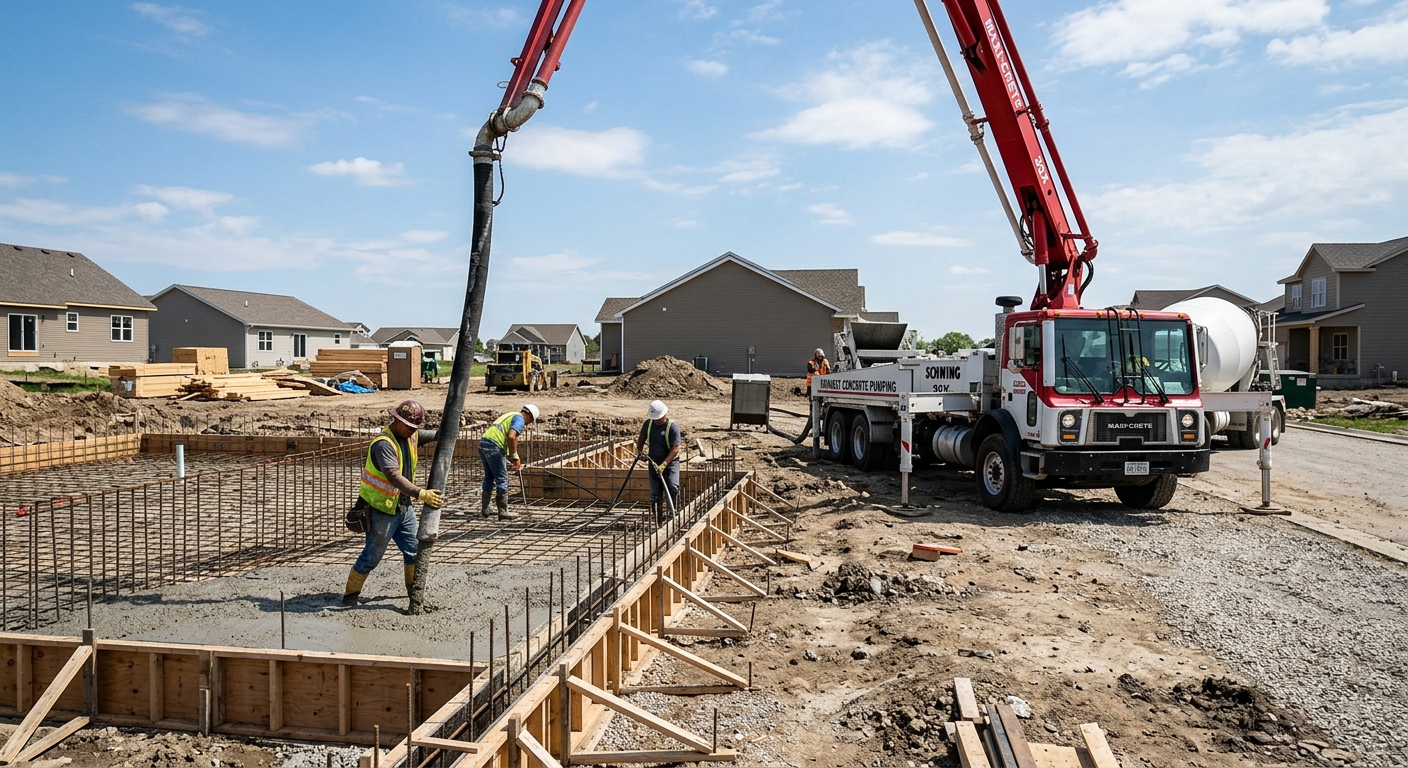
Concrete work options and costs in Calmar
Calmar is a town where concrete flatwork gets plenty of use—driveways, patios, walkways, and garage slabs all see freeze–thaw stress every winter. The good news is that the local housing stock is mostly single-detached (77.7% of dwellings), so there’s steady demand for driveway and patio work. With 740 homeowner households (80.9% of households own), most projects are homeowner-led upgrades rather than large multi-unit developments, which helps contractors plan crews around typical backyard access and standard forms.
In the Edmonton economic region, costs are shaped by climate and schedule. Exterior slabs often need deeper excavation and a well-compacted granular base because footings and flatwork are designed to sit below frost influence; in Alberta, that typically means deeper formed work than homeowners expect. Freeze–thaw cycles through late fall, winter, and spring also require air-entrained concrete, good drainage, and correctly spaced control joints to reduce cracking and surface spalling. The pour season is also shorter, so labour can be more booked in late spring to early fall, which can push scheduling premiums.
In Calmar, trade demand tends to spike around residential expansions and curb-access neighbourhood pockets like the core residential streets near the main amenities, where driveway and entrance improvements are common. If you’re budgeting, it’s easiest to compare common options side-by-side—standard broom, exposed aggregate, stamped, and structural foundation footings—using the range table below as your starting point.
| Application |
Typical Size |
Key Spec |
Finish Option |
Price Range |
| Concrete driveway (standard broom finish) |
24 ft x 10 ft (240 sq. ft.) |
Air-entrained exterior mix, compacted granular base |
Broom finish + joints |
$9,000–$14,000 |
| Exposed aggregate driveway |
24 ft x 10 ft (240 sq. ft.) |
Air-entrained mix, clean stone exposure |
Exposed aggregate (sealer recommended) |
$13,000–$18,000 |
| Stamped concrete driveway or patio |
16 ft x 12 ft (192 sq. ft.) |
Air-entrained mix, colour hardener, release agent |
Stamped pattern + borders |
$12,000–$26,000 |
| Plain concrete patio or walkway |
12 ft x 12 ft (144 sq. ft.) |
Exterior air-entrained mix, drainage-minded grade |
Broom or smooth finish (lightly broomed) |
$3,500–$9,000 |
| Garage floor (interior slab) |
22 ft x 20 ft (440 sq. ft.) |
Vapour barrier + compacted base; typical fibre or mesh |
Trowel/float finish (sealed optional) |
$9,000–$18,000 |
| Foundation footings (structural, below frost) |
Typical house perimeter/bearing area |
Designed depth below frost, rebar per engineering |
Structural concrete formwork |
$25,000–$60,000 |
Prices are estimates only and vary by project scope, site access and material selection.
What affects the price of concrete work in Calmar
In Calmar and the wider Edmonton area, two quotes for the “same” concrete job can differ by 30–50% because the real variables are hidden in preparation and spec. A basic broom-finish driveway might start near the lower end of the market, but if excavation is deeper than expected, if the base needs to be rebuilt due to poor soil, or if the schedule forces cold-weather curing measures, costs climb fast. Premium finishes like stamped or exposed aggregate also add labour, colour materials, and time-intensive finishing.
Climate is a major driver. Frost line depth and freeze–thaw cycles dictate nearly every spec in this region: footings must extend below the design frost depth (often up to about 2.4 m in Alberta) to prevent frost heave, and exterior slabs need air-entrained concrete to survive repeated freezing and thawing. Edmonton’s shorter pour season means more work gets compressed into late spring–early fall, so labour and truck availability can tighten. In colder conditions, concrete must be protected with insulated blankets or heated enclosures so it cures properly—those add material, fuel, and setup time.
De-icing salt further increases the risk of surface spalling if the concrete isn’t properly air-entrained or if it isn’t sealed at the right time. For example, if your driveway budget is around the $9,000–$14,000 range for standard broomwork, adding a thicker slab, improved drainage, and engineered jointing may be worth it—while switching to stamped can realistically push you toward $12,000–$26,000 depending on pattern complexity and area. Housing age also matters: with 39.3% of homes built before 1981, older lots often have older drains, weaker grading, or settled approaches that increase the excavation and regrading scope.
| Price Factor |
Why It Matters |
Cost Impact |
| Frost line depth — determines footing depth and form height |
Deeper frost requirements increase excavation, formwork, and concrete volume |
Higher for structural footings; can shift total by tens of thousands |
| Site preparation — excavation, grading, compacted granular base |
Cold soils and settlement issues require more base removal/rebuild |
Often one of the biggest unknowns in quotes |
| Reinforcement — rebar or wire mesh requirement |
Crack control and structural capacity depend on correct reinforcement placement |
Adds material and labour; increases cost but reduces failure risk |
| Mix design — air-entrainment and compressive strength spec |
Air content and strength are critical for freeze–thaw durability |
Moderate material increase; major durability benefit |
| Finish type — broom vs. stamped vs. exposed aggregate |
Finishing steps change labour time and consumables |
Stamped/exposed typically move projects into higher bands |
| Pour size and concrete truck access to site |
Short access can require pumps or additional staging/time |
Access issues can add labour and equipment charges |
| Cold-weather curing precautions — heating and blankets |
Ensures proper set and strength gain in Alberta conditions |
Can add setup costs during shoulder-season pours |
| Control joint pattern and sealing cost |
Joints reduce random cracking; sealing helps resist de-icing salt damage |
Small line-items that prevent expensive repairs later |
Permits & regulations in Alberta
In Alberta, concrete work falls into two practical categories for permitting: structural foundation work typically needs a building permit and often engineered drawings, while most plain concrete flatwork usually does not. For your Calmar project, concrete that DOES commonly require a permit includes foundation footings, foundation walls, grade beams, and other structural concrete tied to the building’s engineered design. Concrete flatwork such as patios, walkways, driveways, and garage slabs typically does NOT require a permit by default—unless it involves changes that affect lot grading, stormwater drainage, or municipal limits on impervious surfaces and right-of-way concerns. Always confirm with the municipality before you start digging, especially if you’re changing elevations or moving drainage patterns.
Before hiring, verify three things in writing: (1) contractor liability insurance, (2) WSIB/WCB coverage, and (3) the correct licensing/registration where applicable. Step-by-step for Calmar homeowners: start by asking the contractor for a current Certificate of Insurance naming you/the property as applicable and showing liability coverage limits; then request their WSIB/WCB clearance or account confirmation—many contractors provide it as a letter or current certificate upon request. Finally, check the contractor’s business and any trade registration through appropriate provincial resources and their public online listings. Then ask for references from similar concrete scopes in the Edmonton area (driveways, exterior slabs, or structural foundation work).
Getting concrete right in Calmar's freeze-thaw climate
Concrete fails in Calmar most often because of one of five weaknesses: inadequate base preparation, the wrong mix for freeze–thaw, missing or poorly planned joints, insufficient curing protection, or no (or late) sealing against de-icing salt. To spec the job correctly for this Edmonton-area climate, start with base preparation: excavate to the correct depth and build a compacted granular sub-base with proper grading and drainage. Next, use an air-entrained exterior mix—commonly 5–7% air content for exterior flatwork—so the concrete can resist freeze expansion. For strength, ask for a minimum 32 MPa compressive strength for typical residential exterior slabs and ensure reinforcement is placed correctly where required. Control joints should be laid out to limit random cracking; in practice, this means consistent spacing and attention to edges and transitions.
Curing is the quiet but critical part: cold-weather pours need protection with insulated blankets or enclosures so the concrete reaches adequate strength. Plan on minimum 7 days of curing under proper conditions before heavy exposure. Then apply a penetrating sealer after the concrete has cured sufficiently—often around 28 days post-pour—so water and salts don’t attack the surface. If you skip sealing, you’ll often see scaling sooner in salted drive lanes.
As a dollar example, switching from a plain broom-finish patio to stamped adds labour and materials; it can move you from roughly the $3,500–$9,000 patio band toward the $12,000–$26,000 decorative band depending on area and pattern. That upgrade is justified if the base and joints are already built correctly; if the foundation/bases are weak, the cheaper finish won’t last either—decorative work will just fail more visibly.
| Spec |
Why It Matters in Calmar |
What to Ask For |
Impact if Skipped |
| Compacted granular base (depth?) |
Proper thickness and compaction prevent frost movement and settlement |
Base depth and compaction method/requirements for local soil |
Low spots, cracking, and early surface failure |
| Air-entrained concrete mix (target air %?) |
Freeze–thaw survival depends on correct air entrainment |
Air content target (commonly 5–7% for exterior flatwork) |
Spalling and scaling during salted winters |
| Compressive strength (MPa rating) |
Strength gain supports durability under traffic and temperature cycling |
Minimum 32 MPa (or project-engineered spec) |
Surface wear, crumbling, reduced long-term performance |
| Control joints (spacing per ACI guidelines) |
Controls where cracking happens when concrete shrinks |
Joint spacing plan and saw-cut timing |
Random cracks that widen and invite moisture |
| Minimum 7-day curing period |
Early strength is critical in Alberta’s temperature swings |
Curing plan for shoulder-season conditions |
Reduced strength and higher risk of cracking |
| Penetrating sealer (when applied after cure) |
Helps repel water and de-icing salts from the surface pores |
Application timing (often 28 days post-pour) and product type |
Faster scaling and staining, especially on drive approaches |
How to choose a concrete work contractor in Calmar
Choosing the right concrete contractor in Calmar is mostly about verifying capability and reducing quote risk. Start with Alberta-required due diligence: ask for proof of liability insurance (with current dates) and WSIB/WCB coverage (or a current clearance letter/certificate). Then confirm any relevant trade registration or licensing information the business holds through public listings and their own paperwork. A reputable crew won’t hesitate to provide certificates before you sign anything.
Next, insist on 2–3 itemised written quotes rather than a single lump sum. You want labour and materials broken out so you can see what’s included in site prep, base depth, reinforcement, mix design, finishing, joints, curing protection, and disposal. Read the exclusions line-by-line: for example, is permit handling included (if required), is gravel hauling/disposal included, and is the contractor responsible for saw-cutting and sealing? Also ask about warranty terms. Look for a workmanship warranty length and whether it’s product/manufacturer-backed for items like sealers, plus whether warranties are transferable if you sell the home.
Payment schedule matters in Alberta’s busy season. Never pay more than 10–15% upfront. Use a holdback until the job is complete, inspected, and cleaned up. Finally, demand a written timeline: a start date and realistic completion estimate, since truck access and cold-weather curing planning can shift schedules.
- Ask for recent photos of similar Edmonton-area exterior flatwork and foundation scopes.
- Request a site visit so base depth and soil condition aren’t guessed.
- Confirm air-entrained mix and minimum strength in writing.
- Verify reinforcement placement and whether mesh/rebar is supported at the correct height.
- Get joint spacing and edge details explained before the pour.
- Ask who handles snow/ice removal and protection before finishing work.
- Confirm disposal of excess excavated material (and whether topsoil is stockpiled).
- Make sure concrete truck access plan is included (no surprises on delivery day).
- Check if cold-weather curing blankets/heating are included when needed.
- Request curing and sealing timelines (including when sealer is applied).
- Confirm warranty coverage for workmanship and what it excludes.
- Use a signed contract with scope, specs, schedule, and payment terms.
Concrete red flags in Calmar include: quotes that omit base preparation depth or compaction requirements, finishing-only proposals that don’t address freeze–thaw specs (air content and joints), “cheap” mixes without written strength/air-entrainment targets, vague schedules that ignore cold-weather curing protection, and contractors who ask for large upfront payments or refuse to provide insurance/WSIB/WCB documentation.
Frequently asked questions — concrete work in Calmar
What is the difference between concrete and cement?
In plain terms, cement is one ingredient, and concrete is the full manufactured product. Cement is the binder that reacts with water to create strength. Concrete is cement plus water, fine and coarse aggregates (sand and gravel), and—crucially for Alberta—air-entrainment admixtures for exterior work. That air-entrained mix is what helps the surface resist freeze–thaw cycles in and around Calmar. When you get a quote, you should focus less on the word “cement” and more on the mix design details: target air content for exterior flatwork, compressive strength (commonly minimum 32 MPa), curing protection, and joint/sealing plans. If any contractor won’t specify those items, it’s hard to compare quotes fairly.
How much does concrete work cost in Calmar?
For Calmar homeowners, budgeting usually starts with comparing the project type to realistic Alberta price bands. A standard concrete driveway commonly lands around $9,000–$18,000 depending on excavation complexity, thickness, and access. A plain concrete patio or walkway is often in the $3,500–$9,000 range for typical residential sizes. For decorative work, stamped concrete often pushes higher—commonly within $12,000–$26,000—because of labour and materials like colour hardener and release agents. Foundation footings are a separate, structural category and commonly fall in the $25,000–$60,000 band due to deeper excavation below frost. The fastest way to tighten your budget is to get itemised quotes that spell out base prep, reinforcement, and frost-aware specifications.
How deep must footings be for Calmar's frost line?
Footings need to be designed below the local frost influence to reduce frost heave risk, and in the Edmonton area that generally means deeper excavation than milder climates. In practical residential building terms for Alberta, you should expect footing designs that can reach around 2.4 m below grade in many cases (exact depth depends on soil conditions and engineered design). Because Calmar projects vary with site soil and drainage, the correct answer is the design frost depth stated in your engineering and permit documents—not a one-size number from the internet. When you’re reviewing a foundation quote, ask for the engineered footing design depth, excavation assumptions, and how the contractor will protect concrete during the cold-weather portion of the build. This is one reason foundation work costs commonly sit in the $25,000–$60,000 band.
Why does concrete crack in Calmar and how is it prevented?
Concrete cracks for predictable reasons: shrinkage as it cures, temperature movement, and differential settlement if the base isn’t uniform. In Calmar’s freeze–thaw climate, poor durability specs can make cracks widen faster because moisture gets in and repeatedly freezes. Prevention is mostly about three choices: (1) correct base preparation and compaction so the slab doesn’t move, (2) air-entrained concrete with proper strength for exterior freeze–thaw survival, and (3) a control joint plan that encourages cracking at intended locations. Joints and sealing work together—control joints reduce random cracking, while penetrating sealer applied after curing helps resist de-icing salt damage. When a contractor only talks about finishing but doesn’t address air entrainment, joint spacing, and curing protection, that’s where premature cracking and spalling usually start.
Stamped vs broom-finish concrete — cost difference?
Stamped concrete is typically more expensive because the finish is more complex and time-intensive: colour placement, release agents, stamping, and often more labour for borders and detailing. In Calmar, you can often see broom-finish driveways and standard flatwork in the $9,000–$18,000 driveway band, while stamped options commonly fall into the $12,000–$26,000 range depending on square footage and pattern complexity. The key point is that the cost jump is justified only if the “invisible” work—base prep, air-entrainment, joint layout, and curing—meets Edmonton-area durability requirements. If a contractor cuts corners underground to make the stamped price look better, the decorative surface won’t prevent heaving, cracking, or scaling in winter.
When is the best time to pour concrete in Calmar?
The best time to pour concrete in Calmar is late spring through early fall when temperatures support normal curing and trucks can access sites reliably. In practice, scheduling often tightens because Edmonton-area flatwork crews need a workable weather window; colder periods can require heated enclosures or insulated blankets, which increases labour and material costs. If you must pour in colder shoulder-season conditions, the contractor should have a cold-weather curing plan and protect the slab long enough to achieve adequate strength. For homeowners, this also affects practical timelines—delivering the concrete, forming/jointing, finishing, and then protecting the work can all be impacted. Ask your contractor about weather-dependent curing procedures and whether sealer timing (often around 28 days after pour) is included in the schedule.