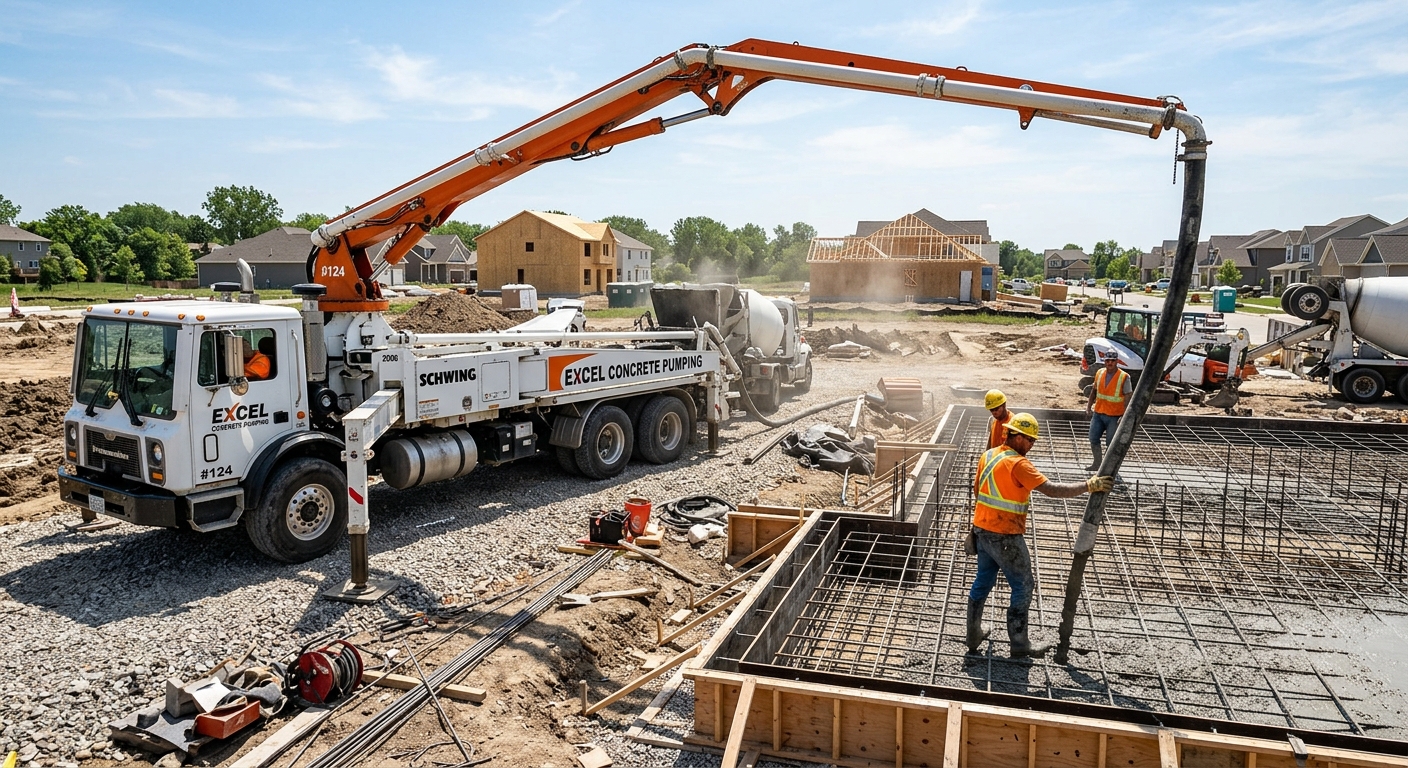
Concrete work options and costs in McQueen
Concrete work in McQueen comes down to picking the right mix, the right base, and the right finish for Alberta’s winter, not just choosing a colour. McQueen is a small community (population 1,670 in 2021, Statistics Canada, 2021 Census), so contractors who consistently handle logistics and winter curing—especially around the Calgary economic region—tend to be in higher demand. Like much of the surrounding Calgary area, the typical neighbourhood build-out is heavy on single-family homes, which drives steady work for driveways, patios, walkway slabs, and garage floors.
In this cold continental climate, the design frost depth is about 1.2 m (roughly 4 ft), so footings and some slab edges must extend below undisturbed soil at depth to reduce frost heave and seasonal movement. Exterior slabs also need air-entrained concrete and well-spaced control joints to manage freeze–thaw cycling. That’s why you’ll often see foundation and exterior slab projects priced higher in Calgary than in milder provinces: excavation volumes are larger, winter placement is more constrained, and curing quality becomes a bigger cost lever. Stacking these factors together is exactly how a “similar” patio quote can differ by thousands.
In McQueen, flatwork tends to be especially in demand near newer residential pockets and growing commuter routes where homeowners upgrade aging driveways and add secondary patios for summer use. With the right specs, these upgrades last—without spalling and scaling. Below is a practical comparison of typical options and price bands to help you line up apples-to-apples before you request detailed quotes.
| Application |
Typical Size |
Key Spec |
Finish Option |
Price Range |
| Concrete driveway (standard broom finish) |
20 ft x 10 ft (200 sq. ft.) |
Air-entrained, control joints, compacted base |
Broom finish |
$12,000–$18,000 |
| Exposed aggregate driveway |
20 ft x 10 ft (200 sq. ft.) |
Air-entrained, properly cured, aggregate exposure |
Exposed aggregate |
$14,500–$22,500 |
| Stamped concrete driveway or patio |
16 ft x 12 ft (192 sq. ft.) |
Air-entrained, integral colour, sealed finish |
Stamped (pattern + release + seal) |
$15,000–$26,000 |
| Plain concrete patio or walkway |
12 ft x 10 ft (120 sq. ft.) |
Air-entrained, proper slope, control joints |
Plain/float + broom edge |
$5,000–$9,000 |
| Garage floor (interior slab) |
20 ft x 22 ft (440 sq. ft.) |
Vapour control where needed, fibre optional |
Plain trowel/finish |
$6,500–$12,500 |
| Foundation footings (structural, below frost) |
Typical house footprint (engineering-dependent) |
Excavation to frost depth; engineered steel as required |
Structural concrete only |
$28,000–$45,000 |
Prices are estimates only and vary by project scope, site access and material selection.
What affects the price of concrete work in McQueen
In Calgary and the surrounding region, it’s common for quotes for the “same” concrete job to vary by 30–50%. The reason isn’t just labour—it’s that cold-weather engineering changes what must be built underneath the concrete (and how it’s cured), and those choices have real material and equipment costs. Frost depth drives footing and formwork height, granular base prep, and excavation volumes. In Alberta, footing work typically needs to bear below the design frost depth (about 1.2 m here), so excavation is deeper and more intensive than in warmer climates. Combine that with frequent freeze–thaw cycles and you’ll also see air-entrained mixes, stronger specs, and more careful jointing—especially for exterior slabs.
Cold seasons also shorten the exterior pour window, and contractors may need winter-grade curing measures like insulating blankets or temporary heat to meet the required strength development. If a contractor “rushes the cure,” you’re more likely to see surface scaling and long-term durability issues, and that risk shows up in how responsible crews price the job. De-icing salts add another pressure point: they accelerate surface wear, so sealing is often recommended for driveways and patios.
Local site conditions can push costs up or down in McQueen. For example, a driveway replacement on well-drained, compactable soil may land nearer the driveway band of $12,000–$18,000, while the same size pour on unstable subgrade or with tight access for a concrete truck can run toward the top end or require extra base. A stamped patio might only make sense if you’re upgrading aesthetic value where you’ll actually use the space—otherwise a plain patio band of $5,000–$9,000 can be the better ROI.
| Price Factor |
Why It Matters |
Cost Impact |
| Frost line depth — determines footing depth and form height |
Footings must sit below design frost depth to reduce frost heave |
Higher excavation and concrete volume increases cost |
| Site preparation — excavation, grading, compacted granular base |
Proper base thickness and compaction prevent settlement and cracking |
More haul-off or more granular material pushes price up |
| Reinforcement — rebar or wire mesh requirement |
Rebar/wire mesh controls cracking under load and thermal movement |
Labour and steel cost vary by design and thickness |
| Mix design — air-entrainment and compressive strength spec |
Exterior freeze–thaw performance relies on air-entrainment |
Correct mix may cost more per yard but improves durability |
| Finish type — broom vs. stamped vs. exposed aggregate |
Finish affects labour hours, tooling, and seal requirements |
Decorative systems typically add several thousand dollars |
| Pour size and concrete truck access to site |
Smaller pours cost more per square foot; tight access adds labour |
Long wheelbarrow runs or crane/boom needs increase costs |
| Cold-weather curing precautions — heating and blankets |
Ensures strength gain and prevents early-age freezing |
Added equipment and time can raise labour/material costs |
| Control joint pattern and sealing cost |
Joints manage cracks; sealing helps resist de-icing salt damage |
Skipping or reducing joints/seal typically increases future repair risk |
Permits & regulations in Alberta
In Alberta, structural concrete work usually needs a building permit and often engineered drawings reviewed by the municipality. That means foundation-related elements like footings, foundation walls, grade beams, and similar structural concrete typically require a permit process. Concrete flatwork—driveways, patios, and walkways—typically does not require a permit on its own, as long as it doesn’t materially change lot grading, violate impervious surface coverage limits, or affect municipal right-of-way/driveway access rules. Still, in McQueen you should always verify with the local authority before breaking ground, especially when you’re altering drainage, raising slab elevations, or changing how water moves across your property.
Before you hire anyone, confirm the contractor’s insurance and coverage. Here’s a homeowner-friendly step-by-step approach: (1) Ask for the company’s certificate of insurance and verify it includes liability coverage with an expiry date, then ensure you’re named properly as required on the job documents. (2) Verify WSIB/WCB coverage by asking for a clearance letter or proof of account status—don’t accept “we’re insured” without paperwork. (3) For licensing, check the contractor’s registration/credentials through the relevant provincial registry and the company’s business documentation; confirm the specific trade permits and responsibilities match the work being quoted.
Finally, ask for references on projects of similar scale and age—durability in freeze–thaw climates is a workmanship story, not just a materials story.
Getting concrete right in McQueen's freeze-thaw climate
Concrete fails in McQueen mainly when it’s built for a milder climate and then tested by Alberta’s freeze–thaw cycles. The two biggest drivers are inadequate base support and poor mix design. If the base isn’t excavated and compacted to the right depth and density for local soil conditions, the slab can settle unevenly, leading to cracks. If the mix isn’t properly air-entrained, water enters tiny pores and microcracks during melt cycles; then it freezes and expands, which is where spalling and surface scaling start. Calgary-area codes and engineering practice are built around a design frost depth of about 1.2 m, and exterior slabs rely on proper drainage, joints, and air entrainment to survive repeated winter stress.
To spec the job correctly, make sure the base prep is done first: compacted granular sub-base to the specified thickness and grade for the soil. Then verify the mix design: for exterior flatwork, target air-entrainment typically in the 5–7% range and a minimum 32 MPa compressive strength spec. Control joints should be laid out to limit random cracking, not just placed where it looks neat. Curing matters just as much: plan for a minimum 7-day cure under proper conditions, and when cold weather hits, ask about insulated blankets or heat so the concrete doesn’t freeze too early. Finally, seal with a penetrating sealer after the cure window—often around 28 days—to repel de-icing salt effects.
Dollar reality check: going from a plain broom-finished patio to a stamped driveway can add a few thousand—often $15,000–$26,000 versus a driveway in the $12,000–$18,000 band—so you want the decorative choice where you’ll see it daily and use it often. If your goal is durability and safe traction in winter, the “extra cost” is best spent on correct base prep, air entrainment, and curing rather than chasing aesthetics.
| Spec |
Why It Matters in McQueen |
What to Ask For |
Impact if Skipped |
| Compacted granular base (depth?) |
Supports the slab against frost-related movement and settlement |
Granular sub-base thickness based on soil + frost considerations |
Uneven settling, cracking, trip hazards |
| Air-entrained concrete mix (target air %?) |
Freeze–thaw resistance depends on controlled air voids |
Confirm 5–7% air content for exterior flatwork |
Spalling/scaling risk increases dramatically over winters |
| Compressive strength (MPa rating) |
Strength gain affects long-term durability and load capacity |
Minimum 32 MPa (verify spec on quote/engineering) |
Lower strength, surface damage, reduced lifespan |
| Control joints (spacing per ACI guidelines) |
Manages where cracks occur as concrete shrinks/expands |
Joint layout with spacing appropriate to slab thickness and size |
Random cracking and wider repairs later |
| Minimum 7-day curing period |
Concrete needs time for strength development, especially in cold weather |
Specify curing method and protection plan |
Surface scaling, reduced strength, early-age failure |
| Penetrating sealer (when applied after cure) |
Helps repel de-icing salt damage during harsh winters |
Apply after cure—commonly around 28 days—using product suited for concrete |
Faster surface deterioration and spalling at the edges |
How to choose a concrete work contractor in McQueen
Choosing the right contractor in McQueen and the wider Calgary region starts with proof, not promises. In Alberta, always verify liability insurance by requesting the certificate of insurance and checking the effective dates and job coverage. Next, confirm WCB/WSIB clearance or documentation—ask for a clearance letter or proof of account status—so you know subcontractors and crew are properly covered. For licensing and registrations, ask for the contractor’s credentials and confirm they’re appropriate for the scope you’re purchasing (structural foundation work versus flatwork can involve different responsibilities).
Then slow down and request 2–3 itemised, written quotes. A solid quote breaks down labour and materials (concrete volume, reinforcing, excavation and granular base, forms, finishing and sealing). Compare inclusions carefully: is demolition included? Is waste disposal included? Is the permit pull included if structural work requires it? What’s the protection plan for cold weather curing? Also ask about warranty: workmanship warranty length, any product/manufacturer warranty, and whether the warranty is transferable if you sell the home.
Payment schedule should protect you: don’t pay more than 10–15% upfront for mobilization, and hold back a portion until completion and cleanup. Finally, get the start date and a realistic completion estimate in writing—concrete schedules in Alberta are heavily influenced by freezing nights, wind, and curing temperature requirements.
- Confirm liability insurance certificate (expiry date and job coverage).
- Provide WSIB/WCB clearance or proof of coverage on request.
- Get 2–3 itemised quotes with labour + materials, not one lump sum.
- Ask for the exact concrete mix spec (air content for exterior, MPa strength).
- Require base prep details: excavation depth, granular thickness, and compaction.
- Confirm reinforcement plan (mesh/rebar placement, cover, dowels where needed).
- Ask for control joint spacing and sealing plan for exterior flatwork.
- Verify cold-weather curing procedures (blankets, protection, heat if needed).
- Check whether demolition, haul-off, and proper disposal are included.
- Clarify exclusions: cracks in existing slabs, tree roots, drainage issues, soil remediation.
- Set expectations for timeline and weather delays in writing.
- Review warranty terms before signing: workmanship and product coverage details.
Concrete red flags in McQueen: quotes that won’t name the air-entrainment and strength spec, missing details on base depth/compaction, no written curing plan for late fall or early spring pours, warranties limited to “materials only” with no workmanship coverage, and contractors who ask for large upfront payments (beyond 10–15%) before any site work starts.
Frequently asked questions — concrete work in McQueen
What is air-entrained concrete and why does it matter here?
Air-entrained concrete is a mix designed with microscopic air bubbles that help relieve pressure when water inside the concrete freezes and expands. In McQueen and the Calgary region, freeze–thaw cycles are frequent, and that’s why exterior flatwork (driveways, patios, and walkways) should use an air-entrained mix—typically around 5–7% air content for exterior work. Without that, water can damage the surface and you’re more likely to see spalling and scaling over multiple winters, even if the slab looks fine at first. When you compare quotes in Alberta, look for the air content and the MPa strength spec, not just the total price. If one quote is much cheaper, it may be cutting corners on the mix and durability.
How do I prepare the base for a concrete slab?
Proper base prep is what separates long-lasting concrete from the kind of cracking that shows up after the first big winter. The process starts with excavation and grading to the right elevation, then placing and compacting a granular sub-base in lifts so it reaches the required density. Because the frost depth in this region is about 1.2 m (roughly 4 ft), foundation work must bear below undisturbed soil at depth, and exterior slabs still need stable, well-compacted support to reduce movement. You should ask your contractor what granular thickness they plan, how they handle poor-draining soil, and whether they’ll compact with proper equipment (not just “light tamping”). If you want a driveway in the $12,000–$18,000 band, base prep is usually the reason a crew can hit that price without cutting durability.
How do I compare concrete quotes?
Start by comparing scope line-by-line, not just the bottom number. Ask for itemised quotes that split labour and materials: concrete volume, reinforcement, excavation, granular base, forms, finishing, sealing, and disposal. Confirm the concrete spec is consistent—exterior work should be air-entrained and meet a strength requirement (commonly minimum 32 MPa). Make sure the finish details match the quote too: a broom finish is different from exposed aggregate or stamped work, and decorative jobs typically land in higher bands such as $15,000–$26,000 for stamped driveway/patio systems. Also check inclusions for cold-weather curing if your pour is in late fall or early spring—insulated blankets or heat can be essential in Alberta. Finally, compare warranty length and workmanship coverage, because a cheaper quote that can’t stand behind its cure and joints will cost you later.
Can concrete be poured in cold weather in McQueen?
Yes, concrete can be poured in cold weather in McQueen, but it needs the right cold-weather controls. Alberta placements still require proper strength gain, and the biggest risk is early-age freezing before the concrete reaches sufficient strength. That’s why reputable contractors plan for curing protection: insulated blankets, wind protection, and sometimes temporary heat. Your contractor should explain the method they’ll use, not just say “we’ll pour anyway.” The practical pour season for exterior work is shorter than in milder climates, so scheduling matters. When concrete is placed near freezing, costs can rise due to added labour and equipment. If a quote ignores cold-weather precautions, expect higher risk of surface scaling and long-term durability problems—especially on driveways and patios exposed to de-icing salts.
How do I maintain concrete in McQueen's freeze-thaw climate?
Maintenance is mostly about protecting the surface from water ingress and de-icing damage. For exterior concrete in McQueen, sealing is a key step: use a penetrating sealer applied after the recommended cure window (commonly around 28 days post-pour). This helps repel de-icing salts and reduces surface wear. During winter, use de-icers carefully—avoid over-salting, and try to clean up sand and salt residue as the season progresses. Also inspect annually for early signs of trouble: small cracks, edge spalling, or areas where water puddles after rain or snowmelt. Those spots often need repair before they widen. With a driveway near $12,000–$18,000, maintenance is what helps you get the durability you paid for—especially where freeze–thaw cycling is constant.
What causes concrete to spall in McQueen winters?
Spalling is usually caused by freeze–thaw damage concentrated at the surface. The root mechanisms are water getting into the concrete (through pores or cracks) and then freezing, which expands and breaks off the outer layer. In McQueen and the Calgary region, this is strongly linked to inadequate air-entrainment in exterior mixes—without the right air void system, freeze pressure isn’t relieved. De-icing salts accelerate the problem by increasing chemical and moisture exposure at the surface, and areas that stay wet (low spots, poor drainage, or insufficient slope) tend to fail sooner. Another contributor is poor curing or insufficient strength gain early on, which leaves the surface vulnerable. If you’re evaluating repairs or planning a new driveway, patio, or walkway, ask whether the quote includes air-entrainment specs, proper curing, control joints, and sealing.