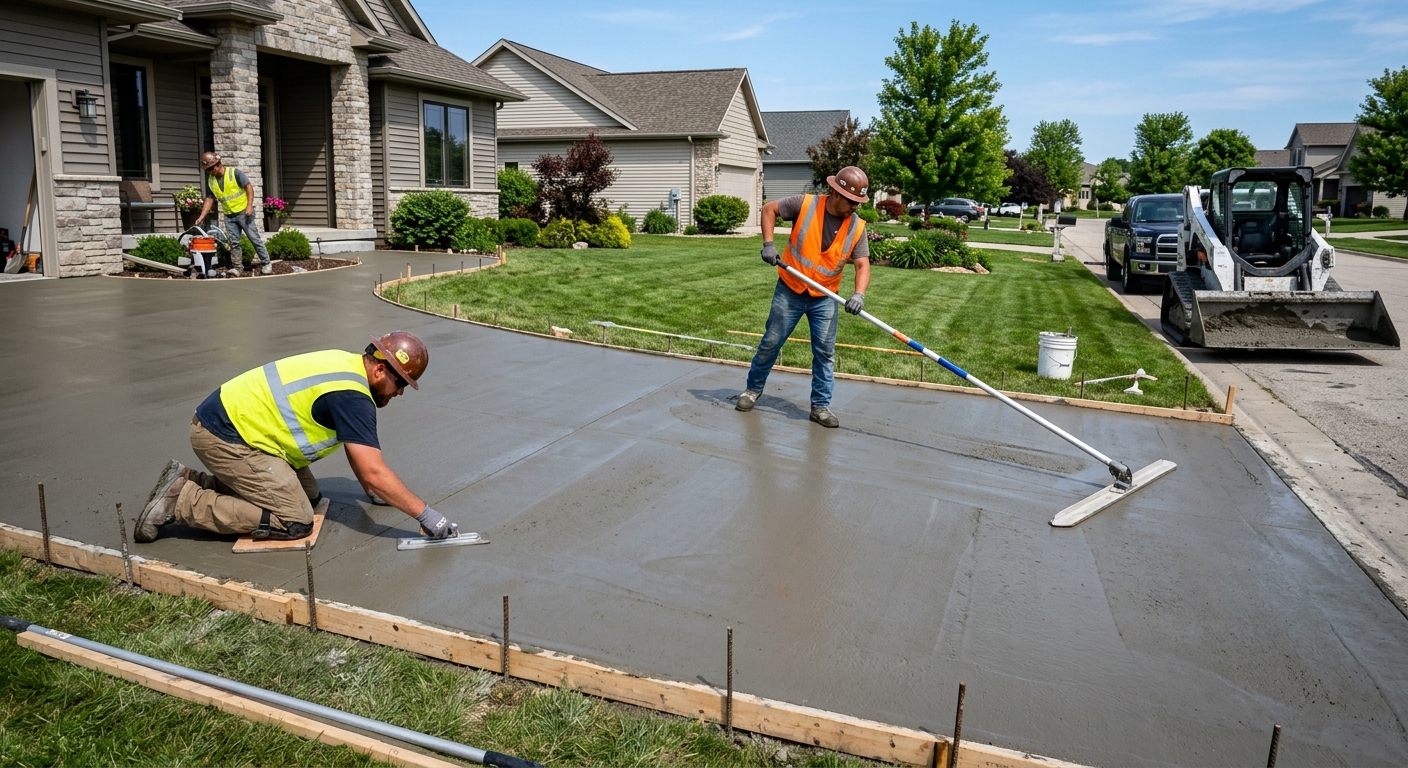
Concrete work options and costs in Cameron Heights
Concrete work is a common upgrade in Cameron Heights, Alberta, where homeowners typically need durable flatwork around single-detached homes and growing infill lots (Statistics Canada, 2021 Census). While the community is small—about 1,123 residents—it sits inside the Calgary concrete market, so scheduling, minimum truck loads, and material availability still reflect regional demand. In Calgary and area, concrete pricing is shaped as much by logistics and climate as by surface design, especially for exterior slabs like driveways, patios and walkways.
Calgary’s cold continental winters bring frequent freeze–thaw cycles, which drives contractors to engineer for frost depth and curb cracking risk. In practice, local engineering assumes a deep frost line (about 1.2 m, roughly 4 ft), so footings and any frost-susceptible areas must bear on undisturbed soil below that depth. That means more excavation and higher footing volumes than in milder climates, which is why foundation work typically runs higher than many homeowners expect. At the same time, because exterior slabs see de-icing salt and rapid temperature swings, contractors prefer air-entrained mixes, granular base prep, and well-spaced control joints to reduce spalling and scaling.
Within Cameron Heights, demand is especially strong in older infill pockets along busier access routes and near the main collector roads, where driveways and backyard access see heavy winter wear. For many homeowners, choosing between a standard broom finish and decorative options is less about appearance alone and more about how much maintenance they want over time. Use the ranges below as a starting point before you compare quotes.
| Application |
Typical Size |
Key Spec |
Finish Option |
Price Range |
| Concrete driveway (standard broom finish) |
12 m x 3 m (approx. 36 m²) |
Air-entrained exterior mix; compacted granular base |
Broomed |
$12,000–$18,000 |
| Exposed aggregate driveway |
12 m x 3 m (approx. 36 m²) |
Air-entrained exterior mix; proper curing to polish sheen evenly |
Exposed aggregate |
$15,000–$22,000 |
| Stamped concrete driveway or patio |
30 m² to 45 m² (varies by home) |
Air-entrained exterior mix; base prep for frost protection |
Stamped pattern with release agent |
$15,000–$26,000 |
| Plain concrete patio or walkway |
25 m² to 35 m² |
Air-entrained exterior mix; jointing plan |
Float/finish with light broom texture |
$5,000–$9,000 |
| Garage floor (interior slab) |
18 m² to 26 m² |
Vapour control as required; minimum 32 MPa mix |
Steel-trowel or broom finish |
$7,500–$13,000 |
| Foundation footings (structural, below frost) |
Typical house footprint (varies by design) |
Engineered steel + below-design frost bearing depth |
Structural concrete |
$28,000–$45,000 |
Prices are estimates only and vary by project scope, site access and material selection.
What affects the price of concrete work in Cameron Heights
In Cameron Heights, two homeowners can get quotes that look wildly different for what seems like the same concrete job—often by 30–50%. The main reason is that “concrete” isn’t just the pour. Quotes hinge on excavation depth for frost protection, how much granular base is installed and compacted, reinforcement requirements, mix design (especially air-entrainment), and how a contractor handles cold-weather curing and logistics. In a region like Calgary, labour and equipment scheduling can also swing pricing, because the exterior pour season tightens when temperatures drop and overnight freezing becomes common.
First, the frost line depth drives every structural decision for footings and any slab-on-grade risks. Local engineering practice commonly assumes a design frost depth around 1.2 m, so form height and excavation volumes rise compared to areas with shallower frost. Second, freeze–thaw cycles push contractors toward air-entrained concrete mixes for exterior flatwork, plus control joints and sealing to reduce spalling from de-icing salt. Third, cold-weather placement may require winter-grade mix adjustments, insulating blankets, and sometimes temporary heating to reach proper curing—costs that show up immediately in your quote.
In Cameron Heights specifically, costs can rise when access is limited (smaller streets, tight driveways, or long hose paths for placement) and when soil conditions demand extra base stabilization. For example, a 36 m² broom-finished driveway might sit near the $12,000–$18,000 band, but if you add stamped detailing you’re typically moving toward the $15,000–$26,000 range—because stamp mats, release agents, and additional finishing labour are real line items. Likewise, a foundation upgrade can feel “one step” different, but deeper excavation below frost and engineered reinforcement can quickly shift you from the lower to upper end of the $28,000–$45,000 footing band. In short: climate and preparation details are where the money goes.
| Price Factor |
Why It Matters |
Cost Impact |
| Frost line depth |
Determines footing depth and form height to prevent frost heave |
Higher excavation = more concrete and labour; can add thousands |
| Site preparation |
Excavation, grading, and compacted granular base reduce settlement |
Extra base or stabilization can increase costs significantly |
| Reinforcement |
Rebar or mesh controls shrinkage cracking and improves load capacity |
Material + labour placement adds measurable expense |
| Mix design |
Air-entrainment and compressive strength spec improve freeze–thaw durability |
Winter-grade/engineered specs cost more than standard mixes |
| Finish type |
Broom vs. stamped vs. exposed aggregate changes labour time and materials |
Decorative finishes often move pricing toward upper bands |
| Pour size and concrete truck access to site |
Placement method affects labour, time, and equipment needs |
Long pushes/limited access can increase crew hours |
| Cold-weather curing precautions |
Heating, insulation blankets, and timing protect curing in winter conditions |
Can add overhead during late fall and early spring |
| Control joint pattern and sealing cost |
Joints manage cracking; sealers reduce salt penetration and surface scaling |
Skipping these often reduces short-term cost but increases failure risk |
Permits & regulations in Alberta
In Alberta, structural concrete work is typically more regulated than flatwork. Footings, foundation walls, and grade beams usually require a building permit, and many projects also rely on engineered drawings that the municipality reviews during the permit process. For concrete flatwork—driveways, patios, walkways—the work often does not require a permit on its own unless it affects lot grading, drainage, or impervious surface/coverage limits, or if you’re working within or near the municipal right-of-way. Even when a permit isn’t required for the slab, it can become necessary if the scope changes drainage patterns, lowers a swale, or alters how water runs off the property.
Before breaking ground in Cameron Heights, verify your contractor’s compliance and documentation. Step one: confirm whether your scope is “structural” (permit likely) or “flatwork” (often no permit unless grading/drainage impacts). Step two: ask for their current liability insurance certificate of insurance showing the company name and coverage dates. Step three: confirm WSIB/WCB coverage (the letter or coverage proof should match the contractor you’re hiring). Step four: check whether the contractor is registered/licensed appropriately for the work they’re performing, and ask for references from similar-scale Calgary-area projects (especially those poured during freeze–thaw periods).
If anything is unclear, contact the local permitting office and ask what applies to your specific location and design. Clear answers now prevent delays later.
Getting concrete right in Cameron Heights's freeze-thaw climate
Concrete failure in Cameron Heights usually traces back to five things: poor base preparation, the wrong mix for freeze–thaw durability, missing or poorly placed control joints, rushed curing, and inadequate sealing against de-icing salt. In Calgary’s cold continental climate, freeze–thaw cycles expand and contract moisture in the slab and sub-base. If the base isn’t compacted to the correct depth or if the concrete lacks sufficient air entrainment, you can get early surface scaling and, in worse cases, deeper cracking and spalling.
To spec the job correctly, start with base prep: excavate to the required frost-protected depth and install a properly graded, compacted granular sub-base. Next is mix design. For exterior flatwork, request an air-entrained concrete mix with target air content typically in the 5–7% range, and specify a minimum 32 MPa compressive strength (engineered specs may be higher). Then control joints: spacing should limit random cracking and guide where cracks form. Curing matters just as much. Plan for a minimum 7-day curing period under conditions that protect the slab—when it’s cold, that can mean insulated blankets or controlled heat to keep curing on track. Finally, apply a penetrating sealer about 28 days after the pour to help repel de-icing salts.
Here’s where pricing is justified: if you’re choosing between a plain patio and stamped concrete, the stamped option may cost more (for example, moving toward the $15,000–$26,000 band for larger decorative projects). The premium makes sense when it includes the same freeze–thaw durability specs—not when it tries to “save” on air-entrainment, base depth, joints, or curing. The cheapest quote often appears cheaper because those line items were reduced.
| Spec |
Why It Matters in Cameron Heights |
What to Ask For |
Impact if Skipped |
| Compacted granular base (depth?) |
Prevents frost-related movement and reduces settlement during freeze–thaw cycles |
Ask for excavation depth, base material type, and compaction method/testing |
Uneven support leads to cracking, lifting, and premature joint failure |
| Air-entrained concrete mix (target air %?) |
Improves freeze–thaw durability and reduces scaling/spalling risk on exterior slabs |
Request target air content typically 5–7% for exterior flatwork |
Higher chance of surface scaling and flaking in winter |
| Compressive strength (MPa rating) |
Ensures structural durability and resistance to early wear |
Minimum 32 MPa (confirm whether engineered design requires more) |
Greater risk of cracking under traffic and freeze–thaw stress |
| Control joints (spacing per ACI guidelines) |
Manages where cracks occur so they’re narrow and less damaging |
Ask for joint spacing plan and whether joints are saw-cut or formed |
Random cracking can spread and create pathways for water/salt |
| Minimum 7-day curing period |
Builds strength and protects surface quality through winter temperature swings |
Ask how curing will be protected if freezing occurs (blankets/heating) |
Reduced surface strength and higher scaling risk |
| Penetrating sealer (when applied after cure) |
Reduces moisture and de-icing salt penetration, helping prevent spalling |
Confirm sealer timing (often ~28 days post-pour) and product type |
Faster deterioration of the top surface and joints |
How to choose a concrete work contractor in Cameron Heights
Choosing the right contractor in Cameron Heights starts with verification. In Alberta, confirm the contractor has valid liability insurance for the correct legal entity and asks for a certificate of insurance. Next, request proof of WSIB/WCB coverage—if they can’t produce it, treat that as a major red flag because coverage gaps can leave homeowners exposed. You should also verify their registration/licensing as applicable to the scope (structural concrete vs. flatwork) and make sure the crew on site matches the company name on paperwork.
Then get 2–3 itemised written quotes. A good quote breaks labour and materials clearly (excavation/grading, granular base, reinforcement, concrete supply, finishing, jointing, sealing, and curing measures). Don’t accept a vague “all-in” number that doesn’t state what’s included. Ask whether permits are included for structural work and whether disposal of excess soil is included. Clarify waste handling, truck access, and any work within right-of-way or near drainage features.
Warranty should be specific: workmanship warranty length and what it covers (and what it doesn’t), plus any product/manufacturer warranty for concrete components or sealers. Payment scheduling matters in Calgary: never pay more than about 10–15% upfront and hold a portion back until the job is complete and walk-through items are addressed. Finally, insist on a written timeline with start date and estimated completion—cold-weather constraints can affect sequencing.
- Proof of liability insurance (certificate with coverage dates)
- WSIB/WCB coverage documentation for the trade crew
- Recent references for similar driveways/patios/footings in the Calgary area
- Itemised quote: base prep, reinforcement, concrete supply, curing, finishing, sealing
- Clear exclusions (what’s not included for excavation, rebar/mats, disposal, or drainage)
- Jointing plan included (spacing and whether saw-cut timing is specified)
- Air-entrainment and strength spec stated for exterior work
- Cold-weather method described (blankets/heating/curing plan)
- Protection plan for lawns/sidewalks/landscaping during form-and-pour
- Concrete access logistics explained (where trucks can set up and how placement occurs)
- Warranty terms in writing (workmanship and product/sealer coverage)
- Payment schedule aligns with partial holdback (no large upfront deposits)
Concrete contractor red flags I see in the Cameron Heights area: vague scopes (“we’ll pour concrete”), no mention of air-entrainment for exterior work, skipping joint spacing details, quoting a cure timeline that ignores freezing conditions, and refusing to provide insurance/WSIB/WCB paperwork or clear references.
Frequently asked questions — concrete work in Cameron Heights
Concrete vs pavers for a patio in Cameron Heights?
For a patio in Cameron Heights, concrete is often the better “durability per dollar” choice when you want a smooth finish that stands up to de-icing salts and freeze–thaw cycles. A plain concrete patio is commonly in the $5,000–$9,000 range depending on square footage and site conditions, and it can be specified with air-entrainment, proper jointing, and sealing for winter performance. Pavers can also work well, but they rely on excellent base drainage and correct bedding depth; if the base settles, you get movement and uneven surfaces. If you’re hoping for a designer look, stamped concrete moves into the $15,000–$26,000 range, while pavers typically vary widely based on stone type and excavation. In Calgary-area winters, either option needs good sub-base prep—concrete is simply more forgiving when the spec is right.
How long does a concrete driveway last?
A properly built concrete driveway in Alberta can last decades, but “how long” depends heavily on frost protection, air-entrainment, and jointing. In Calgary’s freeze–thaw climate, surface scaling usually shows up first when air content is too low or curing is rushed during cold snaps. Driveways poured with engineered base prep (compacted granular base), control joints at appropriate spacing, and a sealing plan tend to perform significantly better through winters. If you’re pricing a standard broom-finish driveway, many projects land in the $12,000–$18,000 band for typical sizes. That price usually reflects the real work: excavation depth for frost considerations and the concrete mix suited for exterior exposure. Neglecting those details can shorten lifespan dramatically, even if the driveway looks fine at first.
What is air-entrained concrete and why does it matter here?
Air-entrained concrete is mixed with microscopic air bubbles that give freezing water places to expand without damaging the paste. In Cameron Heights and the wider Calgary region, freeze–thaw cycles are frequent, and that’s why air-entrainment is a core specification for exterior flatwork. Without sufficient air content (commonly targeted around 5–7% for exterior slabs), concrete is more likely to spall and scale—often starting on the surface where de-icing salts accumulate. This is also why “cheap concrete” failures often appear as flaking or rough scaling after a few winters rather than as a sudden collapse. When you get quotes, ask for the mix spec (air-entrainment and minimum strength such as 32 MPa) and how the contractor protects curing during cold weather. In this climate, curing practices are just as important as the mix itself.
How do I prepare the base for a concrete slab?
Base preparation is where most driveway and patio performance is decided in Alberta. The slab needs support that won’t move when the ground freezes and thaws. That typically means excavating to the required depth, installing a compacted granular sub-base, and achieving proper compaction rather than “dumping and leveling.” For slabs exposed to winter weather and frost action, the base must be engineered to protect against frost heave—local engineering practice often assumes a design frost depth around 1.2 m for relevant bearing decisions. Even for non-structural flatwork, the base depth, grading, and compaction matter for drainage and settlement. Ask your contractor to explain the base material type, lift/compaction process, and whether they’ll manage soft spots or unstable soil. A strong quote should show this work in the scope, not hide it inside a lump sum.
How do I compare concrete quotes?
When comparing concrete quotes in Cameron Heights, don’t just compare total price—compare what you’re buying. Request itemised estimates that break out labour and materials: excavation/grading, granular base, reinforcement (mesh or rebar), concrete supply, finishing, joints, sealing, and curing protections. Look for whether the quote specifies air-entrainment and minimum compressive strength for exterior work, and ask how they’ll handle curing if temperatures dip. For example, a standard driveway in the $12,000–$18,000 band should include the same frost-aware preparation and exterior mix spec as the more expensive options; the difference should be the finish (broom vs decorative) and associated labour. If one quote is much lower without explaining reductions in base prep, mix design, joints, or curing, that’s usually where the risk is. Also confirm disposal is included and truck access constraints are accounted for.
Can concrete be poured in cold weather in Cameron Heights?
Concrete can be poured in cold weather in Cameron Heights, but it should be engineered and managed—not rushed. The Calgary region’s freeze–thaw reality means you need protection so the concrete reaches adequate early strength. That can include winter-grade concrete mix adjustments, insulating blankets, and sometimes temporary heating depending on temperature and wind. The goal is to keep the slab curing reliably through freezing conditions so you don’t end up with surface scaling or weakened durability. A good contractor will describe their cold-weather plan in writing and tie it to curing duration (commonly planning for at least 7 days of protected curing). If you’re working late in the pour season, ask if they’re scheduling the pour earlier, how they’ll monitor temperatures, and what protection they’ll use to keep the slab from freezing too soon. In this climate, that discipline can be the difference between “looks great” and “holds up for years.”