Concrete work options and costs in Discovery Ridge
Discovery Ridge homeowners typically start with the same question: what will concrete flatwork or foundation work really cost? With the town’s population at 4,330 (Statistics Canada, 2021 Census), demand is steady for driveways, patios and walkways, especially around the newer sub-neighbourhood pockets tied to growth in the Calgary economic region. That matters because most concrete contractors plan crews around repeat work and season timing—so pricing and scheduling can shift quickly when footing and slab demand is high.
Concrete flatwork is also tightly linked to the housing stock. Discovery Ridge and the surrounding Calgary area are dominated by single-detached and low-rise communities where homeowners want durable, clean-finish exterior slabs that can handle long winters. In this part of Alberta, cold continental weather and frequent freeze–thaw cycles drive the “hidden” portion of the budget: deeper excavation, granular base prep, air-entrained mixes, and careful curing.
Because the design frost depth in Calgary is about 1.2 m (roughly 4 ft), foundation-related work needs to bear on undisturbed soil below that depth, which raises excavation volume and foundation costs compared with milder regions. For exterior slabs, it’s not just concrete—it’s the engineered approach: well-spaced control joints, proper base drainage, and (when required) winter placement precautions like insulated curing blankets and, at times, temporary heat.
Trade demand is especially noticeable near the busy residential corridors leading to amenities and school routes, where homeowners commonly upgrade driveways and add rear patios in the same project year. Below is a practical comparison of typical options and realistic price ranges to help you read quotes clearly.
| Application |
Typical Size |
Key Spec |
Finish Option |
Price Range |
| Concrete driveway (standard broom finish) |
400–550 sq. ft. |
Air-entrained exterior mix, compacted granular base |
Broom finish with saw-cut control joints |
$12,000–$18,000 |
| Exposed aggregate driveway |
400–550 sq. ft. |
Air-entrained exterior mix, higher material allowance |
Exposed aggregate with sealed surface |
$14,500–$22,000 |
| Stamped concrete driveway or patio |
300–500 sq. ft. |
Air-entrained exterior mix, reinforced where needed |
Stamped pattern with integral colour (or colour hardener) |
$15,000–$26,000 |
| Plain concrete patio or walkway |
200–350 sq. ft. |
Air-entrained exterior mix, compacted base and joints |
Broom or light broom + edge finishing |
$5,000–$9,000 |
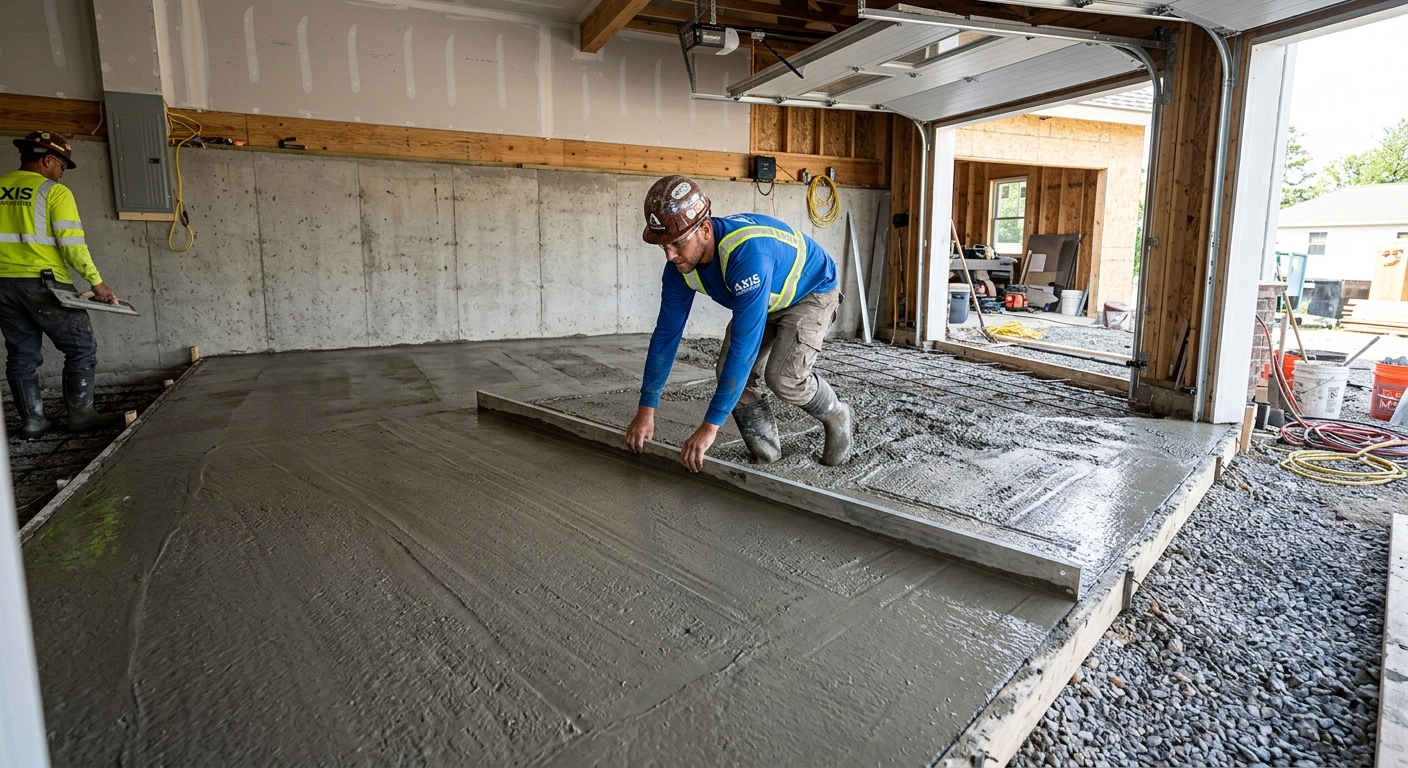
| Garage floor (interior slab) |
400–600 sq. ft. |
32 MPa mix, vapour barrier (as applicable), reinforcement if required |
Smooth trowel or broom finish (depending on use) |
$10,500–$16,500 |
| Foundation footings (structural, below frost) |
Typical house footprint, varies by design |
Designed concrete placement below design frost depth, engineered reinforcement |
Structural formwork and finish level set by engineering |
$28,000–$45,000 |
Prices are estimates only and vary by project scope, site access and material selection.
What affects the price of concrete work in Discovery Ridge
In Discovery Ridge and across the Calgary region, two contractors can quote the “same” project and still be apart by 30–50%. The gap usually isn’t the concrete itself—it’s the engineering and installation details that protect the slab through Alberta’s freeze–thaw cycles. Calgary-area crews also face a shorter practical exterior working window than homeowners expect, so when the schedule tightens, labour and equipment availability can push rates upward.
Start with the frost line depth. Calgary’s design frost depth is about 1.2 m (roughly 4 ft), which means excavations and footing volumes for houses, garages, decks, and retaining structures must reach undisturbed soil below that depth. That one requirement drives up foundation / footing costs compared with areas where frost penetration is shallower. Next, freeze–thaw dictates exterior specs: air-entrained concrete mixes are non-negotiable for driveways, patios and walkways, and control joints must be placed to limit random cracking and reduce spalling.
In colder months, curing becomes a line item. If you pour late in the season, contractors may need insulated blankets, wind protection, and sometimes temporary heat to achieve proper curing. That adds cost, but it’s cheaper than dealing with premature scaling later. Finally, de-icing salt accelerates surface damage—so sealing is often recommended to improve longevity, especially on exposed aggregate or stamped finishes.
For example, moving from a standard broom driveway to an exposed aggregate finish often shifts the estimate toward the upper end of the $12,000–$18,000 driveway range because of added material and finishing labour. Similarly, a stamped driveway or patio can land near the $15,000–$26,000 band when colour, stamps, and workflow time increase. In Discovery Ridge, the cost difference is usually justified when the base prep and air-entrainment specs stay consistent.
| Price Factor |
Why It Matters |
Cost Impact |
| Frost line depth — determines footing depth and form height |
Footings must sit below design frost to prevent frost heave and seasonal movement |
Higher excavation and concrete volume; often shifts foundation pricing toward the top of the band |
| Site preparation — excavation, grading, compacted granular base |
Bad base prep leads to settlement and cracking regardless of finish |
More hauling and granular material increases cost; tight access can raise labour time |
| Reinforcement — rebar or wire mesh requirement |
Reduces cracking and controls slab behaviour under load (driveways/garage floors) |
Material and labour add; can be required by design or slab thickness |
| Mix design — air-entrainment and compressive strength spec |
Air-entrainment improves freeze–thaw durability; strength affects structural performance |
Specialty ordering and testing can add cost, but it protects against spalling |
| Finish type — broom vs. stamped vs. exposed aggregate |
Finish controls appearance and surface texture; stamped/exposed require extra steps |
Stamped/exposed often pushes pricing into higher bands vs. plain broom |
| Pour size and concrete truck access to site |
Large or hard-to-access sites slow placement and may require pumps/extra labour |
Can materially increase labour and equipment rental time |
| Cold-weather curing precautions — heating and blankets |
Proper curing prevents scaling and surface/strength problems when nights drop |
Adds supplies and time; critical in late fall/early spring pours |
| Control joint pattern and sealing cost |
Joints reduce random cracking; sealing helps repel de-icing salts |
More saw-cut layout and labour; sealing adds a separate material step |
Permits & regulations in Alberta
In Alberta, concrete work falls into two buckets: structural concrete and flatwork. Structural concrete work—such as footings, foundation walls, grade beams, and any engineered foundation elements—typically requires a building permit and often engineered drawings that are reviewed as part of the municipal process. For homeowners in Discovery Ridge, that means you should expect permit steps for new foundations or any foundation alterations that change structural load paths.
Concrete flatwork (patios, walkways, driveways, and garage slabs) usually does not require a permit by default. However, permits or approvals can become necessary if the work affects lot grading, drainage, or impervious surface coverage rules, or if the project impacts a municipal right-of-way. Always confirm with the local authority before breaking ground.
To verify a contractor before work starts, follow a simple checklist. First, confirm they carry general liability insurance (ask for a current certificate of insurance and ensure you’re listed as an interested party where applicable). Next, verify they have WSIB/WCB coverage for their workers and subcontractors; ask for clearance letters or proof of coverage. For licensing, use Alberta’s official contractor/safety and licensing resources (or ask the contractor for their registration number and document it in your file). Finally, request references from similar-scale projects in the Calgary area—driveways, garage slabs, or footing packages—so you’re matching scope to experience.
If you want, tell me whether your project is a driveway, patio, or foundation and I’ll outline the typical documentation you should expect to see with that scope.
Getting concrete right in Discovery Ridge's freeze-thaw climate
In Discovery Ridge, concrete failures most often come from freeze–thaw damage plus shortcut base or curing practices. The two biggest culprits are inadequate base preparation (leading to settlement) and insufficient air-entrainment (leading to spalling and surface scaling). Alberta’s cold continental winters mean water expands during freezing, and that cycle repeats throughout the season—especially when de-icing salts sit on an exposed surface.
To spec the job correctly, start with (1) base preparation: compacted granular sub-base to the required depth for your soil conditions and the frost performance expectations. Don’t guess on thickness—ask for the excavation and granular base plan. Next (2) mix design: exterior flatwork should be air-entrained, typically targeting about 5–7% air content for freeze–thaw durability, with a minimum 32 MPa compressive strength for common residential exterior applications. (3) Control joints matter: they’re your plan to control cracking instead of letting it happen randomly. (4) Curing: plan for at least 7 days under proper conditions; in cold snaps, contractors may insulate and manage temperature to keep curing on track. (5) Sealing: apply a penetrating sealer about 28 days after the pour to help repel de-icing salts and reduce surface deterioration.
Here’s a realistic dollars example. If you’re choosing between a plain broom patio and a stamped patio, the stamped option can push you toward the higher end of the broader concrete finishing band ($15,000–$26,000 when stamped work is larger or includes colour and pattern steps). The premium is justified only if the contractor is already doing the same freeze–thaw protection details—air-entrainment, base prep, joints, and proper curing—because those determine whether the patio lasts through Calgary-area winters.
| Spec |
Why It Matters in Discovery Ridge |
What to Ask For |
Impact if Skipped |
| Compacted granular base (depth?) |
Proper base thickness and compaction prevent settlement that turns into cracking |
Granular type, compacted lift depth, and target sub-grade elevation |
Uneven slab, rocking, accelerated joint failure |
| Air-entrained concrete mix (target air %?) |
Air voids provide room for freezing water, reducing spalling |
Target air content (commonly 5–7% for exterior flatwork) and mix verification |
Scaling, spalling, and early surface deterioration |
| Compressive strength (MPa rating) |
Strength supports durability under traffic and winter freeze–thaw stress |
Minimum 32 MPa rating (or engineered requirement for your design) |
Higher risk of cracking and long-term performance issues |
| Control joints (spacing per ACI guidelines) |
Joints guide where cracks form during shrinkage and temperature movement |
Planned saw-cut pattern and spacing for your slab dimensions |
Random cracks that reduce lifespan and allow water intrusion |
| Minimum 7-day curing period |
Cold weather slows strength gain; proper curing reduces surface scaling |
How curing will be protected during cold snaps (blankets/heat if needed) |
Surface weakness, scaling, and reduced durability |
| Penetrating sealer (when applied after cure) |
Sealer helps repel de-icing salts and limits moisture ingress |
Sealer type and timing (typically about 28 days after the pour) |
Faster spalling and discolouration from salt exposure |
How to choose a concrete work contractor in Discovery Ridge
Choosing the right concrete contractor in Discovery Ridge starts with documentation. First, verify Alberta licensing/registration as applicable to the type of work, and confirm they carry current general liability insurance—ask for a certificate of insurance before the pour. Next, check WSIB/WCB coverage for their workers and any subcontractors; request proof of clearance or coverage documents. Don’t rely on verbal confirmation.
Then get 2–3 itemised written quotes. You’re looking for a breakdown that separates labour and materials (concrete, reinforcement, granular base, forms, finishing, saw-cutting, disposal, and sealing if included). Avoid “lump sum with no scope.” Read exclusions carefully: is excavation and hauling included? Is permit time included if required? Are you paying extra for pump access, higher reinforcement requirements, or cold-weather curing measures?
Warranty is also critical. Ask for the workmanship warranty length (how long they stand behind finishing and jointing) and whether there’s a product/manufacturer warranty for materials like sealer or admixtures. Confirm if the warranty transfers if you sell the home. For payment, follow a conservative schedule: never pay more than 10–15% upfront, and hold back a portion until completion and walk-through. Finally, insist on a written timeline with a start date window and completion estimate—winter scheduling matters because cold-weather curing decisions can affect long-term performance.
- Ask for a written scope that includes base preparation depth and compacted granular requirements.
- Confirm air-entrainment and minimum strength (and that they’ll use an appropriate winter mix if needed).
- Require a joint plan: spacing, saw-cut timing, and where expansion/score joints will be located.
- Check whether disposal of excavated material is included or billed separately.
- Verify reinforcement details (wire mesh vs rebar, placement, and coverage thickness).
- Request proof of WSIB/WCB coverage for workers and subcontractors.
- Ask for general liability insurance certificate and ensure it’s active for the project dates.
- Confirm whether sealing is included and the curing-to-sealer timeline (often about 28 days).
- Get quotes that include site protection (cutting/demolition boundaries, clean-up, and debris removal).
- Require a cold-weather curing plan if pours may occur near freezing—blankets/heat details.
- Use a payment schedule that limits upfront payment and ties final payment to punch list completion.
- Walk the site with the estimator and agree on elevations, slope/drainage direction, and thickness assumptions.
In Discovery Ridge, common contractor red flags include: vague scope (“concrete and forms only” with no base or joint details), missing or out-of-date insurance/WSIB proof, no written curing plan for late-season work, refusing to itemise quote components, and discounting sealing/jointing as “optional” despite de-icing salt exposure and freeze–thaw cycles.
Frequently asked questions — concrete work in Discovery Ridge
How do I compare concrete quotes?
To compare concrete quotes in Discovery Ridge (Calgary region), start by lining up apples-to-apples. Ask each contractor to quote the same size and thickness, the same sub-base depth and granular prep, and the same mix requirements for freeze–thaw durability. For exterior work, ensure air-entrainment is explicitly included and control joints are described with spacing and saw-cut timing. Also check what’s included in the price: excavation and hauling, reinforcement type (wire mesh vs rebar), disposal, and whether cold-weather curing precautions are allowed for. If you’re considering a standard driveway versus upgraded finishes, compare against the local pricing band: driveways commonly land around $12,000–$18,000 for standard work, while decorative options like stamped work often shift higher. The lowest quote can cost more if base prep or joints are underspecified.
Can concrete be poured in cold weather in Discovery Ridge?
Yes, concrete can be poured in cold weather in Discovery Ridge, but it must be engineered and protected. In Calgary-area conditions, freeze risk and curing slowdown are the issue—not just the air temperature. A reputable Alberta contractor will discuss winter-grade mixes, insulation/blankets, wind protection, and sometimes temporary heat to keep the concrete within the required temperature range during the curing period. Ask how they plan to protect the slab for at least 7 days and what they’ll do if temperatures drop overnight. If a contractor wants to rush cure time, that’s where scaling and durability problems begin. For best results, crews often schedule exterior pours when they can manage curing reliably; late fall and early spring require more precautions and can add cost, even if the base scope looks identical.
How do I maintain concrete in Discovery Ridge's freeze-thaw climate?
Maintenance in Alberta is mostly about keeping water and salts off the surface long enough to reduce freeze–thaw damage. After the slab has fully cured (and once a penetrating sealer has been applied—often around 28 days post-pour), sweep debris regularly so sand and grit don’t grind the surface. Use de-icing products carefully: rock salt is effective but can accelerate surface deterioration if moisture repeatedly penetrates the slab. Keep drainage directed away from the concrete so meltwater doesn’t pool near joints. Re-seal schedules depend on product and traffic, but many homeowners plan for periodic resealing after a few seasons if they see increased water absorption. Also inspect joints in spring: if edges crumble or joints open, repairs should be addressed early so water can’t move underneath the slab and cause settlement.
What causes concrete to spall in Discovery Ridge winters?
Spalling in Discovery Ridge winters is usually caused by moisture and salt getting into the concrete, then being damaged by repeated freeze–thaw cycles. The most common technical reason is inadequate air-entrainment: without the right air void system, freezing water expands inside the paste and causes chipping and scaling. Poor base drainage and weak base prep can also contribute because settlement and cracking let more water reach the surface. Another contributor is skipping proper curing—especially in cold weather—so the surface doesn’t develop enough strength before temperature swings. Finally, excessive de-icing salt exposure can speed up surface deterioration when the slab isn’t sealed or when the seal has worn off. If you’re pricing options, pay attention to whether the contractor’s mix design and curing plan are clearly specified—not just the finish look.
What is rebar and when is it required in Alberta?
Rebar (reinforcing steel bars) are used to control cracking and improve slab performance under load and temperature movement. Whether you need it in Alberta depends on the slab type, thickness, design loads, and engineering requirements. For typical interior garage floors or exterior slabs like driveways, reinforcement may be required or strongly recommended—particularly if the slab is thicker, will carry heavier vehicles, or if the design calls for it. Some projects use wire mesh, but rebar is often used when the slab design requires higher reinforcement or better crack control. In structural foundation work (footings and grade beams), reinforcement is standard and engineered. For your quote in Discovery Ridge, ask what reinforcement type is included (rebar grade, spacing, and placement), and what the slab thickness is—because reinforcement without proper cover and base prep won’t perform as intended.
How long does a concrete project take in Discovery Ridge?
Typical timelines vary by scope and weather, but in Discovery Ridge you can generally think in phases. Base prep and forms usually take 1–3 days depending on excavation depth, access, and grading complexity. Reinforcement placement and layout can add another 0.5–2 days. The actual pour is often the shortest part—commonly 1 day, but sometimes longer if there are multiple elevations or staged placements. Curing is the limiting factor: while concrete continues gaining strength, many contractors plan practical handling and early protection within the first 1–3 days, then expect at least 7 days for proper cure before heavy use. If cold-weather precautions are required (blankets/heat), cure time still matters and may extend scheduling. For larger driveway or decorative projects, you also need time for finishing and, if included, sealing coordination once curing is complete.